
Viverrid fishing cat (speckled cat, fishing cat)
Civet-tailed fishing catThe spotted cat, also known as the fish cat, is native to Southeast Asia. While similar in appearance to other wild cats, it differs from them in its unusual lifestyle, habits, and diet. The civet cat is often found in zoos, but is unsuitable as a pet for a number of reasons.
Content
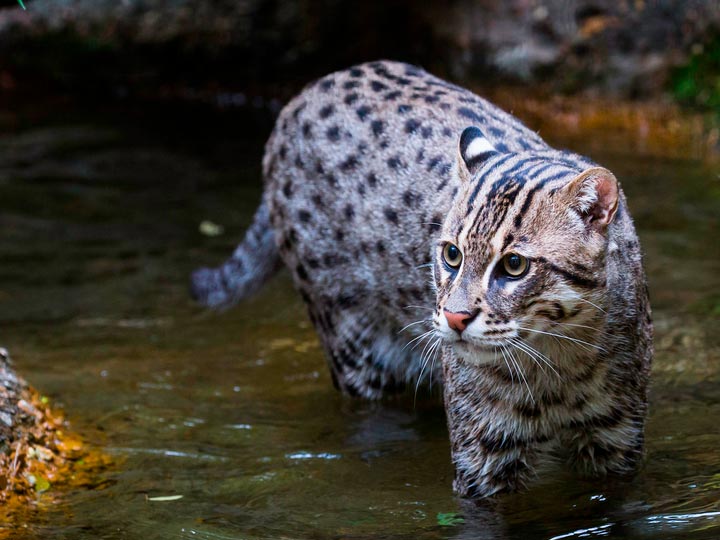
A civet cat fishing in the wild
The European fishing cat is found in tropical and subtropical regions of Southeast Asia, including Southeast India, Indochina, Sumatra, Ceylon, Java, and Bali. Not to be confused with jungle cat, which differs from the viverrid both in appearance and lifestyle. Fishing cats inhabit near bodies of water, lakes, swamps, and slow-moving rivers—in short, anywhere they can find food and escape human observation. An adult viverrid occupies a territory of 4-8 square kilometers, while males can occupy territories as large as 22 square kilometers.
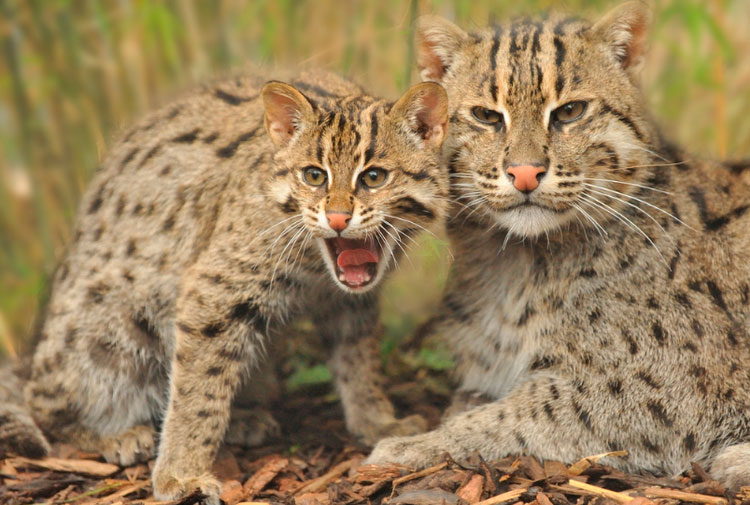
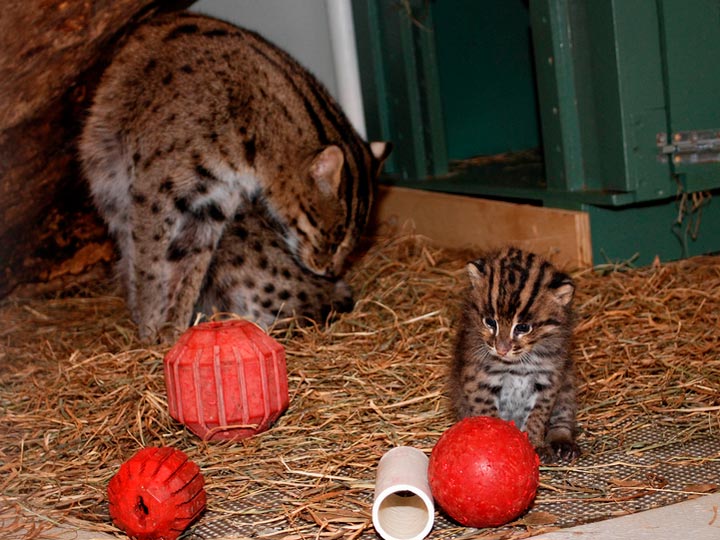
Fishing cats reproduce year-round. Gestation lasts 63-70 days. Litters are small, typically producing 2-3 kittens. At 4.5 months, the young begin to eat adult food, and by 9 months, they have caught up with their parents in size and become self-sufficient. They reach sexual maturity much later, at 2-3 years. In captivity, males assist the female in raising their offspring, but their behavior in the wild is unknown. Furthermore, the lifestyle of these cats is not well understood.
Video about viverrid fishing cats:
Appearance
The African fishing cat resembles the African civet in appearance. In fact, it is the latter's Latin name, viverra, and this similarity that give it its name. Like wild cats, African fishing cats are carnivores, but they are known for another trait: they eat coffee berries. The beans that pass through their digestive tract are then collected, roasted, and brewed into an expensive coffee drink called Coffee Luwak.
But let's return to the fishermen. An adult male cat weighs 11-15 kg, while females weigh less, 6-7 kg. Their body length is 96-120 cm, and their height at the withers is 38-40 cm. An adult cat's canines reach 3 cm in length, and their claws are 1.5-2 cm. Experts divide fishermen cats into two species, which differ slightly in color and size. Fishermen from Southeast Asia, including Sumatra, are much larger than their relatives from Java and Bali. Within the cat family, the fishermen's closest relatives are Far Eastern (Amur) cats.
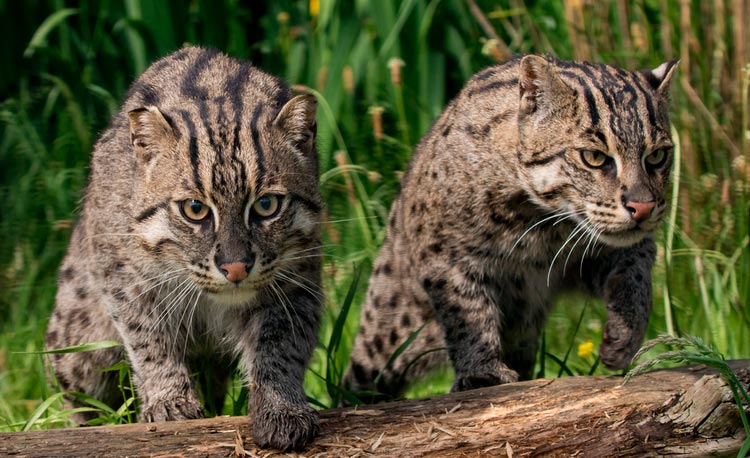
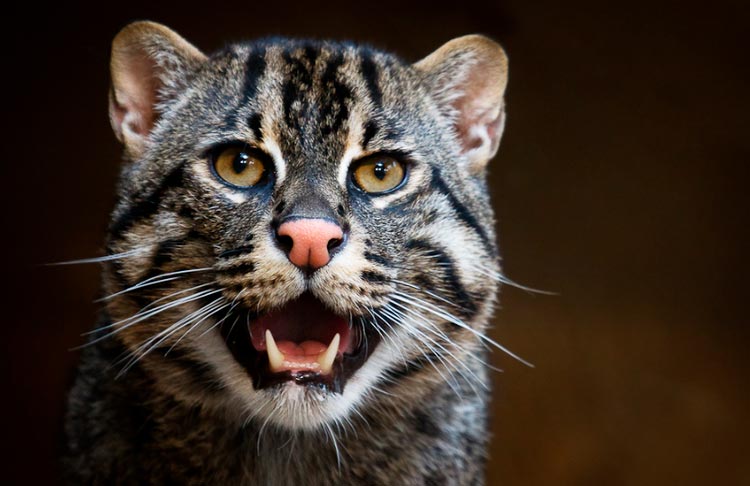
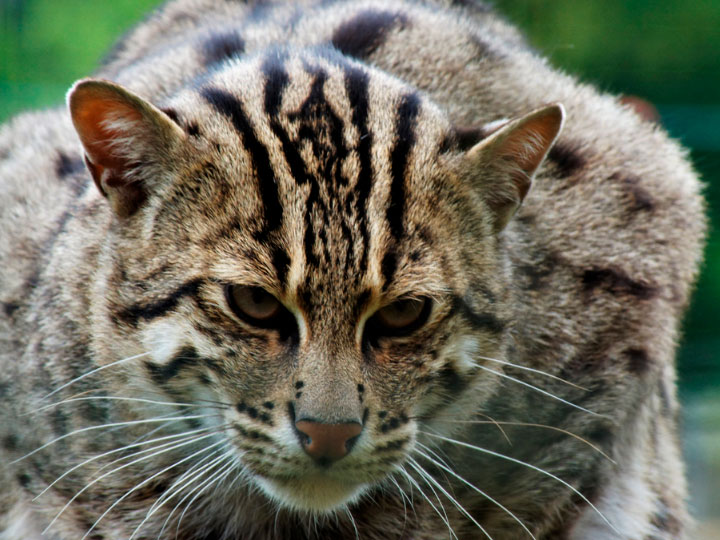
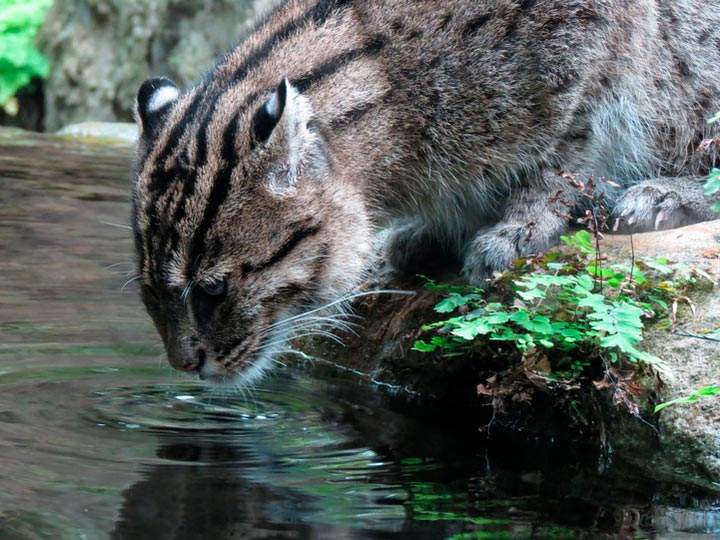
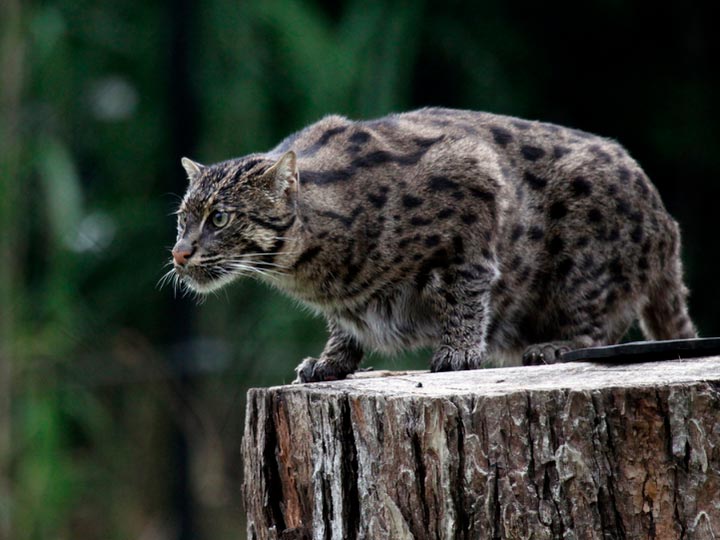
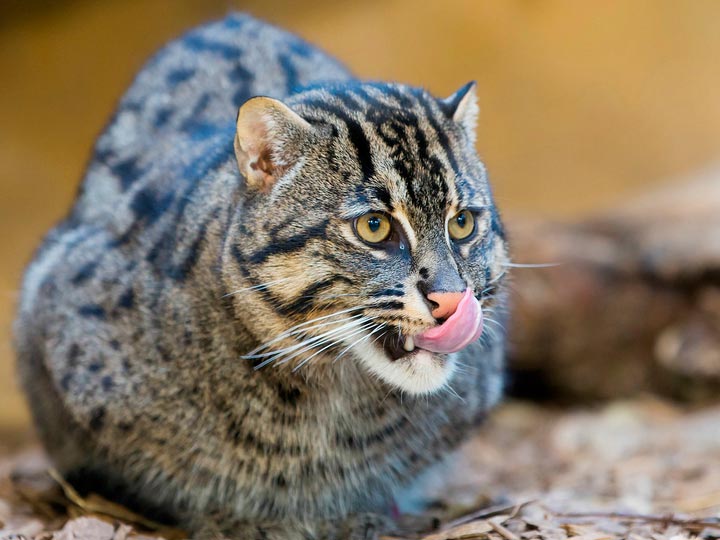
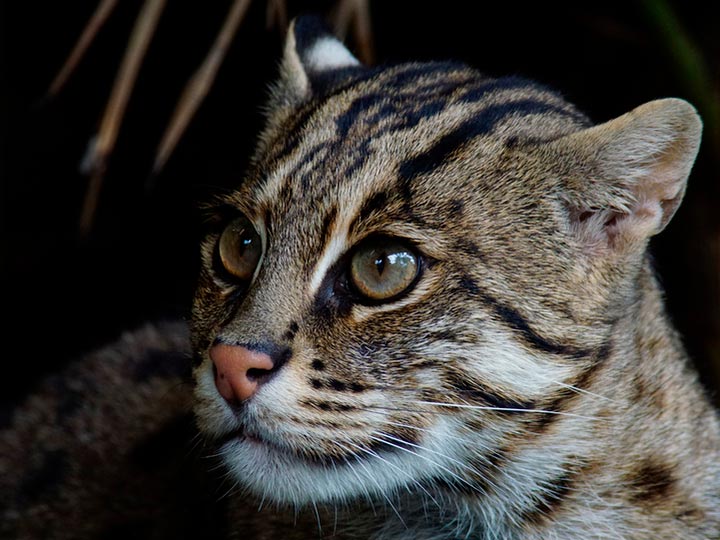
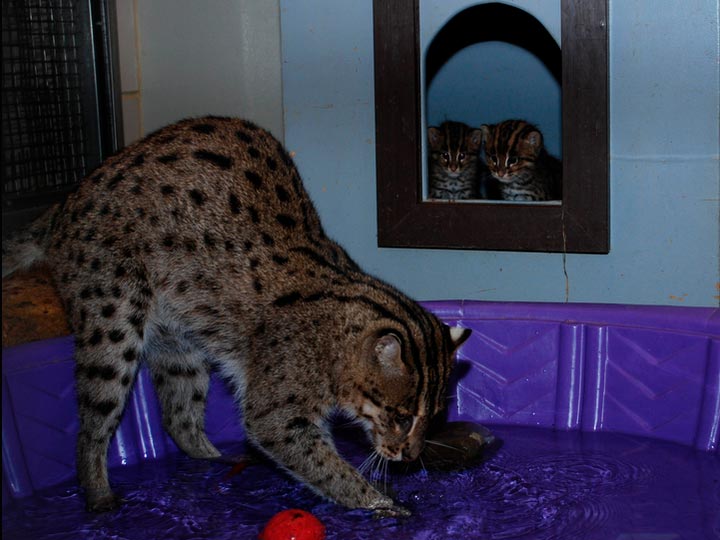
The Fishing Cat has a strong build and well-developed muscles. They are generally very strong and agile. The muzzle is broad and short. The bridge of the nose is virtually absent, and the nose is very wide and large, the widest of all cats. This structure allows the cat to swim and dive freely. The ears are small and round, set low on the sides of the head. The lower jaw is very well developed and rounded. The head is set well on a short neck. The legs are relatively short, as is the tail, which makes up 1/4 of the total body length and is of equal thickness from base to tip. The coat is grayish-brown with black stripes and spots. Behind the primarily black auricle are white spots, called eye spots. The toes on the front paws are webbed. This webbing prevents the cat from fully retracting its claws, but is very helpful in swimming and fishing.
Character and behavior
In the wild, the fishing cat is extremely cautious, avoiding human contact at all costs and, if possible, avoiding conflict, but will always defend itself. Many report their aggressiveness and assertiveness. Local residents tell numerous stories of fishermen entering settlements, fearing no one, and easily dispersing packs of dogs. In Singapore, there's a myth that a fishing cat carried off a baby. However, there's no documentary evidence to support this. However, there is another true story. At one zoo, a very large male escaped from his cage and was captured by a leopard, which he killed in a fight.
The fishing cat can meow and hiss, and also makes other interesting sounds, vaguely resembling laughter, barking, or short, abrupt yelps. These sounds are difficult to describe, but can be heard on video. The fishing cat's main activity is resting and sleeping; in its free time, the animal wanders through shallow water in search of food or hunts small land animals. In zoos, fishing cats lead a moderately active lifestyle; they may frolic a bit, but generally do not waste energy. They can climb trees, but do not like to perch high on branches. They roost on the ground or rest at low altitudes.
Keeping a fishing cat in captivity
Exotic lovers should always remember that viverrids, even if raised from a young age and lovingly cared for, remain wild animals. Even if you manage to raise a relatively docile one, you must remain constantly vigilant. Young kittens are very playful, quickly bond with their humans, are obedient and affectionate, and very vocal. It's not just the timbre of their voices that is striking, but also their volume and variety of sounds. Both kittens and adult cats are far more energetic than their domestic counterparts.
There are many nuances to raising a civet cat. Someone who has never handled wild animals is unlikely to be able to raise a properly behaved pet without an experienced mentor.
To earn the cat's respect and love, it is hand-fed from a very young age. Playing with its hand or foot is not allowed. Toys are available for play. During training and training to break undesirable behavior, yelling and, especially, hitting the cat are prohibited. This usually provokes a negative response: aggression or a desire for revenge.
The civet cat is a purely wild predator, finding it difficult to adapt to life in captivity even in a zoo, let alone an apartment or country house. It requires space, its own hunting area, and a body of water.
The European fishing cat reaches sexual maturity at 2-3 years of age. This is where the biggest problems arise. First, it begins marking its territory. Naturally, the amount of urine and its smell are superior in every way to those of a domestic cat. Second, the kitten now becomes an adult and begins searching for its place, exhibiting aggression, fighting for territory and its "place in the sun." Neutering and spaying cannot completely eradicate aggression and other behaviors unacceptable for a domestic cat. One family member may become an object of desire, while the other, on the contrary, becomes an adversary. Resisting the arguments of a sexually obsessed animal, which also possesses incredible strength and sharp claws, is very difficult. If you plan to keep a Fishing Cat as a pet, it must be spayed/neutered no later than eight months of age.
My fascination with viverrid cats began in 2006, when the first articles about a fisherman named John Davis appeared online. The cat settled into an ordinary Krasnoyarsk apartment and even acquired a personal website, chronicling his life with numerous photos. The wild predator was raised from a young age. For three years, he lived with a family and was friends with a Siberian cat. The story ended with a sad separation and the cat's move to a zoo. The problem was that the now-grown fisherman began to "win" his owner back from her husband.
The civet fishing cat is not the best choice for an apartment or even a private home. The optimal way to keep an exotic animal is a very spacious enclosure that imitates its natural habitat, that is, with thickets and a stocked pond. The area is fenced with netting on all sides, including the top. If there are no trees, it's essential to create shelves at different heights or install cut trees. Small insulated shelters are built in one or more locations. Maintaining a positive temperature inside is especially important during the colder months. Fishing cats do not tolerate frost well.

Diet
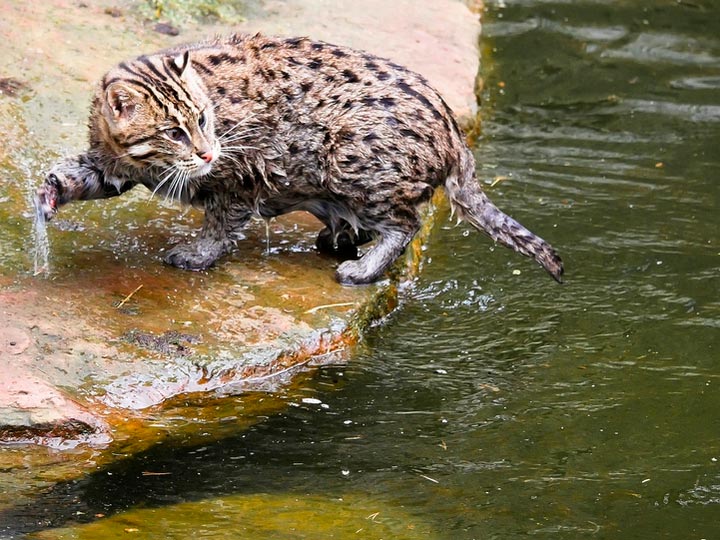
The dietary preferences of fishermen are very different from those of most other cats. The basis of their diet is live fish and other aquatic inhabitants: frogs, snails. Cats hunt in several ways. While searching for food, they can wander for long periods in shallow water or wait on the shore, then pounce with a well-aimed leap; if necessary, they will swim and dive for fish. Interestingly, while hunting, they often resort to cunning: they stand motionless in the water and lightly touch the surface with their whiskers. This imitates the movement of insects and attracts fish. Cats also feed on birds, small mammals, rodents, and carrion. On land, they sometimes hunt insects. In exceptional cases, they may attack larger animals.
What to feed a fisherman at home
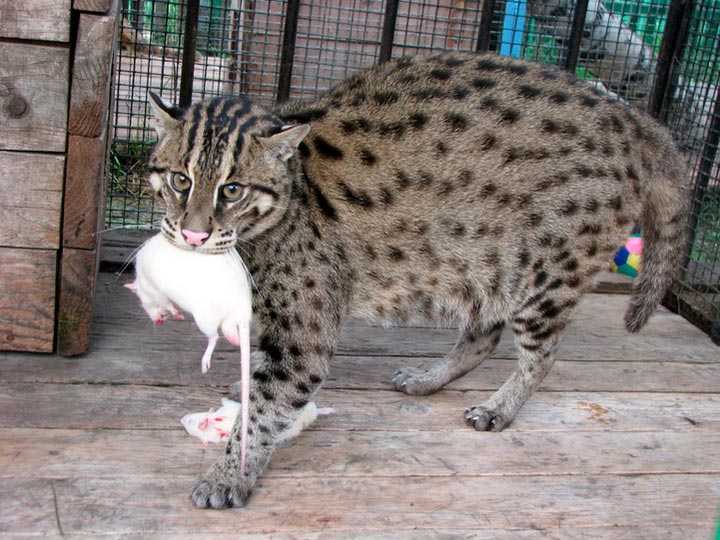
A cat's diet at home should be as close to its natural diet as possible. This applies not only to the type and quantity of food, but also to the method of obtaining it. This means that the fisherman should be able to hunt fish in a pond, catch a live mouse, or gut a bird. Naturally, such a diet will result in a fair amount of dirt. A fishing cat may mistake any animal smaller than itself for food. The daily requirement is 0.2-0.5 kg of fish or meat. Given that domestic cats' activity levels and energy requirements are much lower than in the wild, they are given a fasting or semi-fasting day once or twice a week. Their diet is supplemented with chicken or quail eggs and fresh grass.
Health and life expectancy
Little is known about the lifespan of fishing cats in the wild. In captivity, they typically live for about 10 years. The longest recorded age for a civet cat in a zoo was 12 years. Captive animals are vaccinated against rabies and major infectious feline diseases. Most illnesses are associated with poor nutrition or living conditions that are only vaguely reminiscent of natural conditions.
Where to buy a fishing cat: choosing a kitten and price
The European fishing cat, like many other wild cats, is protected and listed in Appendix II of the CITIES. To avoid problems, owners must obtain a permit from the Federal Service for Supervision of Natural Resources. In many countries, keeping exotic pets remains prohibited.In Russia, there are laws prohibiting the illegal hunting of exotic and rare animals, as well as cruelty to animals, which can include keeping them in an apartment or house in confined and remote conditions. There's no specific document prohibiting keeping exotic animals in apartments. A state standard for keeping non-productive animals in urban areas came into force in 2016, but it's only advisory. Assistance with obtaining documents for civets is sometimes provided by individuals or breeding facilities.
Advertisements for the sale of fishing kittens are sometimes posted on the Internet, but such are rare. The price of a civet kitten usually ranges from 300,000 to 450,000 rubles. It's rare to find ads for a civet cub for sale, priced around 100,000 rubles. The further the cub is from its natural habitat, the higher the price. Besides the price you'll have to pay for the animal, it's important to remember that caring for a civet cub isn't cheap.
Photos
The gallery contains photos of viverrid fishing cats in the wild, in zoos, and as domesticated cats.
Read also:


Add a comment