
Giardia in dogs: symptoms and treatment
Giardiasis is a parasitic disease affecting the intestines. It is caused by the microorganism Lamblia spp., which belongs to the genus of flagellated protozoa called Diplomonas. This infection is diagnosed in 10% of domestic dogs, almost every second puppy, and virtually all stray dogs or animals living in shelters and kennels. This pathology is not specific to gender, age, or breed, but older and weakened dogs are at risk.
Veterinarians say that in healthy adult animals, the body sometimes fights the infection on its own, and recovery occurs without treatment, but this is the exception rather than the rule. Most often, giardiasis must be treated, as the disease leads to depletion of the body, and if chronic, it weakens the immune system and can cause general intoxication and the development of duodenitis, colitis or recurrent dermatitis, damage to the liver and pancreas.

Pathogen and routes of infection
Giardia is a single-celled parasite that is perfectly adapted to its own existence. It remains viable:
- in water and soil - up to 70 days;
- in feces - up to 1 month;
- in urine - 3-4 days.
Giardia parasites are not very resistant to high temperatures: heating to 70°C kills them within 10 minutes, while 100°C kills them instantly. However, surviving Giardia reproduce very quickly by dividing, doubling their numbers every 9–12 hours.
Lamblia protozoa exist in two morphological forms. In the mobile vegetative form (trophozoites), the parasite lives in favorable conditions, such as the dog's intestine; Giardia acquires a "preserved" form (cysts) when exposed to an unfavorable external environment.
Trophozoites are pear-shaped, contain two nuclei, four pairs of flagella, which serve as organs of locomotion, and a disk used for attachment to the intestinal epithelium. Trophozoites measure approximately 9 x 12 µm. Giardia cysts are similar in size but oval in shape, with a coiled flagellar apparatus.
The method of infection with giardiasis is Fecal-oral. During transmission, the pathogen goes through three phases:
- release of an infection from the body of an animal carrier;
- presence of a microorganism in the external environment;
- introduction into a new organism.
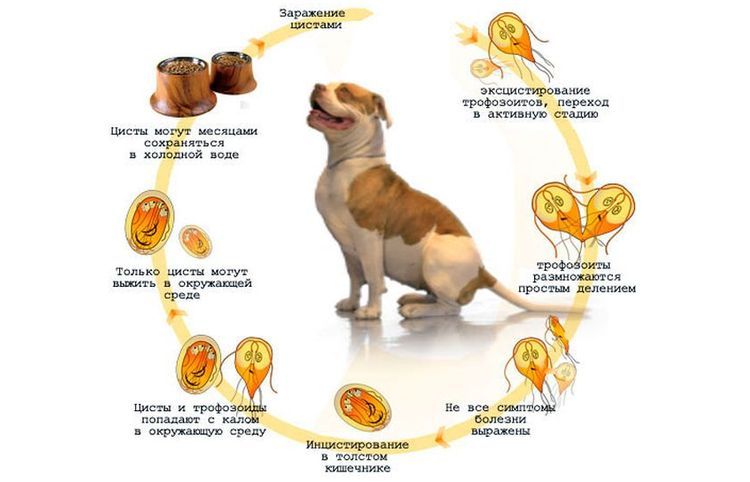
Infection factors include water, food products, and feces.
Once a Giardia cyst enters a dog's gastrointestinal tract, it immediately becomes mobile, moves to the intestine, attaches to the intestinal wall, and begins feeding and reproducing. From time to time, it changes its "location" to a more nutrient-rich area of the mucosa. Giardia's habitat is the duodenum and small intestine.
Important! Giardiasis is considered a zoonotic disease common to both animals and humans. Therefore, if your pet has been diagnosed with giardiasis, thoroughly disinfecting the area where the dog is kept and washing your hands with soap after contact with the dog should become a routine.
Symptoms
Giardiasis doesn't always produce a clear clinical picture. Its symptoms are common to many gastrointestinal diseases, and it's often mistaken for the effects of mild poisoning or an allergic reaction to a new food. Therefore, in many cases, the presence of giardia in a dog is discovered accidentally during routine checkups.
Signs of this pathology may include:
- Diarrhea, which can last for several months, alternating with normal bowel movements or constipation, can be watery, mixed with mucus, and sometimes blood, or pasty due to the presence of fat.
- Bad breath.
- Belching, flatulence.
- Pain in the lower abdomen, in the intestinal area.
- Visible weight loss with normal appetite.
- Apathy, irritability.
- Dull, brittle fur.
- Allergic reactions such as skin rashes, conjunctivitis or cracked lips.

Diagnostics
To establish a diagnosis, if the symptoms described above are present, the veterinarian will need to review the owner's medical history, conduct an examination, and obtain laboratory and imaging test results. For differential diagnosis of giardiasis, the following tests are typically prescribed:
- general stool analysis;
- rapid stool test for specific Giardia antigens (immunochromatic test);
- polymerase chain reaction analysis of feces or anal swabs
- (PCR), which allows detecting the pathogen’s DNA even in small quantities in the biomaterial;
To confirm the diagnosis, an enzyme-linked immunosorbent assay (ELISA) of blood serum may be prescribed. This test measures the reaction of antibodies produced by the sick animal to the pathogen antigen in a standard laboratory sample. In some cases, an intestinal endoscopy is required.
Treatment
There is no cure for Giardiasis in dogs, as the membrane surrounding its "preserved" form—the cyst—is impermeable to most chemicals. However, antiprotozoal medications can effectively cure giardiasis by destroying all trophozoites (the active form of Giardia) living in the intestines. The active ingredients in these medications inhibit the production of nucleic acids in the DNA of the single-celled Lamblia bacteria, causing their death. A course of treatment with antiprotozoal medications typically lasts 5-7 days.
The following are considered effective for the treatment of giardiasis in dogs:
- Metronidazole (synonyms: Klion, Metrogyl). Dosage: 22 mg/kg body weight twice daily.
- Albendazole (synonyms: Aldazole, Vormil, Nemozol). Dosage: 25 mg/kg body weight twice daily.
- Macmiror (synonym: Nifuratel). Dosage: 15 mg/kg body weight twice daily.
- Panacur. Dosage: 450 mg/kg of body weight once daily.
- Tiberal (synonym Ornidazole) Dosage: 25 mg/kg of weight once a day.

The next stage of treatment involves therapy aimed at detoxifying the body, restoring fluid balance, and strengthening the immune system. For this purpose, the animal is prescribed enterosorbents, water-electrolyte balance regulators such as Gastrolit and Regidron (in case of severe dehydration, intravenous injections of Polysorb, sodium chloride, and/or glucose are prescribed), and immunomodulators. Probiotics are prescribed to restore the natural intestinal microflora.Lactobifid, Linexi, Divopride, Prokolin).
Diet is an essential component of comprehensive treatment. Veterinarians recommend therapeutic foods designed for animals with digestive system diseases: Hill's PD Canine, PVD Canine EN, and Royal Canin GASTRO-INTESTINAL.
Important! After completing the treatment course, to ensure the giardia has been eliminated from the dog's body, follow-up stool tests are performed. If 2-3 tests are negative, the animal is considered cured.
Preventive measures
Giardiasis prevention involves sanitary, hygienic, and therapeutic measures. It is strictly forbidden to allow your dog to:
- drink from bodies of stagnant water;
- swim in dirty waters;
- eat food from the ground;
- contact with stray animals.
Dog owners should keep their dog's living quarters and eating utensils clean. Walking dogs off-leash or letting them roam unsupervised is not recommended. Timely deworming and preventative veterinary examinations are essential for preventing all parasitic diseases in pets.
Diagnosis of Giardia in Pets: video
Read also:
- Anthelmintic medications for dogs: reviews, prices
- Troncil for dogs
- Enterocolitis in dogs: symptoms and treatment


Add a comment