
Sheba cat food
Almost everyone in our country is familiar with the commercials for Sheba, a cat food product sold in pouches. These videos feature cats greedily devouring juicy, beautiful pieces of meat in a delicate sauce from brightly colored pouches. But what's behind the ad, and is this food really that good? Let's explore all the nuances together.
Sheba is a cat food brand from Mars, a large food manufacturing company. This company has several factories in Russia that produce pet food, including well-known brands such as Whiskas, Kitekat, Pedigree, and many others. However, the company places a special emphasis on cat food under the Sheba brand—wet food available in cans and sachets. According to the manufacturer, Sheba is the ideal super-premium food, designed for daily feeding of furry pets of all breeds. However, to meet all the requirements of a super-premium food, these diets must contain high-quality ingredients. We will review the company's product range and analyze one type of Sheba cat food in detail to determine whether its ingredients meet the quality claims.
Content
Assortment of feed
All food sold under the Sheba brand is wet, canned food, available in pouches or small jars. There is no dry food available from this brand. This is a plus, as wet food is more natural and beneficial for cats and helps prevent urolithiasis. However, it limits the selection and increases the risk of plaque buildup in pets. The Sheba cat food line includes the following series:
- Pleasure
- Classic
- Naturalle
- Appetite
All foods are produced in the form of 85g pouches, intended for one meal, and only the Classic series is produced in the form of small jars weighing 80 grams.
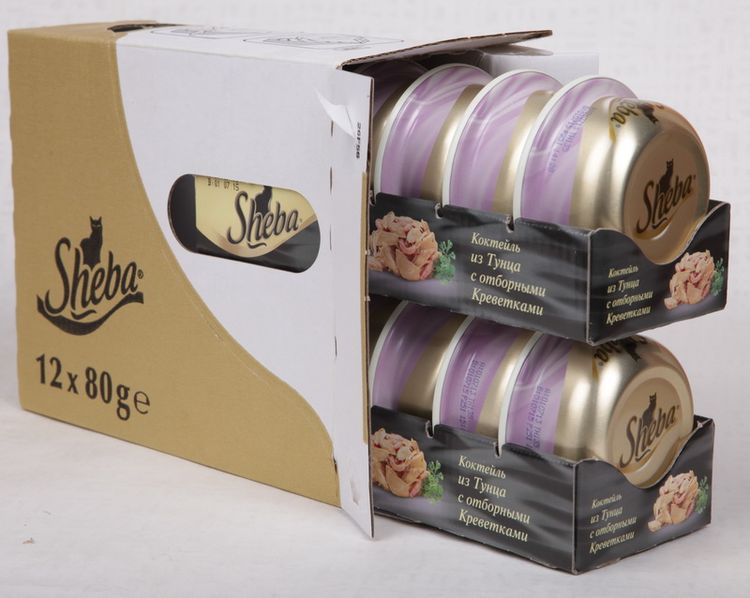
As for tastes, the division is as follows:
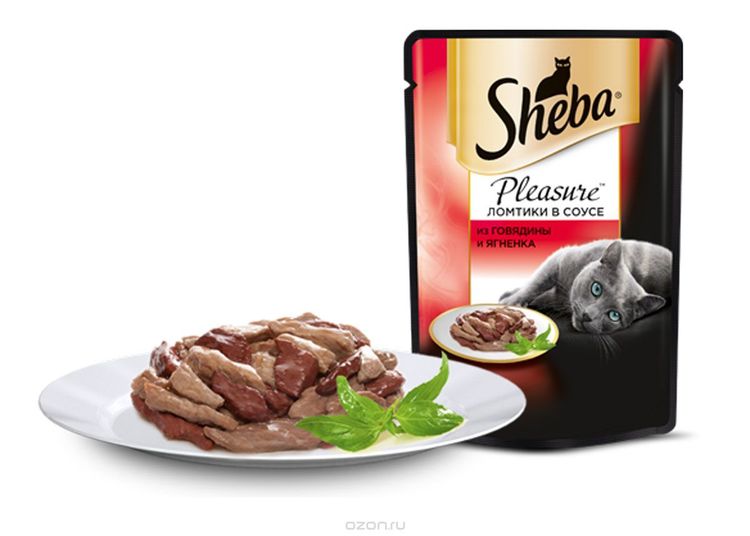
Sheba Pleasure offers your cat a choice of eight different flavors, including:
- Salmon and tuna
- Duck meat with chicken
- Veal and beef tongue
- Lamb and beef
- Shrimp with trout meat
- Chicken with turkey meat
- Rabbit with beef
- Chicken with rabbit
The Classic Series promises to treat your pet with the following delicacies:
- Pieces of tender tuna in sauce
- Chicken fillet sauté
- Mixed chicken and duck
- Pieces of tuna with delicious shrimp
Naturalle is not far behind and offers your gourmet the following flavors:
- Lamb with tender beef
- Duck fillet with chicken
- Turkey pieces mixed with chicken fillet
And finally, the Appetito series offers your pet 4 more flavors:
- Beef tongue with veal
- Salmon fillet with tuna
- Chicken pieces with turkey
- Rabbit in sauce with beef.
 It would seem like there's a huge selection to satisfy even the pickiest cat. But what do these diets actually consist of, and do they really contain all the delicious treats that the Sheba cat food ads and packaging so colorfully tout?
Composition of Sheba cat food
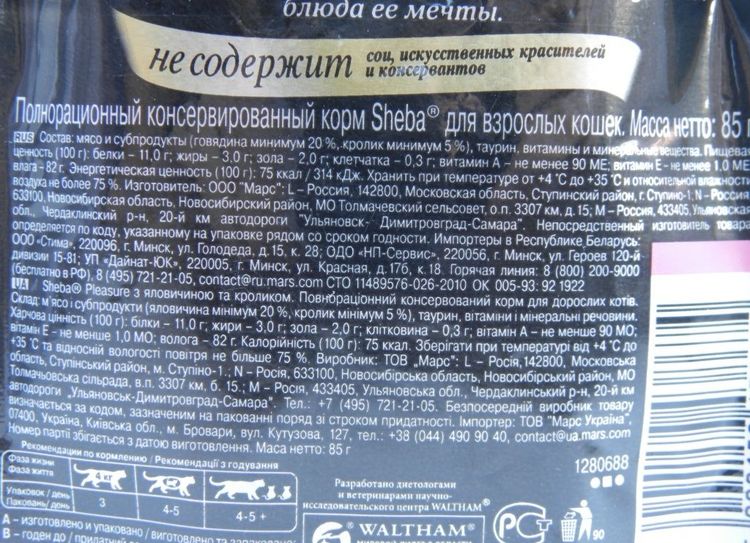
For our analysis, we chose one of the most popular flavors—a sachet from the Pleasure series with chicken and duck. Examining the ingredients listed on the packaging, we discovered the following: each sachet contains:
Meat and by-products, duck (4%), chicken (4%), as well as taurine, and as additional ingredients - vitamins and minerals.
That's the entire composition. Frankly, it's quite meager even for a premium product, let alone the super-premium segment this food claims to be. The manufacturer makes no secret of the fact that the duck and chicken listed in the product name are only 4% each, or 4 grams per 100 grams of product. A single pouch, therefore, contains 3.2 grams. Sounds like a joke, doesn't it?
The package also contains information about the guaranteed composition:
- Proteins - 11 g/100 g (low value)
- Fats - 3 g/100 g (less than normal)
- Ash - 2 g/100 g (normal value)
- Fiber - 0.3 g/100 g (significantly less than the norm)
- Moisture - 82 g/100 g (significant amount).
- Energy value of feed is 75 kcal/100g.
The food contains 82% moisture and only 18% nutrients. However, veterinarian reviews of Sheba cat food highlight the water content as a plus.
Protein
The ingredients list meat and by-products as the source of protein, but neither the weight nor the percentage is provided—this is a flaw. Furthermore, there's no information about the quality of the by-products or their origin. Such vague wording often conceals low-grade connective tissue, skin, cartilage, and other raw materials that are no longer used in production due to their low quality. This is also a drawback for the food. As for the content of the main ingredients (according to the advertising), we've already mentioned them above.
Fat
The source of the fat in the food is unclear, and it's most likely cheap, low-quality animal fats. We draw this conclusion based on obvious logic: if the ingredients contained high-quality fat components, the manufacturer would have made a point of mentioning it, earning extra points for themselves.
Carbohydrates
The packaging doesn't mention carbohydrates, which are most often added in the form of corn or wheat. We don't know if this food contains grains, but the lack of any information on this matter is a major drawback, preventing Sheba cat food from receiving excellent reviews.
Additional components
Taurine is a very beneficial supplement. Cats don't produce it, unlike dogs, but they desperately need it. This component is a definite plus for this food.
"Vitamins and minerals" is a rather vague term. Most likely, it refers to a basic premix containing a minimum set of essential microelements and vitamins.
That's all there is to know about this food. Therefore, we conclude that the pieces in the bag aren't meat at all, but, at best, formed from minced offal. We also couldn't find a word about the sauce's ingredients—it remains a mystery. As for the additional ingredients, they're completely lacking: there are no vegetables, fruits, or herbs. In other words, nothing that could be beneficial for your pet's health.
But there's a silver lining: the manufacturer claims that Sheba food is free of preservatives, soy, artificial flavor enhancers, and colorings. These aren't even listed as ingredients, but according to some Sheba reviews, the food has a rather strong odor. This likely means it contains some kind of flavor-enhancing additive to encourage pets to eat the food. We'll leave that to the manufacturer's discretion.
That said, the price of Sheba cat food is quite high: with the recommended feeding rate, a 5-kilogram cat will eat 2-3 packets per day. This is definitely more expensive than natural food and also more expensive than many super-premium dry foods.
Reviews of Sheba cat food
We've reviewed numerous reviews of this food, and overall, pet owners are satisfied with it. Many even write that they're willing to buy Sheba cat food in bulk, often searching for special offers at retailers.
Unless a cat has a personal intolerance to any of the ingredients, they'll happily eat this food, leaving only a clean bowl. This partially supports our belief that flavor enhancers and fragrances are present.
However, there are also occasional negative comments describing digestive problems in animals after eating this food. This is most likely caused by food allergies, and it's difficult to place the blame entirely on the food.
As for doctors, veterinarians' reviews of Sheba cat food aren't overwhelmingly negative. Doctors say it's an acceptable pet food, emphasizing the beneficial effects of the moisture in the formula on digestion and the urinary system. However, there's a caveat: veterinarians recommend using Sheba pouches exclusively as a supplement—a treat for your pet. It should be combined with another, complete food that provides a complete and healthy diet, not only with proteins, fats, and carbohydrates, but also with vitamins.
Sheba pet food prices
Given that all pouches are sold at the same price, it's easy to find pricing information for this food. In stores, prices start at 32 rubles for an 85-gram package, and 95 rubles for an 80-gram jar. You can find this food cheaper by taking advantage of promotions at various retail chains, saving you a significant amount.
We wish your pets good health, and remember that before making any changes to their food, it is best to consult with your pet's veterinarian!
Read also:


Add a comment