
Purina One cat food
Originating in the 1890s as a small mill with a bakery, Purina is now one of the most recognizable brands in the pet food market. It all began with dog treats called Shapes—small biscuits that our four-legged friends loved (incidentally, this product is still in production today, over 100 years later). By 1920, the company opened the world's first canine nutrition research center in Seattle, USA. In 1926, the first Purina dog food, in the form we know today—dry kibble—was launched. By that time, a pet care center had already opened, where the company's specialists developed new nutritional formulas. In the 1950s, canned cat food was launched, marking a breakthrough in the cat food market.
Today, Purina is part of the massive Nestlé conglomerate and includes such well-known brands as Felix, Friskies, ProPlan, Gourmet, Darling, Cat Chow, and others. But today, we'll focus on one product and take a closer look at Purina One cat food. Opinions are divided on the quality of this food: some consumers claim it's a high-quality budget option, while others insist it's premium. Where's the truth? It's unclear. Let's take a closer look at this brand of cat food and finally set the record straight.
Content
Purina One cat food range
The One Series diet line consists of meals categorized by age—including menus for kittens, pets over one year old, and senior cats (over 11 years old). The manufacturer also focuses on the specific needs of cats, offering specialized menus:
- For sensitive digestion - turkey and rice;
- For indoor cats that don't go outside - turkey and cereals;
- For pets after sterilization/castration – salmon or beef;
- A menu that promotes healthy skin and hairball control is chicken and grains.
Most of the brand's recipes include chicken and grains, which are essential for a pet's healthy diet. Purina dry cat food for neuters contains salmon, or beef if your pet isn't particularly interested in fish. The food for cats with sensitive stomachs also stands out: it contains turkey as a source of protein and rice as a source of carbohydrates. This truly reduces the burden on the stomach and promotes easy digestion.
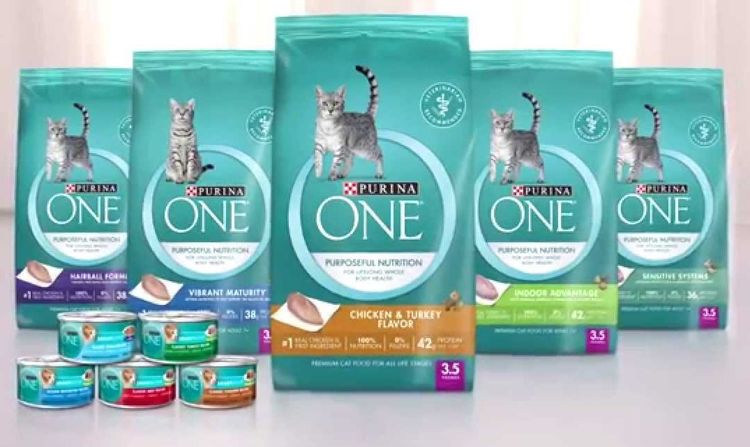
As you can see, this brand doesn't boast a particularly wide variety. However, we might be surprised by the quality of the ingredients, given the lackluster quantity. For a more detailed examination, we decided to choose the most popular cat food, Purina One, for indoor cats with turkey and grains.
Feed composition
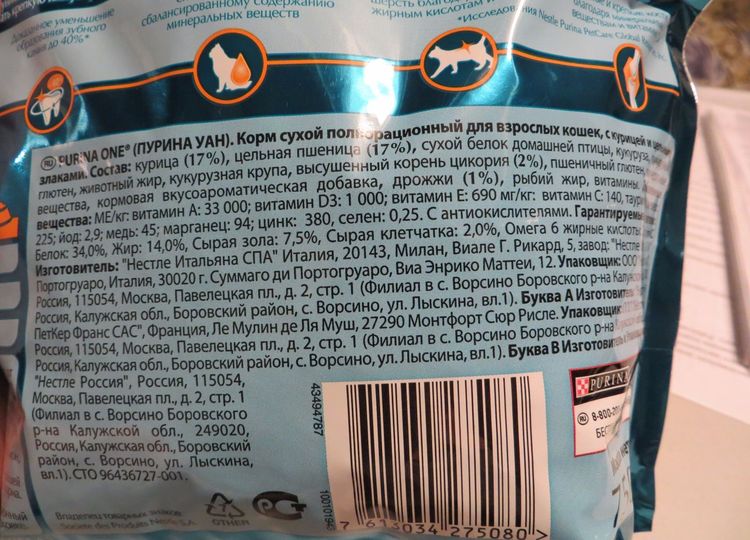
For our analysis, we use the food composition listed on each package. The formula for this food consists of the following ingredients: turkey (17%), followed by wheat, also at 17%. Next comes corn gluten, the amount of which is unknown. Then comes dried poultry protein, corn, and animal fat as a lipid filler. Dried beet pulp and pea protein complete the list of key ingredients. Next, we see dried chicory root, minerals, and flavoring. The final ingredients are yeast, fish oil, and a vitamin complex.
That's the entire composition. It's quite modest, for a high-quality, complete diet for a domestic predator.
We can also find information about the guaranteed composition on the package:
- Protein: 34.0% (normal value)
- Fat: 13.0% (within the normal range for domestic cats)
- Ash content: 7.5% (normal)
- Fiber: 6.0% (above average).
On the one hand, the food does not contain ingredients that are obviously harmful to cats and could cause illness. On the other hand, the diet is very simple and lacks ingredients typical of the super-premium and holistic segments. Despite this, reviews of Purina One cat food attest to its popularity among the general public. Let's take a look at the quality characteristics of the ingredients.
Squirrels
The protein listed is turkey, dry poultry protein, and pea protein. These ingredients qualify this food for premium status. It does not contain by-products of questionable quality or chemicals that mimic protein.
But it's worth noting that "turkey" is a broad term. That is, the condition of the raw material isn't specified: was it pure fresh meat, or was a whole bird used without any pre-processing? Based on our experience, we can say the following: if the ingredients contained pure meat, and especially dehydrated poultry, the manufacturer would have clearly stated it. Often, the term "turkey" or "chicken" conceals less-than-perfect raw materials, such as a whole bird, ground up with bones, cartilage, skin, and entrails.
Another source of protein is poultry protein powder. This component is a good source of protein, but other beneficial components are lost during the processing of poultry to produce this powder. Therefore, it is often used to adjust the protein content to the requirements of a particular feed class.
Pea protein isn't a particularly healthy ingredient, as it essentially just replaces animal protein. It's added solely as a cheap nutrient to boost protein content.
Fats
Animal fat and fish oil are listed as sources of fat. Animal fat is a cover word, often used to refer to low-quality animal fats (beef and pork). These are not very healthy for cats. Fish oil, however, is a good ingredient. It's healthy, easily digestible, and most importantly, contains polyunsaturated fatty acids. This is a very good ingredient, but it's a shame it's in short supply (it's listed second to last).
Carbohydrates
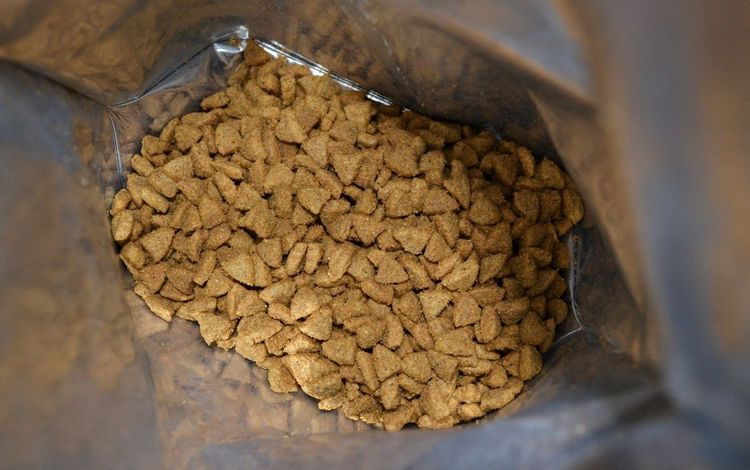
The relatively low price of Purina One cat food is achieved through a simple strategy: enriching the formula with plant-based carbohydrates. In this case, we see wheat, corn, and corn gluten. The percentage of grains isn't specified, but with some simple calculations, we can determine that this diet contains approximately 30% carbohydrates. This is a significant amount, as carnivores (cats in particular) are unable to digest this component at all. This is, rather, a negative aspect of this food.
Additional components
Beet pulp, a source of fiber often used in animal feed, is listed as an additive. Besides being a source of plant fiber, this component is often used as a simple and inexpensive filler.
Dried chicory root is beneficial, first and foremost, for the intestines—it stimulates epithelial renewal and aids digestion. A truly beneficial ingredient.
Yeast is a controversial ingredient that can cause allergies in some cats. However, it's otherwise a great fur care product, as it contains a wealth of B vitamins.
The flavoring is a definite minus. This additive is designed to encourage consumption of larger portions of food and is used when the natural meat flavor of the food is insufficient.
Vitamin and mineral complexes are useful components that support your pet’s health.
Overall, there's nothing "criminal" about the ingredients in Purina One cat food, and it's a good alternative to cheaper, budget-friendly options. However, if you have the opportunity, consider super-premium and holistic nutrition for your pet.
Purina One cat food reviews
Thanks to the popularity of the Purina One brand, we've found numerous reviews, both positive and negative. Here are just a few of the most common opinions about this diet:
Pavel Sergeevich, owner of the British cat Mais:
"Our Mais has always been prone to obesity and is quite a picky eater—that's the paradox. Our vet advised us to look into reduced-fat foods. One of those at the local store turned out to be Purina One for indoor cats. Mais eats it with gusto, and I'm happy with the food!"
Elena, Gray cat:
"Our Serik eats everything, so we've never had any problems with food. We started having problems with his coat—it became dull. A friend told me she gives him Purina for his coat, and indeed—after three weeks of feeding it, his coat became brighter and shinier."
Anton, owner of Siamese cat Persik:
"My cat isn't very picky—he eats everything. But I don't have time to cook porridge, so I put him on dry food. I fed him Royal, but then I decided to save money and bought Purina One. It's a nightmare—he started having terrible diarrhea, and the vet told me to switch back to his old diet. I also gave him bifidobacteria for two weeks—it barely cleared up. I don't recommend this food to anyone!"
Regarding veterinarians, reviews of Purina One cat food are not particularly varied. All doctors agree that this food can only be recommended as a replacement for economy foods, but not as a perfectly balanced diet. When switching your pet to this food, it's best to consult your veterinarian first.
The price of Purina One cat food
Since Purina One cat food is readily available at any pet store, many consumers are wondering: What's the price of Purina One? We compared several well-known stores and calculated the average price for the brand's most popular diets:
Purina One for indoor cats:
- 0.2 kg – from 80 RUR.
- 0.75 kg – from 280 RUR.
- 1.5 kg – from 510 RUR.
Purina One for kittens: 0.2 kg – from 95 rubles.
As we can see, this food is very reasonably priced, making it affordable for everyone. If you can afford a more expensive, high-quality food for your furry friend, they'll be grateful!
Read also:


1 comment
Angelina
The comments are encouraging. Just because someone's cat—ONE cat—fell apart, they're ruining the entire line by slinging mud at it. Always base your decisions on the animal. Of course, we're not counting "Kitekat" and "Whiskas"—cats will happily gobble them up anyway because of the chemicals, just like Felix—they're full of dye. So Purina One isn't such a bad food. It's not dyed and it's not exactly croutons, like N.M. As for flavorings—they're also present in "Proplan," so Purina is guilty of that. But by "flavorings," they don't mean chemicals, but the animal fat they coat their kibble with—I know this firsthand, I communicate with Purina representatives regularly.
Personally, my cats feel great on it - their fur is shiny, they are moderately well-fed, no diarrhea, watery eyes or problems.
Add a comment