
Whiskas cat food
The Whiskas brand is so popular that even people who don't have a cat know it's cat food. This brand has been around for over 50 years and is worth over a billion dollars. It's one of 42 brands owned by the global corporation Mars and is part of the Petcare division, which specializes in pet products. Today, we'll tell you about Whiskas cat food without the hype or myths—just the facts about its ingredients, product range, reviews, and more.
Content
Brand history
Whiskas pet food was the first commercial pet food product launched by the American company Mars in 1932, and today it is the world's leading commercial cat food brand in terms of sales. The company has divisions worldwide, but its main office, Mars Petcare, is located in Brussels, Belgium. The company began operations in Russia in 1991, and its first pet food factory opened in Stupino in 1995. Currently, there are several pet food factories in Russia.
The company's pride and joy is its Waltham Research and Development Center, located in the UK. Leading experts in veterinary medicine and pet nutrition develop new concepts used in ready-to-eat cat food formulas. One of the laboratory's most famous achievements is the recognition of the important role of taurine in the body of cats. Cats cannot produce this substance themselves and must obtain it from their food, so Whiskas was the first cat food to include it. This was a significant breakthrough in the field of prepared diets for domestic cats. Currently, all complete cat foods include taurine.
Assortment
The scientific research of the Waltham Institute of Nutrition has become the foundation for the formulas of many Mars Petcare brands, including Whiskas cat food. Whiskas is an economy-class food and is available in two segments: dry and wet stern.
All diets are divided into 4 lines according to age criteria:
- Kittens;
- Cats from one to seven years old;
- Pets who have crossed the 7-year mark;
- There are also special formulas for castrated and sterilized animals.
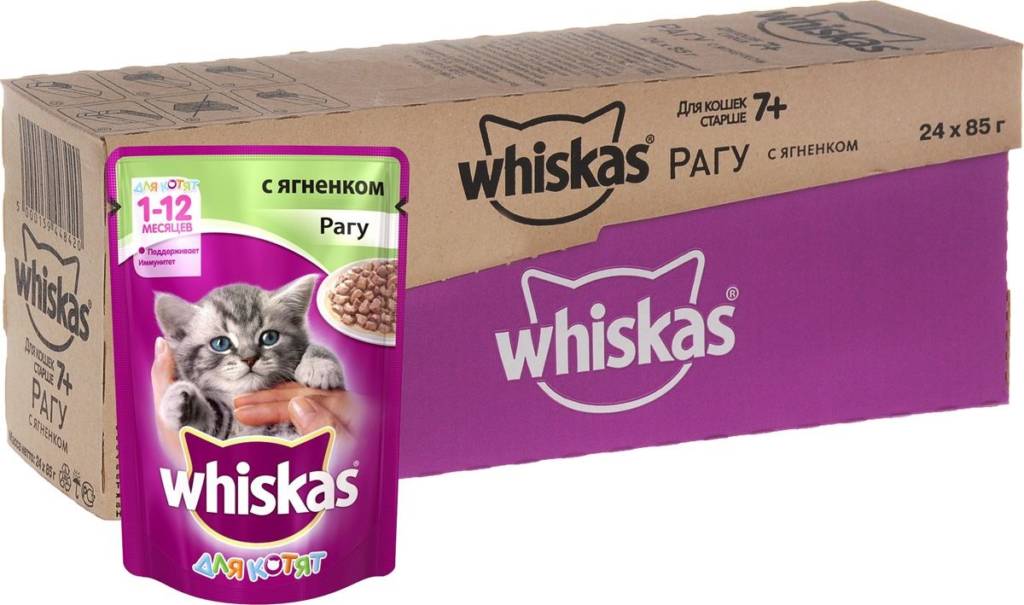
The kitten line includes one dry food option and several pouches (sachets) with different flavors. The adult cat food category offers the widest selection, with four dry food options and over 20 pouch menu variations. These include flavors such as beef and lamb, turkey and vegetables, salmon, veal, rabbit with vegetables, and many others. For senior cats, Whiskas offers only three wet food options (veal, lamb, and chicken) and one dry food with poultry. Sterilized pets can only choose dry food, which comes in three flavors: chicken, beef, and rabbit. Whiskas Special pouches from this line were previously available, but the official website has no information about them, and according to online sources, they have long been discontinued.
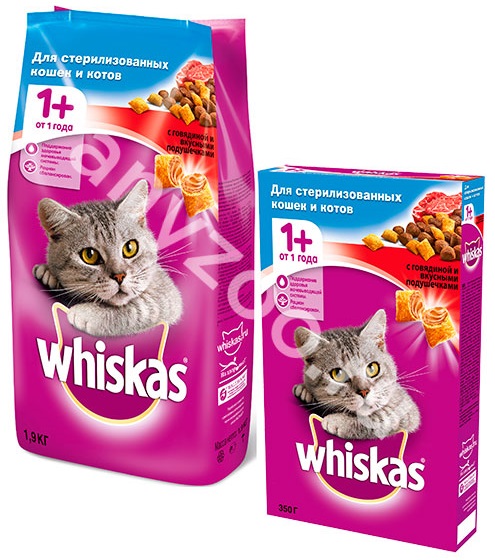
Almost all dry foods, with a few exceptions, are available in 350g, 800g, 1.9kg, and 5kg packages. Wet food in pouches, in addition to a wide range of flavors, is also divided into four consistency varieties: ragout (pieces with gravy), jelly (pieces in jelly), and pâté and cream soup (pieces in white gravy).
Analysis of the composition of dry food
The description of each Whiskas meal is replete with words like "delicious" and "appetizing," and names like "beef stroganoff" and "cream soup with cream sauce" sound quite tempting. It's as if we're looking at a restaurant menu. Of course, we understand that this is a clever marketing ploy, but who wouldn't be tempted to treat their pet to such a delicacy? Perhaps someone for whom it's far more important to know what's inside those attractive packages with such enticing names.
Nutritional value
The manufacturer recommends combining dry and wet diets and feeding your cat both daily. Therefore, we'll take a closer look at both Whiskas diets. Let's start with the dry diet designed for adult cats—a selection of beef, lamb, and rabbit (pâté kibble). Here are its nutritional values:
| Squirrels | 36% | within acceptable limits |
| Fats | 11.5% | normal indicator |
| Humidity | 10% | norm |
| Ash content | 7.5% | within normal limits |
| Fiber | 1.5% | below the average recommended level |
At first glance, these figures are only a little concerning: the very low fiber level. In cats, fiber is important not only for normal gastrointestinal function but also partly helps eliminate hairballs. Overall, for an economy-class food, the composition is quite good in this regard.
To understand the ingredients behind these numbers, let's take a closer look at the composition of Whiskas dry food:
- Wheat flour;
- Animal flour;
- Plant protein extracts;
- Cereals;
- Animal fats and vegetable oil.
The ingredients list then lists dried pork and chicken liver, followed by brewer's yeast, beet pulp, and carrots. The last ingredient listed is a mineral and vitamin blend. The first five ingredients are considered the foundation of the food's formula; they make the largest contribution to the formula, and their characteristics allow for an objective analysis of the product.
Overall rating
It's worth noting that Whiskas cat food contains meat only in the form of animal meal. Component #2—"meal of animal origin"—is specified as a mixture of poultry, beef, lamb, and rabbit meal (with the beef, lamb, and rabbit content being at least 4% of the reddish-brown kibble).
Incidentally, this is the only ingredient listing that specifies the quantity; the percentages of all other ingredients are not indicated. This is a significant shortcoming of the product, as it is simply impossible to estimate the mass percentage of each ingredient in the diet.
The manufacturer claims that Whiskas contains highly digestible ingredients and fiber for digestion. Well, we're already aware of the low fiber content; let's see if the rest holds true.
Squirrels
The source of animal protein here is animal meal, or more precisely, a mix of four types of flour. Chicken meal obviously accounts for the majority. The amount of beef, lamb, and rabbit can be judged by the 4% figure, meaning that 100 grams of red-brown kibble contains only 4 grams of these meat components.
Animal meal can be either meat or bone meal, or meat and bone meal, as well as blood meal or hydrolyzed feather meal. This definition makes it difficult to accurately determine the specific type of meal. The raw materials used in its production are waste products from animal and poultry processing, unfit for human consumption. This component is often used in cheap feed to save money. It is not considered high-quality or valuable in animal nutrition.
Another animal-based ingredient in Whiskas pet food is chicken and pork liver. Given that this ingredient appears below the middle of the list, it can be concluded that its quantity is extremely small and its primary purpose in the recipe is to enhance the aroma and palatability of the food.
There are no other animal proteins here, meaning that the lion's share of the stated 36% protein content comes from plant components. This food cannot be considered complete or highly digestible for cats, as the carnivore's body requires meat and various by-products to form the basis of its diet.
Carbohydrates and vegetable protein
We've deliberately grouped them together because they share the same ingredients. Wheat flour is the number one ingredient in Whiskas cat food, meaning it's the most abundant ingredient in this menu. Plant protein extract and grains are the third and fourth ingredients. Essentially, all three ingredients come from the same source—grains—and together, they form the basis of the Whiskas recipe.
Wheat flour offers absolutely no benefit to cats; it's difficult to digest and can even trigger allergies caused by wheat protein (gluten). It's considered a cheap ingredient and isn't found in super-premium cat foods. Plant protein extract is often made from soy, rice, wheat, and pea proteins. This formulation is very vague and makes it impossible to determine the raw materials used in its production; it could also be a mixture of several types of plant proteins. This is a highly questionable and undesirable ingredient in a cat's diet.
Whiskas cat food also contains grains. What kind of grains are they—corn, wheat, or barley? They may be mixtures of several grains or their byproducts. This is an ingredient whose origin is unknown, and therefore questionable. Most often, it's just wheat—a cheap filler that offers no benefit other than increasing the protein content on the food label.
Fats
The ingredient list lists animal fats and vegetable oil as the primary fat sources. Animal fat is derived from the sebaceous waste of animal tissues considered unfit for human consumption. Vegetable oil is produced from the seeds, grains, or fruits of various plants. It is rich in beneficial linoleic acid, but cats are unable to digest it due to their digestive tract conditions. Therefore, fish or chicken oils are much preferable.
Furthermore, the content of beneficial omega acids varies greatly depending on the fat source itself. The degree of refining of the oil and fat is also important.
It is impossible to determine the raw materials used as fats in Whiskas food, the same applies to the quality of these nutrients.
Fiber
This role is reserved for beet pulp and carrots. Beet pulp is often used in cat food and is believed to promote proper gastrointestinal function. It offers no nutritional value, but a moderate amount is perfectly acceptable as a source of dietary fiber. Carrots are rich in beta-carotene and are also an excellent source of fiber. However, cats lack the ability to convert beta-carotene into vitamin A; only omnivores or herbivores can do this. Therefore, carrots are of little benefit to cats.
The presence of vegetables is welcome, but unfortunately, their quantity is too small (especially carrots) to contribute to the recipe and bring benefits to your pet.
Supplements
Economy-class pet foods, such as Whiskas, don't include berries or phyto-complexes in their formulas. So it's no surprise that there's nothing of the sort here either. It only contains brewer's yeast and "mineral and vitamin blends."
Brewer's yeast is rich in B vitamins, has a beneficial effect on skin and coat condition, and supports healthy microflora and the digestive system overall. Of course, the amount is too small to have any significant impact on the overall nutritional profile. It was most likely added to meet the minimum requirements and standards adopted in commercial pet food production.
The manufacturer provides no information about preservatives or flavors, but the presence of multicolored pellets indicates the use of at least dyes in the food's production. It's entirely possible that the dyes could be of either natural or artificial origin—the exact nature of these is unknown.
Analysis of the composition of wet food
We'll be discussing the wet food line of Whiskas cat food, available in soft 85-gram pouches. It's marketed as a balanced diet containing everything a cat needs. Let's find out if this is true using the beef and lamb jelly formula as an example.
Nutritional value
Its nutritional value has the following indicators:
| Squirrels | 8.5% | average indicator |
| Fats | 5% | within normal limits |
| Fiber | 0.3% | below average |
| Ash | 2.5% | above normal |
| Humidity | 82% | norm |
Its composition contains only 5 points:
- Meat and offal;
- Cereals;
- Taurine;
- Vitamins;
- Mineral substances.
After the first ingredient is listed, there's a clarification: "including beef and lamb at least 4%." The main ingredient is meat and by-products, about which virtually nothing is known. Neither the total content in the food, nor the source of the meat, nor the specific by-products used are specified. The only information we can rely on is the percentage of beef and lamb—min. 4%.
Regarding the "meat and by-products" component, it can be said that these are the remains of meat raw materials that cannot be used for human consumption, obtained after butchering livestock, poultry, etc. This includes tendons, connective tissue, internal organs, ligaments, and so on. It goes without saying that, in an effort to save money, the manufacturer uses the cheapest raw materials, rather than lamb or beef. This component absolutely does not inspire confidence, since the buyer essentially has no idea what's inside the bag. Incidentally, this is quite natural for an economy-class pet food—that's what it's called. On the other hand, compared to other similar pet foods, Whiskas has some of the best nutritional values.
Component number two is grains. The situation repeats itself here. The quantity, quality, and even the grain used are unclear. Could it be brown rice or barley? Unlikely: as with other budget-friendly diets, this one will contain wheat or corn, which are at the top of the list of grains known to cause food intolerances and allergies. A highly questionable ingredient.
Additional substances
The food contains taurine, which is vital for cats, as well as vitamins and mineral supplements. Here again, the manufacturer is being secretive and reluctant to lift the veil and reveal the specific minerals in the ingredients.
Pros and cons of Whiskas cat food
In the process of creating a review of Whiskas dry and wet diets, the strengths and weaknesses of its recipes became apparent.
Advantages
- Availability, can be purchased in any supermarket;
- Most cats eat it very willingly;
- Low cost;
- High nutritional value compared to similar products in the economy segment;
- The world's number one brand would hardly have become so just because of price and marketing.
Main disadvantages
- Most of the components are of dubious origin and are described in general terms;
- Low content of meat ingredients, excessive content of grains;
- The presence of a potential allergen – wheat;
- The recipe is based on ingredients that are not digestible by cats;
- High glycemic carbohydrate content.
Reviews
As a rule, the number of detractors of Whiskas food does not significantly exceed the number of those who fed and continue to feed their cats these diets.
After reviewing reviews of this brand's products on various websites, it's clear there's a lot of negativity, often with extremely harsh comments and expressions. However, it's also worth considering that people tend to leave reviews when they're filled with indignation, and much less often when they're satisfied.
Reviews from cat owners
For your information, here are some of them:
Martha, pet - neutered cat:
"I've been feeding my whiskered cat Whiskas for several years now, and he especially enjoys the various pouches. When he was a kitten, he ate small food, but now we've switched to the 1+ year old food. He's a terrible picky eater, refusing even expensive super-premium food, but he crunches on Whiskas and begs for more. I don't see any health issues; he's always playful and happy, and he looks great. I don't see any point in bothering with changing his diet."
Julia:
"Let me say right away, beware of cheap cat food! Our first cat lived for 12 years and ate Whiskas Kitekat her entire life, never having any health issues. Then we got a second cat, loved him, pampered him with delicious jellies from packets, and he would do anything for dry food. This went on for about two and a half years, and I had no idea it was unhealthy. It all ended very sadly – we noticed something was wrong with him and took him to the vet. The diagnosis was acute kidney failure. He couldn't be saved. The doctor said it was all due to bad food. Don't make the same mistake I did if you love your pets."
Veterinarian Reviews
Unlike the mixed opinions of cat owners about Whiskas, reviews from veterinarians are more specific and unambiguous. Most consider it a low-quality product, classified as an economy-class cat food. Veterinarians do not recommend it as a daily diet, emphasizing that its composition does not meet cats' nutritional needs and does not constitute a balanced, complete diet. Furthermore, experts note that regular feeding of this food can lead to metabolic disorders and negatively impact your pet's health.
Prices
The listed price for Whiskas dry food with beef and rabbit may vary slightly from store to store, as we've averaged the data from several online stores:
- 350 gr. – 75 r.;
- 800 gr. – 160 r.;
- 1.9 kg – 360 RUR;
- 5 kg - 850 RUR;
The cost of dry menus for kittens, spayed cats, and cats aged 7+ is virtually the same. The largest 5 kg package is the most cost-effective option, based on price per kg. A pouch of Whiskas wet food costs 17-20 rubles.
Read also:



2 comments
Yana
My cat would buy Whiskas, or rather, she chose it))). Marusya only eats this food. We tried buying different ones, I watched her behavior for about three months, and finally she meowed out that she wanted this one. She eats it with great pleasure.
Dasha is a veterinarian
Read the ingredients to see what's in it. How many dyes, flavors, and preservatives are there? Where are the beneficial elements listed? Honestly, would you regularly feed a child a product with such a composition? I doubt you'd want to feed a complete and healthy diet to avoid health problems. The cat meows and begs because the food is full of additives (both flavorful and addictive), so she demands more (but you wouldn't just eat chips because they're tasty). Not everything that's tasty is healthy. And not everything pets crave is good for their health.
Add a comment