
How to measure a dog's temperature
Every dog owner has at least once wondered how to take their dog's temperature. This measurement is crucial, as it allows you to assess your pet's health and detect illness at an early stage.
Every home usually has a thermometer—mercury or electronic—and either is suitable for taking a dog's temperature. However, for hygiene reasons, each animal should have its own thermometer, so it's best to purchase a personal thermometer for your pet in advance.
Content
How to measure a dog's temperature
An electronic thermometer is considered the most convenient: it provides a result in just 1.5–2 minutes, while a mercury thermometer requires 3–5 minutes. The measurement is taken rectally—the thermometer is gently inserted approximately 2 centimeters into the dog's anus.

If you're wondering how to take a dog's temperature and you're doing it for the first time, here are some things to keep in mind:
- The tip of the thermometer should be lubricated with Vaseline or baby cream so that its insertion does not cause severe discomfort.
- While taking your dog's temperature, reassure him and speak to him kindly. If his appetite is normal and his condition doesn't cause any serious concern, you can treat him with his favorite treat.
- Measurements must be taken in a calm environment, in a quiet place, so as not to cause unnecessary anxiety and worry in the dog.
- After taking the measurement, the thermometer must be disinfected (for example, wiped with alcohol).
If you need to know how to take a dog's temperature at home and you're unsure how to organize the procedure or position the animal correctly, it's best to place the dog on its side. If you're performing the procedure for the first time, this will be easier for both the dog and you. However, if your dog has had to undergo such procedures before, and you have similar experience, you can place the animal standing, as veterinarians do.
Features of the procedure
Owners often wonder how to take a dog's temperature because their pets are simply frightened by the procedure, running away, or resisting. This is a completely normal reaction for dogs if they haven't experienced such procedures before, or if the previous ones were painful or unpleasant. There's no need to resort to force in cases where muzzling, tying, or applying pressure can be avoided. In most cases, owners can easily persuade their dogs to accept the procedure calmly with a little attention and affection. This is the best approach and will definitely help in the future, should any further measurements be necessary.
You can even train your dog to accept such procedures, developing a command like "come and measure," "get treated," or something similar. By warning the dog each time with appropriate words about the need for such a procedure and rewarding it during or after it's performed, you can easily ensure that the dog comes to you on its own when called to have its temperature taken.
How often do measurements need to be taken?
Unless veterinary guidelines for monitoring an animal's condition are in place, temperature checks should only be performed if you suspect illness—or if the animal is ill and you're monitoring its condition yourself. A veterinarian may also check the animal's temperature before vaccinations and during veterinary examinations. The only exception to this rule is for purebred puppies, whose temperature is monitored by breeders in the first few days after birth to prevent illness and death.
If there is a suspicion of injury or illness, open wounds, bruises, or other damage, if the dog has fought with other animals or suffered from human actions, the temperature may indicate an inflammatory process and problems in the body as a whole.
Dull and sticking out fur, lack of appetite, convulsions, vomit or diarrhea, or inappropriate behavior—all of these indicate the need to take the animal's temperature and consult a veterinarian. Whether these symptoms are elevated or low, they indicate underlying health issues and, in some cases, the need for immediate medical attention.
How can you tell if you have a fever without measuring it?
Some dog owners say you can tell if a dog has a fever by looking at its nose. This is a misconception; whether a dog's nose is dry or wet is irrelevant.
But if a dog hangs out its tongue and breathes heavily, lies down, trying to curl up into a ball, or, conversely, spreads its body as wide as possible, if it lies down in a puddle, looks for a warm or cool place - you can judge with a certain degree of certainty that something is wrong with it.
Norm and its variants
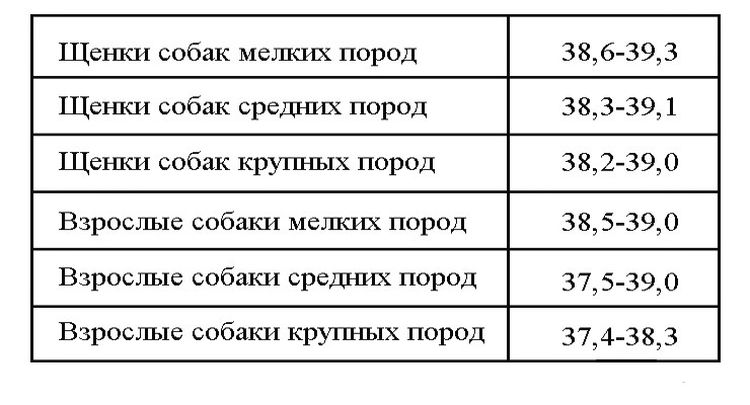
Another important question that may plague owners after taking their dog's temperature is whether the reading is truly normal. This isn't always easy to determine, as dogs' temperature readings are more individual than general—unlike in humans. The diversity of breeds, their different sizes, and their physiology create a wide range of normal readings, from 39.3 (102.3) for small puppies to 37.4 (100.4) for a large adult. A female dog in heat will have a higher temperature than normal, and the reading will drop before and after whelping. Physical activity, emotional state—all of these and many other factors—can affect the reading, making it unstable.
How to take a puppy's temperature
Any changes in a puppy's behavior may indicate the onset of illness. Since puppies' immune systems are not yet fully developed, they develop illnesses more quickly than adult dogs. Therefore, it's important for owners to know how to measure their pet's temperature—even a slight deviation from the norm can be a warning sign.
To measure a puppy's temperature, use the same thermometers as for an adult dog. Normal readings are considered to be between 37.5 and 39.5°C, with slight variations possible depending on the pet's age and size.
The procedure for measuring a puppy's temperature:
- lubricate the tip of the thermometer with Vaseline or similar ointment;
- lay the puppy on its side or place it on a table, if necessary, ask someone to help hold it;
- carefully insert the thermometer into the anus and wait 3-5 minutes (or until the electronic device beeps);
- If the reading exceeds 39.5°C, the puppy should be shown to a veterinarian as soon as possible.
You can also ask our website's staff veterinarian a question, who will answer them as quickly as possible in the comments box below.
Read also:


34 comments
Tatiana
Hello. I have a female German Miniature Spitz. I'm pregnant, and since day 50, we've been taking her temperature and it's consistently been 37.5°C (98.5°F). Is this normal?
Valeria
There was mating three weeks ago.
No food for 4 days. Temperature 39.
Discharge is white with pink
Absolutely lethargic (((
Alexander
Hello, my 1.5 month old German Shepherd puppy is vomiting, has terrible stools, and is not vaccinated against distemper. There is no vet clinic. What could be wrong with him?
Daria is a veterinarian
Hello! German Shepherds are extremely susceptible to distemper virus. If the mother and the puppy are unvaccinated, the infection rate is very high. Without prompt and specific treatment, the animal will die within a few days. Besides distemper, a huge number of diseases, not just infectious ones, have similar symptoms. Without a proper in-person examination and testing, it is impossible to make a diagnosis, and therefore prescribe treatment. Without a veterinarian, you will lose your pet.
Oksana
Hello, our dachshund has been acting strange for the past 24 hours. She's lethargic, almost sad. She's not eating well, only drinking, but she's drinking as usual, not much, not little. We measured her temperature, and it's 39.2 degrees. We have a large wire-haired dachshund, weighing 16 kg. Her urine is dark yellow. She's not shaking, and she's not salivating. It might be time for her heat to start, but I'm not sure.
Daria is a veterinarian
Hello! During heat, behavioral changes may occur, but it's still important to monitor your pet. How often does your pet urinate? If you notice any change in urination frequency or suspicious vaginal discharge, abdominal distension, pain, or lethargy, rush to the vet. An ultrasound is essential. It's essential to rule out pyometra, as it can be closed, meaning the uterus is closed and the pus can't drain. This is the most dangerous condition. An open pyometra is better (firstly, it gives more time to provide assistance, and secondly, you can spot symptoms sooner). This can be caused by hormonal imbalances in unspayed animals. In most cases, it's best to remove the uterus. However, this doesn't mean your pet currently has one. Again, an examination and observation of the animal is essential, and collecting a thorough medical history is crucial.
Novel
Hello! My 5-year-old husky is about 50-52 days pregnant. Is there any way to tell by her temperature or some other way that she's about to give birth today or tomorrow (so I can take time off from work?)? I'm worried that no one will be around when she goes into labor, or that she'll crush the puppies or something?
Tatiana
Good afternoon. This afternoon I took my German Shepherd for a walk in the meadow and near the river. It's December. I didn't treat the dog. It's -2 degrees outside. She ate in the evening, but I had to persuade her not to. She won't drink water. I was afraid she might have caught a tick. We took her temperature this evening, and it's 38.5 degrees. She's sleeping. Her breathing is calm. She's a German Shepherd, male, 9 years old, and weighs 43 kg. At what temperature should I take her to the vet?
Daria is a veterinarian
Hello! 38.5 (100.5°F) is a normal temperature for an adult dog! Don't worry. Temperatures up to 39.5 (102.5°F) are acceptable. A one-time refusal to eat isn't that serious. It's important to monitor the dog's general condition. It's important to look for no vomiting, diarrhea, yellowing of visible mucous membranes, conjunctiva, or sclera, or blood in the urine. Inspect your pet's fur and skin (comb with a fine-tooth comb).
Even in sub-zero temperatures like these, you can still pick up ticks. People have even come home with ticks at -15°C. Once, we brought in our cats when it was -20°C outside, and they were covered in ticks like a Christmas tree with Christmas tree ornaments. We asked the owners and found out there was a hayloft where the cats slept. Most likely, the ticks were "sleeping" in the mown grass (hay), and then the cats "eaten" them.
Nina
Hello, could you please tell me? Three days ago, my small breed puppy started having diarrhea and vomiting. I gave him Polysorb and water. We were on a starvation diet, and he didn't eat either, but he drank water. The next day after lunch, he ate a little boiled chicken and became cheerful and happy. There were no signs of illness for a day, but on the third day after lunch, everything started again. Could it be a fever? We don't have a veterinary clinic. What medications are needed and what should we do in this situation?
Daria is a veterinarian
Hello! It's not enough that it's a small breed. More information is needed. Specifically, please provide its age. What treatments have been done (vaccinations, deworming) and how long ago? Does it walk outside or use a pad at home? Is it likely to "grab" things from the ground outside? Does it feed it anything forbidden from the household? What exactly does the puppy's diet consist of? How often per day? What kind of vomiting? Diarrhea or loose stool (these are different things)? Has its body temperature been measured (not by feeling its nose, but with a thermometer)?
Julia
Hello, I have a small breed dog, she's pregnant. Today is her 59th day of conception. She's been whining and sleeping since this morning. She refuses to eat. When I put my hand on her stomach, I feel it tense up and then relax. How can I ease the onset of contractions? And when exactly should the mucus plug come out to know for sure she's pregnant?
Daria is a veterinarian
Hello! Don't give her anything! Especially not on your own. What can I do to ease the contractions? And then how will you induce labor? If you slow down the contractions, she won't be able to deliver at all. Small breeds should ideally be placed under a doctor's supervision during labor, or a cesarean section should be performed. The plug will come out, and only then will labor begin (the cervix will begin to dilate gradually). It's impossible to predict exactly when the plug will come out. Sometimes it comes out with the first puppy or with the amniotic fluid if the sac ruptures.
Andrey
Hello. I have a one-and-a-half-year-old pug. Usually, after being outside, he jumps into the bathtub to wash his paws, but this evening he didn't. I picked him up under the arms and he whined and started snapping, even nipping me once. My wife says he was kind of lethargic outside, too. He usually runs to the kids, but today he's ignoring her and wouldn't leave her side. When he was lying down, I petted him and felt around for a tick, but nothing was found. We called the vet, who recommended giving him No-Spa. We still couldn't figure out what was hurting him. We tried taking his temperature, but he wouldn't budge; he started biting. All his shots are up to date. He'll need deworming in a month.
Daria is a veterinarian
Hello! Well, I can't guess what's wrong with the animal either. No-Spa is an antispasmodic, not a painkiller. I doubt giving it will improve the animal's condition. We need to determine the source of the inflammation. Perhaps it was injured (fell, jumped awkwardly, or was grabbed by children). Antibiotics, anti-inflammatory medications, or physical therapy may be needed. Observe which area shows the most discomfort when touched. Is the dog licking a certain area intensely? Staring at it? Whining? Anxious? What about a rabies vaccination? This is the most important aspect, considering the animal bit you.
Olga
If my Pekingese has a high temperature, what pill can I give her and what is the dosage? I'm also seeing something strange with her hind legs.
Daria is a veterinarian
Hello! It's tick season now. If your pet's temperature rises or any unexplained signs of illness appear, seek immediate medical attention. Hind leg failure can also indicate a neurological disorder. Giving fever-reducing medications without a diagnosis is prohibited, as the immune system raises body temperature for a reason. This is done to "destroy" bacteria and viruses that have entered the body.
Galina
Hello, what kind of expectorant can I give my dog? He has a dry, paroxysmal cough.
Daria is a veterinarian
Hello! First of all, you need to make a diagnosis and understand the cause of the cough. It could be bronchitis/tracheitis, asthma, heart failure, a helminthic infestation, an allergic reaction, or a foreign body in the airways. There are countless possible causes. But in any case, in addition to an expectorant (at least Sinekod for children), antibiotics are also needed. Expectorants alone won't do. And you need to listen carefully, in case the cough has already spread to the lungs. Your temperature should be taken.
Elena
Hello, my Akita puppy is 3 months old. After his vaccination, he's lethargic, not playing, and not eating well. Is this normal?
Daria is a veterinarian
Hello! If 24 to 3 days have passed since the vaccine was administered, lethargy, decreased appetite, and a slight fever (1-2 degrees Celsius) are normal. This is the body's reaction to a foreign protein—the virus contained in the vaccine. A slight rise in temperature is a protective reaction, as the immune system attempts to destroy the pathogen, and simultaneously produces antibodies. There's no need to bring down the fever; it should subside on its own. This process is what develops lasting immunity (re-administration of the same vaccine is essential, and don't change the manufacturer). You may also experience a lump or redness at the injection site—this is the body's local reaction to the "gateway" of infection (the point where the pathogen entered). I hope I explained it clearly =)
Natalia
Hello, my male husky is 6 months old and has refused to eat for 5 days. He is dewormed and has had his vaccinations as scheduled. What could be the cause? He drinks water and behaves as usual.
Daria is a veterinarian
Hello! It sounds very strange: he's been refusing food for almost a week, but his behavior is normal. This can't be true. Five days of starvation can't possibly pass without leaving a mark, especially for a growing body. Are there really no other symptoms besides refusing food? No lethargy, no fever, no vomiting or diarrhea? Could he have swallowed a foreign object? Have you offered him any treats to assess his appetite (maybe he doesn't like the food)? Are you stressed? Has he picked up any ticks? Why haven't you taken him to the vet during this time? Biochemistry, ultrasound, and an in-person examination are essential.
Vasily
Hello, I have a Staffordshire Terrier, he doesn't eat anything and he's vomiting. What could be wrong with him?
Daria is a veterinarian
Hello! Anything could be wrong with an animal: stomach problems, liver problems, pancreatic problems, kidney failure, poisoning, parasites, infections, foreign bodies, enteritis, and much more. Vomiting isn't a separate symptom. A comprehensive approach to diagnosis is necessary, including a thorough history (what you feed, when and how you treated/vaccinated/dewormed, any other symptoms, how long ago it started, how often per day the animal vomits, whether it vomits before/after meals/regardless of feeding, and other questions), plus additional testing (blood tests and ultrasound).
Valeria
An 11-year-old male Chinese Crested hairless. His walking has been deteriorating since November 19th. A neurologist suspected a tumor or stroke and prescribed 4 mg of Metipred as prescribed, along with 0.5 mg of Gliatilin intramuscularly for 14 days. He received six injections because he had vomiting and diarrhea afterward. He's also trembling all over, as if he's cold, then it stops, then starts trembling again. What's going on with him? He's dressed warmly. Could you please tell me what this could be?
Daria is a veterinarian
Hello! Of course, there's a huge difference between the diagnoses. Treating a pet for a tumor is one thing, but treating a stroke is completely different. Apparently, the doctor decided to settle on a stroke. Did you not see a doctor because of the diarrhea and vomiting? Perhaps he could have changed the medications (individual intolerance to drug components is always possible). You can't stop therapy so abruptly. Your pet is of a breed that shakes under any stress, perhaps because you're injecting it and it's stressed, hence the trembling. But still, take its temperature (chills may be present). Get a thorough examination to establish a diagnosis (X-ray, CT scan—if available in your city, and ultrasound in almost every clinic now, plus biochemistry and a complete blood count). The shaking may be due to pain, but you need to find out what's bothering you.
Margarita
My 6-month-old German Shepherd puppy has a groin temperature of 104 degrees Fahrenheit (40 degrees Celsius). He's not eating but is playing. Is this normal?
Daria is a veterinarian
Hello! Who measures the groin temperature? Animals' temperatures are measured RECTALLY, that is, in the rectum (in the butt)! Measure the temperature regularly. Vaccinations? Deworming? What are they feeding? Are they kept in an apartment or a cage?
Inna
Hello! My German Shepherd puppy is five months old. He has a fever of 39°C (102°F), but is very lethargic, his tail and ears are hanging down, his tongue hangs out when he walks, and his eyes are dull, but he seems to be eating. He seems to be neglected. Please tell me what this could be.
Dasha is a veterinarian
Hello! Vaccinations and deworming—when and what for? What are they feeding? What's their stool like? Any other symptoms? Maybe they're breathing strangely, maybe their stomach is bloated, or maybe they're in pain (whining, fussing). Where is they kept? Are they running or have a runny nose?
Alexander
The whites of the eyes are red
Alexander
My spaniel puppy's eyes are red! What should I do?
Dasha is a veterinarian
Hello! You should see a doctor and determine if there's any underlying issue. How long ago did this happen? What triggered it (maybe stress, lack of sleep, constipation, maybe he's been sick recently, maybe you're giving him something else)? Simply recommending eye drops isn't right; you need to figure out what triggered it. The puppy may have had these proteins from the start and be predisposed to this (weak blood vessels). But it's essential to examine the fundus to make sure there aren't any similar broken blood vessels inside, otherwise the puppy will start losing vision.
Add a comment