
Expertise in cat food
Commercially produced pet food forms the basis of the daily diet for many domestic cats. Their balanced composition and the correct amount of vitamins and microelements ensure a complete diet and a healthy, long life for your pet. Cat food is tested to ensure that the product's stated properties meet established standards.

Content
The need for expertise
The examination is carried out with the aim of:
- Check whether the actual composition of the food complies with established standards. This involves examining the proportion of proteins, carbohydrates, fats, and other components, analyzing their origin and suitability for different categories of animals (for example, the fat requirements for kittens and adult cats differ significantly). Additionally, the percentage of salt, essential vitamins, and microelements, the amounts of which are regulated by standards, is determined.
Note! Excess calcium in food indicates the presence of large amounts of bone meal instead of meat, while high salt content makes the product more palatable for your pet but is detrimental to their health.
- Determine the safety of the feed for the animal itself, its owners, and the environment. Potential hazards in the feed may include improper production technology, storage conditions, and other factors.
Thanks to the examination, it is possible to identify the presence of harmful chemical elements or dangerous microorganisms in food that can cause animal poisoning.
The main requirement for the assessment is that it must be conducted exclusively by organizations independent of pet food producers and consumers. Only then can objective results be obtained and the conditions for a healthy competitive environment in the cat food market be created.
Roskontrol's expertise
The independent quality control system Roskontrol conducted an expert evaluation of cat food, examining nine of the most popular products among consumers:
- Brit Care
- Darling
- Eukanuba
- Happy Cat
- Hill's Nature's Best
- Hill's Science Plan
- KiteKat
- Royal Canin
- Whiskas.
Protein
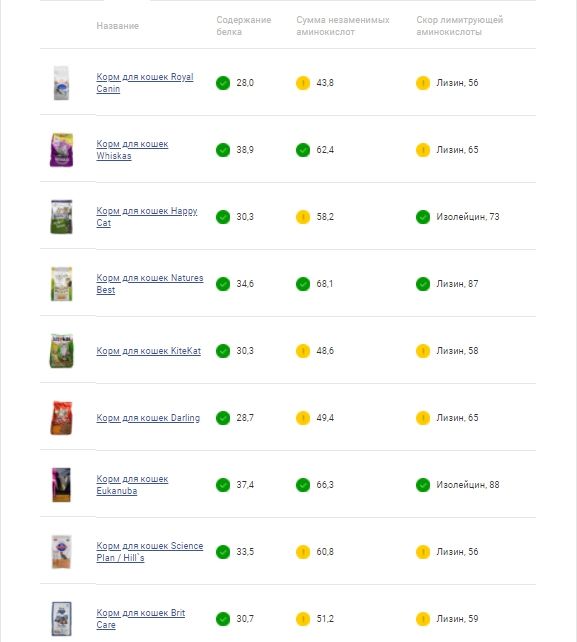
The main component of a cat's diet is protein (necessarily of animal, not plant origin), which, according to standards, should make up at least 26%. According to this criterion:
- A large amount of protein in full compliance with biological value standards was noted in Eukanuba (37.4%), Hill's Nature Best (34.6%), and Whiskas (38.9%).
- Insufficient amounts of some essential amino acids with a sufficient overall protein content were noted in Hill's Science Plan (33.5%), Brit Care (30.7%), Happy Cat and KiteKat (30.3% each), Darling (28.7%),
- Non-compliance with biological value standards for most essential amino acids, despite sufficient total protein mass, was noted in Royal Canin (28%).
Fats
The minimum fat content for commercial cat food is set at 9%. An examination revealed a discrepancy between this figure and the labeling:
- Meets the requirements for the fat content, the amount of which is almost the same as the one indicated on the label - Eukanuba (21.8%),
- Meets the fat content requirements, but the amount is less than stated on the packaging for Hill's Nature Best (16.8%), Hill's Science Plan (16.1%), Happy Cat (16.3%), Brit Care (11%), Royal Canin (10.1%), KiteKat (8.5%), Whiskas (8.2%).
- Does not meet regulated standards (only 6.5% fat) and labeling (23% shortage) – Darling.
Important! Darling has been blacklisted for lower than acceptable fat content and non-compliant labeling.
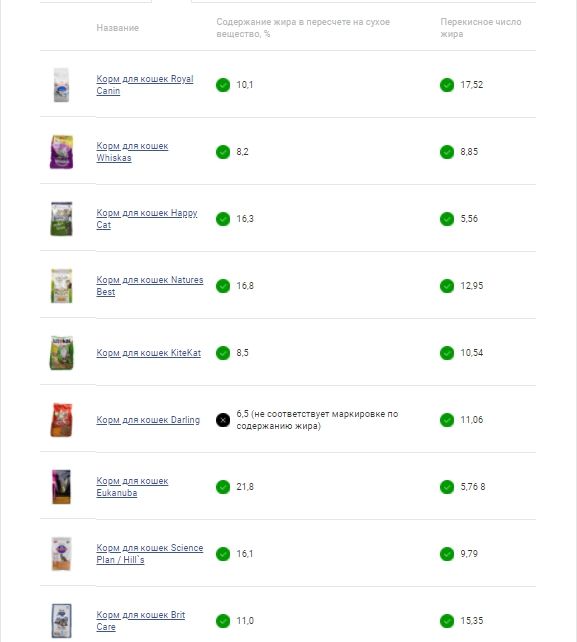
The peroxide value of fat is an indicator of the quality and freshness of edible fat in a product. A high level of peroxide may indicate poor raw material quality or improper storage of the finished product. The analysis revealed:
- The lowest values were found in Eukanuba (5.76 mmol/kg) and Happy Cat (5.56 mmol/kg).
- The highest values were found in Royal Canin (17.52 mmol/kg) and Brit Care (15.35 mmol/kg).
Note! There are no established standards for the peroxide value of fat for dry foods, but, for example, for dry baby food products it is up to 4 mmol/kg, and for fish oil – up to 10 mmol/kg.
Salt
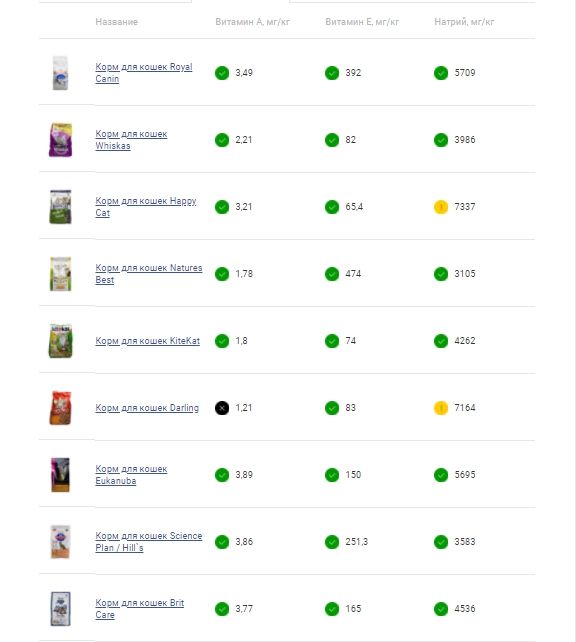
Rock salt is where cats get most of their sodium, but standards stipulate that chlorides should not exceed 0.3%, and sodium should not exceed 0.2-0.5%. Testing revealed that most samples exceeded these standards:
- Hill's Science Plan contains 1.28% chlorides, but since it is not possible to examine the specifications, this value may be related to the product's unique properties. Therefore, it has been added to the list of samples with comments.
- Happy Cat and Hill's Natures Best were found to contain 0.81% chlorides each, while Brit Care contained 0.69%, which also exceeds the standards.
- Royal Canin was found to contain chlorides at 0.34%, which is within the standards.
As for sodium, an excess of it was found in Darling and Happy Cat (0.7% each), while samples from other manufacturers contained an acceptable amount.
Vitamins and microelements
To ensure a healthy body and a beautiful appearance, pet food should be enriched with essential nutrients. According to the expert:
- Vitamin E (with a recommended value of 20-53 mg/kg) is present in significantly higher quantities in these foods (as it also has antioxidant properties). The highest amounts are found in Hill's Nature Best, Royal Canin, and Hill's Science Plan (474, 392, and 251.3 mg/kg, respectively).
- The proportion of vitamin A (with the standard being 1.5 mg/kg) was noted to be deficient in Darling.
Important! Darling's vitamin A deficiency is one of the factors contributing to its blacklisting.
- The proportions of vitamin D, potassium, iron, manganese and magnesium in each sample correspond to the regulated indicators.
- Calcium (the minimum recommended value is 0.6%) was present in adequate quantities in all samples. However, an excess of calcium was noted in KiteKat (1.73%), indicating the presence of a significant amount of bone meal.
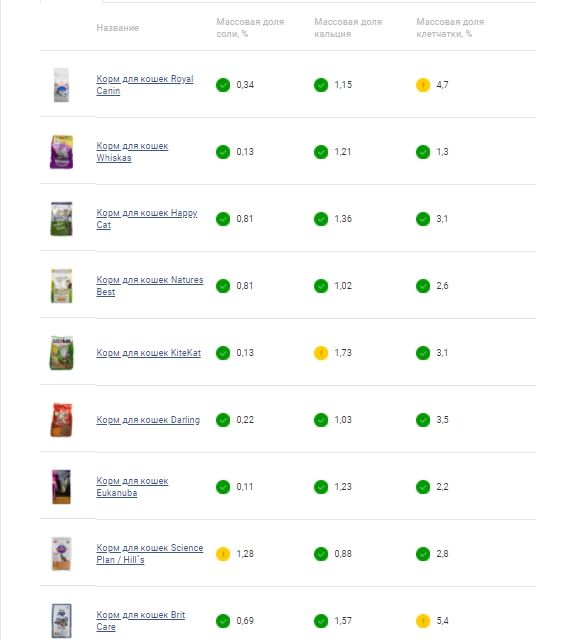
Thus, based on the results of the examination of cat food, it was established that:
- Eukanuba, Hill's Nature Best, Whiskas - no serious complaints.
- Brit Care, Happy Cat, Hill's Science Plan, KiteKat, Royal Canin – have comments on certain criteria.
- Darling – not recommended for purchase.
Read also:
- What food should I feed my British Shorthair cat?
- The best wet cat food: rating
- DIY cat food recipes


Add a comment