
Greater Swiss Mountain Dog (Gross, Large Mountain Dog)
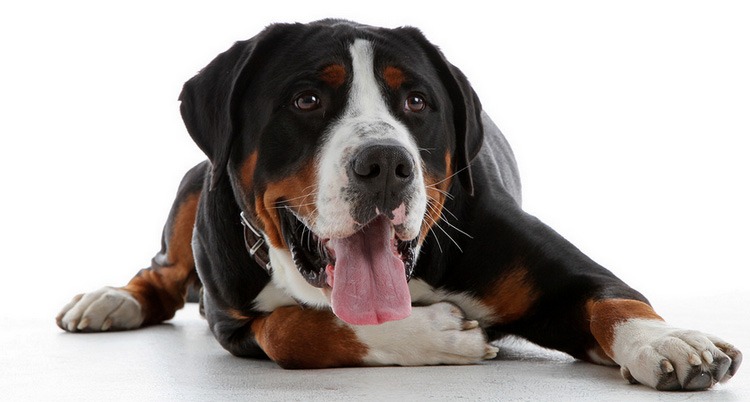
The Greater Swiss Mountain Dog is less well-known than its Bernese cousin, but no less fascinating. It is a versatile working and family dog. It is also known as the Shorthaired Mountain Dog or the Gross.
Content
History of origin
In modern cynology, the correct version of dog origins is considered to be a path from the Tibetan mastiff through ancient Roman molossers to Central European Great Danes and then to the Swiss Mountain Dog. In Switzerland, dogs performed the same work as in other countries. Large dogs served as guards and shepherds, while smaller ones served as watchdogs. Over centuries, local breeds developed spontaneously, without human intervention, but this did not prevent them from acquiring a specific type and characteristic coloring.
After the monks began to use dogs (today's St. Bernards) As rescue dogs, the bicolored dogs from Bern became very popular. These fluffy bicolored dogs began to fetch high prices, and eventually, they were virtually extinct in Switzerland. However, tricolored dogs, previously considered mongrel, survived. They became the basis for all types of Bernese Mountain Dogs. The group includes four breeds:
- Entlebucher Mountain Dog;
- Appenzeller Mountain Dog;
- Bernese Mountain Dog;
- Greater Swiss Mountain Dog (Large Mountain Dog).
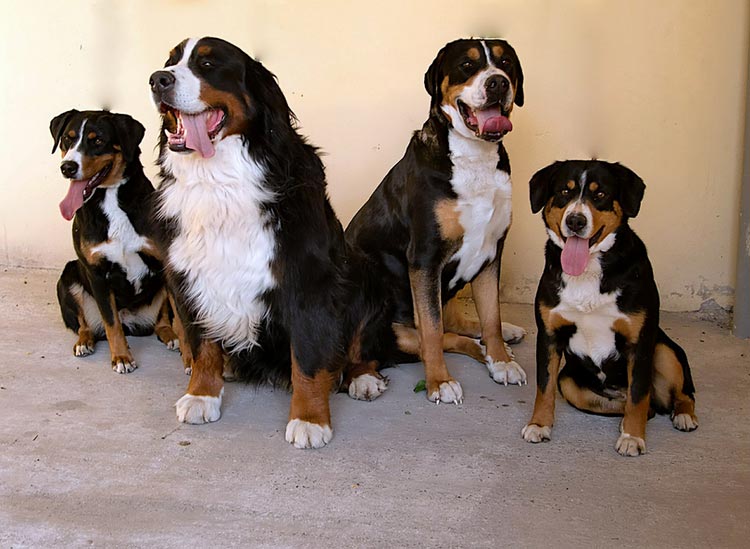
As for the Gross, it owes its appearance to the breeder Bernese Mountain Dogs Franz Schertenleib. He was the one who decided that large, tricolor dogs also deserved attention and brought the first short-haired Sennenhund to a show in Langenthal in 1908. He managed to prove that these dogs were representatives of the large mountain dogs that were almost extinct. In 1909, the breed was recognized by the Swiss Kennel Club. And already in 1939, the first standard was published and the breed was registered with the VFC. Incidentally, it is the Great Sennenhunds that are considered the ancestors of the butcher's dogs, from which they descended. RottweilersAlthough the Gross was originally bred in Switzerland, today the main population is concentrated in Austria and Germany.
Video review of the Greater Swiss Mountain Dog (Gross) dog breed:
Appearance and standards
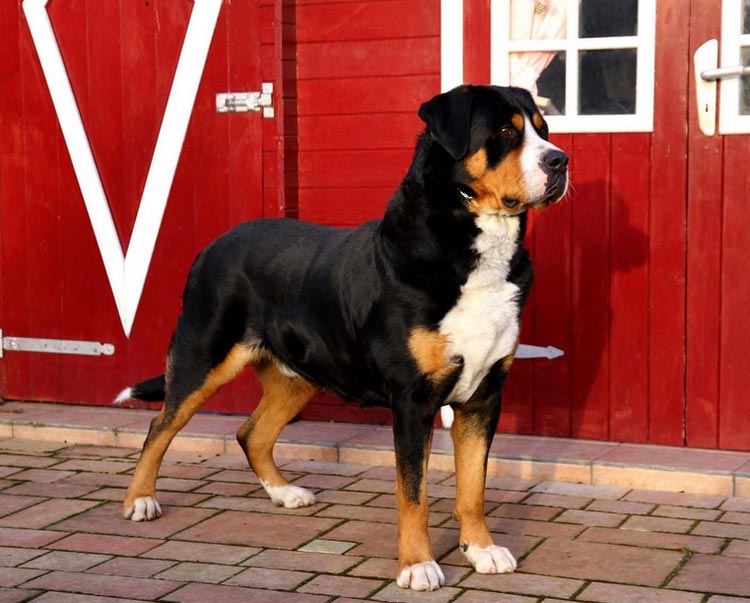
The Greater Swiss Mountain Dog is a large, strongly built dog with a distinctive tricolor coat. The height at the withers is 60-72 cm. Males are noticeably larger and more massive than females.
The Gross standard highlights several important proportions:
- The ratio of length to height is 10 to 9;
- Chest depth to height 1:2;
- The length of the nose is equal to the length of the upper part of the skull 1:1;
- The width of the top of the skull is twice the width of the nose.
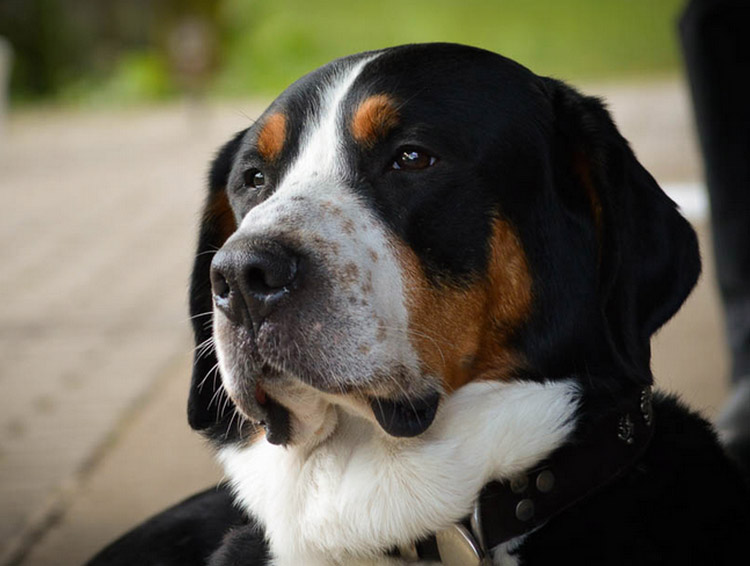
The head is strong but not heavy, more massive in males. The forehead is broad and flat, the frontal furrow narrows toward the tip of the nose, and the occipital protuberance is barely noticeable. The nose should be black. The muzzle is strong, not pointed, and longer than wide. The nasal bridge is straight. The lips are fleshy and fit tightly to the jaw. A scissor bite is present; missing teeth are permitted. The eyes are almond-shaped, medium in size, and range in color from light hazel to dark brown. The eyelids are fully pigmented and fit tightly. The ears are triangular in shape, medium in size, and set high. When relaxed, they hang down, pressed against the cheekbones, and when the dog is excited, they are raised on cartilage and turned forward. The ears are covered with hair both inside and outside.
The neck is thickly arched. The body is slightly elongated. The back is strong and straight. The croup is broad. The chest is broad, slightly sloping, and oval in cross-section. The dog's belly is slightly tucked in. The tail harmoniously continues the topline. It is heavy, reaching to the hocks. When at rest, it is carried low, with a slight curve, and when moving, it is slightly raised and curved. The legs are strong, powerful, and straight. The paws are rounded, close together, with strong nails.
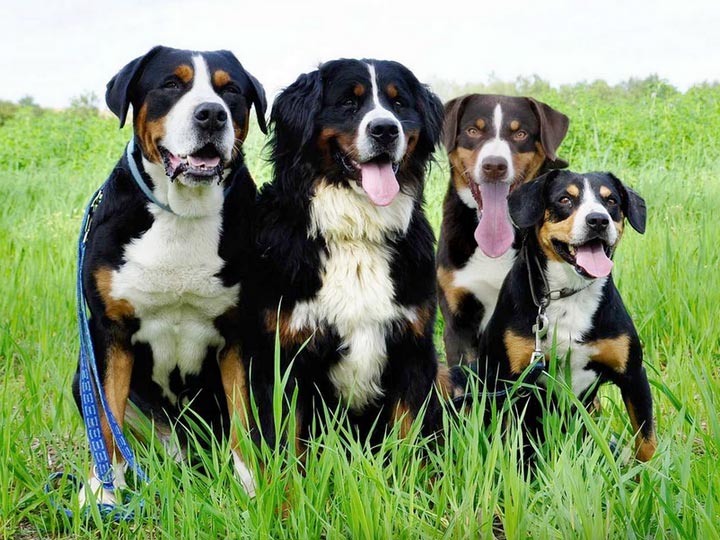
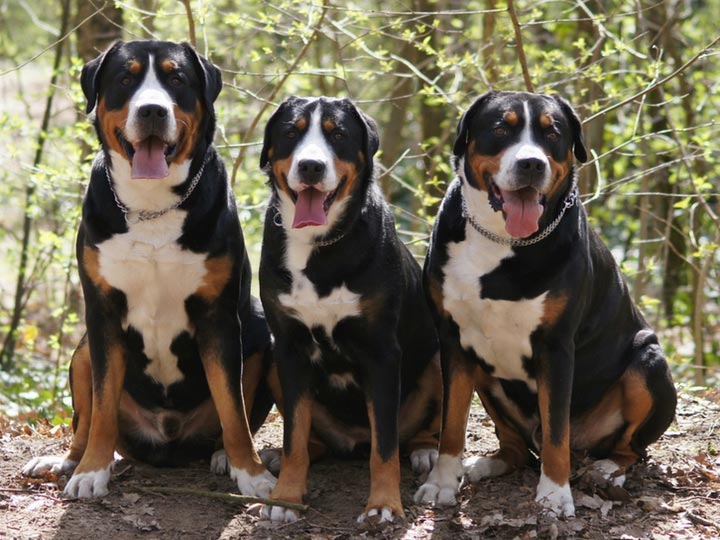
The coat is double and consists of a thick outer coat of short or medium length and a softer, dense undercoat, which can be dark grey or black in colour. Color is tricolor only. The base color is black, with symmetrical tan markings located on the cheeks, above the eyes, on the inside of the ears, on the sides of the sternum, on all four legs, and at the base of the tail. Pure white markings are found on the head, throat, chest, and legs (forming "socks"), as well as on the tip of the tail. It is important that there be a black stripe between the white stripe on the forehead and the tan markings above the eyes. White may extend throughout the neck, forming a ruff.
Character
The Swiss Mountain Dog has a good character. Distinguished traits include nobility, fearlessness, composure, and poise. They are calm, but never sluggish. They are neither shy nor aggressive. The formidable appearance of this large dog makes one regard it with caution, but it will never bark unnecessarily. Incidentally, their aggression usually begins and ends with barking alone. These dogs are especially diligent in guarding women and children.
They are excellent guard dogs that pay attention to every detail.
It's very easy for a human to become a leader for a Gross, as they need a fair guardian and don't seek dominance. They get along well with other animals, especially if they've known each other since puppyhood.
Purpose and training
Modern Swiss Mountain Dogs are mostly kept by families, but they are also used in rescue operations. They also make excellent guard dogs and herders. Young Swiss Mountain Dogs can be very unruly and stubborn. If a dog is bored or tired and doesn't want to go, no amount of persuasion will help; this requires understanding.
Working with a Gross requires patience. Training should be regular and moderate. The critical period is up to eighteen months. While the dog may look big, it's still a playful puppy at heart. Incidentally, it's common for a six-month-old Swissy to pee in the house.
Without training and interaction with people, dogs become dull, develop bad habits, and sometimes become dangerously aggressive.
They are fairly easy to train, and they quickly and permanently remember commands. The fact that many Grossens participate in agility and other dog sports further confirms their high level of intelligence. These dogs require excellent socialization. Furthermore, Swiss Mountain Dog breeders and owners highly recommend taking General Training (OKD) and Protection of the Body (ZKS) courses for their dogs.
Maintenance and care
The Greater Swiss Mountain Dog is not suited for apartment living. They thrive in a private home with a large yard or on a farm, where they happily serve as guard dogs and watchdogs. They require regular interaction with their owner and family members, do not tolerate loneliness well, and are completely unsuitable for leashed confinement or confined to a crate intended solely for shelter from rain and sun. They greatly appreciate space and tolerate cold better than heat.
Gross Terriers are pack dogs, so they develop distinct relationships with each family member. They typically don't choose just one owner, which is very convenient, as with proper training, the dog will obey every family member unconditionally.
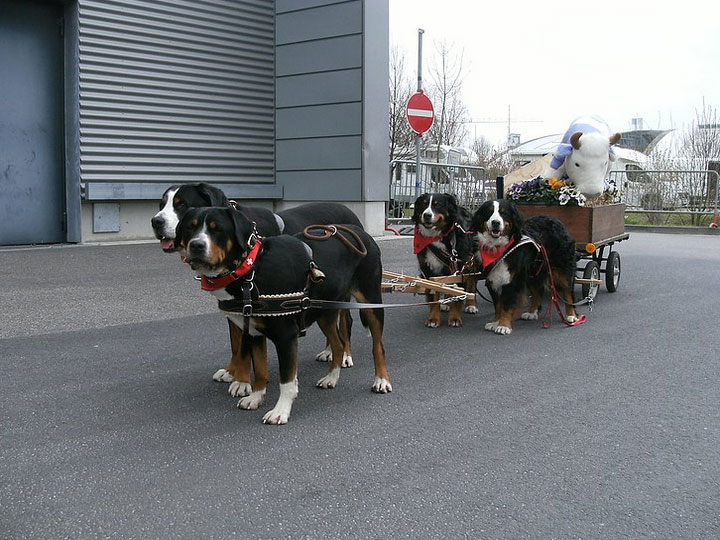
Even if a Gross lives in a large yard, it needs regular long walks. Excellent activities include cycling, swimming, and in winter, sledding with children. When walking a Bernese Mountain Dog, be mindful of its bad habits. It might find something very foul-smelling and roll around in it, or it might chew on anything it comes across. It's best to wean the dog from this habit from puppyhood.
Care
The Greater Swiss Mountain Dog is completely undemanding in terms of care. Brushing your dog once a week is sufficient to remove old hair. Slightly more frequent brushing is necessary during the shedding season. Bathing your dog thoroughly is not recommended; this is only done when absolutely necessary. It's a good idea to get your dog used to brushing their teeth from an early age, and then brush them regularly using a special brush and veterinary toothpaste. If your dog doesn't wear down their nails on their own, they should be trimmed, and their ears should be cleaned as needed.
Diet
It's recommended to feed dogs morning and evening, dividing the daily ration into two portions. The food can be prepared from natural ingredients, but commercially prepared foods are also suitable. The diet should be selected based on the dog's age, size, and physiological condition. Many manufacturers offer food for large and giant breeds. Supplements containing chondroitin and glucosamine, which are especially beneficial for dogs up to eighteen months of age, can be helpful as a supplement to the diet.
Health and life expectancy
In general, Greater Swiss Mountain Dogs are very strong and resilient, have good immunity, are stress-resistant, and adapt easily to new environments. However, selective breeding has left its mark on the breed in the form of a number of hereditary diseases:
- Elbow and hip dysplasia;
- Osteochondrosis;
- Entropion;
- Retinal atrophy;
- Cataract;
- Allergy;
- Oncological diseases.
This doesn't mean that a single dog will have all of these diseases. They may not even exist. It's just that all of these pathologies and illnesses are most common in members of the breed. Proper dog care should include routine vaccinations and regular treatment for external and internal parasites. Their lifespan is typically 10-12 years.
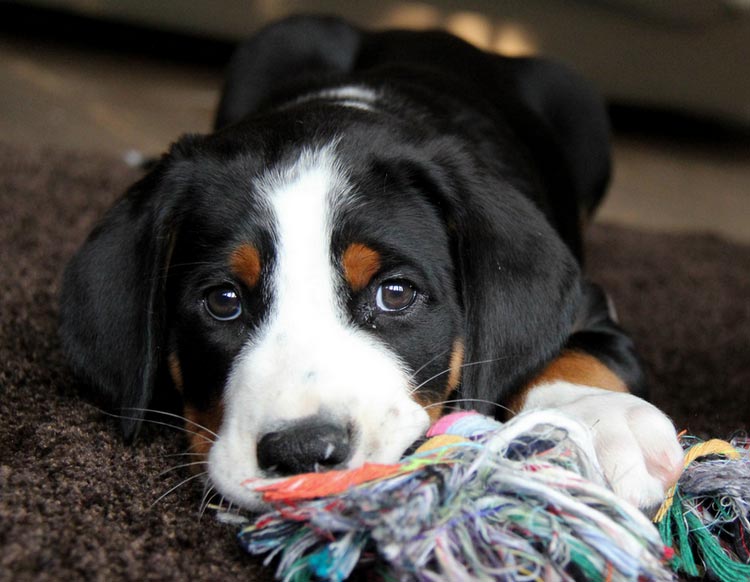
Choosing a puppy. Price
The Greater Swiss Mountain Dog population in Russia is small, but finding a breeder in major cities isn't difficult. Breeders typically work with both Swiss Mountain Dogs and Bernese Mountain Dogs.
Prospective owners typically fall into two types. Some search for a puppy for sale on classifieds, unwilling to wait or delve into details about its origins. This approach is not entirely correct and can lead to tragic consequences. The second type meticulously selects a kennel, meets the breeders, and only if everything is satisfactory do they proceed to select a puppy from the planned litter. In this matter, it's important to consider every detail: the dogs' living conditions, feeding, and appearance. Puppies and adult dogs should be healthy and active, with shiny coats and clear eyes.
The average price of a Greater Swiss Mountain Dog puppy is 25,000-30,000 rubles. In some cases, puppies are sold for less, mostly pet-class dogs. Promising puppies of elite bloodlines, which are of interest to breeders, can cost significantly more – 50,000 rubles and up.
Photos
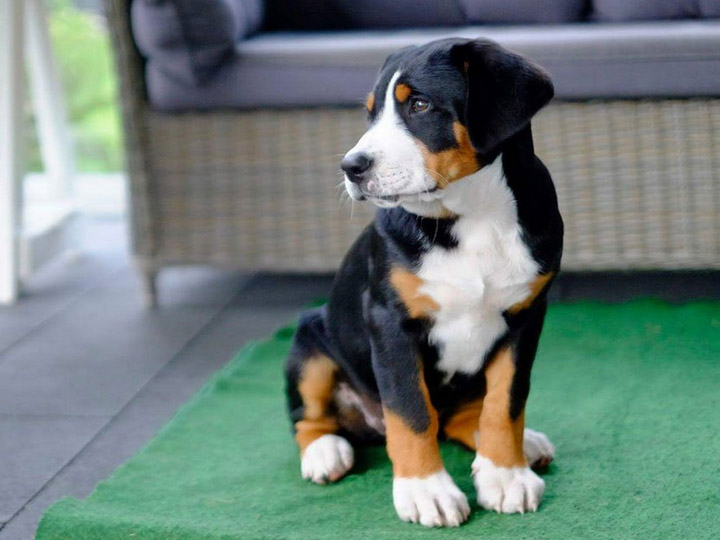
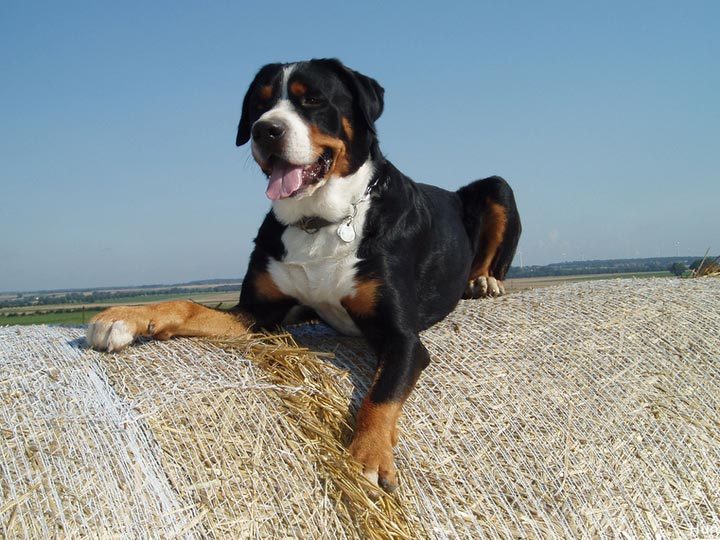
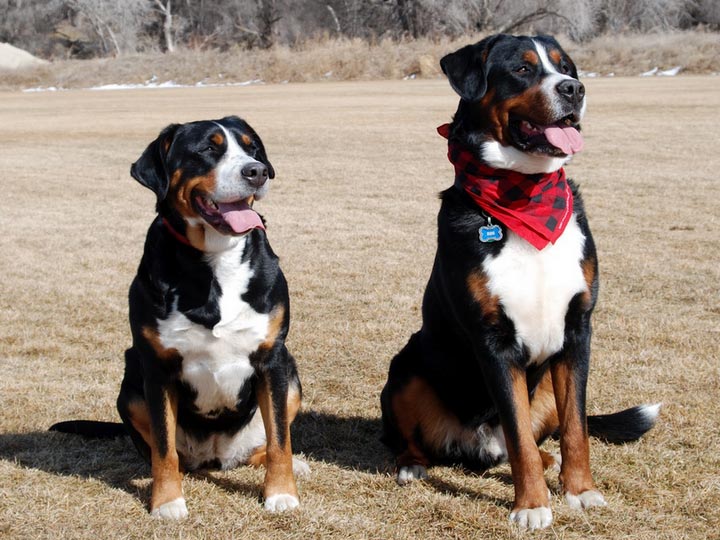
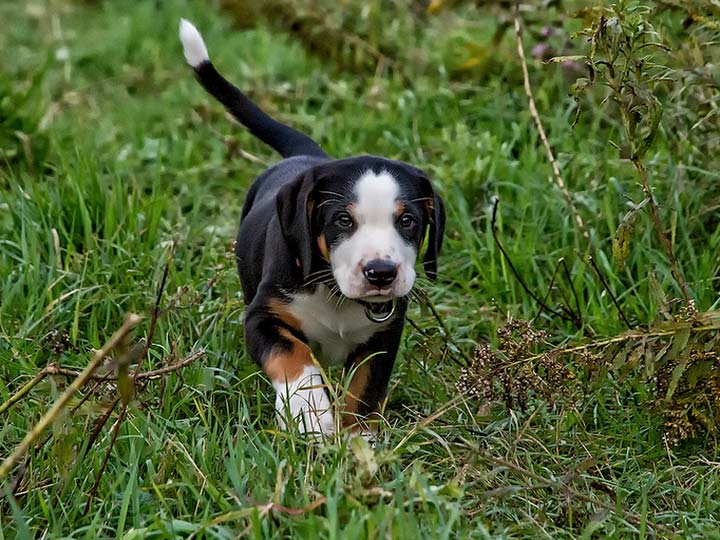
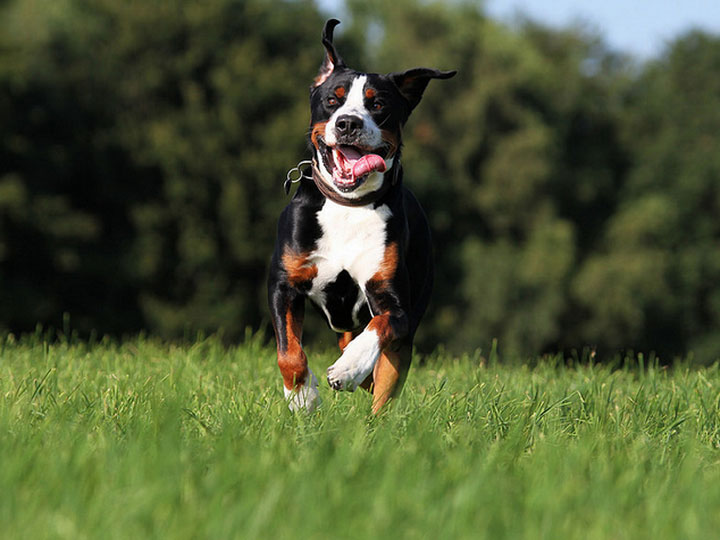
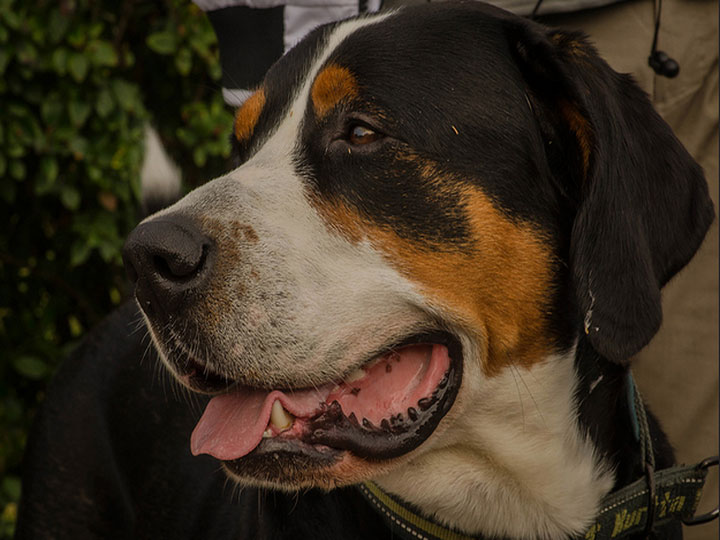
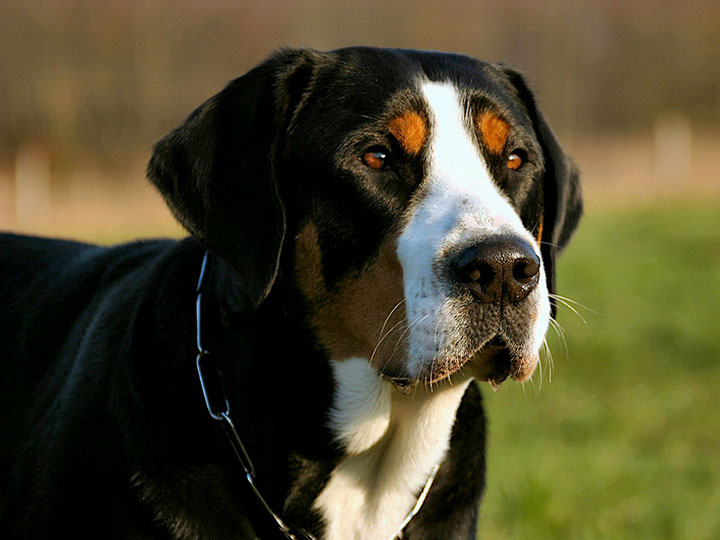
The gallery contains photos of Greater Swiss Mountain Dog puppies and adults:
Read also:



Add a comment