
Burmese cat (sacred Birman)
Burmese cat (sacred Birman) The Burmese is not only an interesting breed, but also a bit mysterious. Many wonderful legends are associated with these cats, who have captivated all animal lovers with their beauty. Today, we'll tell you about the breed's personality, the price of Burmese kittens, owner reviews, and much, much more.
Content
History of origin
One of them says that long ago, in the high mountains of Burma, Buddhist monks lived in a temple. They worshiped the blue-eyed goddess Tsun Kuanxa.
It was believed that she was the one who could transmigrate the souls of deceased monks, and they could return to the temple in the form of cats. For this reason, the temple was home to 100 golden-eyed, white cats, which the monks cherished and revered.
Once, when an attempt was made to steal the golden statue of the goddess, the monks managed to lock themselves in the temple, but one of them was so overcome with grief that his heart stopped. He died next to the statue, arms outstretched. At that moment, the priest's beloved cat, Sinh, jumped on his skull, and its fur immediately turned golden. Its eyes took on the color of the goddess, and the tips of its paws turned white—a sign of the purity and holiness of the monk's soul. The other monks immediately understood this sign and did everything they could to drive the bandits away from the temple.
A week later, the cat Sinh died, carrying the monk's soul to heaven, for it no longer needed to perfect itself, having already achieved its perfection. From then on, whenever a sacred cat died in a Buddhist monastery, it was believed that the monk's soul had found its eternal place in heaven. However, anyone who attempted to kill such a cat would suffer torment until its soul was at peace and forgave its killer.
In 1898, during a military conflict in Burma, the Buddhist temple was saved by British Major Lao-Tsun. As a token of gratitude, the major was presented with a small gold plaque depicting a Burmese cat. The High Lama showed him the sacred cats, told him the legend, and gave him a pair of the animals. Unfortunately, these animals did not survive the journey and died.
Some time later, in 1910, the millionaire Vanderbilt managed to purchase the cats that had previously been stolen from the monastery and gifted them to a Madame Tradd-Haddish. She then transported them to France. A short time later, the cat named Madapour died, but not before the cat, Sita, had given birth to a male heir named Dolly de Madapour. She was then crossed with a male of a different breed, and we can only guess what this wonderful cat truly was.
The Burmese cat managed to win the hearts of the French, and already in 1925 the breed was recognized by the French Association of Cat Fanciers.
More than 300 cats of various breeds participated in the 1926 exhibition, but the most votes went to the sacred Burmese, Doll de Madapour, and her two sons. Unfortunately, the breed nearly died out during World War II, but active efforts to revive it began in 1945. It wasn't until the 1950s that the breed was fully restored, after which it quickly spread among cat lovers across Europe and then beyond.
Breed description and standards
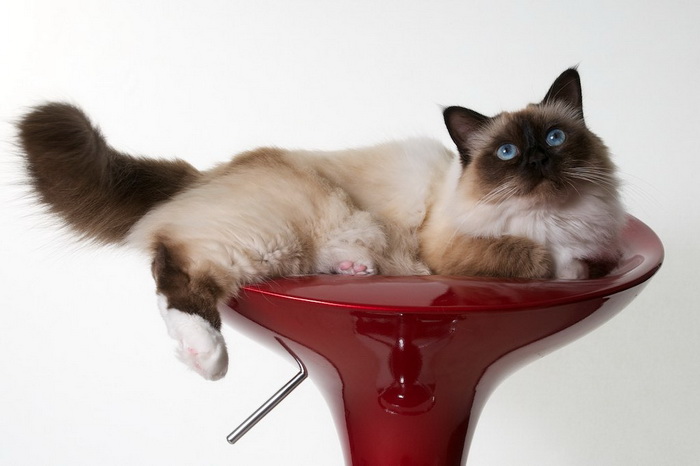
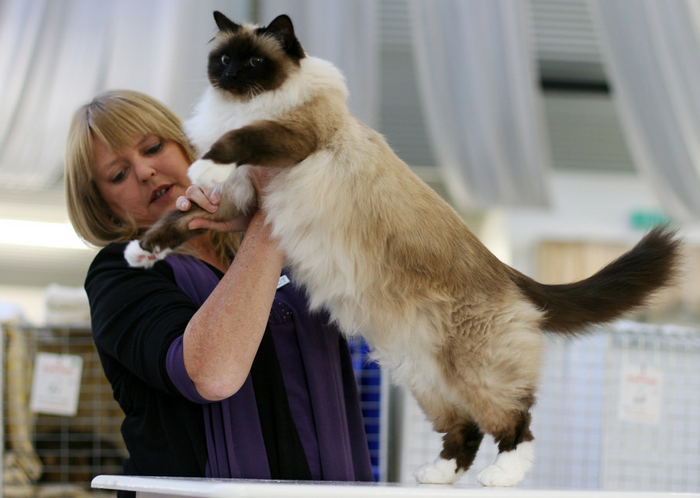
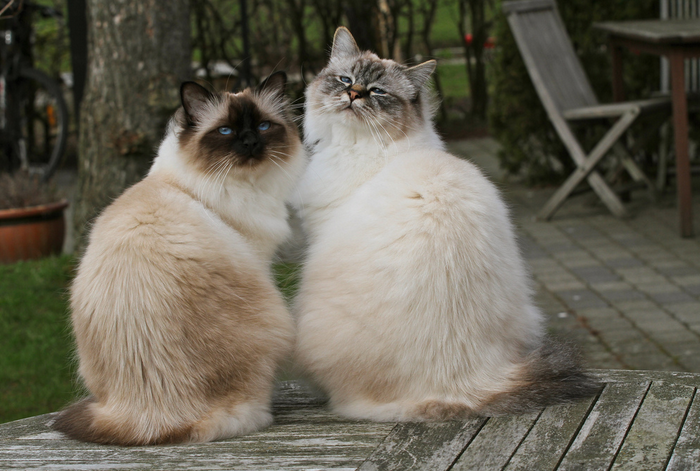
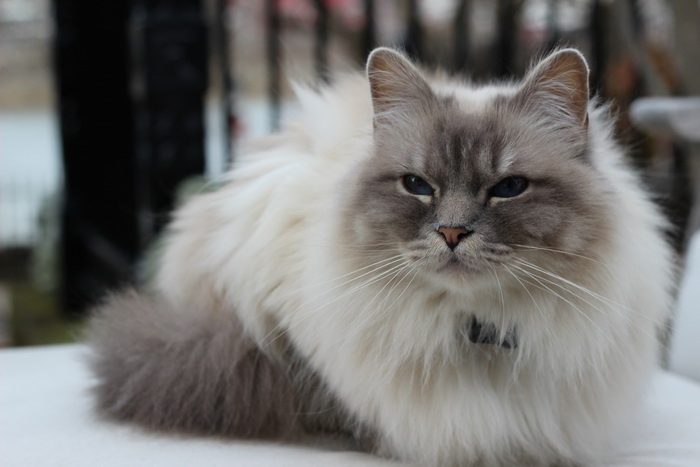
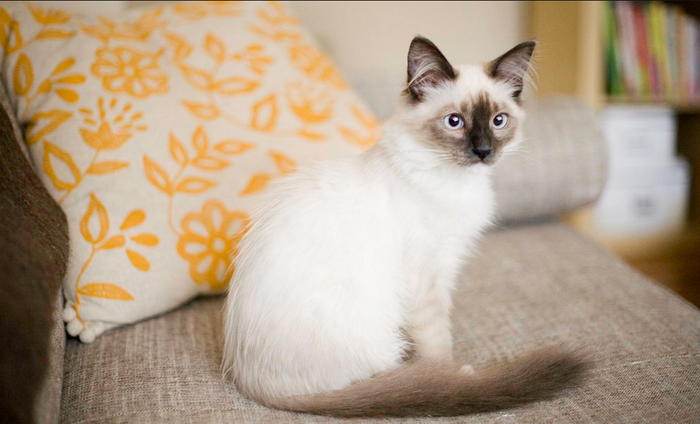
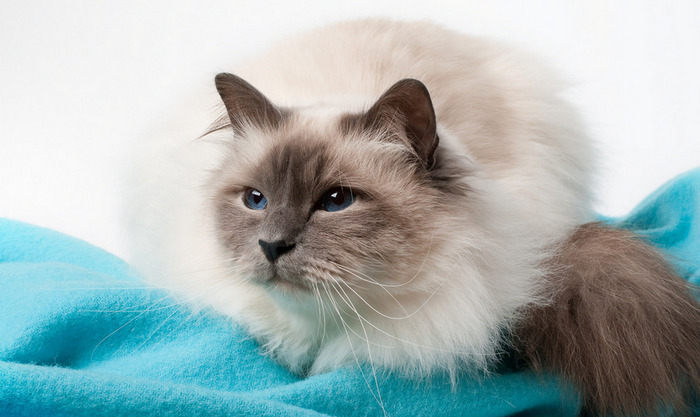
The Birman cat is easily recognizable by its color and coat—it has semi-long, point-colored fur and white paw pads. Its paw pads are a soft pink. Birmans have distinctive eyes—a beautiful round shape and an intense blue color. Below is a detailed description of the Birman cat breed:
Head and muzzle
The Birman's head is triangular in shape with a rounded outline. The cheekbones are set fairly high. The forehead is convex, with a slight stop visible in profile. The nose is fairly large and medium in length. The ears are small, approximately equal in height to their width at the base, with rounded tips. The eyes are almond-shaped, expressive, and set wide apart.
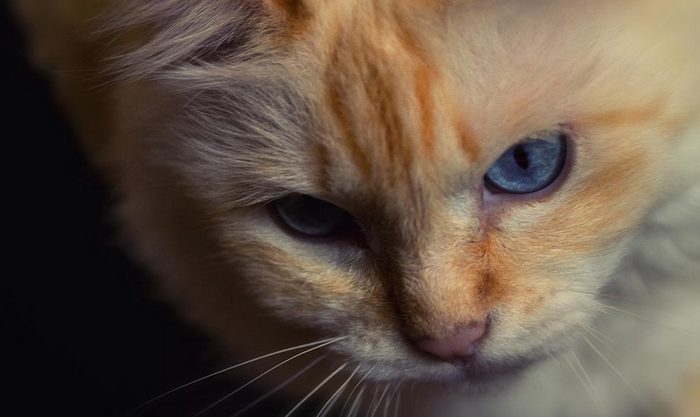
The color of the iris is only bright blue.
Frame
The body is medium-sized. The build is strong, with well-developed muscles. The format is slightly elongated. The legs are short with wide, rounded paws. The tail is of medium length.
Coat
Sacred cats have medium-length fur with little undercoat. It feels very soft and silky to the touch. The hair on the face is short, but it lengthens on the cheeks, forming a rich ruff. The longest hair is on the sides and back. The tail is very well feathered.
Colors
Birman cats have their own distinctive coat pattern. The body coat should be a uniformly light tone, with contrasting colors concentrated in markings. A dark mask should cover the entire muzzle and connect to the dark ears with a stripe. On the front and hind legs, snow-white socks are separated from the darker color by a smooth stripe. The tail should also be darker than the base coat.
There are four colors:
-
- dark brown markings on a light beige or cream color;
- chocolate markings with ivory background;
- blue markings in cats with a bluish-white cool tone on the body;
- purple markings on a white background.
Brown (sable) is considered the most sought-after coat color. Moreover, until recently, this color was considered the only acceptable color for Burmese cats according to the standard. An equally beautiful color is chocolate (coffee with milk). Tortoiseshell allows a mixture of:
- gray-blue with apricot;
- dark brown with red;
- chocolate with red;
- gray with purple.
Character
Birman cats have a gentle and calm nature. They are unobtrusive, moderately active, intelligent, and have a stable temperament. They can always find something to occupy themselves with, yet they demand positive interaction. If a cat doesn't like someone's behavior, they quietly withdraw. Their luxurious appearance may lead many to believe they are lazy and incapable of jumping. This isn't entirely true! Keep in mind that Birmans are very curious cats, and if something really interests them, they can even jump high onto a cabinet on the first try.
Furthermore, Sacred Birmans get along well with other pets in the home, and are not territorial or dominant. They are gentle with children and are the most adaptable cats for family comfort and everyday life.
Cats can be quickly trained to carry toys in their mouths; they are excellent at remembering the names of any object and following simple commands. During play, they understand perfectly what they can and cannot do.
If they try to take any object from your hands, they will never release their claws.
Reviews of the breed
All the reviews of the sacred Birman cat are remarkably similar. Owners claim that their cats are the most affectionate, gentle and docile. At the same time, they are moderately playful and inquisitive. They get along well with children and other animals.
Here is one of the reviews from the owner:

Another opinion about the Burmese cat:
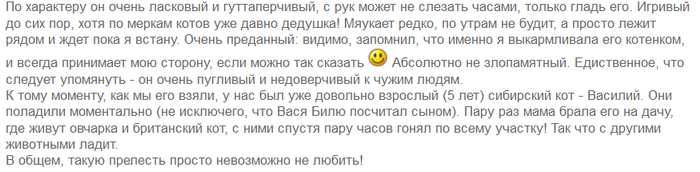
And one more review about the sacred Birman from the forum:
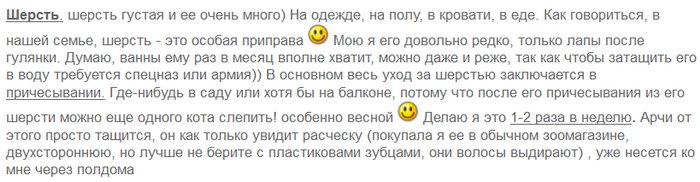
Apparently, the only downside of the Birman is its long hair, but this drawback can be eliminated with regular brushing.
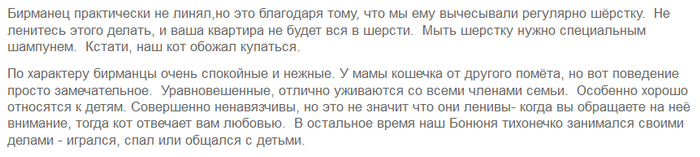
There are no other complaints about these cats. There are only minor individual complaints, such as a fear of the vacuum cleaner or wariness of strangers.

Maintenance and care
Remember that Birmans are not adapted to outdoor life. They fear cold, rain, snow, and drafts. Generally, Birmans don't need walks; they thrive indoors. Birmans, like all cats, enjoy warmth, but hypothermia can lead to inflammatory diseases. During cold weather, if your pet likes to lie on the windowsill, it's best to place a cushion on the sill.
Despite their long fur, Birman cats don't require much grooming. Brushing them once a week is sufficient, but during shedding season, more frequent brushing is recommended to prevent matting. Bathe them infrequently, once or twice a year. Clean their beautiful eyes with special solutions and clean their ears as needed. Their claws can be trimmed if desired.
To care for a Burmese cat you will need:
- a comb with frequent, and preferably rotating, teeth;
- massage brush with antistatic coating;
- nail clipper;
- ear cleaner;
- shampoo;
- wipes for cleaning tear ducts.
Diet
There are no special dietary recommendations or restrictions for Burmese cats. They need everything the same as other cats: high-quality food that will keep them in excellent condition and clean drinking water. Preference can be given to prepared super-premium or holistic diets, or to a natural diet. In the latter case, it can be difficult to formulate a quality diet and ensure the cat eats everything it needs. During shedding periods, cats are given hair removal products or food.
Diseases and life expectancy
Birman cats are delicate apartment cats and are not suited to outdoor life. Furthermore, experts have discovered that the breed is susceptible to several hereditary diseases:
- A disease of the central nervous system called spongiform degeneration. It leads to problems with coordination and limb weakness, and in advanced cases, paralysis.
- A corneal dermoid is a benign growth consisting of skin cells and hair follicles on the cornea. It is removed surgically.
- There is a predisposition to kidney disease.
The fact that Burmese cats are expensive and pedigreed for apartment living does not relieve owners from the need to vaccinate and deworm them on a timely basis!
The average lifespan of Burmese cats is 11-14 years, but there are also some truly long-livers.
Choosing a Sacred Birman kitten
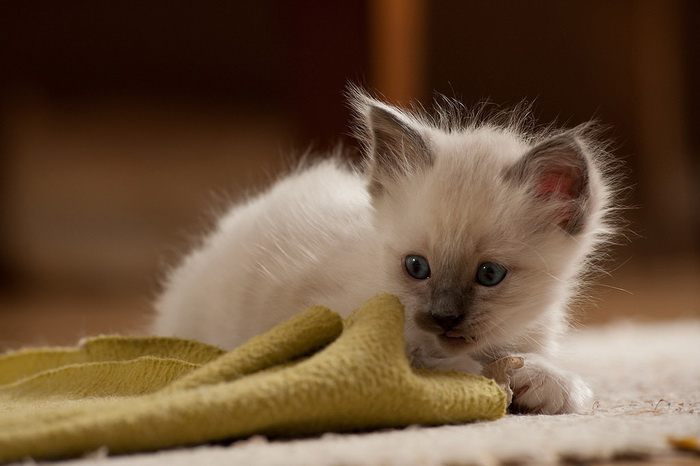
Birman kittens are born almost white. The typical coloring begins to emerge only after a few days, is clearly visible by one month, and is fully developed by two years. The characteristic white "gloves" appear around three months. The eyes of the smallest kittens are bright blue, becoming slightly lighter by the third month, and then darkening again.
Only when the kitten is about six months old can we talk about its quality and prospects.
How to choose the right pet?
In this case, the best answer is with your heart. You can be sure that Sacred Birman kittens of any gender, color, and quality will become the center of your home in just a few days, I guarantee!
Pragmatic people and those who are planning to seriously engage in breeding Burmese cats should focus on the following.
Floor
The personality of Burmese cats depends largely on the degree of socialization of the kittens in the cattery and the parents of the kittens. However, natural differences are also inevitable.
Cats:
- more playful;
- affectionate;
- creative and fluffy.
The disadvantages of a purebred Burmese cat include loud vocalizations when wanting to mate and a habit of scent-marking their territory. If a long-awaited meeting with a female cat is delayed, health and personality problems can arise.
If you are not planning to prepare your cat for a show career or breeding, then castration will be the best option for both of you.
You can also co-own a cat with a cattery. This has its advantages. Breeders will share secrets of caring for and raising a cat with you, and they'll explain potential negative consequences and help you avoid them.
Typically, this type of partnership lasts from one to three years, after which the Burmese cat is transferred to your permanent care. Cats are usually neutered.
Cats:
- more independent;
- moderately playful;
- wiser.
The main drawback is inappropriate behavior during estrus. Moreover, the frequency and intensity of estrus is often unpredictable.
If a Burmese cat is not mated with a male cat for several years, expect health complications for the pet.
Pedigree cats are not recommended for families with small children. For travelers and careerists, the animal will become an unnecessary burden. The animal requires care:
- to bring together with cats;
- help during pregnancy;
- participate in raising kittens.
All this takes time and conditions. Take my word for it, caring for a Burmese cat is a responsible and challenging task. When raising this breed, you have to forget about the simple birthing habits of cats "as kittens."
But all problems can be avoided by spaying and neutering. This ensures a wonderful, trouble-free pet.
How much does a Burmese cat cost?
The Birman is an expensive cat breed and not the most common. If you're considering buying a Birman kitten, it's best to look at breeders and see the breed at shows. You can, of course, buy a kitten online without any preparation, but there's a risk of being scammed.
The price of Birman kittens with a good pedigree ranges from 15,000 to 50,000 rubles. Many factors influence the price:
- kitten class;
- merits of parents;
- location of the nursery, etc.
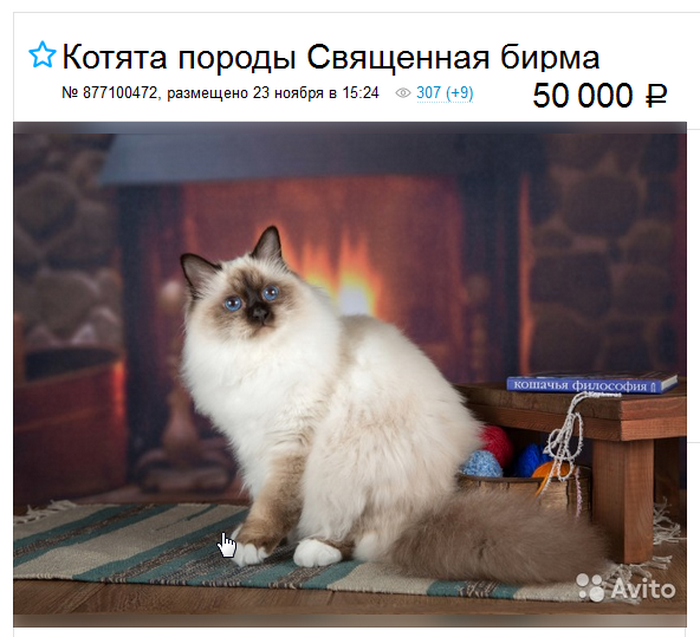
Pet-class cats (for indoor use) are not allowed to breed, yet the offspring of such unions are sold online for 3,000-7,000 rubles. Naturally, the babies come without papers or guarantees.
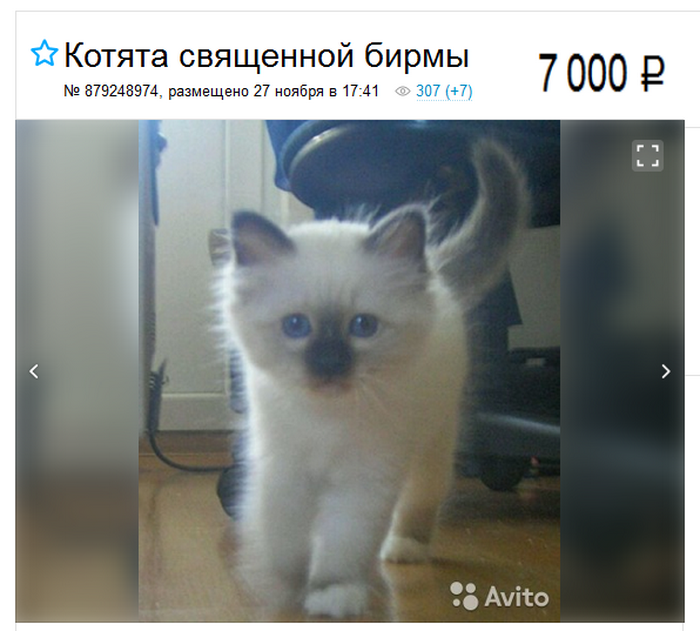
When choosing a kitten, the main thing is to avoid scammers who pass off fluffy kittens with typical Siamese coloring as expensive Sacred Birmans.
Therefore, if you're planning to make a minor celebrity out of your pet, the price of the sacred Birman cat should take a back seat. Yes, you'll get a wonderful pet, but alas, if there's even the slightest discrepancy in the pedigree, you'll only be able to dream of reaching the top.
Burmese catteries
There aren't many specialized catteries in Russia that breed the sacred Birman cat. Their breeding stock isn't particularly large either: 2-3 litters per year, with 2-4 kittens per litter.
Therefore, there are plenty of prospects in this field. But, as already mentioned, anyone who decides to dedicate themselves to breeding the sacred Birman should be prepared for difficulties. This is likely why there are so few Birman cats, and the people who run catteries are true connoisseurs of the breed and experienced breeders. But it's understandable: a Birman cat leaves no one indifferent after meeting you; just one look is enough.
Photos of Sacred Birman cats:
Video review of the Sacred Birman cat breed:
Read also:
- Khao Mani cat
- Cats in ancient times in different countries of the world
- Where did cats come from and how did they appear?


Add a comment