
A cat's age in human years
Many pet owners view their pets as full-fledged and equal members of the family. To better understand their pet, they strive to determine how close their cat's age is to the true human age. Such calculations are possible—the key is knowing the pet's birthdate. Several methods developed by veterinarians and zoologists allow one to determine a cat's age and calculate how closely it compares to human years.
Content
The main stages of life
Scientists unanimously agree that a cat's life is divided into several distinct stages—six in total. Each has its own distinctive characteristics.
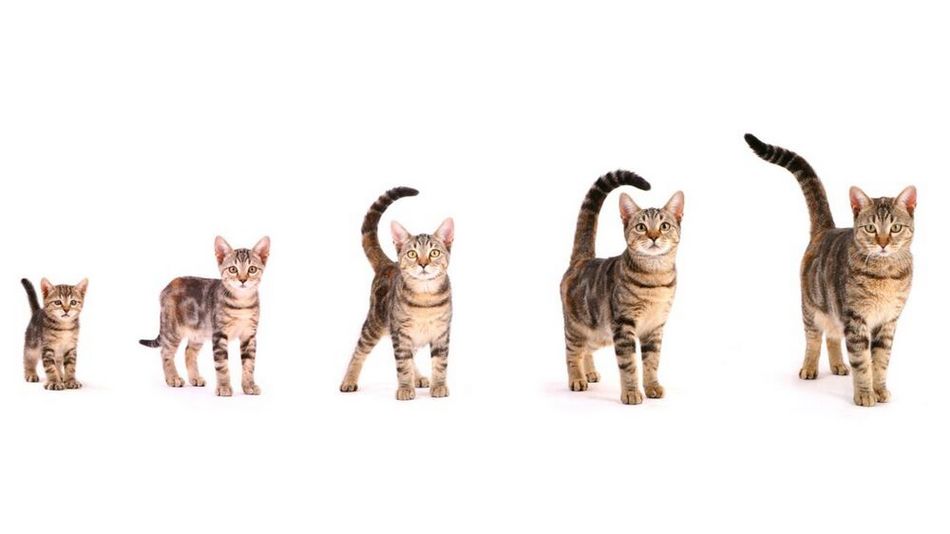
Childhood
This period extends from birth to six months. During this stage, babies grow very rapidly, their development accelerates. They delight you with new skills and abilities almost daily. They are alert, cheerful, active, and feel absolutely happy.
Youth
Animals are considered young between six months and two years of age. Growth and development continue, but at a much slower pace than in childhood. Kittens begin to prepare for adulthood—they reach a fully realized feline age in human terms.
The prime of life
This feline age spans the period from two to seven years of age. Five years is a favorable time for pets—they are at the peak of their activity, and this applies not only to their physical development but also to their mental development. Typically, during this period of their life, a family pet can delight everyone with a beautiful, healthy coat, strong teeth, and bones.
Maturity
The next stage is marked by a slight decrease in activity. A 7- to 10-year-old kitten tries to play and move less, preferring peace and quiet and the opportunity to sleep or simply lie down. However, he still tires less noticeably than he will later.
Elderly stage
At age 10, processes begin that lead to a gradual loss of vitality. By age 15, few children are free of health problems. Almost everyone's coat becomes less smooth and shiny, and their claws and teeth are no longer as sharp as before, and they become worn down.
Old age
Starting at 15 years of age, pets lose their former activity and spend most of their day sleeping—this is the onset of old age in cats, as humans would think. During this time, it's important to pay more attention to maintaining your furry friend's health, remembering to schedule preventative veterinary examinations and promptly administering treatment if needed.
Old age approaches street representatives 2-3 times faster than their domestic counterparts.
The first method
You can quickly and easily determine a cat's age in human years using one of the simplest methods. Its main advantage is that it doesn't require complex mathematical calculations. The only thing required is... multiply the exact number of years pet (in years) by the number 7.
In this case, the translation means: a one-year-old kitten would be equivalent to a seven-year-old child. If the cat's years have passed three, then it's around 21 years old. A respectable 10-year-old cat would be considered a 70-year-old human.
The second method
When determining a cat's age in human years, it's important to consider a crucial detail. The specific age is directly proportional to the rate at which the pet matures. Differences are also based on differences in overall lifespan. Special coefficients help accurately calculate this information.
|
Cats (number of months) |
Conformity coefficient |
People (number of years) |
|
1 |
6–7 |
0.5 |
|
2 |
5–5.5 |
1 |
|
3 |
8–8.6 |
2 |
|
4 |
15–15.5 |
5 |
|
5 |
19.2–20.4 |
8–8.5 |
|
6 |
28–30 |
14–15 |
|
7 |
25.7–26.5 |
15–15.5 |
|
8 |
24–24.75 |
16–16.5 |
As a pet gets older, the calculations change slightly. This is clearly illustrated by the table, which clearly shows how a cat's age is calculated in human years.
|
Cats (years) |
Conformity coefficient |
People (years) |
|
1 |
18–19 |
18–19 |
|
2 |
12.5–13 |
25–26 |
|
3 |
10–11 |
30–33 |
|
4 |
8.75–9.25 |
35–37 |
|
5 |
8–8.6 |
40–43 |
|
6 |
7.1–7.6 |
43–46 |
|
7 |
6.4-6.7 |
45–47 |
|
8 |
6.25–6.63 |
50–53 |
|
9 |
6.1–6.44 |
55–58 |
|
10 |
6–6.3 |
60–63 |
|
11 |
5.6–5.9 |
62–65 |
|
12 |
5.4 |
65–68 |
|
13 |
5.2–5.46 |
68–71 |
|
14 |
5.1–5.2 |
72–73 |
|
15 |
4.9–5 |
74–75 |
|
16 |
4.75–4.8 |
76–77 |
|
17 |
4.5–4.6 |
78–79 |
|
18 |
4.4–4.7 |
80–85 |
|
20 |
5 |
100 |
Such parameters can be adjusted in different directions depending on the animal’s breed, genetic predisposition to various diseases, and specific living conditions.
The third method
Using a coefficient that takes into account not only physiological development but also psychological and intellectual aspects allows for a much more accurate determination of a cat's age in human years. The corresponding calendar tables clearly demonstrate the approximate ratio.
Little kittens
|
Kittens (months) |
People (years) |
|
1 |
0.5 |
|
2 |
1 |
|
3 |
2 |
|
4 |
6 |
|
5 |
10 |
|
6 |
13 |
|
12 |
18 |
Adult animals
|
Cats (years) |
People (years) |
|
2 |
25 |
|
3 |
32 |
|
4 |
34 |
|
5 |
40 |
|
6 |
43 |
|
7 |
46 |
|
8 |
50 |
|
9 |
55 |
|
10 |
60 |
|
11 |
64 |
|
12 |
67 |
|
13 |
70 |
|
14 |
72 |
|
15 |
75 |
|
16 |
76 |
|
17 |
78 |
|
18 |
83 |
|
19 |
91 |
|
20 |
100 |
This method is fairly accurate, but not perfect. To accurately determine a cat's age in human years, it's necessary to take into account the fundamental developmental differences between humans and animals, which are different species. Gender differences, nutritional and environmental considerations, genetics, and breed-specific nuances also need to be considered.
When calculating cat years in human years, it's important to understand that male and female cats live, on average, 12 to 15 years. In cats without serious illnesses and with high-quality care, this figure can reach 20.
Read also:


Add a comment