
East Siberian Laika (VSL)
The East Siberian Laika is a native breed of hunting dog. Highly prized by hunters for its working abilities, it excels at hunting a variety of game, particularly fur and bear. It has a pleasant disposition, is obedient, and adaptable. It is very hardy and requires little grooming.
Content
History of origin
The origin and development of hunting dogs in the northern taiga zone of Eastern Siberia has not been fully studied. They are likely related to other Laikas from the European-Asian continent. Weather conditions and humans, who eliminated unsuitable individuals, played a significant role in their development. The initial basis for breeding at the breeding station was YakutThe Tungus, Primorsky, and Baikal Laika offspring. The Baikal Laika was first described at the beginning of the 20th century, and it was this description that later formed the basis for the VSL standard.
In 1947, the East Siberian Laika was granted breed group status. A provisional standard was published in 1952, and the final standard was approved in 1981. The East Siberian Laika is also recognized by the International Cynological Federation. A significant population is concentrated in the Smolensk, Leningrad, Irkutsk, Tver, and Moscow regions. The breed is highly prized in Scandinavia. Breeding is carried out by selecting stud dogs based on working qualities, and their abilities are determined through field trials.
Usage
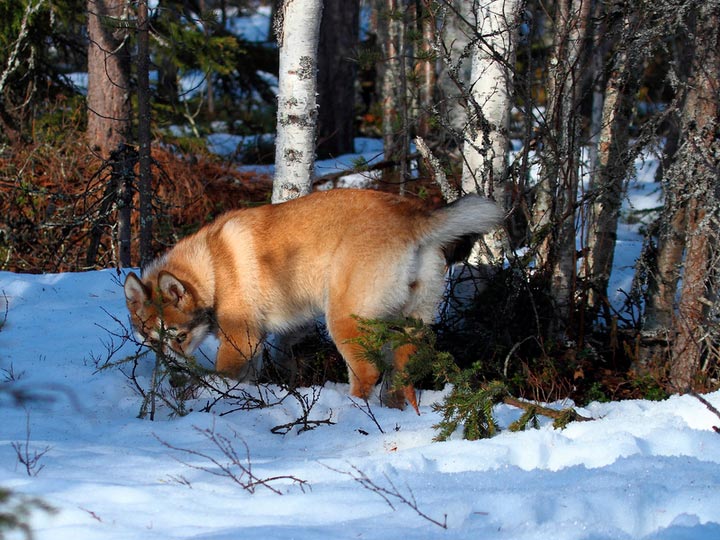
Most East European Laikas possess innate hunting abilities. This allows them to work independently, and skillful training facilitates the development of these desired talents. The East European Laika is keen-eyed, using scent, hearing, and sight in its work. It barks when it finds an animal. It follows the scent silently and is very tenacious. Different dogs exhibit varying degrees of this instinct to seize, strangle, and consume prey. This instinct is useful when hunting large game, but when hunting fur animals, it can lead to spoilage. Unlike other Laikas, the East European Laika typically searches at a trot, occasionally slowing to a walk or gallop. It works independently, without constant guidance or supervision from the hunter. It is intelligent, has a well-developed sense of smell, is quick to locate, and will independently monitor its owner's movements. Constantly calling reduces the dog's effectiveness. It can hunt birds and even retrieve from water.
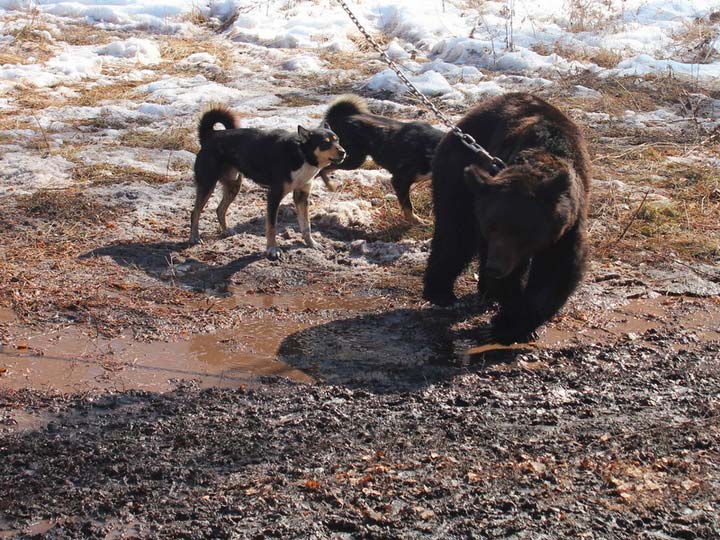
In their traditional habitats, East Siberian Laikas hunt over 30 species of animals and birds. The most important are squirrel, sable, fox, muskrat, bear, and seal.
In some areas, hunters also use Laikas to haul their gear and game. Those living along riverbanks often train their dogs to pull a towline while boats are being pulled upstream. The Laika will navigate, and sometimes even swim around, obstacles to avoid tangling the towline. On the eastern and northern shores of Lake Baikal, dogs are used for hauling water and firewood. Hunters believe this negatively impacts their working abilities, so truly good working dogs are not harnessed.
Appearance
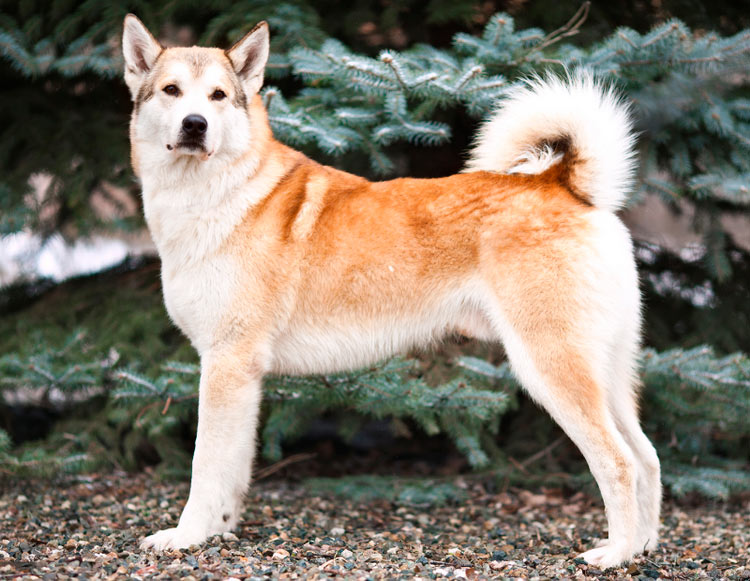
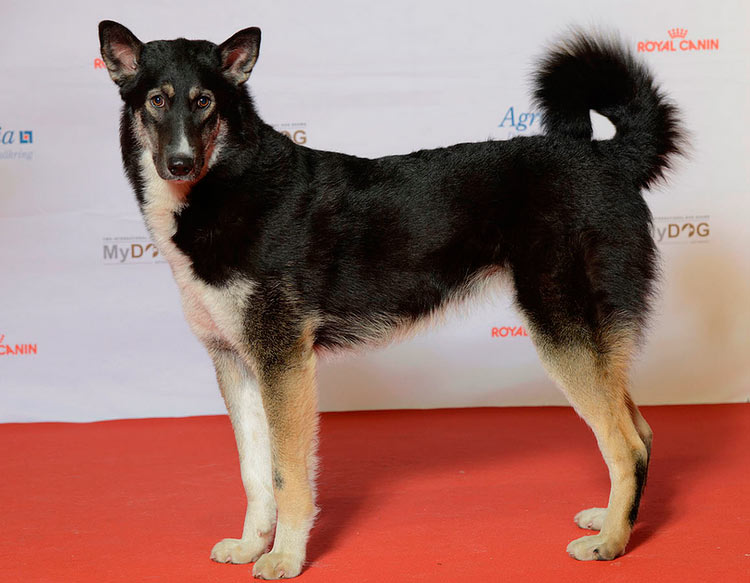
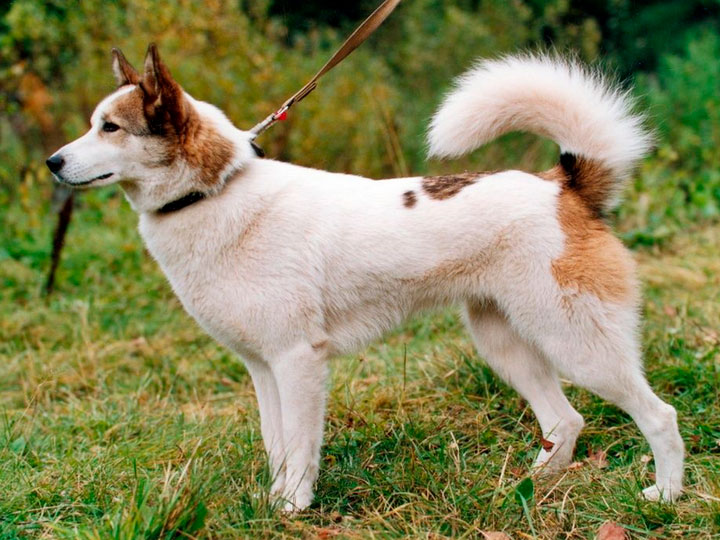
The East Siberian Laika is a medium-sized dog (the largest of all Laikas), compact, strong, and somewhat elongated. The head is very strong and fairly large, the coat is short, and the muscles are well developed. Sexual dimorphism is well-defined.
- Males: height at withers is 1-2 cm greater than height at sacrum; elongation index 104-109; height at withers ― 57-64 cm; weight ― about 25 kg.
- Bitches: height at withers is the same as height at sacrum or 1 cm more; elongation index ― 106-111; height at withers ― 53-60 cm; weight ― about 20 kg.
The head is massive, proportional, wedge-shaped. The cranial region is wide. The length of the muzzle is slightly less than half the length of the head. The length of the skull slightly exceeds the width. The occipital protuberance and parietal ridge are well defined. The stop is smooth. The muzzle is blunt. The nose is black, but in white and field dogs it may be brown, and of medium size. The lips are tight-fitting, moderately dry. The teeth are strong, white, evenly spaced, and well developed. The dentition is complete, with a scissor bite. The cheekbones are not sharply defined. The eyes are oval, medium in size, and set moderately obliquely. The expression is friendly and trusting. The color of the eyes is brown and should harmonize with the coat color. The ears are mobile, V-shaped, erect, with rounded or slightly pointed tips.
The neck is round or slightly oval, muscular, and dry. The length of the neck is equal to the length of the head or slightly shorter. It is set at an angle of 40-50 degrees to the horizontal. The body is strong, with powerful skeleton. The topline is straight, firm, sloping slightly from the withers to the tail. The back is straight and moderately wide. The loin is short, slightly arched. The croup is slightly sloping and wide. The chest is deep and wide, long, and oval in shape. The belly is tucked up. The tail is curled or carried sickle-like. The limbs are dry, muscular, straight, set moderately wide apart, parallel. The length of the forelegs from the elbow to the ground is equal to half the height at the withers. The paws are rounded or slightly oval, with well-knit toes. The hind legs are well angulated and straight and parallel when viewed from behind.
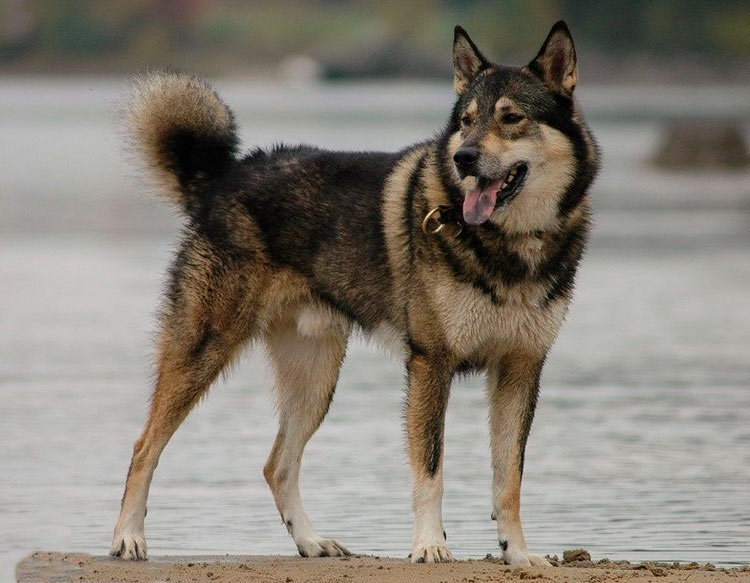
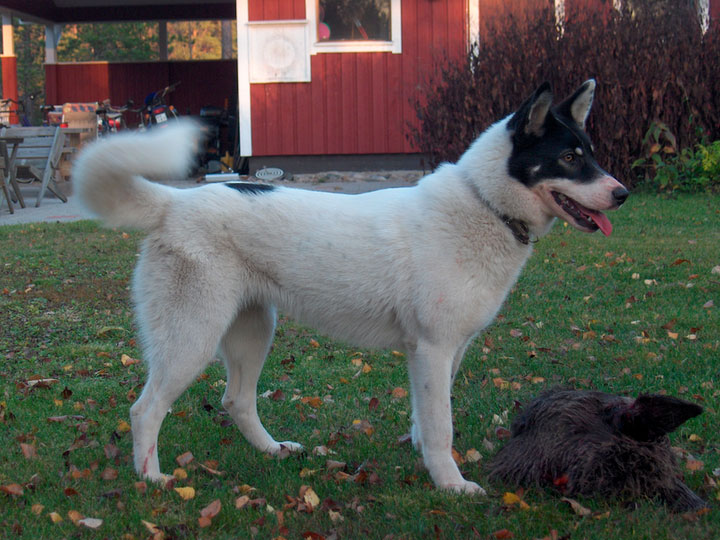
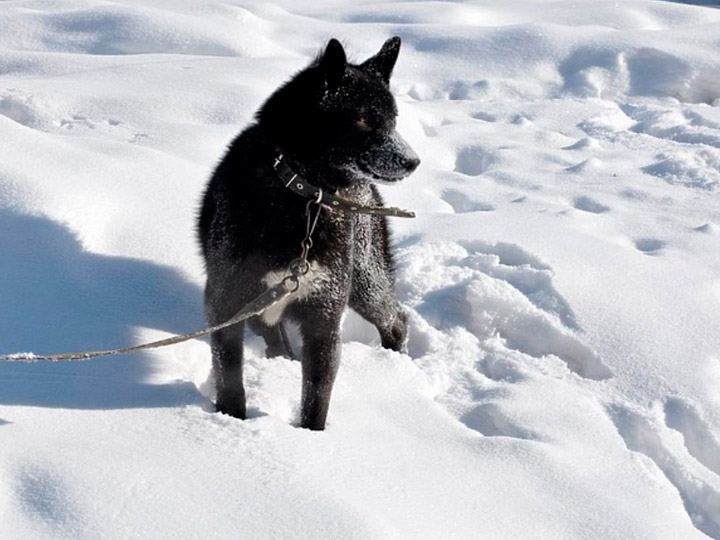
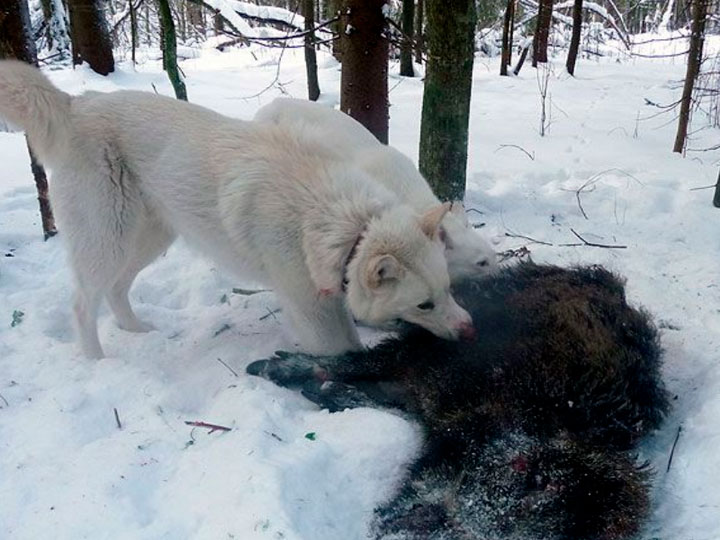
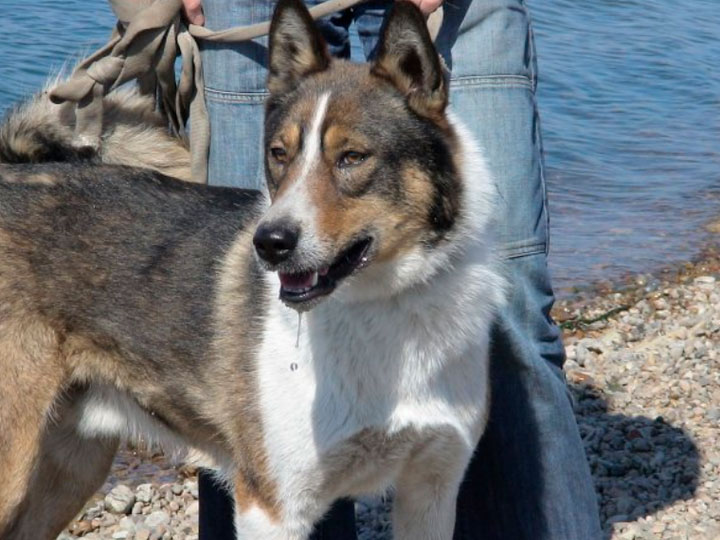
The skin is elastic and dense. The topcoat is coarse, straight, and dense. The undercoat is well developed, abundant, soft, and fluffy. The hair on the head and ears is dense and short. There is a collar on the neck, and sideburns behind the cheekbones. In males, the hair on the withers is longer. The back of the legs is free of feathering. Between the toes, the guard hair resembles a brush. The tail is abundantly covered with coarse, straight hair, longer on the underside. The most typical colors are:
- zonal;
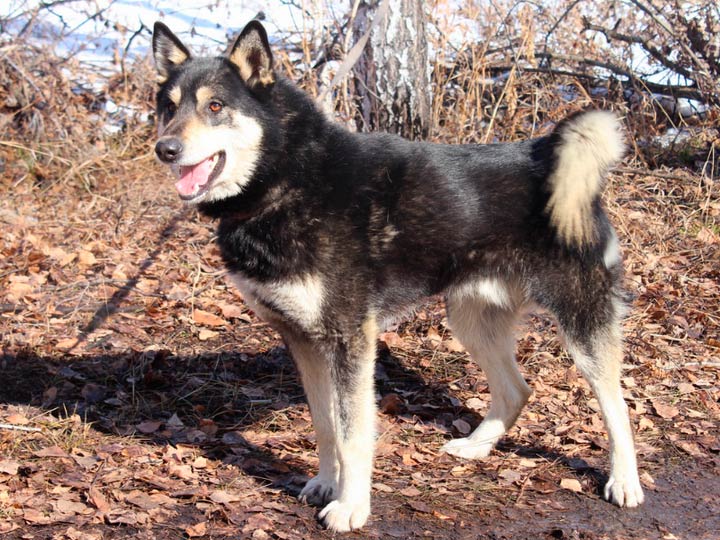
- karamist (black with red tan);
- black;
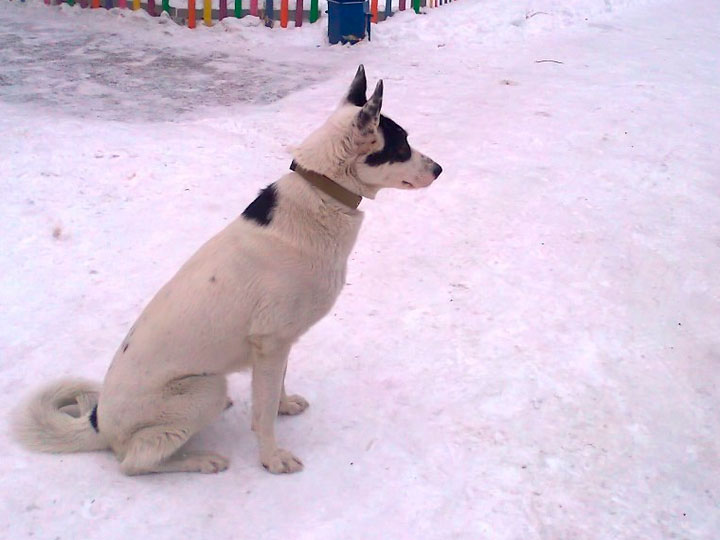
- black and white;
- white;
- spotted with the specified colors.
Slight speckling is permitted on the limbs.
Character and behavior
The East Siberian Laika has a gentle, even touchy, nature. This is important to consider during training, education, and development. It is devoted to its owner but adapts relatively easily to a new owner. It is people-oriented and obedient. It has a pronounced hunting instinct. Its temperament is even.
Aggression toward humans is uncommon for most members of the breed, but some Laikas exhibit aptitude for guarding and protection work. They have strong pack instincts and are territorial, strictly adhering to a pecking order. Strange dogs on their territory are bound to be hostile. They get along only with those they live with. To varying degrees, these dogs exhibit a tendency toward dominance. Laikas view other animals as potential prey.
Education and training
The East Siberian Laika is a very social and outgoing dog, requiring regular interaction with its owner and varied socialization. Overtraining and exercise should be avoided; relaxed play is ideal. Training unquestioning obedience will likely stifle the dog's initiative, which is essential for hunting. It is recommended to repeat a single command no more than three times per session. East Siberian Laika training involves teaching it to walk at its heel, return on command or whistle, sit, and retrieve an object from land or water.
Training plays a vital role in a Laika's life, and should be a fundamental part of the training process. The dog's pedigree is the key to success. Courage, ferocity, and tenacity are all genetically inherited. Training and baiting only strengthen the breed's characteristics and contribute to the development of courage, endurance, and obedience. Particular attention in training young dogs should be given to acclimating them to the gun.
Content Features
Maintaining an East Siberian Laika is not burdensome and does not require significant expenses. Living alongside this intelligent and obedient dog is easy. The ideal environment for a hunting Laika is an enclosure with a warm kennel and the opportunity to spend a lot of time moving around in the open air or running freely around the property. Keeping a Laika in an apartment is possible, but the owner will need to devote much more time to the quantity and quality of walks to ensure the dog maintains those innate qualities essential for hunting.
Care
The East Siberian Laika doesn't require extensive grooming. Occasional brushing is sufficient to maintain a neat appearance. It should be brushed more frequently during the shedding season. The East Siberian Laika sheds quite heavily. Bathing is recommended as needed. Owners should also keep their eyes and ears clean and their nails long.
Health and life expectancy
East Siberian Laikas are generally strong and hardy dogs that rarely get sick. Life expectancy is usually 12-15 years. Diseases are typically associated with improper care, poor nutrition, poor living conditions, or hunting injuries. To maintain the good health of VSLs, important veterinary preventative measures include timely vaccinations and deparasite treatment.
Choosing an East Siberian Laika Puppy
Experienced Laika breeders can tell something about a dog's character from a very early age, but its working qualities will develop much later and depend on heredity. Therefore, the first step in choosing a puppy is to look at its parents. Of course, the dog's subsequent training and the amount of time spent with it in the forest play a significant role, but a strong foundation is essential.
Within just two or three generations, hunting qualities degenerate, and the dog will be unfit for work. If the parents, and especially the grandparents, only attended shows, you can't expect anything from the puppies.
The East Siberian Laika is much less popular than the same Russian-European or West Siberian LaikaHowever, finding a kennel or breeder is not a problem, nor is finding puppies available for sale.
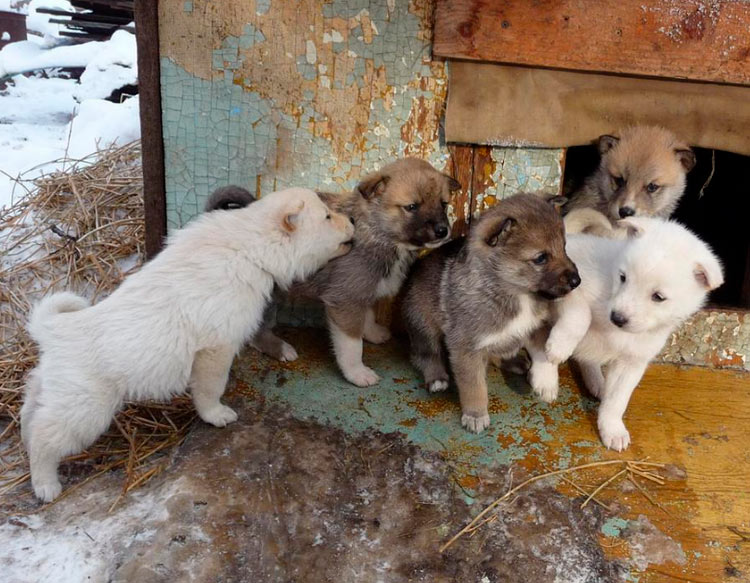
Laikas' weight as puppies varies greatly. Month-old puppies weigh around 5 kg. At 2 months, some can weigh 6 kg, others 8 kg. When choosing a puppy, it's not so much size (the largest dog isn't always the most work-intensive) that matters, but rather resilience: the ability to quickly reach the mother's nipple, activity in unfamiliar surroundings, and leadership qualities demonstrated through play with littermates.
Price
The price of an East Siberian Laika puppy varies greatly depending on geography, the parents' achievements, and many other factors. Puppies from breeders typically cost 25,000-35,000 rubles. From private breeders, they range from 5,000-15,000 rubles. An adult working Laika can cost 60,000 rubles or more.
Photos and videos
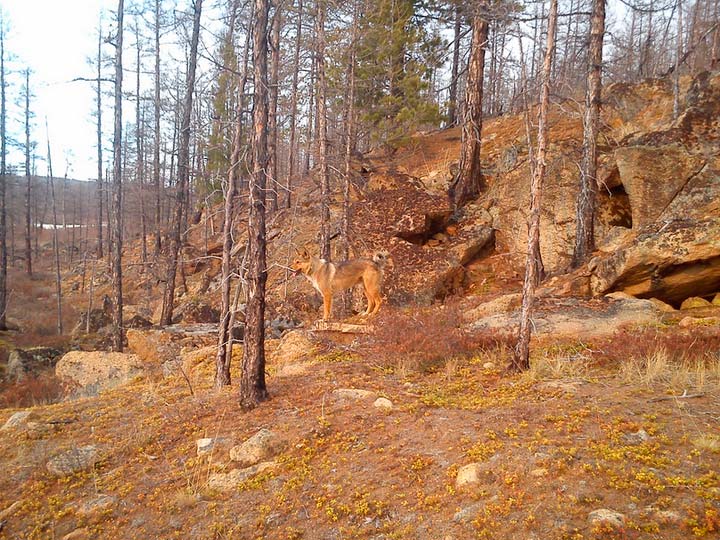
The gallery features photos of East Siberian Laikas of different sexes, ages, and colors.
Video about the East Siberian Laika dog breed
Read also:


Add a comment