
Dropsy in a dog
One of the common pathologies in humans and animals is ascites (abdominal dropsy), a fluid accumulation in the abdominal cavity. This condition is severe for dogs and is often life-threatening, as the presence of fluid in the abdominal cavity can be caused by a dangerous disease or a serious organ disorder.
Content
Causes of abdominal dropsy in dogs
There are a number of diagnoses that can cause hydrocele. The most common include:
- Liver diseases. One of the main functions of this organ is to purify blood and lymph. A diseased liver is unable to filter these components of the body's internal environment, and some fluid migrates through the vessel walls, accumulating in the abdominal cavity. Liver pathologies are the cause of hydrops in 70% of cases.
- Heart failure. Heart disease is the second most common cause of ascites. Many cardiovascular diseases are accompanied by congestion in the systemic circulation, causing fluid in the blood to leak into the abdominal cavity.
- Kidney diseases. The kidneys are responsible for water and electrolyte balance and control the elimination of metabolic waste products. When their function is impaired, sodium is retained in the body, and some proteins are lost in the urine, leading to the development of ascites.
- Protein starvation. When a dog's diet lacks protein, the protein concentration in the blood drops, causing the oncotic (colloid-osmotic) pressure to decrease, and fluids from the bloodstream leak into the peritoneum, forming ascites.
- Peritonitis. The accumulation of fluid in the abdominal cavity during peritonitis occurs due to the disruption of the tightness of the vessel walls caused by the inflammatory process.
- Malignant tumors. Ascites can be caused by a cancerous tumor located in the abdominal cavity. An expanding tumor can compress blood vessels, causing fluid to leak out. When the tumor ruptures, its contents spill into the abdominal cavity, causing ascites.
- Helminthiasis. Some types of worms feed on proteins and lay eggs in the lymph nodes, damaging the lymph flow and causing lymph to leak into the abdominal cavity.
Symptoms
The most obvious and typical symptom of dropsy in dogs is a noticeable increase in the size of the abdomen; it becomes saggy and looks bloated from the inside, the back arches downwards, and the iliac fossa becomes sunken.
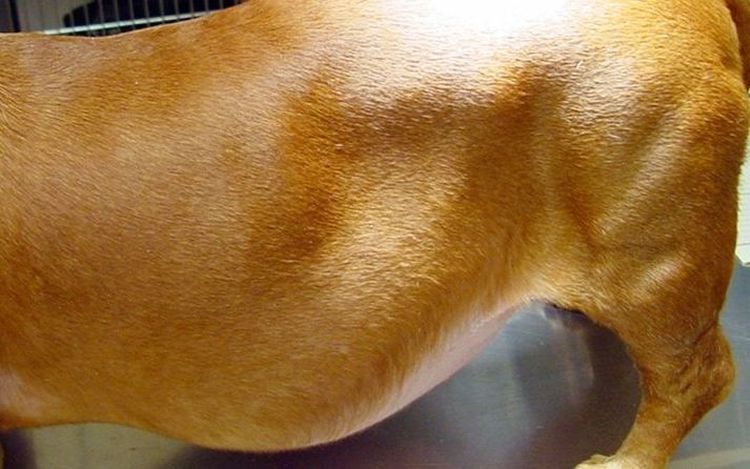
Important! The severity of this symptom depends on the amount of fluid accumulated in the abdominal cavity. In severe ascites, there is so much fluid in the peritoneum that the dog has difficulty lying down and is forced to even sleep sitting up. A mild form of ascites is almost invisible. Therefore, attention should also be paid to other signs characteristic of the pathology.
With ascites the following are also observed:
- a sharp decrease in activity;
- shortness of breath, difficulty breathing caused by pressure of the peritoneum on the diaphragm;
- lethargy, drowsiness;
- loss of appetite;
- intense thirst;
- frequent urination;
- swelling of the extremities;
- increase in body weight with a simultaneous decrease in muscle mass.
If dropsy is caused by liver or kidney disease, or is a consequence of paraneoplastic syndrome in a malignant tumor, the dog may experience vomiting.
Diagnostics
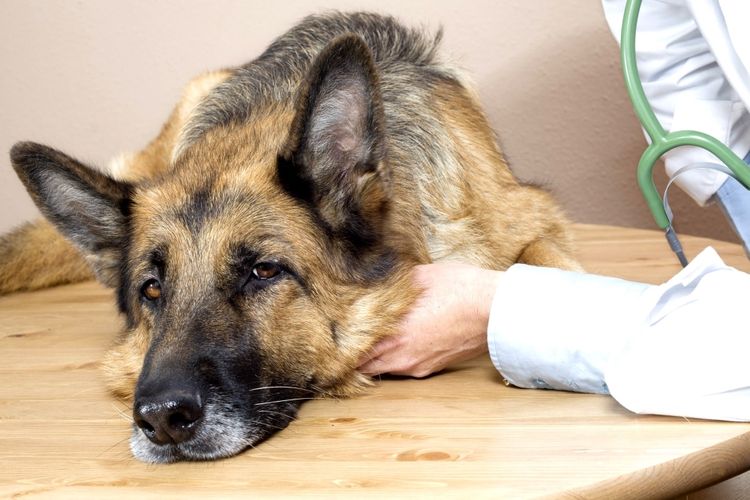
If ascites is suspected in a dog, a veterinarian will review the patient's medical history and conduct a physical examination to identify any clinical signs. A series of tests will then be performed to determine whether fluid is present in the abdominal cavity and to identify it. For example, urine may leak into the peritoneum due to a ruptured bladder (uroperitoneum), blood due to internal bleeding (hemoabdomen), or lymph from damaged vessels.
Transudate analysis (a sample obtained by puncturing the peritoneal wall) includes determination of density and protein fraction content, as well as microscopic examination of the cellular composition. In true ascites, the sample taken from the peritoneum contains a clear or slightly turbid yellow fluid, odorless and free of foreign matter. Abdominal ultrasound or abdominal X-ray are also used for differential diagnosis.
Treatment
Ascites is a consequence of a disease; to get rid of it, the underlying cause must be addressed. Treatment for the underlying disease begins after its detection. However, since diagnosis is quite complex and can be time-consuming, symptomatic treatment aimed at improving the animal's overall condition begins even before the examinations are complete.
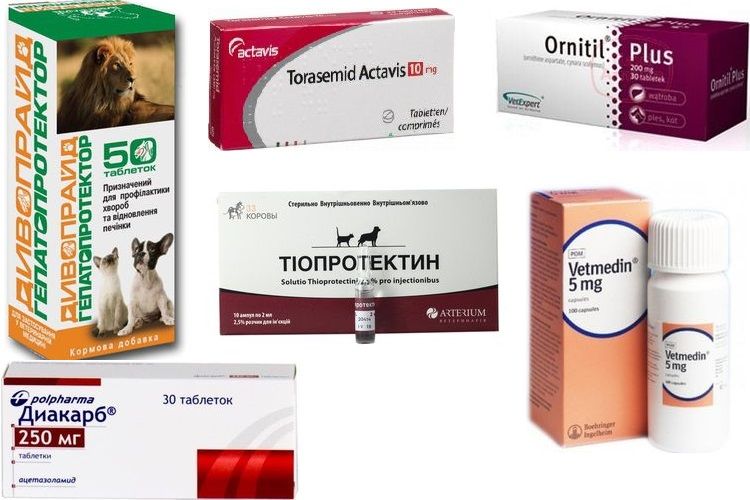
To support the activity of the heart and liver, the dog is prescribed cardio- or hepatoprotectors (Ornithil plus, Divopride, Artirium Thioprotectin, Vetmedin). To reduce the amount of ascitic fluid, diuretics are used (Indapamide, Torasemide, Mercuzal), and if necessary, a laxative is given.
Additionally, the animal is switched to a salt-free protein diet, and albumin is administered as an additional protein source. A course of antibacterial therapy is mandatory, as the transudate accumulated in the peritoneum provides a favorable environment for bacterial growth.
Important to know: In severe cases of ascites, dogs may be prescribed laparocentesis—a procedure to remove transudate by puncturing the peritoneum. This does not address the cause of ascites or prevent further fluid accumulation, so it is only a temporary measure to alleviate the animal's condition.
Home remedies are not used to treat ascites in dogs. There are folk remedies used to alleviate ascites, including herbal infusions with diuretic, anti-inflammatory, and sedative properties. These should be used after consulting with a doctor. Examples include parsley infusions in milk, dyer's broom, or horsetail. Recipes for these remedies can be found on forums.
Prognosis and prevention
Is it possible to completely cure ascites? If the underlying condition can be treated, ascites can soon be a thing of the past. However, if ascites is a symptom of a serious, incurable disease, the prognosis is not always encouraging. However, in any case, timely treatment, even symptomatic therapy, will help improve your pet's overall condition and quality of life.
Preventive measures for dropsy in dogs include proper nutrition and prompt treatment of conditions that can trigger transudate accumulation in the abdominal cavity, and, ideally, preventing the development of such conditions. Therefore, regular preventive veterinary examinations are so important.
Read also:


2 comments
Kate
My dog died, a Chihuahua, the cause was dirofilariasis, along with hepatitis and nephritis... her stomach was bloated, there was no fluid for 2 days, and after another 2 days, ascites started... I suffered for a week... soft clouds, Semyon, forgive us... we fought to the last
Anonymous
My dog died, we tried to treat it but it didn't work(((
Add a comment