
Can dogs see in the dark?
Dog vision has always been a source of controversy and question. There have been many opinions regarding their perception of the color spectrum familiar to humans, the clarity and range of their vision, and other aspects. For a long time, people believed these pets saw the world in black and white, but it was later discovered that they are more accurately described as colorblind or farsighted animals, poorly distinguishing details and colors but recognizing movement well. Now it remains to be seen whether dogs can see in the dark.
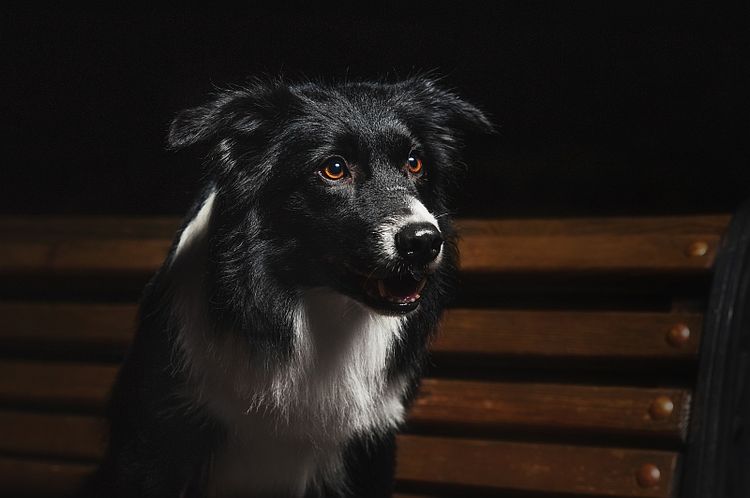
How do dogs see at night?
The ability to see in low-light conditions depends on the structure of the visual organs. The retina consists of two types of cells: cones and rods. In humans, cones predominate, responsible for color perception and daytime vision. There are three types, each perceiving a spectrum of red-orange, green-yellow, and blue-blue hues. However, dogs have only two of these (they lack cones that perceive the red spectrum).
However, dogs have a greater number of rod cells, which provide better nighttime vision than humans. While humans can see little without additional lighting after sunset, dogs feel just as comfortable as they do during the day. This allows them to distinguish a greater number of shades of gray (over 40), which also improves their nighttime vision.
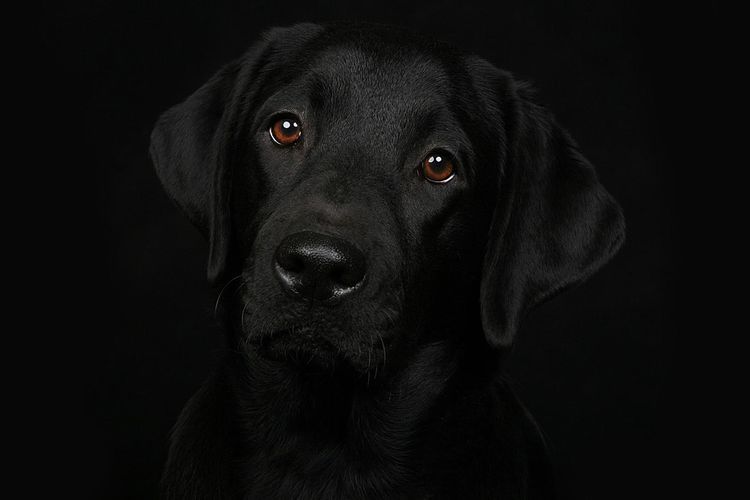
Furthermore, the lower part of the retina contains a special layer of pigments called the tapetum lucidum, which reflects light directed at the animal's eyes. Its presence explains why dogs' eyes glow in the dark. The upper part of the retina absorbs bright sunlight, allowing these animals to see clearly and avoid squinting in bright sunlight.
Read also about: Can cats see in the dark? on our website.
Peculiarities of Dog Vision
Regardless of their breed, dogs see quite well in the dark, but they still perceive the world better and more comfortably with light.
Note! Dogs don't see in the dark as well as cats, but they see 3-4 times better than humans. It's believed that they see objects at night in much the same way humans see in the twilight.
Dogs' night vision developed through evolution. Wild predators are known to have better vision than domesticated animals, due to natural genetic selection and constant visual training during hunting at any time of day. Furthermore, dogs belong to the class of predators, for whom it is important to track their prey both day and night and to have night vision. Despite being one of the first animals domesticated by humans, dogs have retained their characteristic predatory traits to this day.
Scientists also classify dogs as transitional animals, capable of good spatial orientation both during daylight hours and at night. They are characterized by slight farsightedness, which does not interfere with their ability to see their surroundings clearly after dark. Moreover, they recognize objects in motion more clearly than at rest: in the dark, a dog can spot prey moving at a distance of approximately 800-900 meters, while a stationary object can be spotted at a distance of 200-600 meters (depending on the breed).
Regardless of any visual impairments, dogs are perfectly capable of living a fulfilling life. After all, they are protectors, guardians, hunting companions, and simply man's best friends.
Read also:


Add a comment