
Do cats see themselves in the mirror?
Cats are among the most beloved and revered pets. However, despite this, their behavioral characteristics remain incompletely studied. For example, many owners of these furry pets are interested in the question: Do cats see themselves in the mirror? A definitive and definitive answer is impossible. We can only make assumptions based on their behavioral responses.
Content
Do cats see their reflection?
Of course, cats, like people, see their reflection in a mirror, but like small children, they don't understand that it's them that are reflected. For them, a mirror image is something intangible and unreal. Most often, they don't react to it at all. Vision isn't a primary source of information for these predators.
All cats rely more on sounds, smells, and tactile sensations, rather than visual images. For this perception, nature has endowed them with unique sensory organs— vibrissaeVibrissae are sensors in the form of stiff, highly sensitive hairs. They can be found on the face, paws, body, and tail. They are highly responsive to any changes in the environment.
It's precisely in the contact-based nature of cats' perception that the answer to the question lies: Why can't cats see themselves in the mirror? Even if they once become interested in their reflection, they quickly lose interest because it evokes no sensations.
A cat's final reaction to its mirror image also depends largely on age, life experience, and even intelligence. Inexperienced kittens are more receptive to their reflection. They may try to play with it for a while. But such unresponsive interaction quickly becomes tiresome and they no longer pay any attention to it.
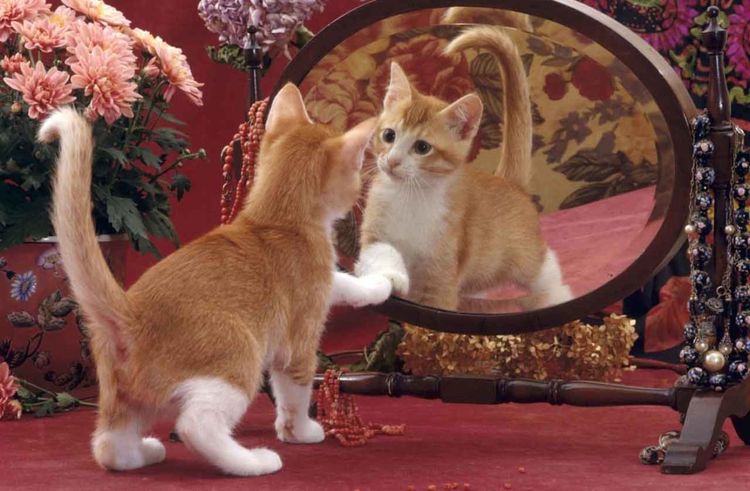
Also, the answer to the question: Why don't cats look in mirrors? It may be because these predators rely more on their senses of smell and hearing than on their visual senses. Consequently, an object that is odorless and silent holds no interest for them.
Aggressive reaction of cats to mirror reflection
According to zoologists, cats are unaware and completely unaware that they are reflected in the mirror, so in addition to indifference, they can also exhibit signs of aggression. Often, upon seeing their reflection, they mistake it for another animal. And the other animal is a rival that must be driven away from their territory.
This is why it's common to see a cat arch its back, hiss, and try in every way to frighten and drive away its mirror "enemy" when it sees its reflection. Typically, the animal only attempts this attack once. Later, the cat realizes that this rival is merely imaginary and poses no threat.
The following technique can help prevent aggression and help your cat recognize itself in the mirror. Pick up your pet and approach a large mirror. Your cat will definitely recognize its owner's reflection in it. While doing so, pet and scratch the cat so it can see it in the mirror. Most pets easily connect these two events and never show any further signs of aggression or fear.
Mirror experiments with cats often use the "self-recognition test"—the classic "mirror test." However, unlike dolphins, elephants, or humans, cats typically fail it—but that doesn't mean they don't understand their reflection at all. Research shows that cats treat a mirror more as an undefined stimulus than as a self-recognition test.
From observations:
-
cats quickly lose interest when they do not detect the smell of a “foreign body”;
-
in the reflection they can see movement, but they do not connect it with their own body;
-
Some individual cats show interest in moving objects in the reflection, especially if they have not previously encountered glass surfaces.
This reflection reading effect is related to visual and tactile perception strategies—cats rely more on smell and tactile interaction than on visual recognition.
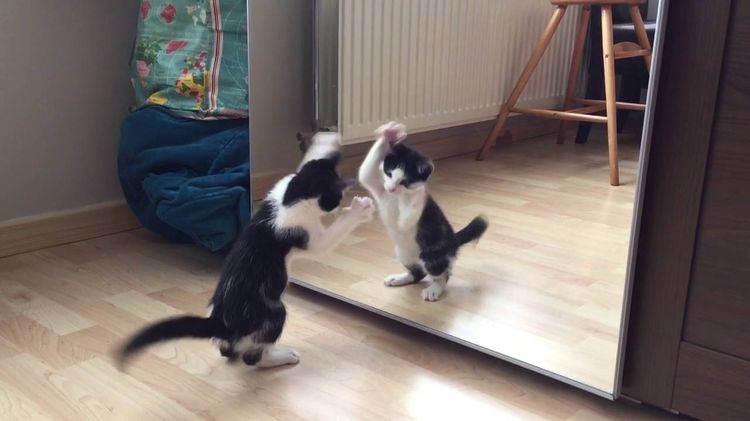
Table: Cats' reactions to mirrors under different conditions
| Experimental conditions | Cat behavior in the mirror |
|---|---|
| First meeting | Curiosity, sniffing the surface, trying to touch |
| A mirror with the smell of another cat | Quick reorganization: looking in the direction of the smell, moving away from the mirror |
| The reflection moves, the cat remains motionless | Ignoring, or trying to "play" with the reflection |
| Permanent exhibition | Complete indifference, ignoring the reflection |
| Mirror + cat movement | Ignoring, lack of connection with movement in the mirror |
Why do cats react this way?
Cats lack a dominant "visual self-recognition" trait: they rarely use their own reflections to construct their self-concept, as some other species do. This is due to the peculiarities of their cognitive system: visual images are significantly less important than affective and olfactory cues. In psychological studies on self-awareness, cats fail the typical mirror test, but rather show signs of indifference or distrust toward their reflections.
What does this mean for owners?
When understanding whether cats see themselves in mirrors, it's important not to expect a reaction like a human's. Owners are often surprised by the lack of emotional reaction—and this is natural. However, if a cat shows interest or aggression, this is abnormal, but it does happen. For example, some animals may perceive their reflection as a rival, especially if it's accompanied by hissing, petting, or rapid movements. This is a reason to pause: remove the mirror, give it time to adjust, and then gently repeat. Sometimes applying a drop of pheromones to the edge of the mirror can help reduce the disorienting effect.
The benefits of mirrors for cats
Although cats don't recognize themselves, mirrors can still serve a stimulating function, especially in a home setting where visual stimulation is needed.
Use cases:
-
a mirror opposite the window: the movement of birds and trees is reflected, the cat watches and ‘comes to life’ – this is a psycho-emotional load without stress;
-
mirrored surfaces in the hallway: a cat can come in, unexpectedly collide with the reflection, and jump - not out of fear, but playfully;
-
Small mirrors at the cat's head level (e.g. mirror toys): help the cat respond to movement, developing hunting instincts.
Superstitions associated with cats and mirrors
Domestic cats are associated with numerous superstitions and prejudices. Most of them have no logical basis. For example, the mystical connection between mirrors and cats. Mirrors, as we know, have been around for a very long time. People back then were largely illiterate and superstitious, so any reaction a pet might have had to its reflection in a mirror was perceived as something mystical.
Since ancient times, it has been believed that the looking glass is the receptacle of the souls of the dead, and a mysterious predator, unafraid of the dark and wandering at night wherever it pleases, can serve as a kind of guide to the world of the living. This was the main reason why cats are forbidden to look into mirrors.
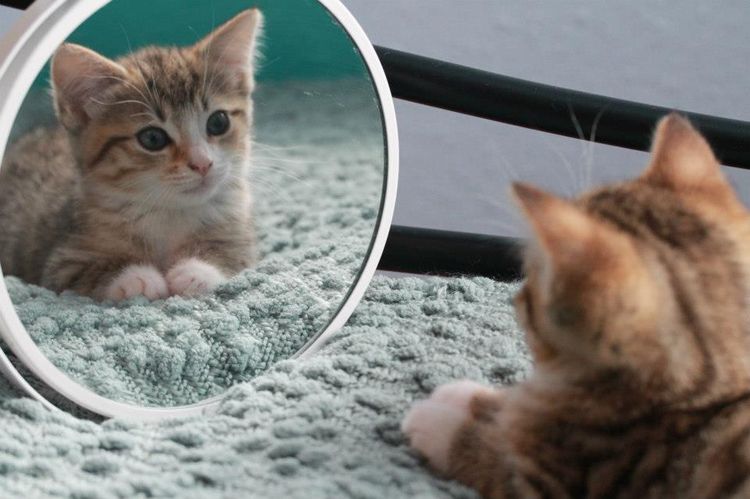
The cat's aggressive reaction to mirrors also alarmed people. They felt as if the cat wasn't looking at its own reflection, but somewhere deep within, where it saw something deeply frightening. Equally strange was the cat's passive reaction, where the cat would stare into the mirror for long periods, unblinking and unmoving. It was believed that in this way, the cat communicated with the dead. And as is well known, any contact with the world of the dead never ends well.
Tips for interactive "mirror" entertainment
-
Place the mirror in a quiet place, without harsh lighting, where the cat can explore it gradually.
-
Use toys in front of a mirror - moving in front of a mirror adds interest without the stress.
-
Mix up olfactory cues: Place a drop of catnip or cat pheromones nearby to reduce anxiety and stimulate interest.
-
Don't linger and don't force your cat to play with the mirror; if it leaves, let it explore voluntarily.
Domestic cats are interesting and friendly animals. Experts have observed that people who keep them are less susceptible to stress, depression, and cardiovascular disease. Therefore, don't complicate your beloved pet's life with superstitions, omens, or ignorant beliefs.
Read also:


Add a comment