
What are whiskers and why do cats need them?
Everyone knows that cats are excellent at navigating in the dark. But contrary to popular belief, this isn't due to their ability to see, but to their ability to sense. And whiskers play a key role in this. Whiskers, or rather, vibrissae (from the Latin vibro - I wriggle, I oscillate) is not only an attribute and decoration of a cat's face, but also the main organ of touch.
A unique receptor, modified over a long period of evolution. Vibrissae provide animals with all the necessary information about the surrounding world, helping them navigate in the dark, hunt, notice the slightest changes in the environment, and even sense changes in atmospheric pressure. It's no coincidence that many folk beliefs are associated with cats.
Content
- 1 How many whiskers does a cat have?
- 2 The difference between a mustache and hair
- 3 From the mustache straight to the brain: how do they work?
- 4 How are cat whiskers structured from an anatomical perspective?
- 5 Damage to a cat's whiskers: consequences
- 6 Dependence of vibrissae on age and health status
- 7 Is it possible to trim cats' whiskers?
- 8 Diseases and pathologies associated with vibrissae
- 9 A video review about why cats need whiskers (vibrissae)?
How many whiskers does a cat have?
Vibrissae aren't just found on the muzzle, as many believe. The most expressive and sensitive ones are actually located on the pads above the upper lip. Shorter ones are found above the eyes, on the chin, and in the cheek area. Less sensitive, but indispensable during hunting, hairs are found on the tail and paws. Learn more about... How many whiskers does a cat have? Read also on our website.
The difference between a mustache and hair
Although cat whiskers are closely related to hair, they have many anatomical and functional differences.
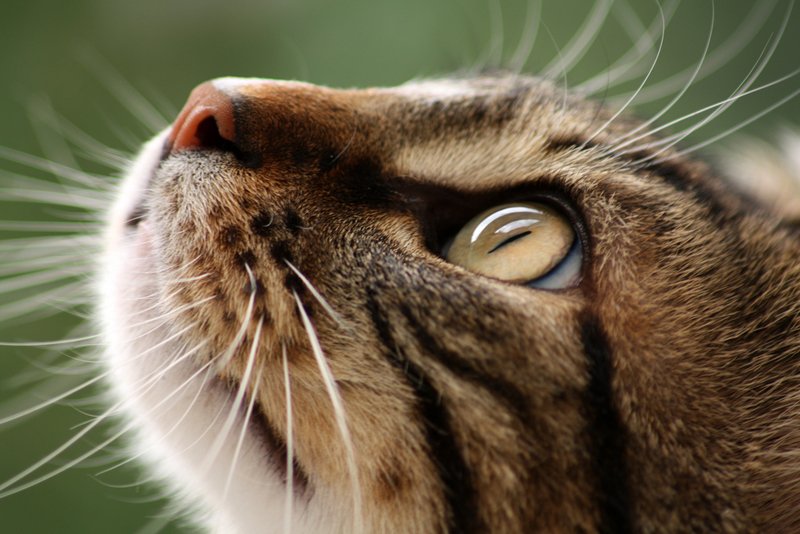
The whisker shaft, its outer part, is distinguished primarily by its length and stiffness, compared to other hairs. The root of the sensitive whisker is located in the superficial layer of the skin, in the follicle. This is where the fun begins.
Vibrissae are well supplied with blood; their roots are located directly in a blood sac, called a sinus, and are surrounded by mechanoreceptors and tens of thousands of nerve endings that detect the slightest movement of the hair and transmit information to the brain. It's worth noting that each vibrissa has its own dedicated location. Whisker movement is enabled by the coordinated action of striated muscles.
From the mustache straight to the brain: how do they work?
It is interesting that the information that comes from the sensitive whiskers and from the eyes goes through the same channel – the trigeminal nerve.
This allows the brain to summarize signals, process them, and create a three-dimensional image of the surrounding world. Depending on the lighting, the pupil can dilate or constrict. In complete darkness, it is maximally dilated, meaning it has difficulty focusing on nearby objects. The mechanoreceptors located at the base of the whiskers don't require light; they detect only the vibration of the hair caused by air currents. This allows the eye to determine the location and distance of an object and avoid obstacles in time, even in complete darkness.
The very first hairs that are formed in kittens while still in the womb are preciselyvibrissae.
As we know from our school physics classes, air not only never stands still, but also changes direction when it collides with an object. Sensitive whiskers are able to reconstruct a clear picture of the surrounding environment based on air movement data. For this reason, it's impossible to approach a cat unnoticed.
It may not see or hear you, but it can detect the reflected air current. The only way to catch the animal off guard is to approach from downwind.
Vibrissae in cats in the wild
By nature, cats are, first and foremost, excellent hunters—it's in their blood, so to speak. And their whiskers play a significant role here. Thanks to them, a cat can close its eyes at the right moment to protect them from a twig or blade of grass while making its way through thickets and bushes. And then continue hunting without taking its eyes off its prey. Once the prey is caught, the predator holds it in its teeth, out of sight. At this point, only the extended whiskers help it assess the situation and control its prey's behavior.
Cats' confident leaps are achieved solely by their whiskers. By moving them, cats detect the direction and speed of the wind, allowing them to adjust the force of their thrust and body position during the jump.
Worn out or broken off whiskerssy They are restored regardless of shedding. This further emphasizes their incredibly important role in a cat's life.
Throughout the coat, you can see particularly long and coarse hairs. These are much softer and don't perform as significant a function as whiskers, but they also possess some sensitivity. These hairs help cats detect the nature of touch and distinguish between dangerous and pleasant contacts.
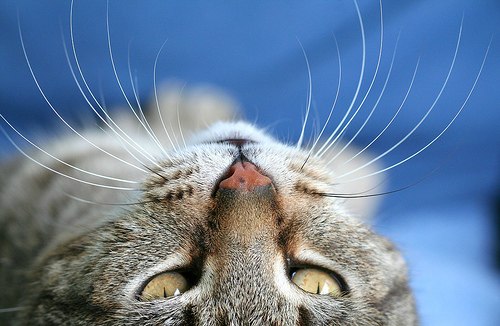
When meeting a cat, you can easily determine its attitude toward you. Interest, curiosity, and friendliness are indicated by whiskers pointing forward. However, if the animal presses them against its face, it's best to hold off on petting; the cat is likely aggressive. The movement and position of its whiskers is a kind of "body language" for these animals.
How are cat whiskers structured from an anatomical perspective?
Vibrissae are thickened hairs that extend deep into the skin and are connected to a network of nerve endings and capillaries. Unlike regular hair, each vibrissa is anchored in a follicle with a "capsule," which contains:
-
nerve endings that instantly react to the slightest movement of air;
-
special receptors directly connected to the brain;
-
blood vessels that provide nutrition and sensation.
Therefore, even the lightest touch on a whisker is instantly transmitted to the cat's brain. Scientists note that cats' whiskers are comparable in sensitivity to human fingers.
Damage to a cat's whiskers: consequences
Cat whiskers (vibri(links) – this is a unique navigation system, damage to which leads to difficulties in orientation.
An animal with damaged or broken whiskers may bump into obstacles, and an inability to close its eyes or plan a jump can lead to disastrous consequences. Difficulty correctly assessing the size of an opening can arise, and the cat may even get stuck. Therefore, if the damage is severe, whiskers, recommends keeping the animal at home for several months and not exposing it to the risk of injury.
Why does a mother cat bite off her kittens' whiskers?
Sometimes you can see a mother cat nibbling the whiskers of her kittens. The exact reason for this is still unknown. Some experts suggest that this is an attempt to prevent her kittens from becoming overly curious and leaving the nest too early. After 5-6 months, when the whiskers have grown back, the kitten will be able to fully explore the world around it.
What about hairless cats?
Many will ask, what about Sphynx cats? Indeed, this hairless breed often lacks whiskers entirely or has only small, curled whiskers. But what's interesting is that these animals navigate and hunt just as well as those with luxurious whiskers. Whether this latest feline mystery will ever be solved remains to be seen.
Dependence of vibrissae on age and health status
Kittens have shorter and thinner whiskers, which grow with the animal. As kittens age, whiskers become brittle and may fall out more frequently, due to a slower metabolism. Whisker loss can also be caused by:
-
hormonal changes;
-
lack of vitamins B and D;
-
skin diseases;
-
stress.
Regular care and proper nutrition help keep whiskers healthy.
Is it possible to trim cats' whiskers?
Some owners wonder if it's okay to trim a cat's whiskers. This is absolutely not recommended. If the whiskers are damaged, the cat may experience problems:
-
coordination of movements is impaired;
-
the animal has poor orientation in the dark;
-
a feeling of anxiety arises, the pet becomes less self-confident.
Even if the whisker breaks accidentally, it will grow back over time, but until then the cat may behave differently - avoid jumping, move more carefully.
Diseases and pathologies associated with vibrissae
Although the whiskers themselves don't hurt, their condition can indicate health issues. Possible changes:
-
Severe loss of mustache hair despite normal care may indicate dermatitis or a fungal infection;
-
fragility and brittleness are a possible sign of calcium deficiency;
-
Asymmetrical moustache growth sometimes indicates injury or inflammation of the skin.
In such cases, it is worth showing your pet to a veterinarian.
Table: Basic signals based on the state of the whiskers
| Sign | Possible cause | Recommendations for the owner |
|---|---|---|
| Increased hair loss | stress, skin diseases | see a doctor |
| Fragility | lack of vitamins | revise your diet |
| Different mustache lengths | natural renewal or injury | observe an animal |
| Pressed mustache | fear, aggression | do not provoke your pet |
A video review about why cats need whiskers (vibrissae)?
- What are vibrissae?
- How do they work?
- Vibrissae in other animals
Read also:



1 comment
anna.fomina
More about vibrissae https://www.youtube.com/watch?v=a10SIKJFdbc
Add a comment