
Weimaraner
The Weimaraner is one of those breeds you can't pass by without noticing. Stunning grace, extraordinary coloring, expressive gaze, and the boundless energy of a born hunter. This breed, while full of virtues, isn't for everyone. Another name for this breed is the Weimaraner.
Content
History of origin
Gray hunting dogs have been known in France since the 12th century. The breed is believed to have emerged and developed during the reign of Louis IX, nicknamed Saint Louis. Some historians believe the monarch brought hunting dogs of this type back from the Seventh Crusade. For a long time, they were even known as Louis's dogs. They are mentioned under this name in Gaston de Foix's "Book of Hunting," written in the 14th century. Dogs resembling the Weimaraner are depicted in many medieval tapestries and paintings. Their hunting success was so remarkable that many royal courts in Europe followed the French example and began breeding gray hunting dogs.
The breed was first mentioned under the name Weimaraner in the late 19th century. At the time, gray dogs were popular in Germany, specifically around the town of Weimar. In 1880, Weimaraners were first exhibited in Berlin, but were classified as crossbreeds. Then, Karl August, Duke of Weimar, decided to correct this injustice. He infused his Weimaraners with the blood of other breeds and began working to create a fully formed group.
Hunters call Weimaraners "silver ghosts" for their ability to be cat-like, accurate, fast, and silent on the hunt.
In 1896, the commission finally recognized the breed as a separate breed. Several sportsmen and hunters founded the German Weimaraner Club and bred dogs exclusively for working purposes. To buy a puppy, one had to become a club member. Eventually, even in Germany, it became virtually impossible to buy a Weimaraner. Incidentally, today the German position has remained virtually unchanged: working qualities are valued more highly, sometimes at the expense of appearance. In many countries, particularly Russia, it is much easier to buy a puppy with good working qualities and good appearance.
Video review of the Weimaraner dog breed:
https://youtu.be/AeLzl6Y29Sc
Appearance and standards
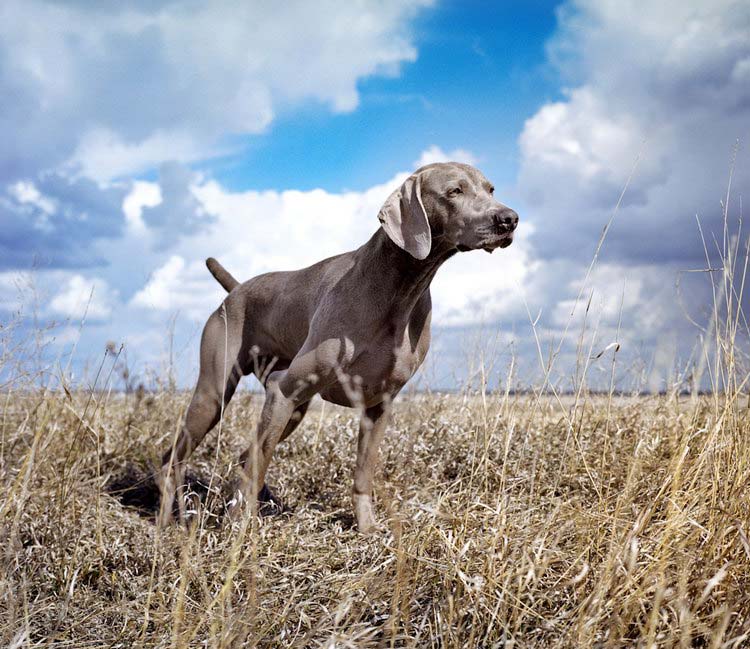
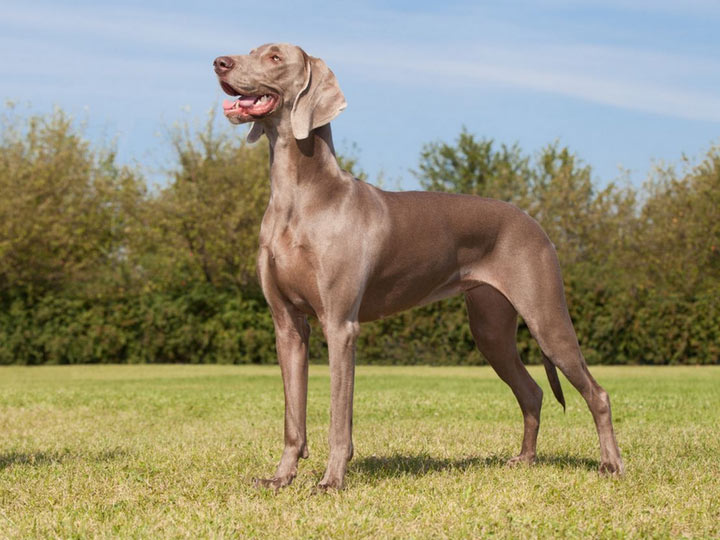
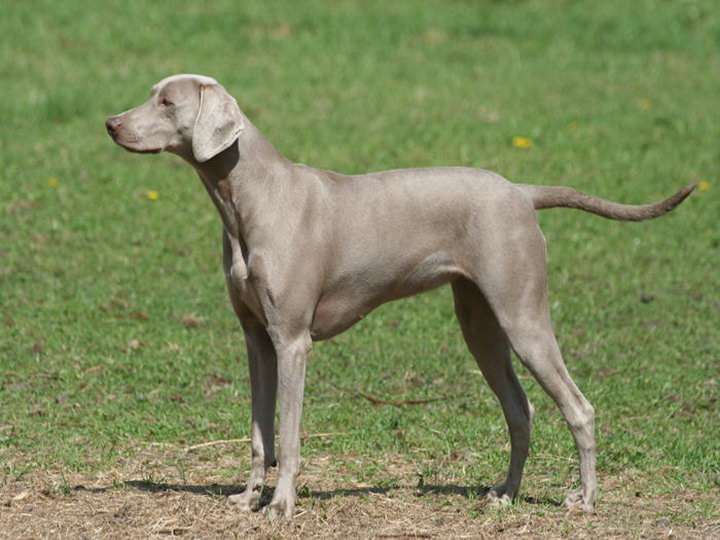
The Weimaraner is a working dog, wiry and muscular, with a strong build, yet graceful, and above-average size. It weighs 25-40 kg and stands 50-70 cm tall, with genders clearly visible. Its gait is long and fluid. Its gallop is long and ground-breaking, and at the trot, its back remains level.
Head and muzzle
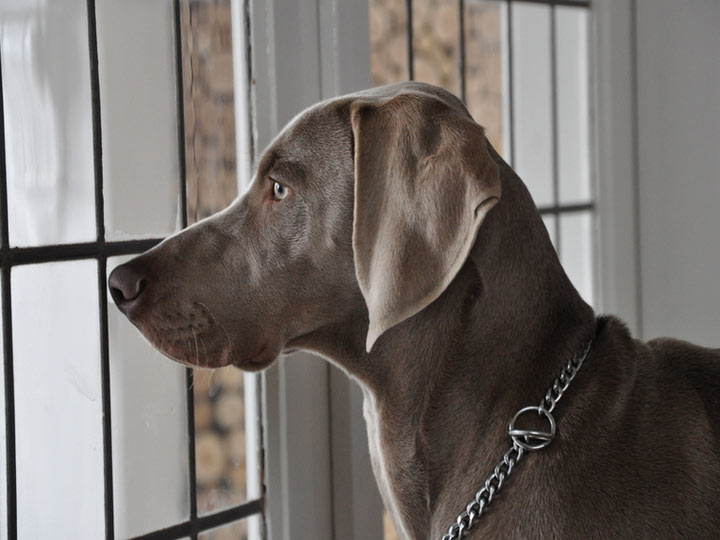
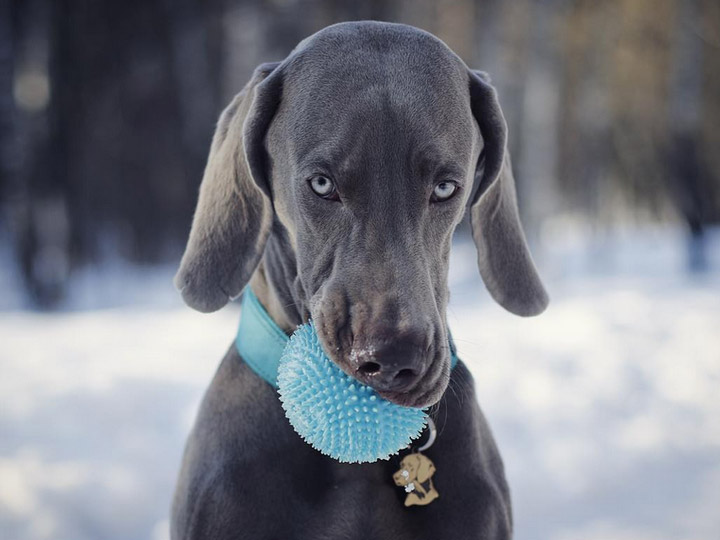
The skull should be in proportion to the size of the head and body. The zygomatic arches are visible behind the eyes. The stop is smooth. The muzzle is long and rectangular. The bridge of the nose is straight, may be slightly convex, but not concave. The eyes are rounded, amber in color (from dark to light). The pendant ears are set close together and high. The auricle is wide and long. The rounded tips reach the corner of the mouth. When the dog is alert, the ears are turned forward. The nose is prominent, wide, and flesh-colored.
Physique
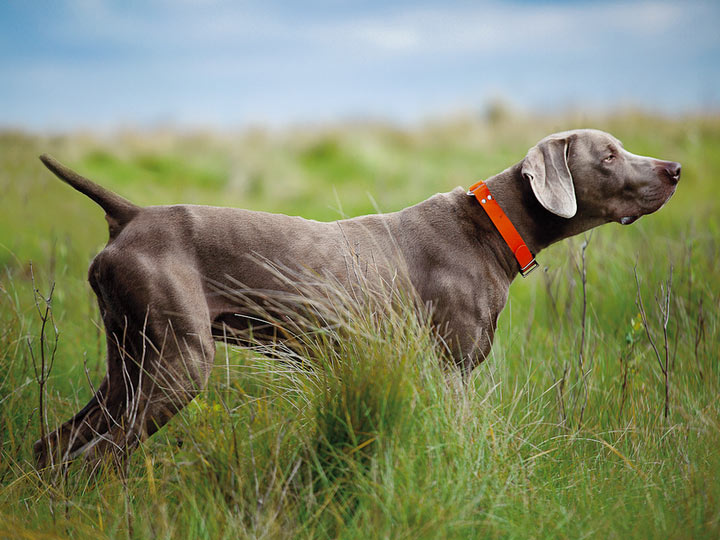
The neck is dry, widening toward the shoulders, with a slightly convex topline when viewed in profile. The back is firm and level. The croup is moderately sloping. The chest is broad and deep enough. The ribs are well sprung and long. The underline is slightly tucked up. The legs are high, straight, and set parallel. The toes are well arched. The nails are light or dark, and the pads are pigmented and hard. The skin is strong and fits well all over the body.
Coat and colors
Based on the quality and length of their coat, Weimaraners are divided into two types:
- Shorthaired cats are distinguished by a very dense, short topcoat that lies flat against the body. They have either no undercoat or a very sparse one.
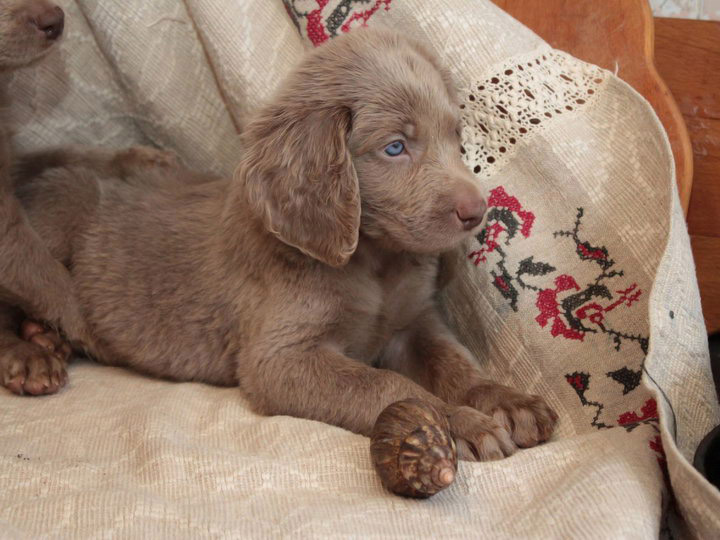
- Longhaired cats are distinguished by a softer, longer topcoat with a sparse undercoat. The hair at the base of the ears is slightly wavy and falls down. The outer coat is 3-5 cm long, slightly longer on the neck, belly, and chest, and feathering is clearly visible on the tail and legs.
The coat comes in shades of gray. There are three main colors: silver-gray, gray-brown, and mouse-gray. The fur on the head and ears is slightly lighter. White markings are permitted only on the chest and toes.

Character and psychological portrait
Weimaraners are intelligent and hardworking dogs, devoted to their owners, affectionate with other family members and friendly with guests, but alert and wary of strangers. They are good with children if they get to know them from an early age. Generally, they are sociable and friendly, with boundless energy and a strong hunting instinct.
The intelligent and strong Weimaraner is very proud and independent, so it may try to assume a dominant position. It will easily identify those who are most loyal to it and will take advantage of this. While not aggressive by nature, Weimaraners will, if necessary, defend their family, fearlessly attacking any attackers. They get along well with other dogs, especially if well socialized from an early age, but are unlikely to pass by a stray cat without warning.
Weimaraners can sometimes be very stubborn and independent. They need to be around people at all times and cannot live in a crate or be left alone for long periods of time. This can often cause significant difficulties when raising a puppy. Furthermore, if a dog isn't given the opportunity to express itself, it can develop undesirable personality traits, such as irrational activity, persistence, destructive behavior, or even aggression.
Of course, the Weimaraner's hunting skills are most highly developed, but their high level of socialization, intelligence, and adaptability make them excellent pets and companions.

Training and exercise
The Weimaraner is quite trainable, but physical force should not be used during training, otherwise the dog may become cautious and distrustful. If an experienced owner devotes training Given enough time, the dog will be able to demonstrate miracles of obedience, but it will require a lot of time and effort.
Thanks to their highly developed sense of smell and intelligence, Weimaraners are used in search and rescue services, but the dog's primary purpose remains assisting in hunting.
A good amount of exercise is essential. Plan on two 1-2 hour walks a day with playtime and opportunities to run off-leash. It's crucial to give your dog the opportunity to burn off all its energy, whether through hunting or sports (coursing, frisbee, agility, pitch-go). Before hunting season, it's important to prepare your dog. Intense exercise, such as 5-7 km runs, will improve heart and lung function and make your dog more resilient and strong.
Hunting with a Weimaraner
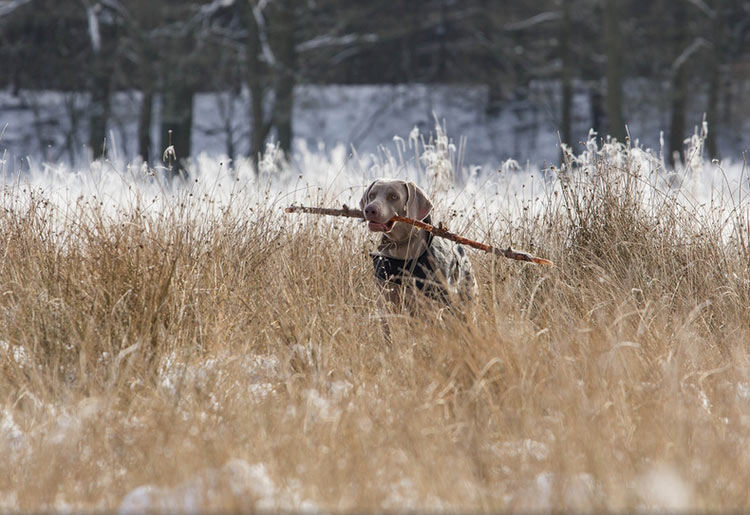
Weimaraners begin hunting with puppies as early as six months of age. At this age, the dog's passion for hunting is most active, and skills are more quickly established and acquired. Proper training instills discipline in the field. Weimaraners are first trained to hunt birds. They progress to bloodsnout hunting after two or three successful seasons.
Maintenance and care
The ideal home for a Weimaraner is a private home, where it will have a large area to explore and a warm sleeping area near the family. A Weimaraner will feel uneasy in the city. The most important requirement for living with a Weimaraner is a large forest or park near the house or apartment for active off-leash walks. A Weimaraner should have a spacious sleeping area with a flat, moderately firm surface. For winter walks in freezing temperatures, a warm jumpsuit or blanket is required.
The Weimaraner is an energetic hunting dog, recommended for active people with ample time or for hunters. The breed is not the best choice for older or busy individuals, or for urban families with small children.
Care
Grooming is easy. Periodically, remove dead hairs using a special rubber glove for smooth-coated dogs or a damp towel. Brush the coat slightly more frequently during shedding season. Bathe as needed, usually once a month. Keep the eyes and ears clean.
Feeding
Feeding requires special attention, as the breed is prone to food allergies and bloat, including the risk of bloat. The owner determines the most suitable feeding method. This can include a well-balanced natural diet or commercially prepared foods. It's important to maintain a regular schedule for Weimaraners, feeding them portioned meals two hours before or after exercise. Food should be at room temperature, and drinking water should be freely available.

Health, disease and life expectancy
The average lifespan of a Weimaraner is 10-12 years. Generally, Weimaraners are strong, robust, and resilient dogs, especially if their owners are responsible about their diet, exercise levels, and preventative care.
One common problem is allergies. Additionally, the breed is known to have a number of genetic defects and a predisposition to various diseases:
- Gastric torsion and intestines;
- Inversion of the eyelid;
- Districhiasis (presence of extra eyelashes);
- Corneal dystrophy;
- Hip dysplasia;
- Cryptorchidism;
- Tendency to dermatitis (interdigital dermatitis is most often recorded), as well as to demodicosis;
- In adulthood, the development of oncological diseases (fibrosarcoma, melanoma, lipoma) is possible.
Choosing a Weimaraner Puppy and Price
In the CIS countries, the Weimaraner is not a very common breed. Puppy reservations often have to be made in advance, preferably through a reputable breeder. Care should be taken when choosing a puppy online. Fraudsters and unscrupulous breeders often pass off "blue" and "black" puppies as representatives of elite lines with unusual colors. In reality, such colors do not meet the standard and are a disqualifying factor.
Puppies from reputable pedigree breeders can be purchased for an average of $800, but those with excellent hunting qualities can fetch significantly more. Dogs not destined for show or breeding purposes average $500.
Photos
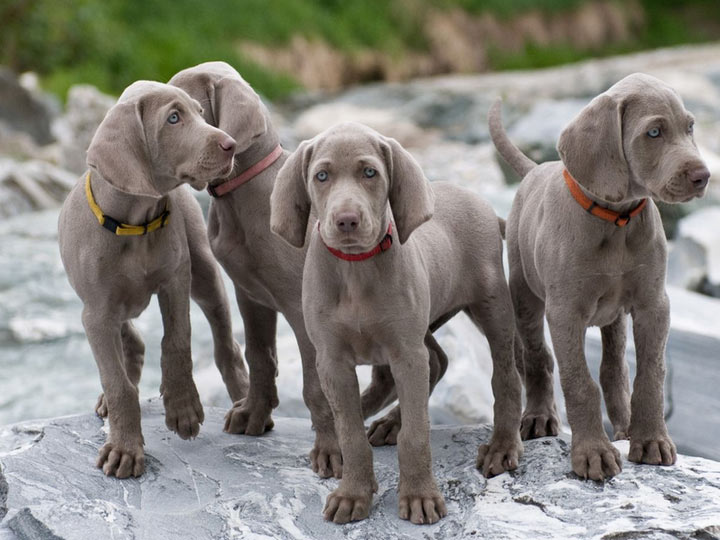
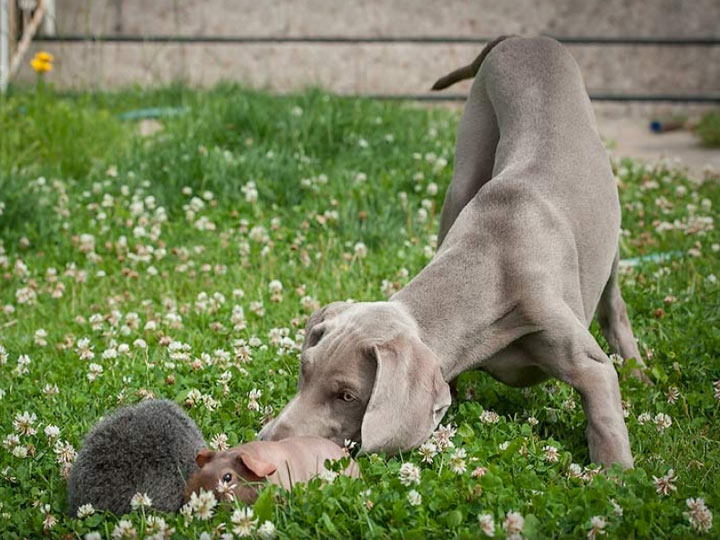
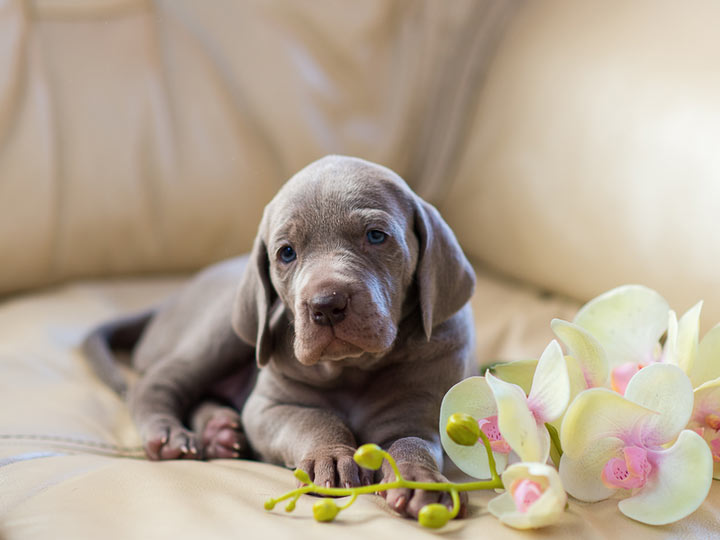
Photos of Weimaraner puppies and dogs:

Read also:
Read also:
- Hungarian Vizsla (Hungarian Shorthaired Pointing Dog)
- Miniature Dachshund
- Bouvier des Flandres (cowhound)


Add a comment