
Wachtelhund (German Spaniel, Quail Dog)
The German Wachtelhund is a versatile hunting dog that developed into its current form in Germany at the turn of the 19th and 20th centuries. A reliable companion and valuable hunting companion, the breed is bred for working performance. Other names for the Wachtelhund include the German Spaniel and the Quail Dog.
Content
History of origin
In the mid-19th century in Germany, many people hunted with English pointers, but they didn't meet all the requirements. There was a pressing need for a dog that could work equally well in open terrain, in thickets, and with a voice in the forest. Then breeders recalled the old spaniel. In hunting literature from the 13th to 17th centuries, it was often referred to as a falcon or quail dog. It was used for catching quail with a net and also in falconry. One cynologist suggested that German spaniels originated from crossing Spanish dogs with the ancestors of today's long-haired German dogs.
The breed inherited its name from its ancestors; it comes from two German words: wachtel, meaning “quail,” and hund, meaning “dog.”
The father of the breed is considered to be Rudolf Fries, a forester who managed to gather the remaining German spaniels from hunting kennels and spent the following years developing the breed. He conducted such a thorough and targeted selection process, focusing on working qualities, that he managed to avoid degeneration and many hereditary diseases, despite the small initial stock. Initially, Fries also divided dogs by color. Brown dogs worked closely with the hunter. Brown roan dogs were more independent and were better trackers. This difference in performance is not typical of modern dogs.
Purpose: hunting with a Wachtelhund
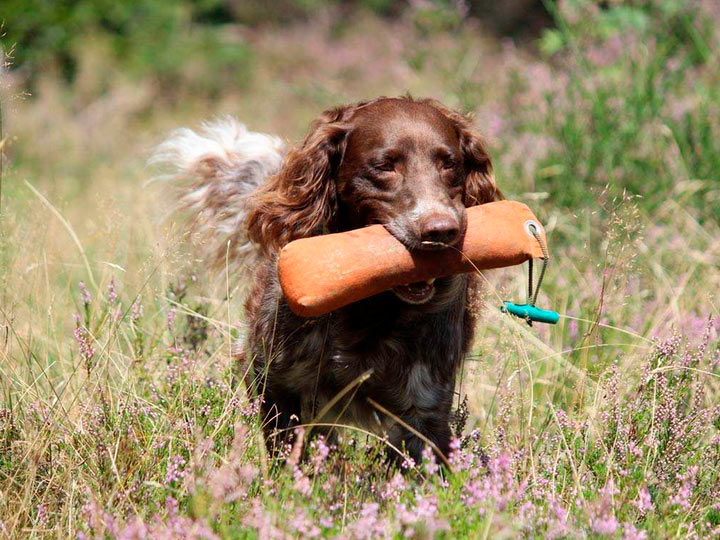
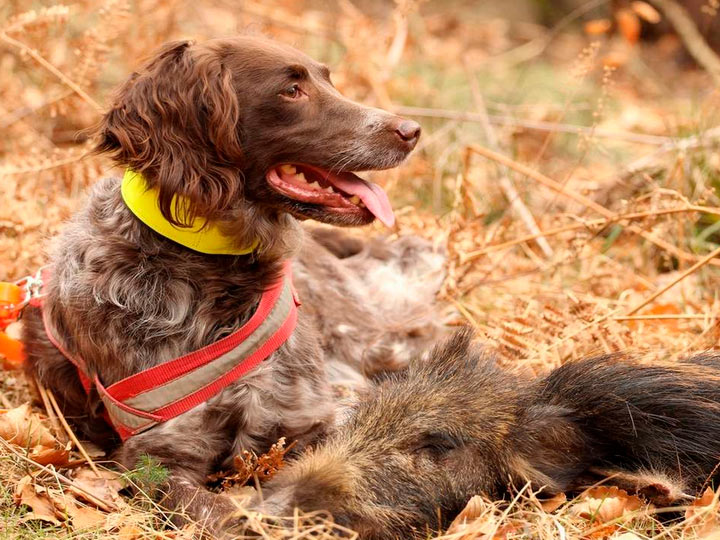
Like many other German hunting dogs, the Wachtelhund is a versatile dog, capable of performing a variety of tasks: searching for and rousing game, retrieving, and following a blood trail (elk, deer, and wild boar). Wachtelhunds are used for hunting birds, including waterfowl, and virtually any other game (from hare and fox to wild boar and ungulates). They are capable of holding a wounded boar until a human arrives. In Russia, they are successfully used in driven hunts for ungulates. Some Wachtelhunds will stand in a standstill when in close proximity to a bird.
When hunting, the Wachtelhund doesn't get underfoot; it works independently, thoroughly searching the area and finding its way well even in dense undergrowth. It follows the scent with a vocalization. It tenaciously pursues game and drives it to the shooter, or returns after 20-40 minutes.
Working qualities of the German Wachtelhund:
- persistent in search;
- follows the trail confidently and easily;
- works with voice;
- has an excellent sense of smell and malice towards animals;
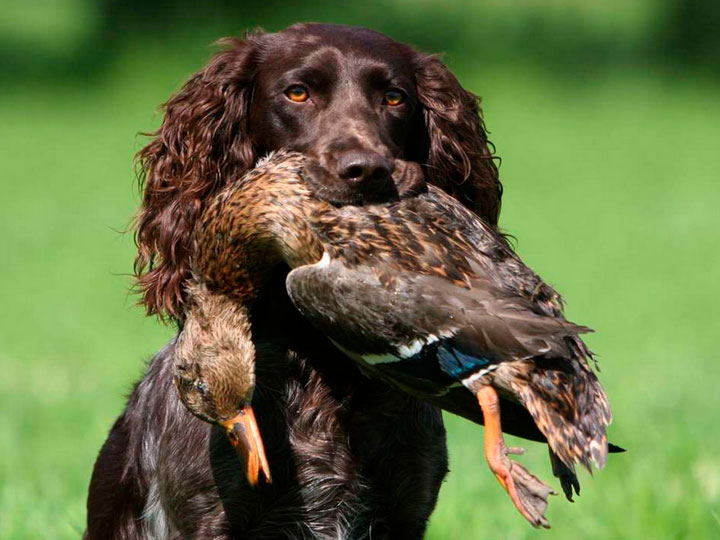
- Serves well, including from water;
With proper training, it works independently, controlling the search width. It is a versatile gundog, especially suitable for wooded areas and water.
Appearance
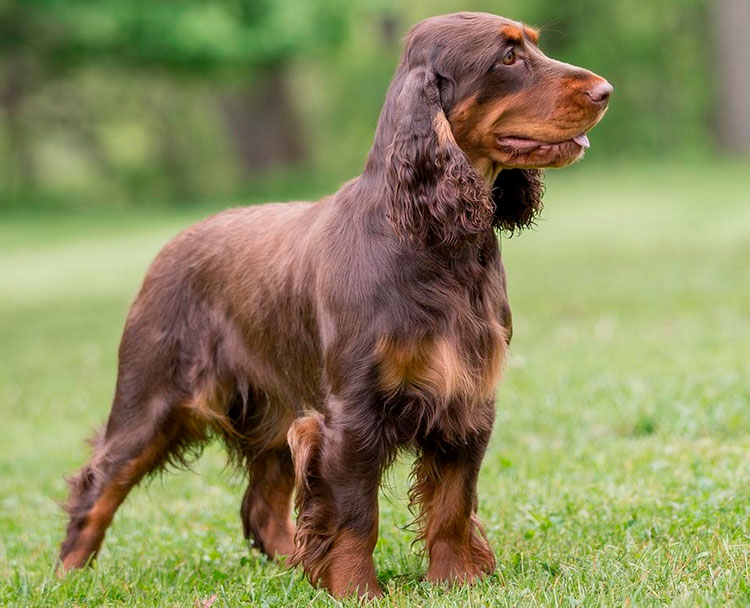
The German Wachtelhund (German Spaniel) is a long-haired, muscular, medium-sized dog with strong bones and a noble head, somewhat elongated in format, and short legs. Sexual dimorphism is well expressed. The height at the withers of males is 48-54 cm, females 45-52 cm, weight 18-25 kg.
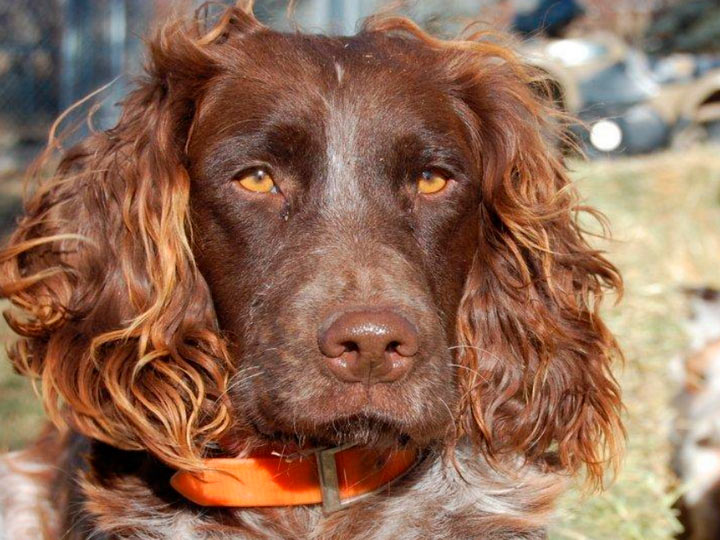
The head is proportionate to the size of the body. The skull is moderately broad and flat. The stop is moderately pronounced. The muzzle has a wide nasal bridge, is strong, not pointed, and slightly rounded at the bottom. The nose is large, dark in color, with open nostrils. The lips are dry, not pendulous, and fit tightly. The dentition is complete. The bite is scissor-shaped, a level bite is acceptable. The zygomatic arches are not protruding. The eyes are dark, medium in size, and set slightly slanted. The eyelids fit tightly, the sclera is not visible. The skin of the eyelids is covered with hair. The ears are set high, hanging, wide, and lie close to the skull behind the eyes. They are evenly covered with hair, which extends beyond the lower edge.
The neck is well-muscled, strong, and forms an obtuse angle with the withers, without dewlap or dewlap. The ratio of the body to the height at the withers is 1.2:1. The topline is solid and straight. The withers are well defined. The back is short and straight. The loin is wide. The croup is slightly sloping, slightly below the withers. The chest is oval, reaching below the elbows. The ribs are well sprung. The belly is moderately tucked up. When relaxed, the tail is carried level with the topline or slightly below. When excited, it rises higher than the back. To prevent injury during hunting, the tail is docked no more than 1/3 in countries where this is not prohibited. The forelimbs are straight, parallel, and set firmly under the body with good angulation. The hindquarters have well-defined hocks and stifles, straight and parallel, with well-developed bone. The paws are oval, the toes are arched and well knit.
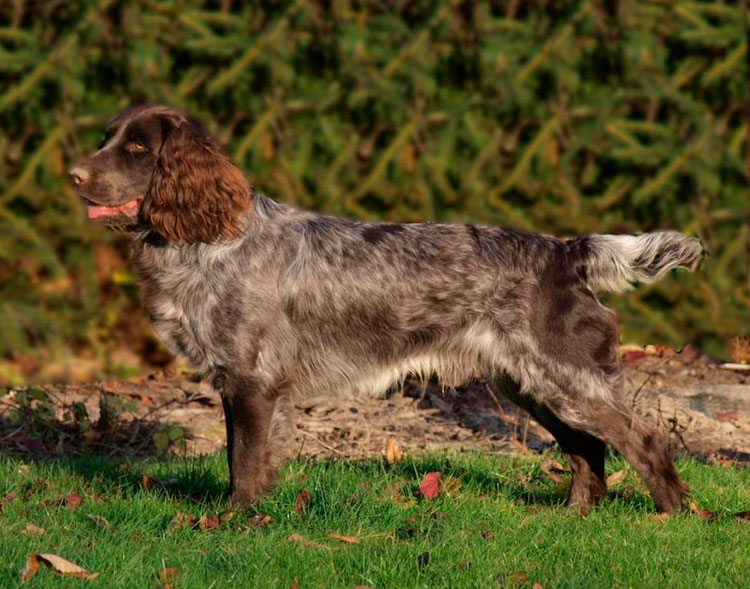
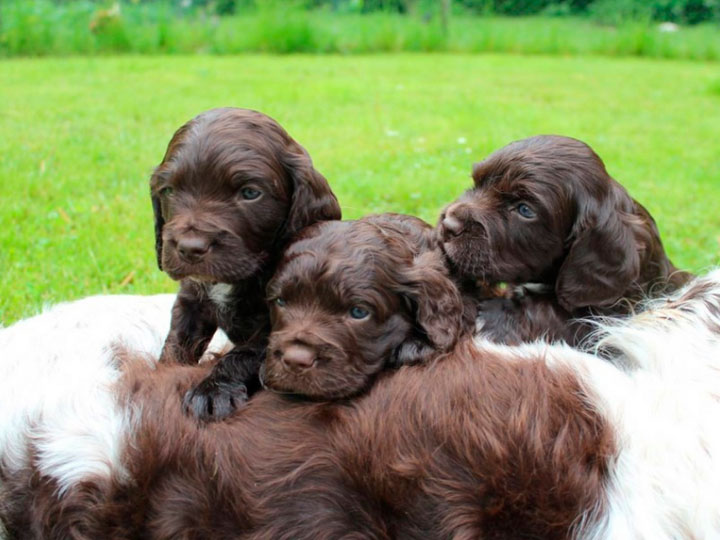
The coat is thick, lying close to the body, wavy, and less commonly curly or smooth. The undercoat is dense. The hair forms curls on the back of the head, croup, and ears, feathering on the back of the legs, a plume on the tail, and a frill on the neck. The belly is well-furred. The hair on the muzzle and head is short but very dense. Between the toes, it forms thick, but not too long, tufts. The German Spaniel comes in two colors:
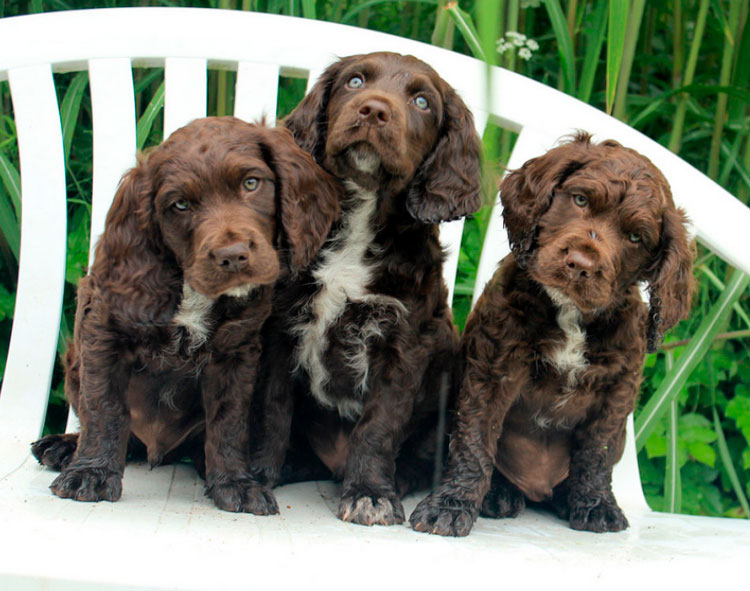
- Solid brown (including light and reddish shades). White markings or speckles on the chest and legs are possible;
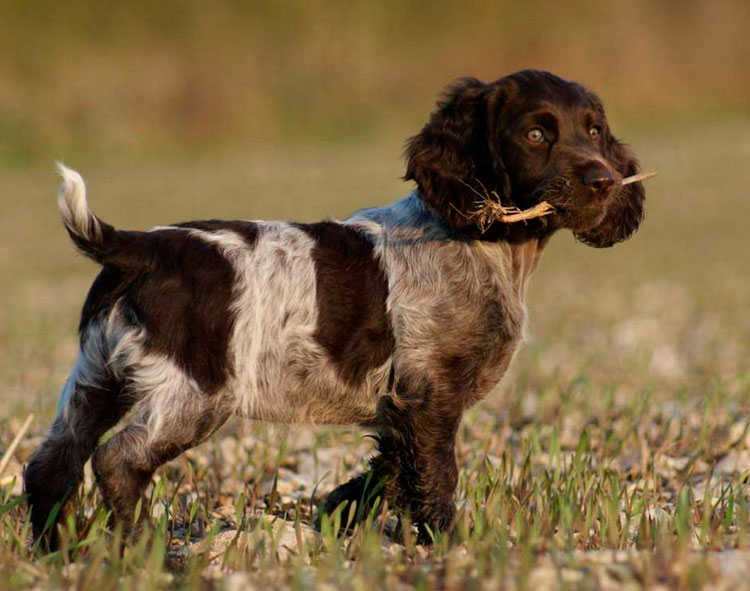
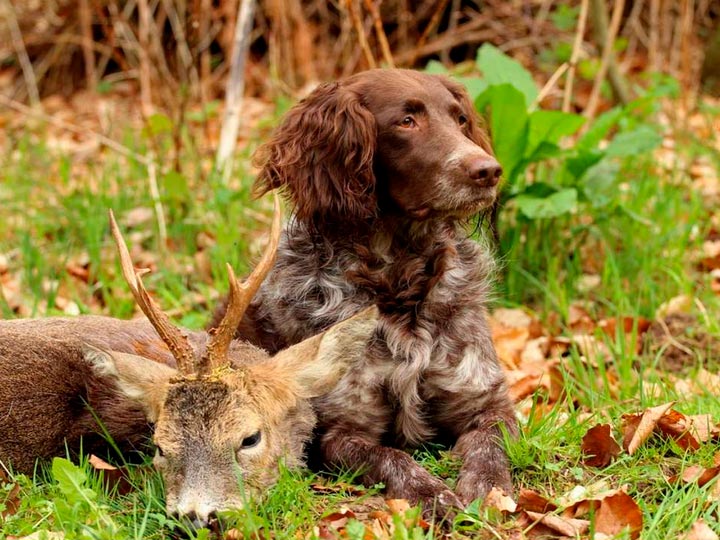
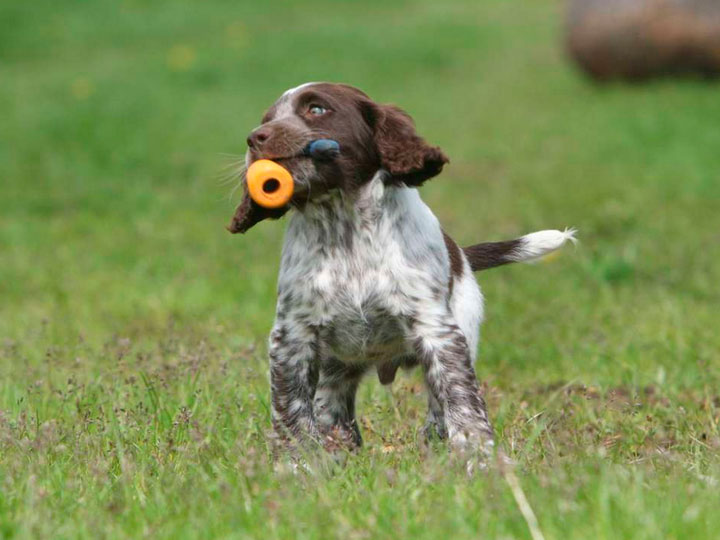
- Brown roan or red roan.
With any color, tan markings are allowed above the eyes, on the muzzle, under the tail and on the limbs.
Character and behavior
The German Wachtelhund has a balanced, friendly personality. It is peaceful and trusting, showing no signs of cowardice or aggression toward people or other animals. It will bark at the arrival of guests or strangers, but will not chase anyone away, greeting them with a cheerful wagging tail. It has a strong hunting instinct. Keeping a Wachtelhund exclusively as a family dog is quite difficult, especially in the city. Failure to realize a hunter's talents can lead to various behavioral problems.
The Wachtelhund is very devoted to its owner and forms strong bonds with other family members. It gets along well with children. It learns quickly and adapts easily to new situations. Its character is characterized by fortitude and courage.
Education and training
Success with a Wachtelhund depends largely on the experience and authority of the trainer. If the owner trains the dog independently, they should have knowledge of cynology and hunting dog psychology. The Wachtelhund is highly intelligent, easily learns commands, and is eager to please its owner, but it requires strong motivation (verbal praise and treats) to work. Harshness can cause it to withdraw and refuse to work, but an occasional light scolding is necessary.
Content Features
The Wachtelhund shouldn't be kept for aesthetic reasons. It's an intelligent and capable hunting dog, born to work. Bred with working tests, it's suitable for both outdoor and indoor use. Indoors, the German Wachtelhund is relatively calm. It's affectionate and neat, preferring to stay out of the way, resting, or minding its own business while waiting for its next walk.
Wachtels are prone to gaining excess weight, especially if they lack physical activity.
Daily exercise should be adequate. Jogging or cycling are encouraged in adulthood. Regular, long walks in open areas or forests are essential. In warmer weather, swimming and water retrieving are beneficial pastimes. Of course, all this is in addition to regular hunting trips, skill development, and the development of natural talents.
Care
Regular brushing will help keep the coat in good condition, prevent mats, and significantly minimize shedding. Bathing is recommended as needed. Typically, a dog should be washed with shampoo once a month or less frequently.
It's also important to check and clean the ear canal to prevent infection. Nails are trimmed as needed. In winter, the fur between the toes is also trimmed to prevent snow and ice from sticking to them, which can injure the paw.
Health and life expectancy
German Spaniels are generally healthy, robust dogs with strong immune systems. They rarely get sick. Life expectancy is 12-14 years. Some Wachtelhunds suffer from hereditary diseases:
- skin problems (eczema, dermatitis);
- dental diseases (more common in dogs with an incomplete set of teeth or malocclusion);
- eye diseases (volvulus or eversion of the eyelids, progressive retinal atrophy, cataracts);
- allergies;
- degenerative diseases of intervertebral discs;
- hypothyroidism;
- hip dysplasia;
- melanoma;
- epilepsy.
To maintain your dog's health, it is important to adhere to a schedule of veterinary and preventative measures: vaccinations, parasite treatments, and routine medical examinations.
Choosing a German Wachtelhund Puppy
The German Wachtelhund is very popular in Germany and many other European countries. In Russia, the total population is approximately 50 dogs. There is a breed club registered with the Russian Kennel Federation (RKF) called "Wachtelclub." It brings together enthusiasts and breeders, organizes matings, registers litters, and assists in finding and selling puppies. In Ukraine, the population is approximately 10 dogs, mostly imported from Poland.
The Wachtelhund is widespread throughout Germany. Around 700 puppies are registered annually in the country. The breed is becoming increasingly popular in Sweden, Denmark, Finland, Slovenia, the Czech Republic, Hungary, Italy, Austria, Switzerland, Luxembourg, France, Canada, and the United States. It has also attracted the attention of Russian and Ukrainian hunters.
You should only buy a German Spaniel puppy from reputable breeders or kennels. The parents of the litter must have the correct exterior, character, and working qualities, not just from the owner's words. Show scores and working trial diplomas serve as proof. Testing for common genetic diseases in the breed, such as dysplasia screening and ophthalmological evaluation, is encouraged. Each puppy must have a tattoo, a puppy card, and a veterinary passport with deworming and vaccination records. Puppies are usually picked up at 8-9 weeks of age. They should be healthy, active, and curious, with no signs of shyness or aggression.
Price
Breeders who are members of the Wachtelclub adhere to a reasonable pricing policy, ranging from 20,000 to 30,000 rubles. Potential owners undergo a rigorous selection process. Prices for puppies registered with other societies or unregistered are not monitored, and no one is responsible for the quality of the litter.
Photos and videos
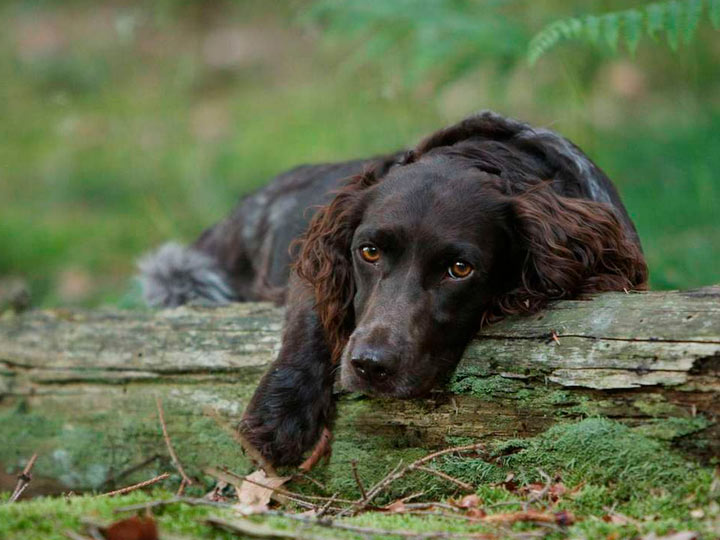
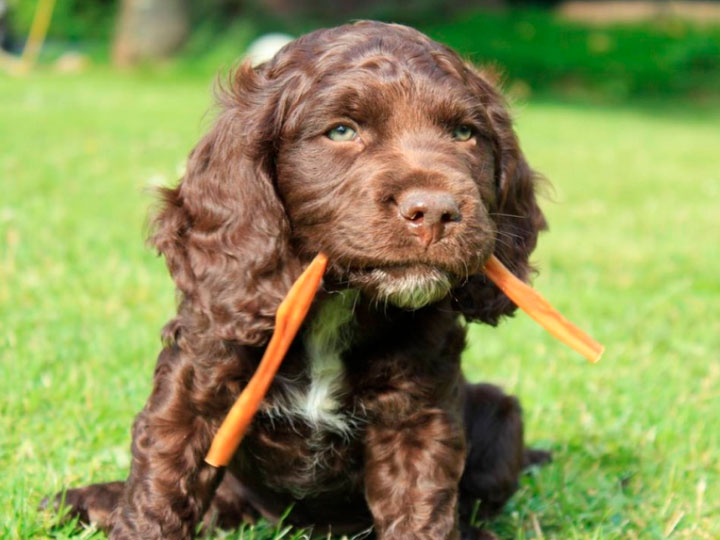
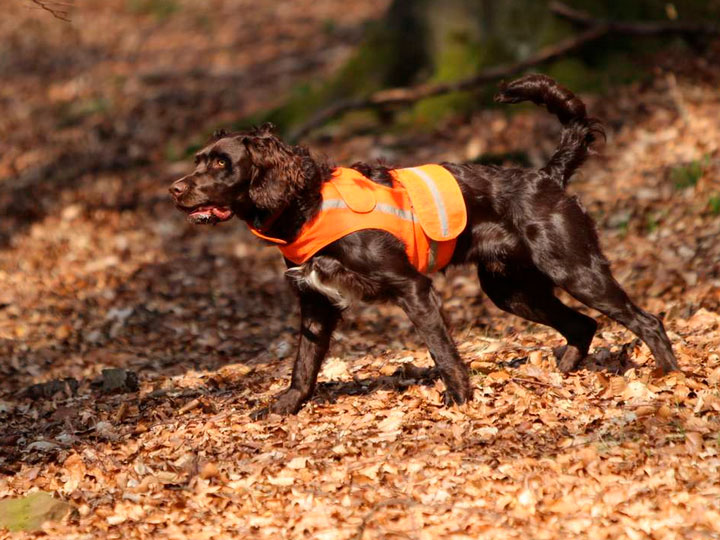
The gallery features photographs of German Wachtelhunds. The pictures feature spaniels of different genders, ages, and colors, and some include trophies, demonstrating their versatility.
Video about the German Wachtelhund (quail dog, German spaniel) dog breed.
Read also:


Add a comment