
Ear mites in dogs: symptoms and treatment
Veterinarians say ear mites in dogs are not the most common parasitic disease, but every owner should be aware of the symptoms that may appear in the early stages of infection and how to properly treat their pet at home.
Content
Types of ticks and their characteristics
There are over 900 species of ticks in nature, but only a few species can infest dogs. However, the parasites that cause diseases in dogs can also pose a danger not only to other pets but also to humans.
|
Name of the tick |
Where it parasitizes |
What disease does it cause? |
Probability of transmission to humans |
|
Sarcoptes scabiei |
Superficial layers of the skin |
High, causes itchy scabies |
|
|
Demodex canis |
Hair follicles and sebaceous glands |
Extremely low, people have resistance to infection |
|
|
Otodectes cynotis |
The auricle and auditory canal |
Otodectosis |
Low, may cause skin thinning |
|
Notoedres spp. |
Scalp, ears, nose |
High, causes skin lesions |
|
|
Cheyletiella yasguri |
Skin surface |
Cheyletiellosis |
High, causes itching and rash |
|
Ixodidae |
Skin (if bitten) |
Piroplasmosis (babesiosis) |
Not transferableHuman piroplasmosis is caused by other species of babesia |
Each mite species infests specific areas. Only two species can cause ear inflammation, but:
- Notoedres tick most often affects the scalp and external auditory canal;
- Otodectes tick It spreads specifically in the auricle, but without proper treatment it can penetrate deep into the ear canal, causing serious pathologies.
That's why, when people talk about "ear mites," they usually mean the Otodectes cynotis mite species, which causes ear mite disease in cats and dogs. Fortunately, this species is extremely rarely transmitted to humans (the disease can only occur in young children and people with severely weakened immune systems).
Otodectes ear mite
Everyone knows what an ixodid tick looks like on a dog, as the parasite's size allows it to be seen with the naked eye. However, spotting an ear mite in a pet's ear is quite difficult, as an adult tick is only 0.3-0.5 mm in size.
You can see what an ear mite looks like on a dog under a microscope. Its body is elongated and slightly flattened, with four pairs of legs: the two front pairs are long, and the two back pairs are short, barely protruding beyond the body.
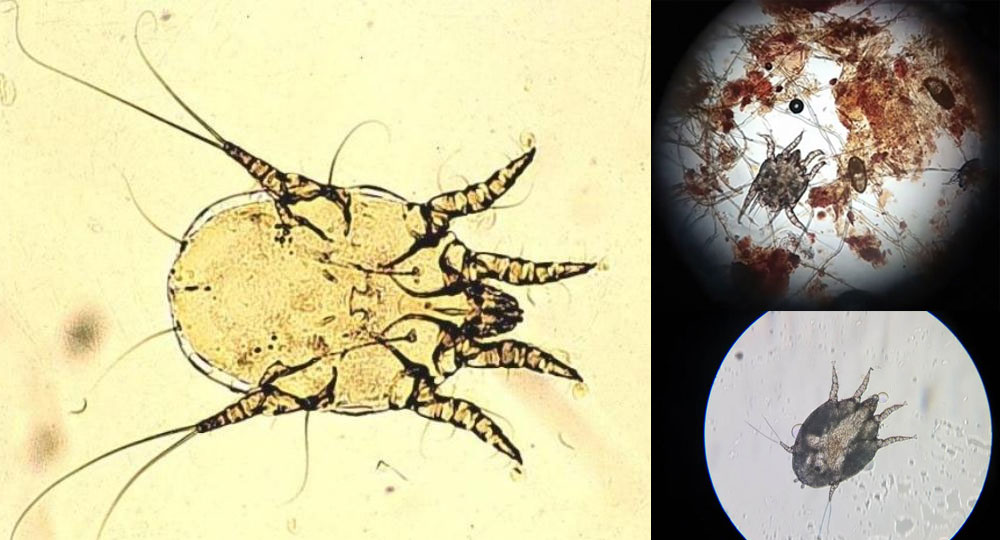
In severe infestations, small whitish-yellow dots may be visible in the auricle. Although Otodectes most commonly infests the external auditory canal, cases of skin lesions around the ear, face, and neck are also common, as are parasites penetrating deeper into the auricle.
Otodectes cynotis lives up to 2 months, going through 4 stages in its development:
- egg (3-4 days);
- larva (3-10 days);
- nymph (3-5 days) – the most active period;
- adult individual.
It feeds on the upper layers of the skin (epithelial cells), lymph, and earwax. Although the Otodectes parasite is not subcutaneous, it damages the tissues of the ear canal during its life cycle, causing inflammation that can be complicated by secondary infection. Dogs' ears infested by mites are intensely itchy, causing the animal to scratch them with its paws until they bleed. This process is also dangerous, as the damaged skin can become secondarily infected with bacteria.

Routes of infection
Where does Otodectes cynotis come from in an adult dog or puppy?
In most cases, infection is by contact. This means that an animal can only contract the parasite through close contact with an infected animal (usually a cat or dog).
However, reinfection from the external environment cannot be ruled out. Outside the host's body, this species of tick remains viable for about 3 days (but can survive up to 2 weeks in a warm, humid environment). Sources of reinfection may include:
- bed or bedding;
- towel;
- upholstered furniture;
- pet clothes;
- toys.
A tick can also be transmitted from a large pet to a healthy one by the owner (through unwashed hands). This type of transmission, without infecting a person, is called mechanical.
Symptoms of the disease
Ear mites are a disease that can affect dogs of any age or gender. There is no breed predisposition, but statistics show that the disease most often affects puppies and weakened animals.
The first symptoms that may suggest that your dog has ear mites are similar to other inflammatory diseases of the ear canal:
- discomfort, causing the animal to shake its head in a characteristic manner;
- itching, because of which the dog scratches its ear with its paw (sometimes until it bleeds);
- redness of the auricle (if the ears are cleared of excess hair, like in a Yorkie, then this symptom is easy to notice, but in long-haired dogs it can be difficult to assess the condition of the skin of the ears);
- profuse discharge (usually brown in color);
- unpleasant odor (occurs against the background of inflammation or when a bacterial infection occurs);
- loss of appetite or refusal to eat (may be observed when the condition worsens);
- ear pain (if the inflammatory process spreads deeper into the auricle, quite intense pain may occur);
- forced head position (the dog may constantly keep one ear down and this symptom already indicates the development of otitis);
- drooping jowls and eyelids + constriction of the pupil, also clear signs of deep inflammation of the internal structures of the ear;
- loss of coordination or walking in circles – symptoms characteristic of the onset of meningitis.
At the first stage, only head shaking, itching, and an increase in the volume and change in the nature of the discharge may be observed. Symptoms intensify as the mite spreads. The photo shows what an ear looks like if a dog has had ear mites for some time.
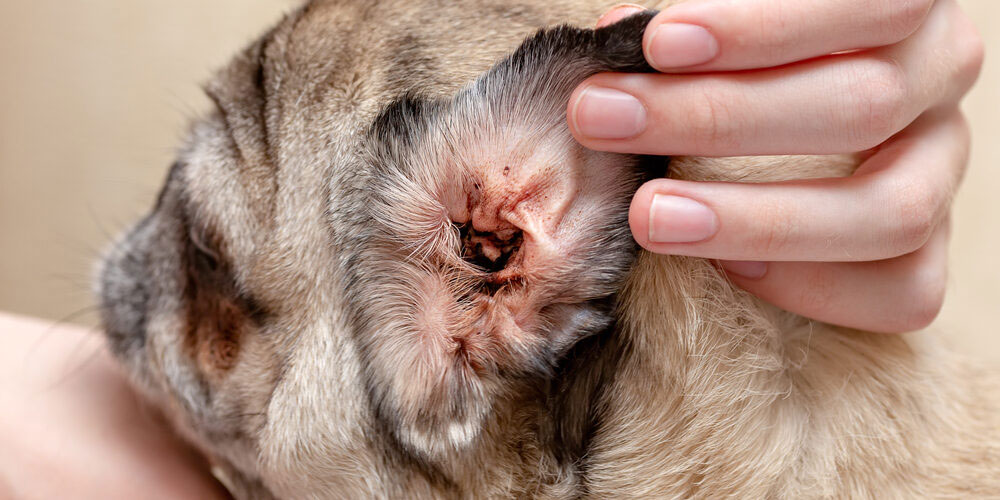
If the disease is not treated in time, serious complications are possible:
- chronic otitis and thickening of the skin of the ear canal;
- bacterial or fungal complications, suppuration;
- damage to the eardrum and inner ear, which can lead to deafness;
- Meningitis (inflammation of the brain) – can develop with severe spread of the secondary inflammatory process and can be fatal.
That's why, if you notice the first symptoms in your dog that suggest ear mites have taken up residence in your pet's ear canal, you should immediately conduct a diagnosis and begin treatment.
Diagnostic methods
A doctor can make a diagnosis based solely on a medical history and an examination of the ear canal. If the main symptoms described above are present and mites (small white dots that move when attempting to clear the ear of discharge) are clearly visible in the ear, no further testing is necessary.
Sometimes it's impossible to see mites. For example, if the mites are deep in the ear or if their numbers are small. In this case, a laboratory analysis of the discharge can confirm the veterinarian's suspicion. Microscopy allows for the accurate detection of Otodectes mites in various stages of development.

Because ear mites in dogs are often accompanied by a secondary infection, your veterinarian may recommend cytology (a test to determine the presence of bacteria and fungi) to more accurately determine treatment.
Treatment of otodectosis
Although ear mites on dogs, as the photos show, are quite unpleasant and pose a potential danger to all people and animals living in the house, they can be treated at home quite easily.
To ensure the problem is eliminated, it is crucial to select effective medications and follow all veterinarian recommendations to prevent re-infection.
As a rule, the treatment complex includes:
Veterinarian's advice
What should you do if you notice your dog's ear is bothering you but can't get to the vet? Simple, inexpensive, and effective home treatments for ear mites and uncomplicated otitis are described in this video:
However, if your pet exhibits any serious symptoms (nausea, vomiting, fever, or loss of coordination), it should be taken to a clinic as soon as possible. Veterinarians warn that improper treatment can lead to serious complications, the development of chronic diseases, or the growth of resistant bacteria.
Questions about otodectosis
Read also:
- Hot Ears in Dogs: Why and What to Do
- Ectoparasites in dogs and treatment against them
- My dog's ears are bleeding: cause and treatment


Add a comment