
Lump under the skin in cats: what to do
Pets often develop growths between the skin and muscle. These growths can be harmless or dangerous. Therefore, if you notice a lump under your cat's skin, even if it's not inflamed and isn't causing discomfort or pain, make an appointment with your veterinarian to determine the cause of the nodular hardening of the subcutaneous tissue and, if necessary, promptly treat it.

Types and signs of subcutaneous formations
Subcutaneous neoplasms (tumors) can be benign or malignant. The former pose a danger only if they grow to a large size and begin to compress nearby organs. Malignant tumors (sarcomas and fibrosarcomas) cause cellular degeneration and metastasis, and therefore often lead to the death of the animal.
Benign subcutaneous tumors, depending on their histological structure and causes of formation, are divided into several categories:
- A hematoma is a painful lump caused by damage to small blood vessels during an injury. It typically has a purple color ("bruise") due to a collection of blood under the skin and may be accompanied by a local increase in temperature. A hematoma can become infected, forming a cyst.
- Post-injection infiltrate. A small lump that forms at the injection site. If there is no infection, it causes little or no discomfort to the animal and resolves on its own.
- A lipoma is a soft, subcutaneous lump that tends to grow. This lump, located under the skin of a cat, moves easily when pressure is applied, causing no discomfort. These tumors form from connective tissue in areas with a high concentration of fat cells and are often found on the abdomen of older animals.
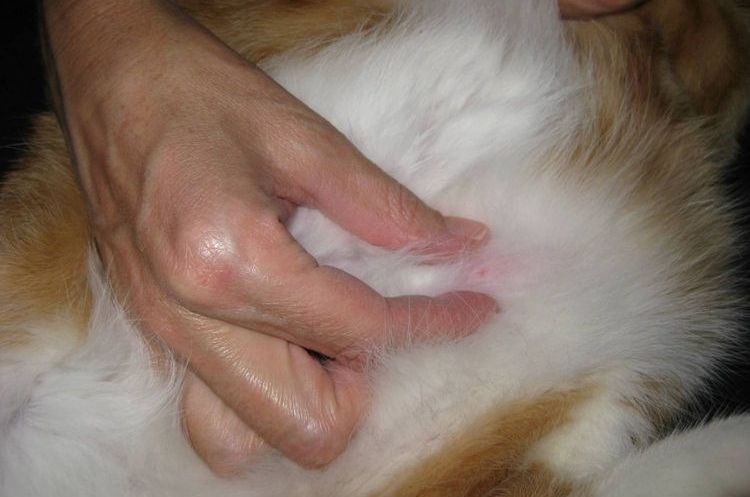
- Cavernous hemangioma. A vascular growth that appears as a soft, bumpy, nodular formation of a bright red or bluish-purple color.
- Syringoepithelioma. This is a modified element of a part of a sweat gland, appearing as a nodule up to 1.5 cm in size. The skin over the nodule usually retains its normal color, and the tumor itself causes no discomfort to the animal: it is neither painful nor itchy. In cats, this type of neoplasm often develops on the abdomen.
- Abscess (abscess, abscess). The cause of the abscess development can be a wound, an insect bite, an unsuccessful injection, or scratching of the skin (for example, with "cat scabies"» – notoedrosis). Abscesses in a cat's neck, abdomen, or head occur when a bacterial infection enters the damaged skin. Abscesses are painful and can cause fever.
- A cyst is a round, serous-filled capsule. These "balls" can be located anywhere on a cat's body, ranging in size from 2-3 mm to several centimeters. Cysts grow slowly and are usually painless. Most often, these growths are harmless and result from a blocked sebaceous gland (atheromas, pilar cysts) or lymph node.
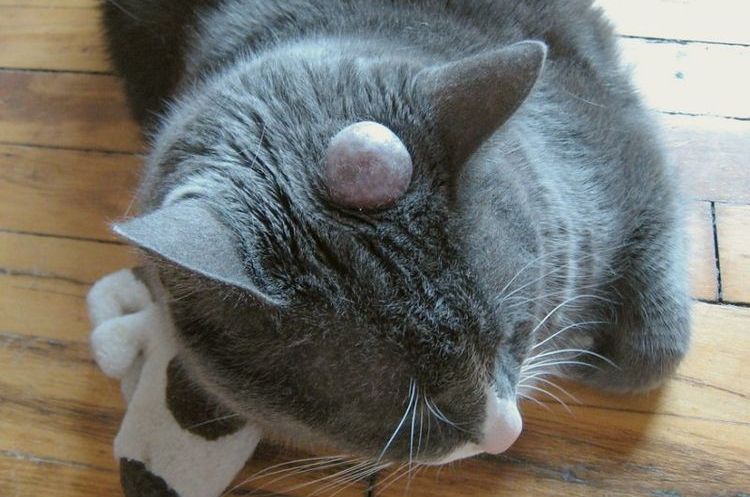
A small, ball-like lump of unknown origin under the skin on a cat's neck or head may be a tick that has embedded itself and fed blood. It should be carefully removed entirely to prevent any remaining part of the insect from developing an abscess. A lump can also form as a result of a small foreign body being lodged under the cat's skin. The foreign body becomes encapsulated in the subcutaneous tissue and appears as a round, hard mass.
Diagnostics
The origin of some subcutaneous lumps in cats can be determined by their appearance. For example, an attached tick can be easily detected by a careful examination by the owner. An experienced veterinarian can usually accurately diagnose a lipoma, abscess, or hematoma.
To establish a diagnosis, the doctor first takes a medical history: the cat's age, the presence of any pathologies or diseases, how long the lump has been present, whether it is growing, and whether it is bothering the animal. The doctor then palpates the neoplasm and surrounding tissue to determine the size of the lump, its mobility, and the condition of nearby lymph nodes.
Important to know! Most benign tumors have clear borders, low density, and a smooth surface. Malignant tumors are characterized by blurred borders and a bumpy surface, and they also typically grow rapidly.
In many cases, additional tests are required to establish an accurate diagnosis. These may include histological or cytological tests to determine the tumor's structural composition, as well as analysis of the neoplasm's contents to detect bacteria, fungi, or other infestations. A biopsy, a procedure that removes a small amount of tissue from the tumor for cytological analysis, allows for clear differentiation between benign and malignant tumors.

Treatment
Treatment for a subcutaneous mass in a cat depends on the nature of the neoplasm, its size, and clinical symptoms. Some benign subcutaneous tumors require no treatment. For example, a hematoma, an uncomplicated post-injection infiltrate, or a small, non-growing lipoma do not require treatment. Large lipomas, cavernous hemangiomas, and sweat gland epitheliomas are usually removed surgically under local anesthesia.
Subcutaneous tumors such as abscesses and cysts require more complex treatment. If subcutaneous abscesses are detected in your cat, you should contact your veterinarian. There, a specialist will incise the abscess cavity, drain the pus, and then disinfect the cavity with furacilin or hydrogen peroxide. The procedure may be repeated if necessary. To prevent infection, your cat may be prescribed a course of antibiotics.
Caution! Many cat owners believe that they can simply squeeze out an abscess and the wound will quickly heal on its own. Veterinarians consider this dangerous. There's a high risk of introducing pathogenic microflora into the open wound, and improper movements when removing the exudate can cause it to migrate deeper, which can lead to a recurrence of a severe abscess.
Cysts, despite the general name of the tumor, come in different forms:
- Atheromas are small, up to 2.5 cm in diameter, dense cysts filled with sebaceous contents;
- Pilar cysts - are formed as a result of blockage of the sebaceous or sweat glands;
- Keratinized cysts are hollow tumors filled with a curd-like substance: keratinized epidermal cells and fat particles;
- Follicular cysts. The most common type of subcutaneous cyst, they are sacs filled with serous fluid.
Caution! If a cyst contains a colony of parasites (alveolar tapeworms or echinococcus helminths), it can be dangerous to others, including humans.
If the cyst is small, soft, non-infectious, non-parasitic, and not causing pain or discomfort, your veterinarian may recommend observation rather than removal. Small subcutaneous cysts often resolve on their own, but if the cyst grows, surgery will be necessary.
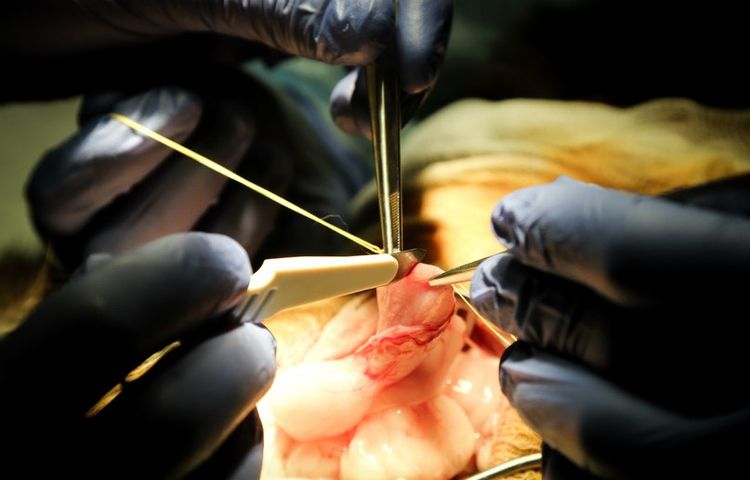
Freezing with liquid nitrogen and destruction with high-frequency currents (electrocautery) are widely used methods for removing benign subcutaneous tumors today. These procedures minimize the trauma inherent in surgical procedures.
Early-stage malignant subcutaneous tumors are removed surgically, with excision of surrounding tissue. This reduces the risk of recurrence. Following surgery, the animal is prescribed a course of restorative therapy. Chemotherapy and radiation therapy are rarely prescribed to cats.
Read also:
- Mammary tumor in a cat
- My cat's lower lip is swollen: causes and what to do
- Chin Acne in Cats: Causes and Treatment


Add a comment