
Declawing cats
When bringing a small, fluffy bundle into the home, few owners consider potential problems, such as uncontrollable aggression toward people or pets, or damage to furniture, wallpaper, and curtains. If attempts to retrain the animal fail, a veterinarian may offer a radical solution: declawing, or onychectomy, for cats.
Content
About the procedure
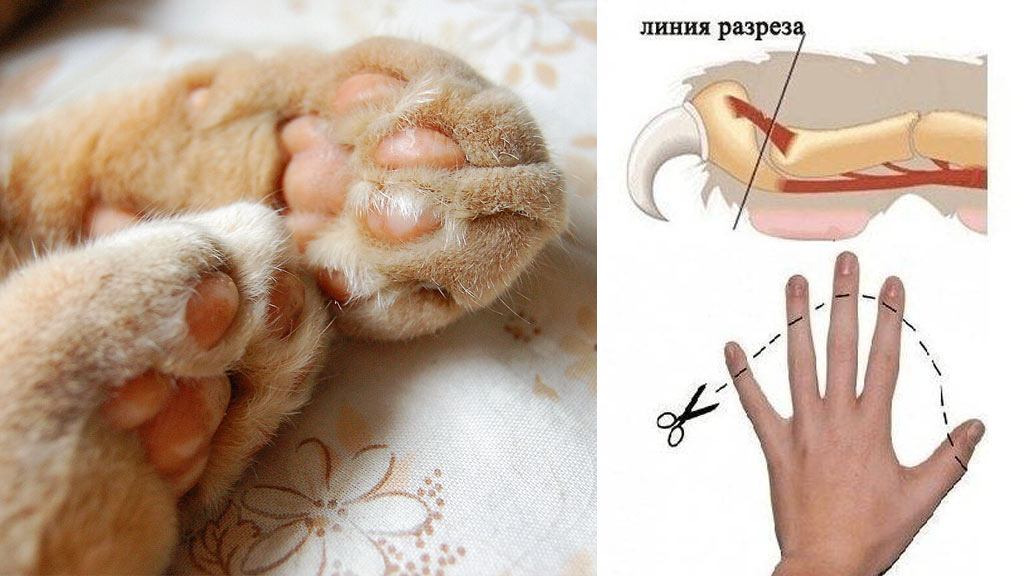
The procedure of declawing cats is affectionately called "soft paws" or "velvet paws," but the scientific term is onychectomy. It's a surgical procedure in which the animal's outermost (ulnar) phalanx is completely removed. For medical reasons, onychectomy is performed not only on cats, but also on dogs, primates, and sometimes even birds.
Important! Onychectomy is a major surgical procedure performed under general anesthesia. Therefore, before making a decision, it is important to conduct a comprehensive examination of the animal and ensure that the cat can tolerate anesthesia and the difficult recovery period.
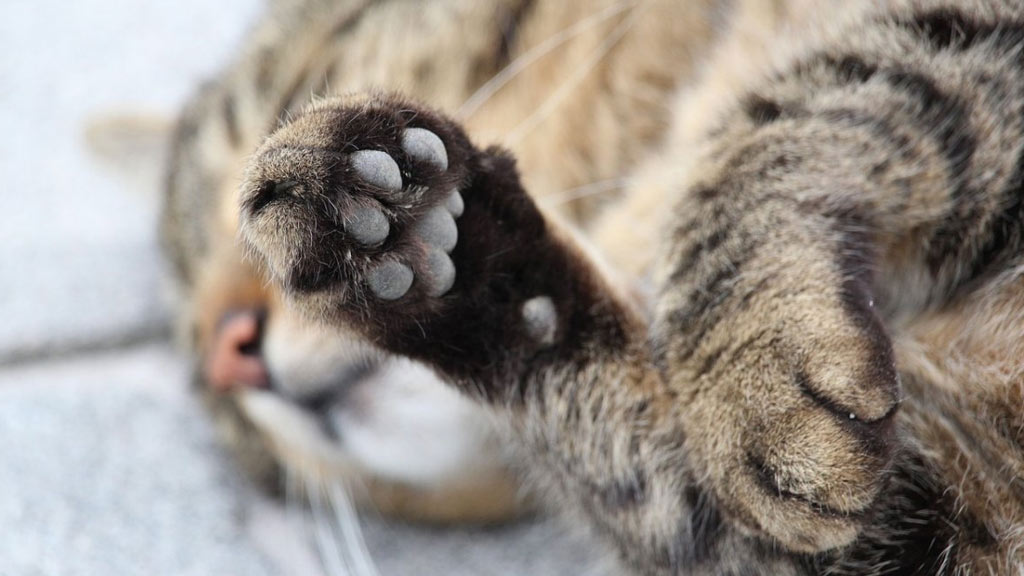
Indications for surgery:
- severe damage to the nail phalanx (due to injury or disease);
- uncontrolled aggression of an animal towards others;
- the owner's wishes (in this case, the veterinarian may refuse to perform the procedure).
At what age do cats have their claws removed?
Due to the above indications, declawing kittens under 3 months of age is extremely rare (usually for medical reasons). It's important to understand that in cases of aromatization, one or more nails must be amputated. However, when performing the procedure for the safety of others or preserving the interior, the veterinarian must remove all nails, which is very traumatic.
The optimal period for performing the “soft paws” procedure is from 6 months to a year.
When discussing the age at which a cat can have its claws removed, veterinarians cite the following arguments in favor of the specified age range:
- the cardiovascular system is already strengthened;
- the instinct to scratch everything in sight has not yet formed and become entrenched;
- The cat is just entering puberty.
In cases of uncontrolled aggression, cats can have their claws removed at any age, provided they are in good health. However, it is important to understand that the older the animal, the more difficult it will be for it to undergo the rehabilitation period and adapt to the new realities of life.
How does the operation proceed?
Before performing an onychectomy, tests are taken and an examination is carried out, in particular, the functioning of the cardiovascular system is checked, which determines the cat's readiness for anesthesia.
Advice! It is recommended not to feed your cat for 12 hours before the surgery!
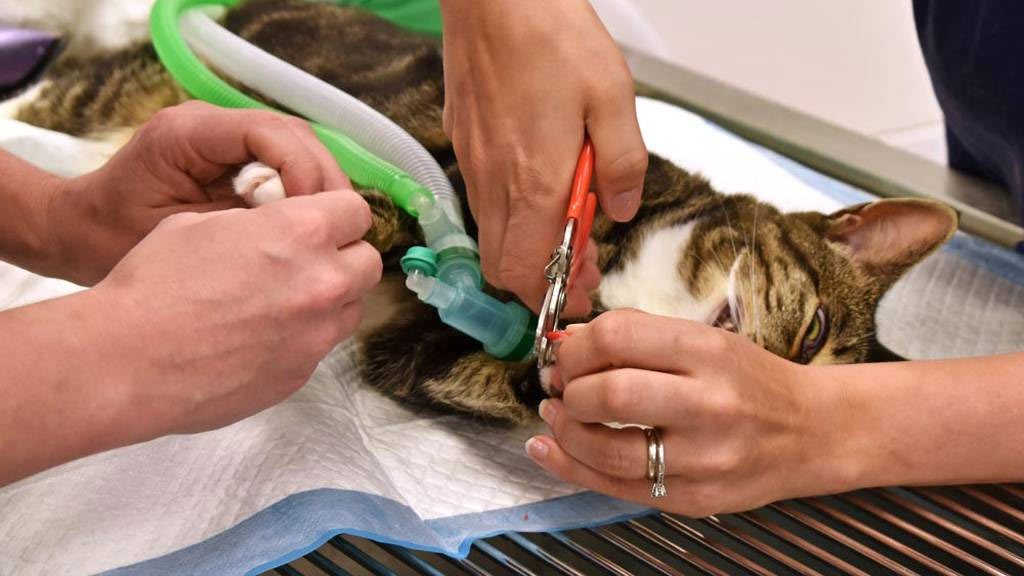
Procedure:
- setting up general anesthesia;
- applying a pressure bandage to prevent bleeding;
- treating paws with an antiseptic;
- excision of the nail phalanges (the surrounding tissues are not injured);
- removal of the pressure bandage;
- final treatment of wounds;
- applying a bandage (should cover most of the forearm);
- an injection of antibiotics and painkillers.
Important! In the postoperative period (3-5 days), you will need to continue to inject antibiotics and pain medication. To relieve pain, you will also need to wear bandages And postoperative collar it may take much longer.
On average, the rehabilitation process, assuming no complications, takes about a month. It's important to understand that during this period, the animal will be unable to move normally, and after the bandages are removed, it will have to relearn how to walk, as the distribution of weight on the paws changes significantly when the outer phalanges are removed.
Sometimes veterinarians recommend performing the surgery in stages, first on the front legs and then on the hind legs, but in this case, the painful period for the animal only prolongs, and the animal will also have to undergo two general anesthesias, which doubles the negative impact on the body.
Rehabilitation
As with any surgical procedure, your furry pet will require special care after declawing to ensure they can get back on their feet.
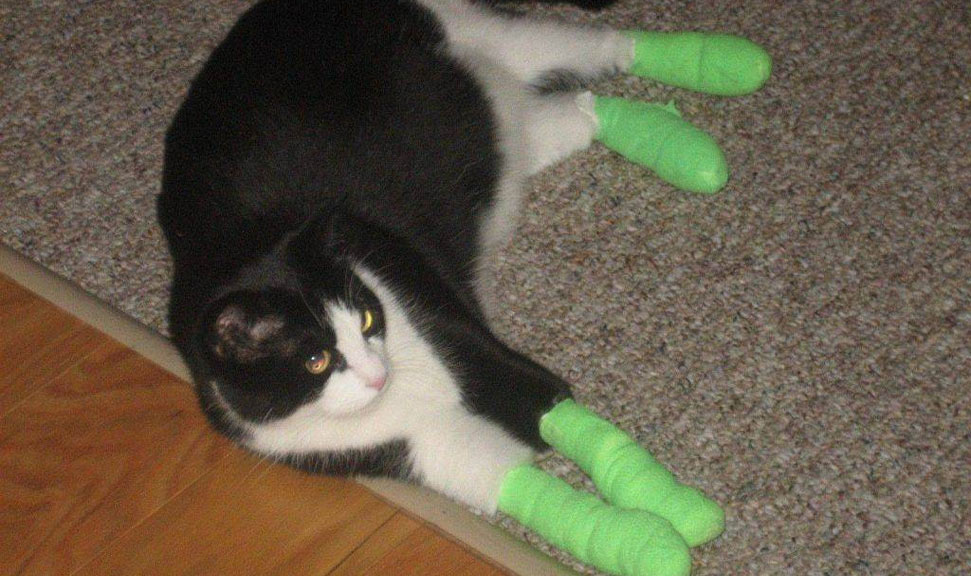
For normal rehabilitation of the animal it is necessary:
- Use pain-relieving injections only on the advice of a veterinarian;
- show the operated animal to the doctor every 3-4 days;
- the stitches need to be treated daily and the dressing needs to be changed;
- It's important to ensure that your cat doesn't remove the protective collar. You need to prevent your pet from chewing on the bandages and stitches.
The average recovery period is 3-4 weeks. Declawing is not recommended for kittens under 7 months old, but it's generally better to spay the animal first and analyze its behavior. After all, declawing is often unnecessary.
Consequences of the operation
Animal rights activists unequivocally oppose this procedure unless it has a medical indication. They compare declawing a cat to removing the last phalanx of a human finger. Doctors, however, argue that this comparison is inappropriate. However, after a total onychectomy, cats experience irreversible changes.
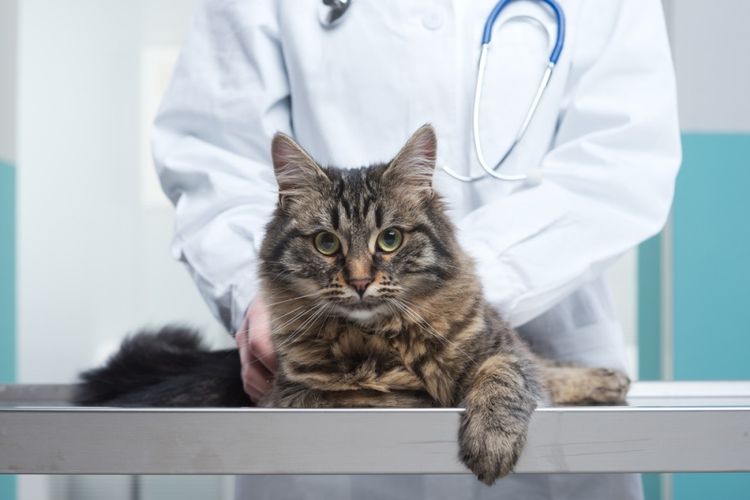
Here are some of the consequences you might notice in your cat after declawing:
- inflammation of soft tissues and even osteomyelitis (necrotic process);
- During surgery, the cat may lose a large amount of blood;
- the healing process usually takes longer than expected;
- the animal's coordination of movements is impaired;
- the cat's character changes, since the rehabilitation process takes a lot of time and is very painful;
- constant supervision of the animal is required to ensure that it does not damage the stitches;
- a cat may not cope well with anesthesia;
- The pet begins to ignore the litter box because it cannot dig in it as before.
These are just a few of the unpleasant consequences of declawing. Of course, if there are medical indications for declawing, they shouldn't be ignored. However, it's also important to understand that if there are medical indications, the cat's claws aren't completely declawed; only the diseased or damaged ones are removed.
How much does cat declawing cost?
The cost of a total onychectomy varies depending on the clinic's level and location. For example, in Moscow and the surrounding region, the cost ranges from 1,500 to 5,000 rubles. Prices may be lower in the regions.
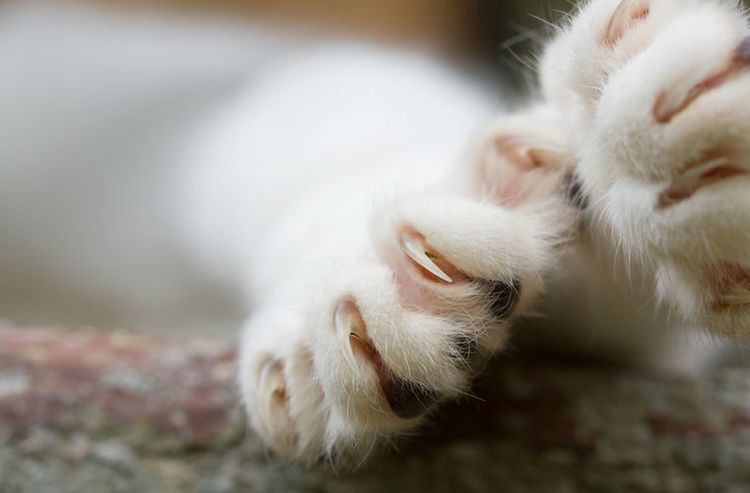
If you're considering such a serious surgery for your pet, don't skimp. It's best to choose a clinic that specializes in surgery. Better yet, choose one that offers a doctor's home visit. If the surgery is performed in your cat's familiar environment, they may recover more quickly.
Reviews
Owner reviews of cat declawing, as well as opinions on the advisability of the procedure, vary widely. Below are a few testimonials from owners who have undergone this complex procedure.
Victoria, Barsik's owner:
"Our Barsik was always a calm and beloved cat. But at some point, he began displaying unjustified aggression toward my husband and some other members of the family. We couldn't determine the cause, and feline sedatives weren't helping. After a long battle, we made a desperate decision—to declaw Barsik. The surgery was successful, and his recovery took just over a month. He completely changed, becoming calm, even a little withdrawn. His activity level dropped significantly. I can't say I regret the surgery, as our problem was completely resolved."
Marina, owner of Sonya and Kitty:
"Sonya was always a calm cat. After a few years, we decided to get her a friend. That's how we got Kitty. The girls quickly became friends, but they still fought sometimes. One time, Sonya scratched the younger one so badly that we even had to take her to the vet. That's when we decided to declaw Sonya.
The surgery went well, but the recovery period was extremely difficult. The cat was lethargic, her appetite was poor, and she was completely unresponsive. Over time, Sonya began to walk confidently, but a slight limp remained. Her jumps were timid, and she couldn't balance on high shelves. Sonya began to completely ignore the litter box. We certainly resolved the cat fighting issue once and for all, but we completely lost our beloved cat. I deeply regret taking this step."
Alternative to the soft paws operation
Onychectomy is a dangerous and cruel procedure that shouldn't be performed on an owner's whim. Declawing a cat is like going to a clinic and amputating your own toes. It's important to approach this step responsibly and understand that any problem can be solved without surgery.
For example, if your cat has a habit of sharpening its claws on furniture or walls, you can create a special place for it. You can buy a scratching post or make one yourself. If your furry friend stubbornly ignores the new scratching spot, you should try to attract them to it. Store-bought scratching posts are usually specially treated to attract cats. The same can be done with homemade equipment. A few drops of valerian will solve any problem.
If your cat is aggressive toward its owners or simply scratches during active play, you can trim its claws regularly. This procedure is available at all veterinary clinics and pet salons, or you can trim the claws yourself. It's important to trim only the sharp tips to avoid injuring the cat. Also, trimming should be done when the cat is calm or half asleep.
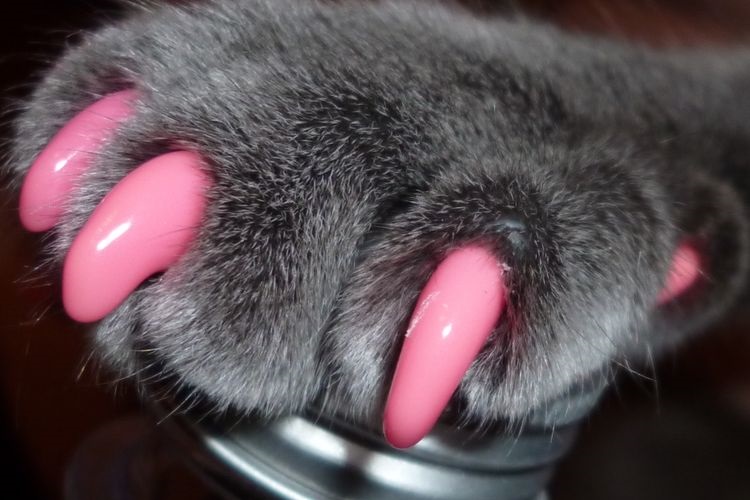
Also all the problems with claws will help solve silicone padsSoft silicone caps securely attach to the claw, protecting owners and furniture from cats' sharp weapons.
Whatever the owner's decision regarding their pet's claws, they should always remember the truism: "We are responsible for what we have tamed." Therefore, all our actions should be aimed at the well-being of their pet and should never harm it. And if you train your cat from the very first day, there will be no problems with either the litter box or claws.
You can also ask our website's staff veterinarian a question, who will answer them as quickly as possible in the comments box below.
Read also:
- Anti-scratch mittens for cats
- Master class on making a scratching post
- How to train a cat to use a scratching post?


22 comments
Elena
A completely barbaric procedure, prohibited in civilized countries.
Catherine
Hello! My cat had her front paws declawed. Afterwards, she stopped eating and can barely walk. I don't know what to do. It's been like this for three weeks now. Please tell me what to do in this situation.
Daria is a veterinarian
Hello! Let's be honest. This is a mutilating surgery. It's not a declawing! It's a severed first phalanx of a finger, complete with a claw. It's the same as if you chopped off the first phalanges and nails on all your fingers. Now think about it: would you be able to eat properly after such an operation? Would you be able to walk as before? The animal is in excruciating pain, even if it can't walk. Essentially, it's already a disabled animal that needs to adapt and learn to walk in a new way. Anesthetize your pet now; it'll put less strain on its paws.
Maria
You know, in some cases, this is much better than throwing the animal away. And people usually throw them away because of damaged furniture, wallpaper, and so on. This way, everyone benefits. Kitty will recover after some time, and everything will be more than fine. Of course, this is only if the operation is performed by a good specialist, and also if the cat is properly diagnosed beforehand. And yes, the cat won't become disabled as a result, unless there are contraindications.
Daria is a veterinarian
Are you serious? It won't? Ask someone who has had all their toes removed with a machine. Is their life okay afterward? Can they do everything normally? Ask those who have had their toes removed after frostbite. Is it comfortable for them to walk? The nail isn't being pulled out, but the toe is being removed! In any case, it affects the physiology of walking, proper foot placement, and weight distribution. Just because an animal adapts to living with such an injury doesn't mean it's okay.
Elena
So what kind of living creature do you keep? Buy a stuffed animal at the store.
Maria
As a veterinarian, you should know that it takes 1-2 months for a cat to recover, and this is completely normal.
Daria is a veterinarian
Hello! As a veterinarian, I know that this procedure is crippling for animals. And it's a human whim. Not a single veterinary clinic in my city performs the "soft paws" procedure precisely because they consider it inhumane. The same goes for clipping dogs' vocal cords. It's so convenient for people, so their animals stay quiet and don't "yelp," as they say when they come in. And when you explain that complications can arise during the healing process, they don't care at all. They're driven solely by personal desires. In proper clinics, where actual doctors work, not those who are just trying to make a buck, regardless of the harm it causes to the animal, this procedure was removed from their list of services long ago. My cat scratches the wallpaper sometimes, and I would never declaw him. It'd be like having my fingernails and toenails trimmed so I wouldn't have to spend money on a manicure; it would save me money for the rest of my life...
Emily
What recovery? They told you outright that the cat would become disabled!
Catherine
I absolutely agree with you. When she was a child, around eight years old, our cat Musya started coming to us. We quickly fell in love with her. But one day, she came home with a huge, bloody wound on her paw and a missing claw. God, how she screamed. And when you hear about such surgeries, not for medical reasons, but at people's whims, I want to know why all the good things eventually turn bad?
Gulya
What can we do if an animal is aggressive and attacks people? She's aggressive for no reason, she's slashed my sister from head to toe, and we're afraid of her. We were offered euthanasia, but we refused.
Natalia
Hello! We got our Abyssinian cat at 9 months old. She was given away when she started fighting her mother cat after she had kittens. We thought the kittens would be given away and the cat would come back, but the mother cat never took her back. Everything was fine, she was loved, and she allowed herself to be loved. It all started a year ago when she attacked me, clinging to my face; it was literally impossible to get her off. After that, I spent two weeks in the emergency room getting bandages changed. We sent her to be spayed; we thought it was the hormones and that spaying would help. After the spay, she calmed down for a while, but then she attacked my face again and again. We decided to euthanize her, but when we went to the vet, we couldn't bring ourselves to do it. We bought her a cage, and since April, she's lived in it full-time, first full-time, and then only at night. In November, she started acting aggressively towards me again, I was covered in scratches again, and the cage was back on permanent duty. I started letting her out in the mornings when no one was home, and then on February 20th, sitting on my lap, for no apparent reason, she dug her claws into my face again. It would be a shame to euthanize her anyway… I saw there's a declawing procedure. The question is, should I euthanize her or do something else? She's never allowed me to trim her claws… What do you recommend? She's always recognized and loved only me; she simply tolerated the rest of the family. I don't know what to do; I'm just giving up.
Daria is a veterinarian
Hello! Declawing only sounds good—"soft paws." In reality, it disables the animal. The phalanges of the fingers where the claws are located are cut off. To understand what this looks like, look at your hands and now cover the phalanges where your nails are. You'll be left with two phalanges. What does that look like? Incomplete, right? How much can you do with those hands? It's the same with cats. They have part of their finger cut off. As a result, the cat is disabled. Walking is uncomfortable and painful for a long time. Jumping and climbing are no longer possible. Try calming it down. However, this behavior could be jealousy. Alternatively, you could try rehoming the cat, warning it about its new owners' behavior. Perhaps someone is familiar with this behavior or has already corrected it.
Faith
Look for the problem within yourself. (What if your perfume irritates your cat?)
You need a zoopsychologist.
And if it is difficult to study the works of the great Durov,
Read the book "Don't Yell at the Dog" by Karen Pryor.
Very useful reading.
And not expensive.
Irina
Get your cat's claws declawed and don't listen to that lousy vet. I had my cat's claws declawed when he was a year old, and he's now 15 and doesn't feel disabled. He jumps everywhere, is very agile, and now he just caresses carpets and furniture with his paws.
Svetlana
I found my cat on the street; he was completely feral. He wouldn't let me pet him, he'd just pounce, bite, and scratch. He tore up everything in the house, so we had to renovate and buy a new sofa. It's not cheap these days. A year has passed since Stepan came to us, and now you'd hardly recognize him. He comes to my lap, rubs himself, purrs like a tractor, and plays with delight. He just needed love; love works wonders.
Love your cats sincerely, speak kind words to them and they will respond in kind.
Dahlia
Good day! What should I do if my cat ignores the scratching post, refuses to let me trim it, no matter how much I coax him, even when he's half asleep, and a trip to the vet is a real nightmare, with angry screams, aggression, biting, and scratching? He's a foster cat, 7 years old, large (6 kg, short-haired), and strong. He doesn't respond to valerian or catnip at all.
Daria is a veterinarian
Hello! This is the first time I've seen a cat indifferent to catnip and valerian. Even the most ferocious and uncooperative cats respond to valerian at least somewhat. Regarding the claw trimming, it's likely that the nails were painfully trimmed once (or are constantly being trimmed with pain). The nails are probably being caught in an area with blood vessels and nerves (they're too close), which is causing the animal's reaction. A reflex has developed. Something needs to be changed in the procedure sequence and the environment. Look for a clinic that uses pheromones (a device in an outlet, drops), which help animals feel calm in the clinic. Animals in such clinics behave quite adequately.
My cat used to have two people holding her while she got her manicure (for about 10 years), and one person clipped her, and by the end of the procedure, she'd be covered in scratches. But now (for three years now), I clip her alone. The secret is simple: I clear the room of all unnecessary people, don't twist her or frighten her, just sit her on my lap and talk to her calmly. She hisses at me, snorts, and growls, but she sits and doesn't pull her paw away, hoping I'll be scared and let her go. But there's no anesthesia, no swaddling, no twisting. Everything is completely peaceful and without any trauma. I clip her little by little. She won't accept a scratching post at all (although she responds to valerian and mint), but she will tear a homemade one made from an old ottoman and covered with carpet to shreds.
Tata
Thank you so much for the article, I wanted to remove my baby's claws, but when I read how they come off, the poor things, I felt bad, we'll buy silicone ones and go
Paul
Hello! My family has lived with dogs our whole life, but we've never had cats. We rescued a cat from a week-long stray. We're considering adopting him; he looks about two years old. What should we consider when making this decision?
Dasha is a veterinarian
Hello! All you need to know is whether you're ready for a cat. They're stubborn. They can be both affectionate and wild. Look at how they treat you. Is they afraid to be picked up? Are they aggressive? Are they litter-trained? The only thing is, you can't give them a command like a dog. Cat behavior is all individual. I had two rescued kittens. They were incredibly affectionate, always following me around with their tails, always sleeping nearby, and rattling so loudly that the car engine was quieter =) And they used the litter box from the very first day, didn't damage anything in the house, and weren't picky eaters. I'd compare them to my mother's purebred: capricious, aggressive, noisy, ruins furniture, and has been meowing at 3 a.m. for 12 years now. So, the cat you rescued could become your very best friend as a token of gratitude! Discuss with your family whether you're ready to take in a new four-legged family member. Right now, your foundling needs care, affection, and love to trust people again.
Edward
Tell me, what should I do if my cat's claws are growing into his pads and he won't retract them? This is causing the nails to rot. We went to the clinic and they prescribed hormones, but it's not helping.
Add a comment