
My dog has red eyes: why and what to do
A healthy dog's eyes should be clean, dry, and free of swelling, redness, or exudative discharge. If any abnormalities in vision are detected, the animal should be taken to a veterinarian immediately to determine the cause. Even a seemingly innocuous symptom such as red eyes (conjunctival hyperemia) can be a sign of a serious illness, although it may be related to lifestyle or breed characteristics.
Content
Causes of conjunctival hyperemia not related to disease
Like humans, dogs' eyes can become red after prolonged exposure to sunlight, smoky environments, or wind, especially if the wind stirs up dust. Particles of soil or sand can irritate the mucous membrane and cause redness. Injuries such as fighting or getting hit in the eye with a branch or foreign object can also trigger conjunctival hyperemia.
Sometimes, dogs' red eyes are caused by a sudden dilation of blood vessels, which can occur as a result of extreme fatigue or stress, such as when moving, or after what the pet perceives as undeserved punishment. In such cases, "red eye syndrome" resolves on its own as the animal calms down and requires no treatment.

Red eyes as an individual characteristic
The only time red whites of a dog's eyes are considered normal is if the animal is an albino. Mammals with this genetic disorder lack melanin, which gives their skin, fur, and eyes their color. These animals have a snow-white coat, and blood capillaries are visible through the colorless, pigment-free whites of the eyes. Albino humans also have red eyes.
Some dog breeds are genetically predisposed to developing "red eye syndrome" due to anatomical differences in the visual system or underactive tear glands. These breeds include:
- massive, short-legged basset hounds;
- "plush" dogs pugs and bulldogs;
- long-haired, walking-chignon-like Lhasa Apso;
- hairless Chinese Crested dogs and the "chrysanthemum dog" Shih Tzu;
- Yorkshire terriers, Pekingese and Brussels griffons, which resemble soft toys.

Diseases accompanied by "red eye syndrome"
Red eyes in dogs can be caused by diseases such as infectious, endocrinological, immune, or anatomical pathologies.
- Conjunctivitis - inflammation of the mucous membrane of the eye. It may be infectious or non-infectious in origin. Additional symptoms include itching and tearing.
- Keratitis ― inflammation of the cornea. This condition is characterized by swelling of the eyelids, severe tearing, and redness and discharge from the dog's eyes.
- Allergic reactionIt manifests itself as red eye syndrome, itching, profuse tearing, and swelling of the eyelids. The allergen may be pollen, hygiene products, or medications.
- Diabetes mellitusThis endocrine disorder causes thinning of blood vessels, leading to pinpoint hemorrhages in the sclera.
- Blockage of the tear ducts. Signs of blocked tear ducts include severe pain, swollen corners of the eyes, and redness of the whites of the eyes.
- Chlamydia. A zoonotic disease caused by bacteria of the genus Clamidia. Other clinical signs of chlamydia include conjunctival hyperemia and inflammation of the mucous membrane and cornea.
- Thelaziosis. This parasitic eye disease is caused by the helminth Thelazia callipaeda. Symptoms include conjunctivitis, blepharitis, and mucopurulent discharge from the eyes.
- PlagueA severe viral disease characterized by damage to the central nervous system, fever, inflammation, and redness of the mucous membranes of the eyes. Additional symptoms include swollen lymph nodes, diarrhea, and vomiting.
- Tumors. Neoplasms of any etiology are capable of exerting a mechanical or hormonal effect on the organs of vision.
- Entropion (inversion of the eyelids). With this pathology, as a result of constant contact of the eyelashes with the mucous membrane of the eye, its inflammation develops, accompanied by redness of the white of the eye and profuse purulent discharge (“glued eyes”).
- Third eyelid prolapse. The conjunctival fold, located in the corner of the eye, contains an accessory lacrimal gland, which produces 30% of the eye's secretions. When the third eyelid prolapses, this membrane prevents the eye from closing, causing itching and conjunctival hyperemia.
Diagnostics
A preliminary diagnosis can be made based on a physical examination and a review of the owner's medical history. If the cause of red eye syndrome requires clarification, a veterinarian may prescribe a number of diagnostic procedures.
These could be:
- Bacterioscopic analysis of eye discharge. This is performed to determine the type of infectious agent.
- Histological examination of biopsy material. Prescribed when a tumor is suspected.
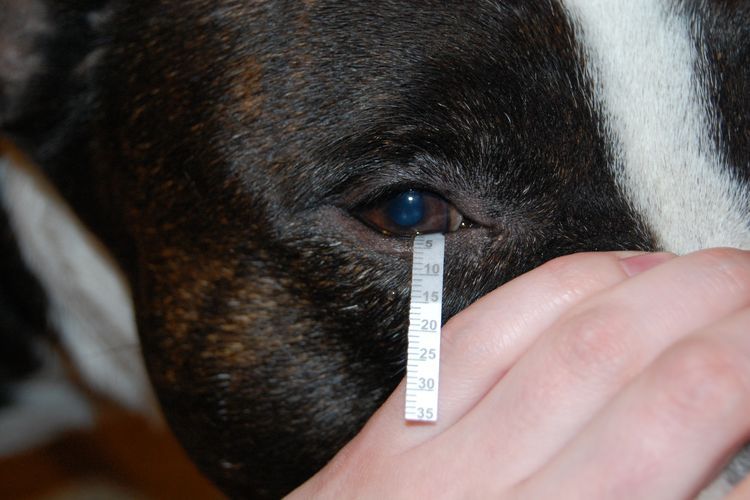
- Schirmer's test. It is carried out at keratoconjunctivitis, allows you to determine the amount of tear fluid produced.
- The Jones test allows you to assess the patency of the tear ducts.
- Fluorescein test. Performed to assess the condition of the cornea.
- Intraocular pressure measurement (prescribed if glaucoma is suspected).
- Ultrasound examination of the eyes. Ultrasound helps detect hemorrhages and inflammatory changes in the vitreous humor.
Treatment
Comprehensive treatment for red eye syndrome depends on the underlying cause. If the condition is infectious, antiseptics, antibiotics, antiviral, or antifungal agents may be used. To alleviate symptoms, dogs are prescribed anti-inflammatory, immunostimulant, and regenerative medications in the form of eye drops, ointments, and rinsing solutions.
The most popular among external ophthalmic agents:
- Sodium sulfacyl. Active ingredient: sulfacetamide;
- Sofradex. Active ingredients: framycetin sulfate, gramicidin, dexamethasone;
- Anandin. A water-glycerin solution of the immunomodulator glucaminopropylcarbacridone.
- Diamond Eyes. An aqueous solution of chlorhexidine, taurine, and budathionic acid.
- Iris. Active ingredient: gentamicin;
- Maxidin. Veterinary immunomodulatory drug;
- Tetracycline ointment. Active ingredient: tetracycline hydrochloride;
- Furacilin. Antimicrobial agent based on Nitrofural;
- Ciprovet. Active ingredient: ciprofloxacin.
To wash reddened and inflamed eyes and soften crusts that have formed on the eyelids, you can use folk remedies: green and black tea, decoctions of calendula, chamomile, plantain, elecampane, string, and sage.
Read also:
- When do puppies open their eyes?
- Dry Eye Syndrome in Dogs: Causes and Treatment
- Treatment for a Dog's Eye Spot


Add a comment