
My cat has a swollen chest: causes and what to do
If a cat's breasts are swollen outside of pregnancy, after breastfeeding, or in spayed cats, this may be a symptom of a serious illness.
Content
Norm and pathology
Normally, there is only one reason for breast swelling in cats – pregnancy and feeding of offspring. Nipples increase from the 4th week of pregnancy, especially in individuals, giving birth for the first time.
Owners often make a common mistake: weaning all the kittens at once. Early weaning can cause problems with the mammary glands, especially if it's the mother's first litter. The mother is under stress, and continued lactation is a reaction to this stress. As the time for birth approaches, the breasts become even larger.
Additional symptoms of stress include aggression, passivity, and refusal to eat or drink. Veterinarians recommend that owners not wean the entire litter, but keep at least one kitten to prevent milk from spoiling. This will minimize the risk of mastitis and mastopathy.
Hard breasts in a cat outside of pregnancy and lactation can be a symptom of several conditions. These include:
- false pregnancy;
- benign and malignant tumors;
- mentioned above mastitis And mastopathy.
False pregnancy
False pregnancy occurs for various reasons, including unsuccessful mating and hormonal imbalances. The symptoms are the same as those of a normal pregnancy:
- the cat is sick;
- the belly gets bigger;
- the nipples swell.
A false pregnancy can be diagnosed with an ultrasound. If the condition recurs several times, it is advisable to spay the animal.

Mastitis
Mastitis occurs due to stagnation of breast milk, infection with E. coli, or staphylococcus. The disease is accompanied by:
- swelling of the mammary glands;
- increasing their size;
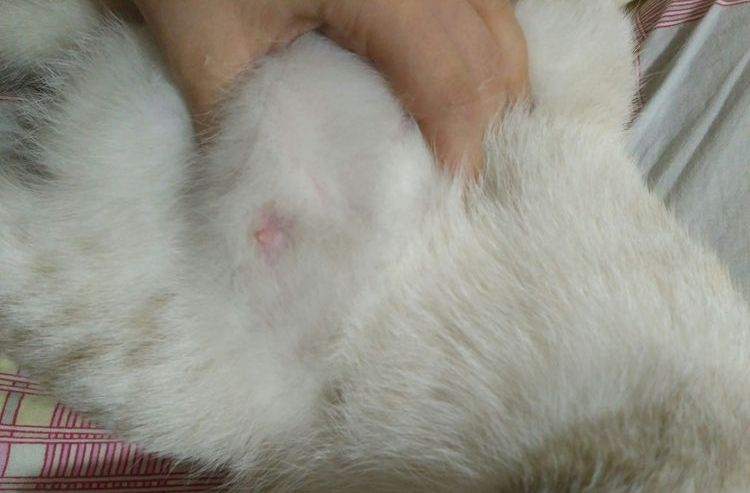
- redness, cracking skin;
- increase in temperature;
- discharge from the breast mixed with pus;
- in some cases – seals that can be felt during palpation.
Cats' behavior changes—they become apathetic, lethargic, and lose their appetite. Touching their mammary glands with fingers causes severe pain.
With mastitis, the milk ducts become inflamed and narrow in diameter, which impedes milk flow and leads to curdling. As a result, the breasts become hard, the cat becomes feverish, and seeks a secluded spot.
Untreated mastitis carries the risk of malignant transformation and sepsis. Only a veterinarian can accurately diagnose the disease and prescribe the necessary treatment.
In the initial stages, owners can help their pet express milk by gently pressing and massaging the nipple. This is possible as long as the animal does not have a fever. To stop lactation, apply a tight bandage to the mammary glands. The amount of fluid the female drinks will need to be reduced for a while.
Mastopathy
Mastopathy is an inflammation of the mammary gland, accompanied by the development of cysts and other lumps. If left untreated and without regular veterinary monitoring, the condition can trigger the formation and proliferation of cancerous cells.
Mastopathy is more common in individuals who have given birth and is practically not diagnosed in cats sterilized at an early age (before or after one year).
The signs of the pathology are in many ways similar to the symptoms of mastitis:
- the cat's breasts are swollen and enlarged;
- bloody discharge appeared;
- the glands are visually enlarged;
- touching causes pain to the female.
If detected early, mastopathy responds well to treatment; cats tolerate medications and injections well. In the early stages, the disease can be treated with iodine-containing medications and immunomodulators.
In advanced cases, when ulcers have appeared on the skin, conservative therapy is ineffective. Severe lesions require surgical intervention, during which the affected glands, as well as the uterus and ovaries, are partially or completely removed. The animal will require long-term rehabilitation.
Benign tumors
The symptoms of benign tumors are the same as those of mastitis and mastopathy. Additionally, the animal's lymph nodes become enlarged.
Cats with a history of hormonal imbalances or mammary trauma are at risk. Some individuals are genetically predisposed to developing benign tumors.
Obesity, frequent childbirth, and taking medications that suppress libido and hormones can trigger breast growth. The severity of the growth can only be determined through a comprehensive examination.
Cancer
Malignant neoplasms are dangerous because they develop latently for a long time. The first warning signs are:
- breast enlargement and firmness;
- lethargy, apathy;
- refusal to eat;
- sudden weight loss.
At the early stage, the tumor can be removed and the animal's life can be saved. Statistics show that 80% of animals survive with timely treatment of stage 1 cancer. At stage 2, surgery and chemotherapy are performed, but only 50% of cats survive.
In the late stages, the prognosis is pessimistic. The cancer metastasizes to the brain, liver, and other organs. The tumor constantly grows, invading adjacent tissues—it's impossible to miss. In these situations, treatment is symptomatic, aimed at relieving pain and improving quality of life.
Chemotherapy and radiation therapy are administered only in a hospital setting under constant veterinary supervision. Some owners refuse them for fear of causing their pet to go bald. These fears are unfounded—the cat's fur will be preserved, unlike human hair.
Owners should understand that while the tumor is dissolving, it's impossible to help the animal. The most humane option is to euthanize the animal.
Diagnosis and prognosis
Any changes in the mammary glands are a reason for an unscheduled visit to the veterinary clinic. The cat will undergo a series of instrumental examinations and laboratory tests. These will take 2-10 days. The most informative diagnostic methods are:
- examination with palpation;
- complete blood count;
- urine analysis;
- examination of breast discharge;
- Ultrasound;
- X-ray examination;
- biopsy;
- MRI.
A comprehensive set of tests allows us to assess your pet's health, establish an accurate diagnosis, and select the most effective treatment. This may involve conservative therapy or a combination of surgery, medication, and radiation therapy.
In the early stages of any disease, the prognosis is favorable and the chances of a full recovery are high.
Diagnosis and treatment of mammary tumors in cats: video
https://youtu.be/j4MAiiTpTgk
Read also:
- Mammary tumor in a cat
- Breast cancer in cats
- Elevated white blood cell count in a cat: causes and treatment


8 comments
Natalia
Good day! We spayed my young female cat, about 8 months old, after her first heat; she'd never had a male cat before. Almost immediately after the spay, all of her mammary glands became swollen. The vet said it was normal, a hormonal imbalance, and that it would go away on its own. You could wipe her mammary glands with camphor alcohol. Two months have passed, and the swelling hasn't gone down... Please advise us on what to do, as I love my cat madly; she's a member of the family, a part of my soul, and I'm very worried about her! Thank you SO MUCH!
Daria is a veterinarian
Hello! I'm very curious about the effect of camphor alcohol on hormonal levels. Perhaps the warmth should have reduced the swelling, but the hormones just won't calm it down. I need to get an ultrasound to check what's going on inside. Did they remove her ovaries or just leave them and tie her tubes? I'm not ruling out fibroadenomatosis, in which case hormone injections would be sufficient. I also don't rule out a retentive ovary, which is what's causing this hormonal surge. How long after her heat cycle was it before the spay?
Marina
Hello, my cat is 1 year old, not spayed. She asked for a male cat, but nothing happened. Two weeks have passed, all her glands are swollen, but there are no nipples.
Daria is a veterinarian
Hello! Has your cat been given anything to suppress her heat (medications, drops, tablets, etc.)? This sometimes occurs in cats if progesterone levels are elevated (this can happen after hormonal medications). If this occurs, take your pet for an appointment. Rule out mammary fibroadenoma due to hormonal changes. This is treatable without surgery. However, an examination and a thorough medical history are necessary.
Zara
Hello, please tell me, my cat gave birth and we gave the kittens away when they were 1.5 months old, and now I see that all of the cat's mammary glands are swollen
Daria is a veterinarian
Hello! Did the cat nurse her kittens just before weaning? If so, due to the sudden separation of the kittens, milk continued to be produced and flowing into the mammary glands. No one is eating it, causing stagnation. Lactostasis will first occur, then mastitis. Take her to the vet, where they will properly tighten (tightly bandage) the glands to prevent the mammary glands from filling with milk. They will prescribe Lactostop and similar medications. Eliminate all "juicy" feedings, reduce fluid intake, and reduce the amount of food to reduce milk production. Do not express milk yourself! Otherwise, more and more will come in!
Diana
Hello, please tell me, my cat (3 years old, not spayed) has swollen mammary glands. Four days before, we took her to the dacha; car travel is always stressful for her. Then it started. She ran around the dacha eating grass, and then vomited it up. She's active and playful, and responds well to massage of her mammary glands. I won't be able to leave the dacha for the next week. Can you tell me what's wrong?
Daria is a veterinarian
Hello! How can you tell what's wrong with an animal without seeing it? It could be an allergic reaction, or a hormonal imbalance (like her heat is approaching). There could be other pathologies. You need to examine and feel the animal, and get a full medical history (when it started, any treatments, contact with other animals, any other clinical signs).
Add a comment