
Territorial aggression in dogs
Dog owners sometimes encounter problems with disobedience and pronounced territorial aggression in dogs toward other dogs or people. Most often, this behavior is territorial aggression in dogs. Of course, the territory where an animal forages for food, rests, and breeds must be protected. But while such instincts help a dog survive in the wild, in urban environments they pose a problem and a danger to others.
Content
- 1 Biological basis of territorial aggression in dogs
- 2 Risk factors and predisposing causes
- 3 Reasons
- 4 Signals warning of territorial aggression
- 5 Proper training of a puppy
- 6 Scenarios for the manifestation of territorial aggression
- 7 Correction of territorial aggression
- 8 A step-by-step plan for working with a dog
- 9 Practical advice for owners
- 10 Frequently Asked Questions
Biological basis of territorial aggression in dogs
Territorial aggression in dogs is linked to innate resource-guarding mechanisms and instincts to protect their group. Biologically, this response is driven by the release of stress hormones and the activation of areas of the brain responsible for safety. When a dog perceives an invasion of its "territory," its body prepares for action: its heart rate increases, muscle tension increases, and its attention is focused on the threat.
These reactions are inherited by dogs from their wild ancestors. In nature, defending territory was a matter of survival: only those animals that knew how to protect their habitat and food resources had a better chance of raising offspring. Therefore, territorial aggression is a natural behavior, although in captivity it often becomes a problem.
Risk factors and predisposing causes
The development of territorial aggression in dogs is influenced by a combination of innate characteristics and upbringing conditions.
| Group of factors | What does it include? | How does it manifest itself? |
|---|---|---|
| Genetics and breed | Guard and shepherd dogs are more likely to guard space | Active barking, aggressive behavior near the house |
| Socialization | Insufficient contact with people and animals during puppyhood | Fear of strangers, turning into aggression |
| Health status | Pain and chronic illnesses increase irritability | The dog reacts sharply even to familiar people |
| Parenting mistakes | Harsh training methods, inconsistency | Distrust of the owner, unauthorized guarding |
| Behavior reinforcement | Successful "chasing away" of strangers | The dog is convinced that aggression works. |
It's important for owners to keep in mind that territorial aggression rarely arises out of nowhere. It usually develops gradually, and an attentive owner can notice the first warning signs.
Reasons
A distinction is made between territories with fixed and "fluid" boundaries. Territory defense is most pronounced in areas with clear boundaries, such as a house, a kennel, a car, etc. Regardless of who crosses this boundary, aggression manifests itself through growling, barking, and possibly even biting, and intensifies as the distance between the dog and the adversary decreases.
The animal feels less confident in a new environment. Aggression is part of normal behavior.
It's perfectly natural for a dog to protect its territory. This is expressed to a greater or lesser degree depending on breed, gender, age, personality, and, of course, upbringing. A sense of ownership develops in animals around 1.5 years of age, and is more pronounced in males. Territoriality is primarily characteristic of guard and herding breeds, while it manifests to a lesser degree in service dogs and is certainly not characteristic of toy and hunting dogs.
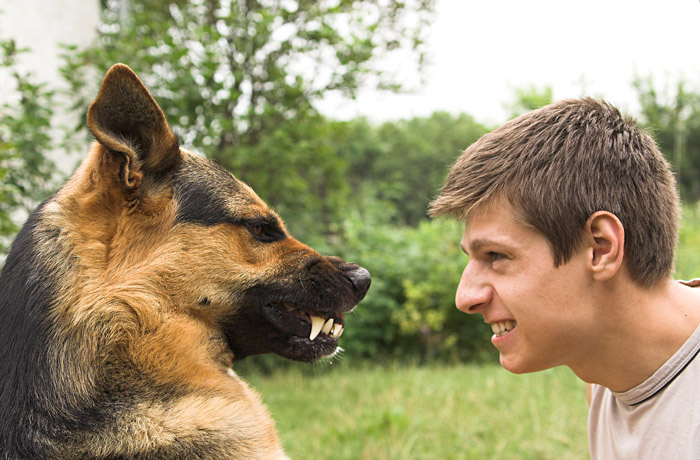
Signals warning of territorial aggression
Dogs never suddenly attack—they send out a whole set of signals. By recognizing them, the owner can react in time.
-
A closer look at the invasion target
-
Raised hair on the withers and tail
-
Tense stance, body leaning forward
-
Flattened ears, growling or snarling
-
Lunges towards an approaching person or animal
The sooner the owner learns to notice such signs, the easier it is to correct the dog's behavior.
Proper training of a puppy
Sometimes owners unknowingly make mistakes in training and training, which reinforce the territorial instinct. They confuse the desire to protect the owner with territoriality, when the animal defends its own interests. First of all, you can't allow a dog to independently decide what to guard.
Read also: agility for dogs - What is it and the best breeds for training
Territorial aggression in dogs should be strictly controlled by the owner's command. Walking along a specific route, especially if it's the perimeter of a park, inadvertently develops a sense of ownership in the animal.
To calm an aggressive dog, the first thing an owner does is cuddle it, pet it, and sometimes give it a treat. This is not recommended. The dog perceives affection as praise, and in this case, it's for the dog's expressed aggression.
Scenarios for the manifestation of territorial aggression
Territorial aggression can manifest itself in different ways, depending on the conditions of detention:
-
Guarding a yard or apartment: the dog reacts violently to strangers at the gate or door
-
Behavior on a walk: the animal protects paths or benches to which it is accustomed
-
Intra-house aggression: protecting a bowl, bed, or favorite resting place
-
Reaction to the owner: the dog perceives the person as a “resource” and reacts aggressively to the approach of strangers
Correction of territorial aggression
Working with an aggressive dog requires patience and consistency. It's important to remember that aggression can't be "brought down" by force—this will only make the problem worse.
The first thing the owner should do is change the walk route. As mentioned earlier, dogs tend to be calmer in new territory. Always keep the dog on a leash and muzzled. When encountering other animals or people, try to get the dog to sit and reward calm behavior with a treat. Scrutinizing or yelling at the dog is pointless; commands should be given in a confident, calm tone. If the dog disobeys, show it who's in charge by jerking the leash sharply.
Sometimes a dog has chosen the house as its territory and, naturally, reacts aggressively to anyone who crosses the threshold. In this case, the animal is not allowed to greet guests but is locked in another room. Only after a certain amount of time can the dog be brought out to the visitors on a leash and praised for its calm behavior. It's best if the guests don't show any interest in the pet during this time.
Effective approaches:
-
Desensitization and counterconditioning– a gradual decrease in sensitivity to stimuli with the simultaneous formation of positive associations (for example, a dog receives a treat when a guest enters the house).
-
Basic command training– “place”, “come to me”, “next to me” help control the dog’s behavior in stressful situations.
-
Environmental Management– restricting access to windows, using fences and muzzles to reduce the risk of attack.
-
Positive reinforcement- rewarding calm behavior instead of punishing aggression.
-
Professional help– a zoopsychologist or dog trainer will be able to develop an individual work program.
A step-by-step plan for working with a dog
| Stage | Task | Actions of the owner |
|---|---|---|
| Behavior analysis | Identify triggers | Keep a diary of situations when the dog shows aggression |
| Environmental control | Minimize provocations | Close access to windows, fence off the yard |
| Initial training | Working remotely | Place commands, distraction with toys or treats |
| Gradual approach of the stimulus | Decreased sensitivity | Letting someone get closer while maintaining control |
| Reinforcing calm behavior | Translating into a habit | Regular exercise, reward for success |
Practical advice for owners
-
Don't let your dog patrol the yard or entrance on its own.
-
Get your pet used to visitors gradually: short visits first, then longer ones
-
Never physically punish a dog for barking or growling - this destroys trust.
-
Create a clear routine: feeding, walking and rest should be on schedule
-
Use mind games and training to channel your dog's energy in a useful way.
Frequently Asked Questions
Is it possible to completely get rid of territorial aggression?
It is impossible to completely eliminate innate instincts, but you can teach your dog to control them.
Should I use a muzzle?
Yes, this is a safety measure, especially in the initial stages of correction.
Is medication support necessary?
In some cases, your veterinarian may prescribe medications to reduce anxiety, but this is always a supportive approach and not a primary solution.
How to act in case of unexpected aggression?
Remain calm, do not yell, or use force. Distract the dog with a command or a treat.


Add a comment