
A story about the difficulties of the general course of training
OKD is a general training course. As the name suggests, it focuses on obedience. It is based on the knowledge of commands such as "heel," "sit," "down," "stay," and "stay," as well as fetch, the dog's attitude toward the muzzle, and the bite. Typically, the OKD training course is "accelerated," lasting four to six months. This isn't entirely true, and frankly, it's not true at all. However, the purpose of this article is not to challenge certain dog training tenets, but to help novice dog owners prepare for the OKD exam.
So, four months have flown by, and the instructor in the group where the owner and his pet were training announces the "day of reckoning." Fear has them forgetting everything the instructors taught their students on the training ground, and even more so the sequence of actions. There's no need to panic; it's not as scary as it seems. Just don't go overboard with your dog in the last week before the exam; it's unlikely to help. Classes should continue as usual, without any "new" additions.
The day before the exam, it's time to give your pet a rest. Judgment Day has arrived, and the owner, in workout clothes (jeans, a comfortable T-shirt, and sneakers are fine if the exam is held in warm weather), anxiously awaits their turn to enter the training area, watching the other dog taking the exam. The excitement mounts, and when it's the new trainee's turn, their knees begin to shake and their legs begin to buckle. The owner leans over to unclip the dog's leash, and… Stop!
To begin, take a deep breath, close your eyes, and mentally say, "I can do this." Do this with faith and firm conviction. Then, calmly lean toward the dog, unfasten the leash (the dog should enter the arena without one), put on the muzzle, and begin walking on command "heel." Approaching the judge, stop, command the dog to "sit," and approach the judge without the dog. The handler hands the judge a dog card containing their initials, the dog's full name, and its breed. This card is issued by the instructor before the exam. After handing over the card, the handler reports:
"Comrade Judge! Instructor Ivanov and his German Shepherd named Jessie have arrived to take the general training course standard."
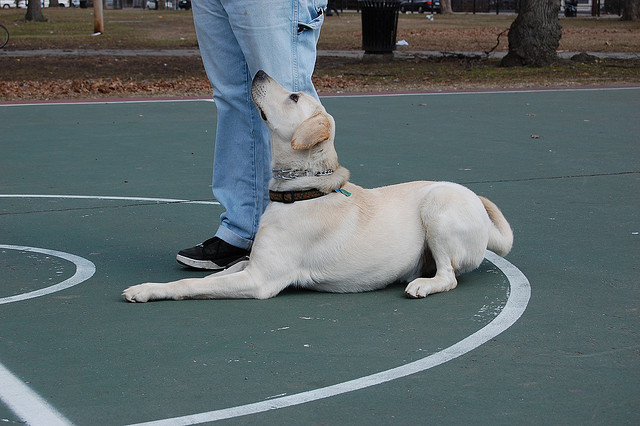
After this, at the judge's direction, the handler returns to the dog, which has been sitting the entire time, and removes the muzzle. The judge approaches the handler with the dog and asks for a bite. The handler places their left hand under the dog's lower jaw and their right hand on the upper jaw, using their fingers to spread the dog's jowls while saying the command "show bite." The dog must not resist; if the dog displays aggression, the overall score for this command is reduced.
The bite is indicated, and the judge instructs the dog to move away from the dog, leaving it in a specific position. This is usually the command "down," but sometimes it's "sit." The handler gives the dog the command specified by the judge and moves away from the dog to the distance specified by the judge—usually 15 to 30 meters. Then, the judge announces "Stand!" (or another command), and the handler must convey the command to their dog using voice and gestures. Deviations from correct execution include repeating the command if the dog doesn't perform it the first time, moving forward from the indicated place (when commanded "stand"), or attempting to run toward the handler. Three attempts are allowed, but if the dog fails to perform the command, it is disqualified from the exam. There are three commands in total: "sit," "stand," and "down."
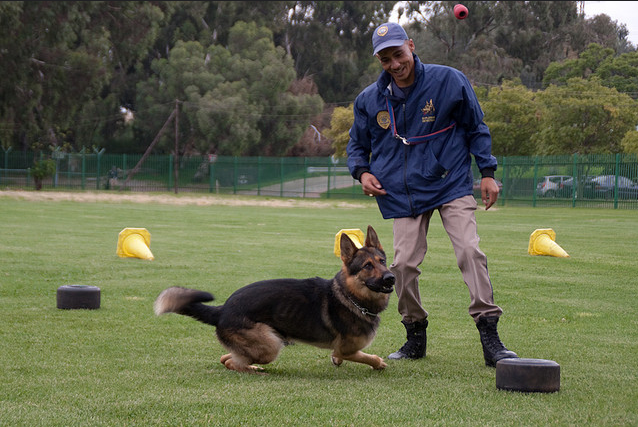 Once the sequence is completed, the handler approaches the dog, positions himself so that the dog is at his left foot, and, at the judge's command, begins walking alongside. The handler and dog walk forward for ten meters, then the judge commands the direction in which to turn.
Typically, it goes like this: "Start moving alongside! Straight ahead! Left! Right! Straight ahead! Back up!"
After the word "back," the handler and dog return to their starting position. The dog sits at the handler's left leg, awaiting the next command. This may be fetch. The animal sits at the handler's left leg, and the handler throws the retrieving object. The dog should never run after the "toy" without the command "fetch," as this will deduct points. On command, the dog runs after the object, retrieves it, returns to the handler, sits opposite them, and only then hands the retrieving object over to the handler.
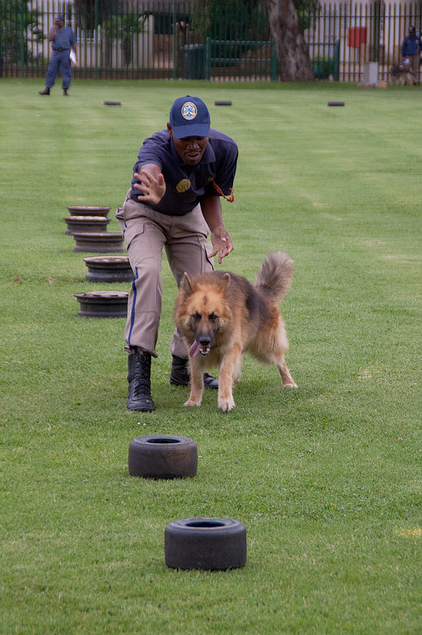
Next comes the "place" command. The handler lays the dog down, places an object (a backpack, bag, etc.) in front of it, and gives the "place" command. The handler then moves away from the dog a distance specified by the judge and calls the dog with a voice and gesture, using the "come" command. The dog runs up to the handler, walks around him, and sits at his left leg. The handler then sends the dog to the object, giving the "place" command. The dog must return to the place and lie down next to the object.
After the obedience test, the second stage begins.
Subjects are asked to navigate the following obstacles: a boom, a slide, a ladder, and finally, a hurdle. The dog approaches each obstacle with the handler on command. It sits at the left leg and, only after the command "forward," does it traverse the obstacle. After the animal has navigated each obstacle, the handler gives the command "heel" as soon as the dog's front paws touch the ground. The dog then continues traversing the obstacle.
When the exam is over, the judge thanks the handler and asks them to return to their seat. The trainer returns to the group and awaits the results. OKD-1, OKD-2, and OKD-3 are the three levels of the general training course. If the dog and handler score between 60 and 79 points, they receive OKD-3. Between 80 and 89 points, they receive OKD-2. Finally, those who score between 90 and 100 points are awarded OKD-1.
To keep your dog energetic and healthy, feed them a nutritious, balanced diet. We recommend a balanced diet, combining both dry and wet food. Wishing your future champion good health!
Read also:
- How to teach a dog the command "Attack"?
- Dog agility: what it is and the best breeds
- UGS for dogs: what is it and what does it include?


Add a comment