
The structure of a dog
Understanding a dog's body structure is important information for owners. Knowing this can help prevent many health problems. Owners can quickly spot behavioral abnormalities or provide first aid if necessary.
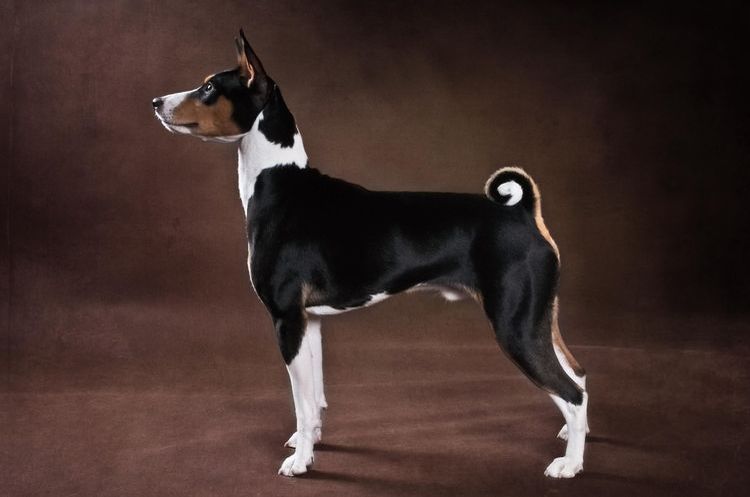
Dogs of different breeds, although very different in appearance, have virtually the same structure. Armed with this knowledge, you can easily create a comfortable environment for your pet and raise it to be active and healthy.
Content
Skeleton or skeletal system
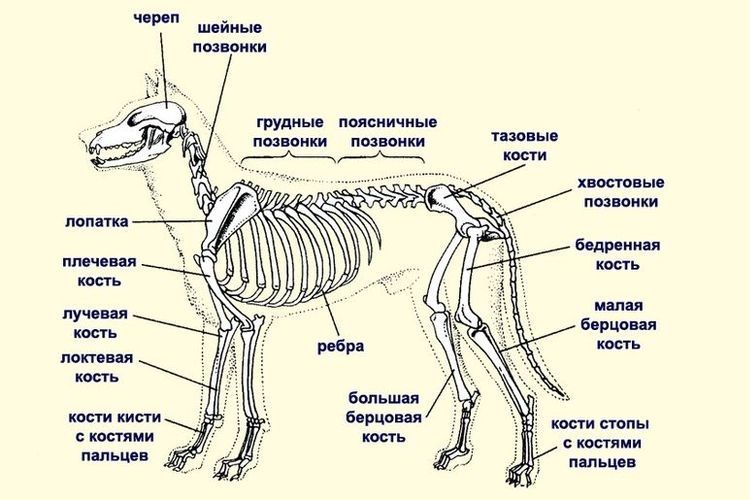
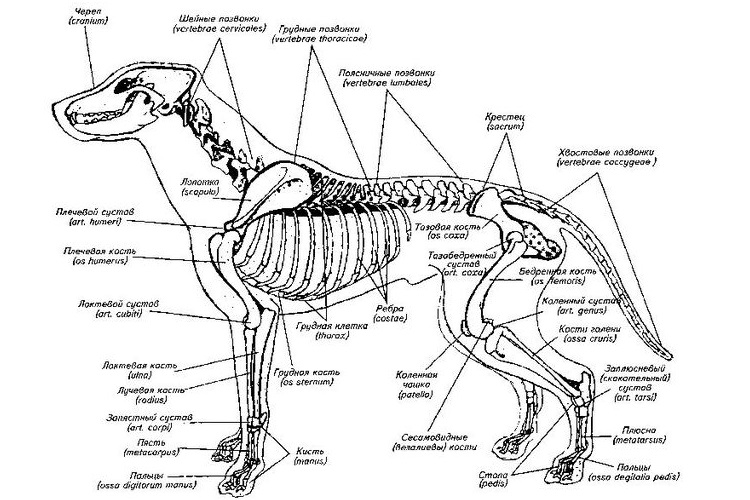
The skeleton is the framework that supports all of a dog's internal organs and muscles. The structure of a dog's skeleton can be easily represented on a diagram as two lines:
- axial, which includes 109 bones (skull and spine with ribs);
- peripheral, consisting of 180 limb bones.
Throughout an animal's life, the composition of bone tissue changes. Therefore, puppies and adolescent dogs have more elastic and lighter bones, while as they age, they are more likely to become brittle and lose strength. The condition of bones and teeth is an indicator of a dog's overall health.
The structure of the skull
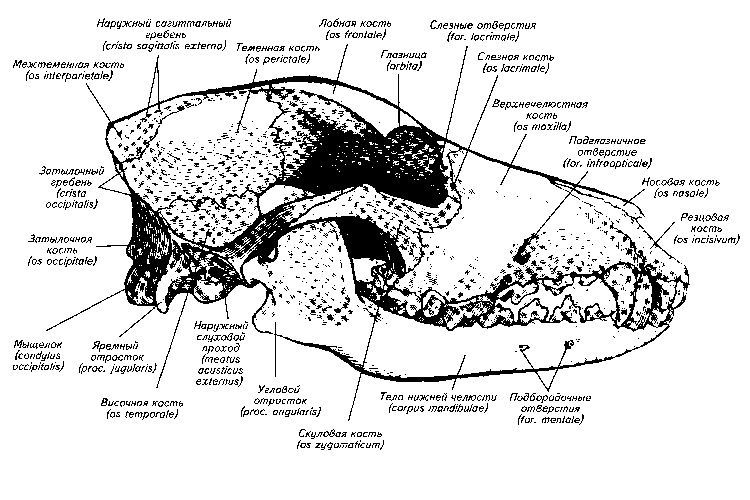
The skull is divided into the facial and cranial parts, both of which contain paired and unpaired bones. The skull consists of 27 bones, connected by cartilaginous tissue. With age, the cartilage ossifies, and mobility remains only in the lower jaw, allowing the dog to chew food.
The figure shows both paired and unpaired bones of the skull.
Based on skull type, dogs are divided into dolichocephalic breeds (notable examples include Italian Greyhounds and Greyhounds) and brachycephalic breeds (e.g., pugs and miniature Spitz). The most significant differences between them are visible in the facial structure. Brachycephalic breeds have a flattened muzzle and a protruding jaw. These traits have been specifically cultivated by breeders over many years to make the breeds recognizable. However, these characteristics are associated with certain health problems.
Structure of teeth
Teeth Teeth are not only an important part of a dog's appearance. They are also essential for biting and grinding food, protecting their owner, and, if necessary, attacking an enemy.
Puppies are born without teeth. At two to three weeks of age, the first baby teeth emerge through the gums. Around four to five months, they begin to fall out to make room for the permanent teeth. By the age of one and a half years, the jaw should have 42 permanent teeth, replacing the 28 baby teeth. Deviations from this schedule are often due to an unbalanced diet or breed characteristics.
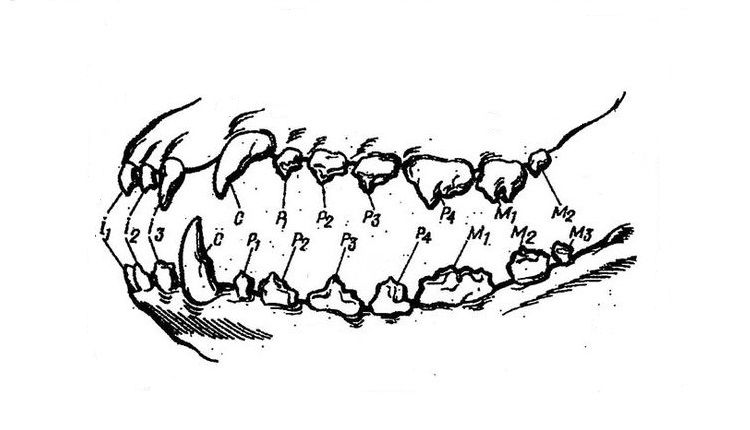
The dental formula of an adult dog includes 42 teeth, 20 of which are located on the top and 22 on the bottom.
The permanent set of teeth of an adult dog includes:
- Incisors – 6 on each jaw.
- Fangs – two on top and two on the bottom. They are a dangerous weapon in combat.
- 4 premolars on both branches of the jaws.
- There are two molars on each branch of the upper jaw, and three on the bottom, for a total of 10 pieces.
A tooth consists of a crown, neck, and root. The crown protrudes significantly above the gumline and has a unique shape for each tooth type. Dentin is the main tissue of the tooth; in the crown area, it is covered by enamel, and in the root area, the dentin is covered by cementum. Inside the tooth, there is a cavity divided into the coronal space and the root canal itself.
The number of teeth, their condition, and bite (or occlusion) directly impact a dog's health. The following bite typologies are distinguished:
- Scissor-shaped.
- Pincer-like.
- Snack.
- Underbite.
The most common type is the first type of bite. Read about malocclusion in a dog on our website.
The structure of the spine
The spinal column is the axis of the skeleton. The skull is attached to it on one side, and it ends in the tail. The ribs and limbs are also attached to it on the sides by cartilaginous tissue.
The structure of the spine can be represented as follows:
- The cervical spine consists of seven vertebrae, the first two of which (the atlas and the cervical spine) are particularly mobile. They are responsible for head movement.
- The thoracic region consists of 13 vertebrae. Attached to them are the ribs, which form the rib cage. Dogs have 9 pairs of true ribs and 4 pairs of false ribs.
- The lumbar region also consists of 7 vertebrae.
- The sacral region is a fused sacral bone consisting of three vertebrae.
A dog's tail, a logical extension of the spine, consists of 20-23 vertebrae. The first five are the most developed and mobile. In the past, tails of some breeds were docked, but this practice is no longer supported by the global canine community.
The structure of the dog's penis deserves special consideration, as it also contains a bone called the baculum, which is formed from the connective tissue of the penis. The baculum is located at the anterior end of the penis. Its upper edge is convex, and underneath, there is a groove containing the urogenital canal. In dogs, the penis is part of both the reproductive and excretory systems, as the urethra also serves as the vas deferens.
Structure of the limbs
Dogs' limbs are complex in structure. The forelimbs are an extension of the scapula, which is attached to the spine by well-developed shoulder muscles. The scapula continues into the humerus, then the forearm and carpal joint. The forearm consists of the radius and ulna, and the metacarpus (canine metacarpus) is made up of five bones. The hind legs are formed by the femur, stifle, tibia, hock, metatarsus, and paw.
The structure of the paws can also be represented this way:
- Pads act as shock absorbers. They reduce stress on bones and joints and help maintain balance. The pads are composed of a substantial layer of fatty tissue, so dogs stay warm in cold weather and their paws retain heat well.
- Pets' toes vary in the number of phalanges. Four toes have three phalanges, while one toe has only two. Animals cannot wiggle their toes as humans can due to the limited space between the toes. Dogs normally have five toes on their front paws and four on their hind paws. There are also vestigial toes—dewy dewclaws located on the hind legs just above the foot. They serve no functional purpose, but in some cases they can be a sign of a high-quality breed. This is true for Briards, Beaucerons, and Pyrenean Mastiffs.
- Unlike cats, dog claws are not retractable and consist of tough, keratinized tissue and pulp—an area rich in blood vessels and nerve endings. It's important to be extremely careful when trimming nails to avoid causing injury or pain. It's also important to monitor the condition and length of the nails, as they are directly connected to the musculoskeletal system. Long nails prevent a four-legged pet from walking normally and can even cause skeletal deformities.

Sense organs
A dog's senses are similar to those of humans, but differ in how they are distributed. The most important are smell and hearing. All senses are controlled by the brain, which processes all incoming signals and generates a response—an action command.
Another peculiarity of dogs is that even if their sense of smell, sight and hearing are “switched off”, they will still have well-developed tactile organs.
The structure of the nose
Smells have a powerful influence on both well-being and physiology. The memory of smells is retained throughout an animal's life and influences many aspects of its behavior. This unique quality is due to the unique structure of their nose. The average-sized dog's nose has approximately 125 million odor receptors, while a human's has approximately 5 million. Dogs receive information not only when they inhale but also when they exhale.
An animal's nose consists of an external part and a nasal cavity. The mucus lining the inside of the nose oozes outward, so pets' noses should normally be moist. This mucus acts as a filter and analyzer of odors from the surrounding world.
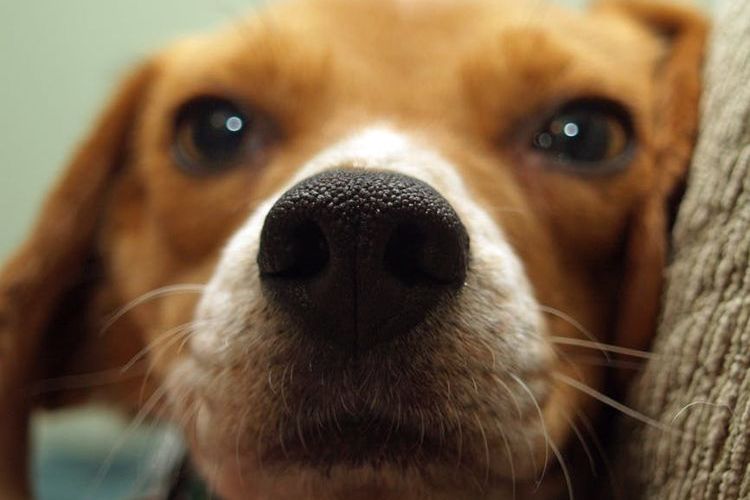
The nasal cavity is divided into upper, middle, and lower passages. The upper part contains the olfactory receptors, while the lower part carries air to the nasopharynx. The lateral openings on the nostrils play a major role in odor recognition; almost half of the inhaled air passes through them.
Interesting fact! A dog's nose, specifically the outer pigmented part, has a unique pattern that is unique to nature, making it easy to distinguish between these four-legged pets.
Structure of the ear
The structure of a dog's ear is similar to that of a human's, consisting of the outer, middle, and inner ear. The outer ear is formed by the pinna and the auditory canal. The pinna is each dog's personal sensory organ, used to perceive sound signals. The size and shape of the pinna can vary significantly depending on the breed.
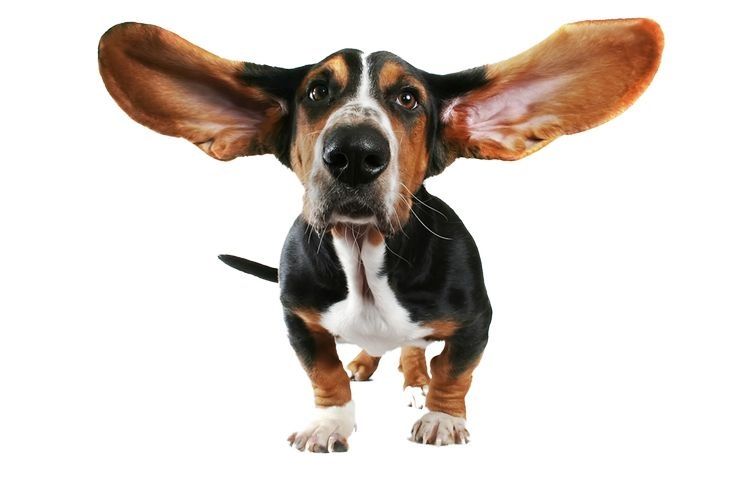
The middle ear consists of the following components:
- Tympanic cavity and membrane.
- Eustachian tube.
- The malleus, stapes, and incus are the auditory bones.
The inner ear contains the receptors of hearing and the organ of balance.
The secret to dogs' excellent hearing lies in their elongated ear canal and impressively large tympanic cavity. A dog's ear can detect signals with a frequency of up to 45,000 Hz, while a human's can only detect up to 25,000 Hz.
However, these structural features also have their drawbacks. The ear canal is positioned in such a way that if fluid gets into it, it cannot escape. This increases the risk of ear diseases and complicates their treatment.
Structure of the eye
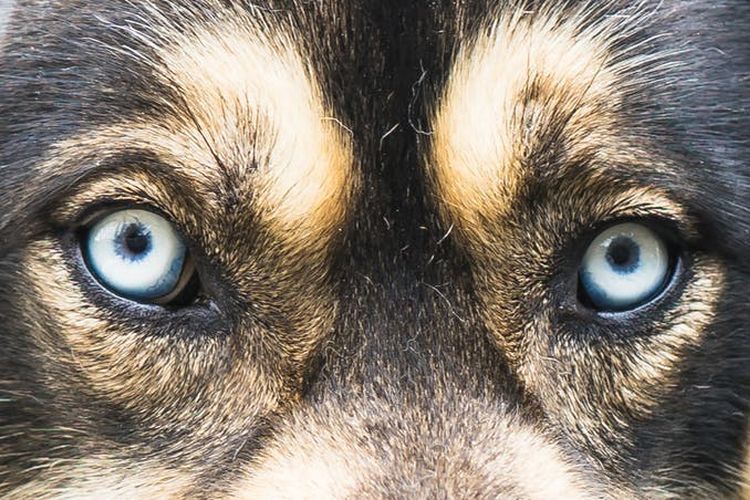
Dogs' eyes are very similar to human eyes, so their perception of visual information is no different from that of other mammals. They are covered from the front by upper and lower eyelids. The eyelids are protected by dense hair on the outside, and eyelashes grow along their edges.
The eye consists of the eyeball, which is connected to the brain by the optic nerve. The visual organs consist of several layers: the outer, middle, and inner layers.
In dogs, rods and cones are responsible for visual perception. This is different from human vision in that dogs lack a macula lutea, where these light-sensing elements are concentrated. Therefore, their vision is less clear and acuity. Dogs see approximately a third of what humans see, but they are able to perceive visual information in varying lighting conditions, even the poorest. Dogs also have superior panoramic vision.
Read also:


Add a comment