
Sokoke: cats and kittens
One of the most ancient cat breeds that has survived to this day is sokokeThe ancestors of these glorious animals are believed to be the African Hadzonzo – wild cats of the Kenyan forests.
Content
History of the breed
Hadzonzo (which translates as "tree bark-like") spent much of their time perched in trees, feeding primarily on insects. In early 1978, Janie Slater, an Englishwoman temporarily living in Africa, discovered tiny, unusual creatures near her home—the very same ones that would eventually become the ancestors of the entire Sokoke breed.
Later, by mid-1984, Jeni's close friend, Gloria Moldrap (a Canadian by birth, then living in Denmark), noticed the unusual kittens and became seriously interested. After persuading Jeni to give her a pair of kittens, she began breeding them in earnest.
So, in late 1985, Moldrap entered a completely new breed into a cat show. Janie Slater focused exclusively on breeding cats, while Gloria created a specialized breeding program for Kenyan cats.
Denmark became the first country to officially recognize the African Shorthair Sokoke as a breed in 1990. By mid-1993, the name "African Sokoke" had been officially confirmed by the International Cat Organization (FIFe).
General characteristics of the breed
What do Sokoke dogs look like?
Appearance
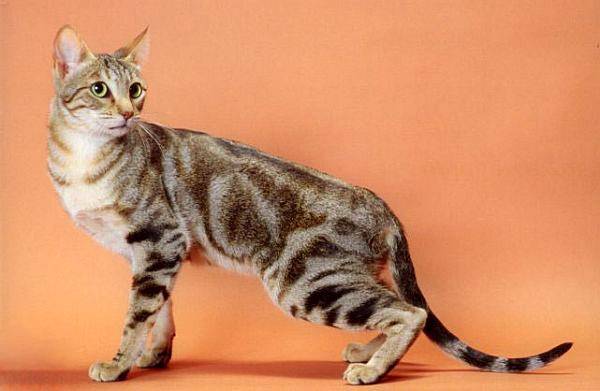
Typical Sokoke dogs have a slender, muscular body with long, flexible legs and a medium-length, solid black tail, slightly thickened at the base and tapering toward the tip. Large, beautiful, medium-sized ears with cheetah-like tufts at the corners are set close together and appear to be always tense. Sokoke dogs appear to be constantly listening for something.
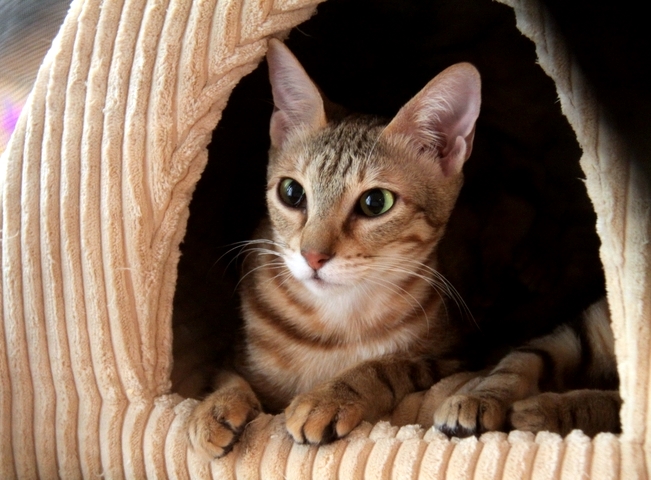
The large, round, and incredibly expressive eyes, set diagonally from the nose, are also very beautiful. The small muzzle, adorned with emerald eyes, evokes a sense of delight in such a sweet animal. It's worth noting that the Sokoke's eyes change color depending on the cat's mood.
When the cat is happy, its color can be amber, while when stressed, it takes on a light green appearance. The Sokoke's hind legs are typically longer than its front legs. This makes its gait quite amusing, something one can watch for hours on end: it appears to be crouching as it moves.
The Sokoke's incredibly beautiful coat features a marbled tabby pattern on a dark background, with a variety of shades. The Sokoke's short, shiny coat doesn't feel silky at all, and the undercoat is often completely absent.
Character
The Sokoke's easygoing, playful nature prevents her from lounging in a chair all day. She's incredibly active: she runs, jumps, and plays while many other cats are snoozing on their owners' laps or in dark, out-of-the-way nooks.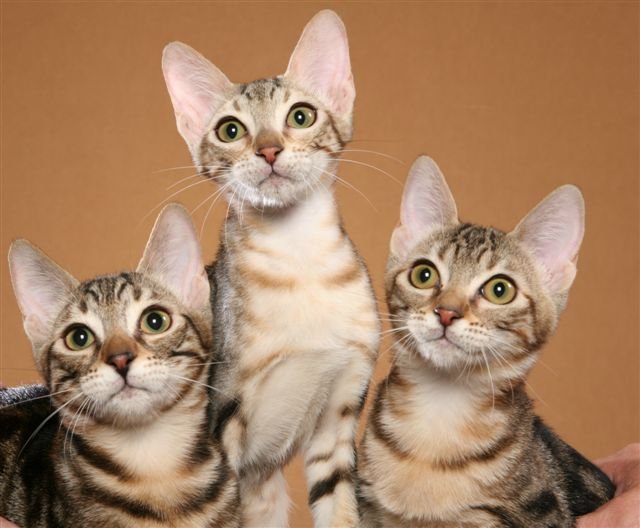
Also, the cheerful nature of cats of this breed allows them to easily make friends with all family members (of all ages) and with other pets.
Rules of care and nutrition
How to properly care for Sokoke cats?
Care
Sokoke cats don't do well, if not quite well, in confined spaces. Due to their increased activity and energy, they require plenty of space. It's recommended to keep a Sokoke in a spacious apartment or house with a large yard, preferably fenced.
The cat's short fur requires constant care: about twice a week, it is necessary to carefully and gently comb the fur with a soft brush to give it a special shine.
This breed has a remarkable love of water. Bathing becomes an extraordinary pleasure for both cat and owner.
Nutrition
Sokoke nutrition, like that of any other cat breed, should be balanced, nutritious, and varied. From a young age, kittens become accustomed to eating proper food and transition seamlessly to adult food.
Particular attention should be paid to ensuring the body receives vitamin E and taurine. Taurine is essential for the health of sokoke dogs. It influences the cardiovascular system and metabolic processes.
Health
Sokoke are distinguished by excellent health and a virtually complete absence of genetic diseases.
Exceptions include injuries common to all cats that occasionally go outside and roam freely (bruises, cuts, infections and parasites), as well as nervous disorders.
Easily excitable Sokoke are prone to hysteria, depression, and neuroses. Often, these nervous disorders are hereditary.
Video review of the Sokoke cat breed (voiceover in English)
Read also:


1 comment
Sardor
I think the Sokoke breed is very similar to the Bengal breed.
Add a comment