
Siberian Cat Park in Tyumen
The Siberian Cat Square in Tyumen is a favorite recreation spot for city residents. This unique sculpture complex was erected in the city center to commemorate the heroic deeds of cats during the Great Patriotic War. They were instrumental in saving the residents of Leningrad during the siege from starvation and rodent infestation.
Humans' reverence for cats dates back to the earliest days of civilization. The ancient Egyptians endowed these graceful animals with superpowers and held them in high esteem. The Romans identified felines with symbols of freedom and independence. In Japan, cat figurines were placed at the entrance to homes as a talisman.
A love of cats has endured to this day. Sculptures depicting these animals adorn the streets of London, Singapore, Haifa, Riga, Vladivostok, Novgorod, Moscow, St. Petersburg, and other cities. However, the most original composition is considered to be the sculptural ensemble located in the heart of the Russian city of Tyumen.
Content
The history of the Siberian Cat Park
Interestingly, the original design was conceived by the creators differently than it currently appears. The sculptures were to be made of granite and marble. The "Alley of Pink Cats" (the original name of the park) was supposed to be adorned with several sculptural compositions: a "fish" in the center, a "family" to the right, and a "love" to the left. The reason why this plan was never realized is unknown.
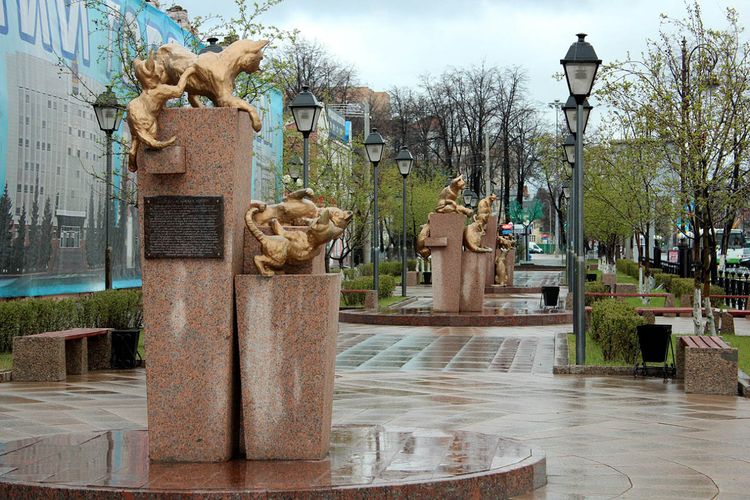
It is believed that the sculptural ensemble was created by sculptor Marina Alchibaeva. In fact, she designed the park itself. The striped animal figures were cast at the renowned Demidov factory in Kasli. The company became famous far beyond Russia for its "openwork casting."
A team of artists worked on the project's design. Elena Zimina conceived the "cat and kittens" ensemble; the cat scratching behind the ear was Svetlana Glazkova's idea. Pavel Pakharukov designed and developed the composition featuring the cat climbing the pedestal.
The square stood empty for a long time. It once had alleys with trees planted along the paths. After the "cat sculptures" appeared, some of the trees had to be cut down. The photo shows how seamlessly the "Siberian Cat Square" fits into the overall urban landscape.
The square opened in 2008 during the city's celebration. The project's name was long in the making. A competition was announced among city residents. More than 60 proposals were received, with the leading ones being "Beloved Cats Square," "By Itself," and "May Day Cats Square." In November 2008, a meeting of the commission for naming and renaming streets and other parts of the city district was held, where it was decided to call the project "Siberian Cats Square."
Siberian cats – saviors of the siege of Leningrad
An unofficial cat holiday is celebrated in Russia on the first day of spring. Cats are of great importance to many Russian cities, as during the Great Patriotic War, they saved people first from hunger and then from rodent infestations. In St. Petersburg, there is a monument to Yelisey the cat and Vasilisa the cat.
The appearance of the sculpture in Tyumen is connected to a curious story. During the war, the city was under siege, and people lived in poverty and hunger. To survive and save their children, they were forced to eat pigeons, mice, and even their own pets. Stray cats were caught and eaten.
At the beginning of the war, many city residents condemned the consumption of animals and birds, but the situation soon became so desperate that the trapping and killing of cats was no longer frowned upon. Cat meat was consumed regularly, and after a while, the furry creatures disappeared from the city streets.
The absence of cats left its mark. Rats began to proliferate in the city. Unafraid of humans, they ran through the streets in broad daylight, paralyzing public transportation, devouring the few grain reserves in storage facilities, and occasionally attacking people. A person who froze and fell asleep outside risked being gnawed by the hungry and aggressive rodents.
Rats are known to carry diseases and infections. During the plague, diseases spread from person to person very quickly. Children and the elderly suffered especially.
The fight against rats was futile: they were poisoned, shot, and even crushed with military equipment, but the number of dangerous rodents increased.
To save Leningrad residents from a rat infestation, train cars loaded with cats from the Yaroslavl region were sent to the city after the siege was broken. The order for the mass capture came from above: a decree signed by the chairman of the Leningrad City Council declared that "smoky cats must be brought from the Yaroslavl region and delivered to Leningrad."
After the siege was finally lifted, another batch of cats was brought into the city. This time, they were imported from Siberia to save the city's museums from a rat infestation. In early 1944, a mass cat cull began in Tyumen. Within 14 days, 238 tabby cats under five years old were prepared for the move. Some residents brought their pet cats to the collection point to donate them to save Leningrad's art monuments.
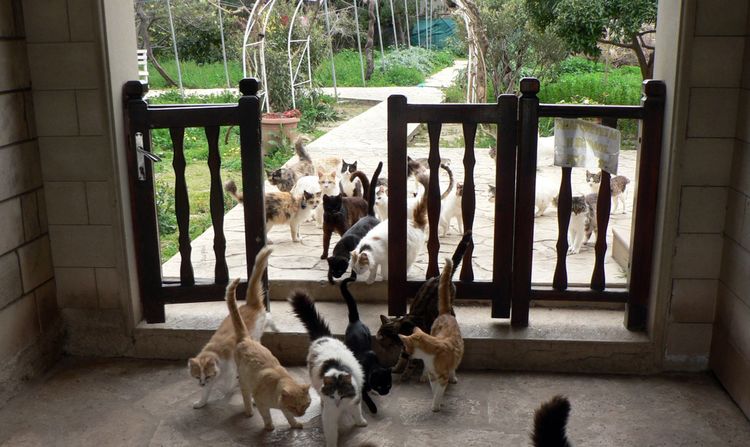
A cat named Amur was the first pet surrendered. Residents of nearby towns joined the voluntary effort. Residents of Ishim, Zavodoukovsk, and Yalutorovsk were particularly active. Through a joint effort, over 5,000 Siberian cats were collected and transported to Leningrad.
Smoke cats are the best rat-catchersThe tabby cats were snapped up in no time. People stood in kilometer-long lines to purchase one. Prices for smoky kittens were astronomical. By early 1944, a kitten could be purchased for 500 rubles, when a kilogram of bread cost 50 rubles.
The exploits of our furry friends: eyewitness accounts
The diary entries of Zoya Kornilyeva, a resident of besieged Leningrad, indicate that people were so desperate for pets that they were willing to trade them for pieces of bread. Some had to save up stale bread for weeks to "pay" for the animal.
A woman who survived the horrors of the Siege of Leningrad recounted how her cat, Vaska, saved the family from starvation throughout the war. He caught birds and small rodents in the streets and brought them to his owner. They cooked them into soup for the whole family. During the harsh winter, Vaska kept the children warm. That's how the three of them slept.
The furry friend has saved his owner from death more than once. Before the bombing, Vaska warned his owners of the danger with his purring and restless behavior. During this time, the grandmother, her daughter, and the cat managed to gather their things and hide in a bomb shelter.
In the spring, Vaska was so weak that he no longer had the strength to forage for food as before, so the woman went "hunting" with him. She scattered bread crumbs she'd collected after meals as bait. When birds flew in, Vaska would leap from his ambush and catch them. The woman helped hold on to the prey. The captured birds were used to make soup or goulash.
Vaska died in 1949. He was buried in the cemetery, and to prevent his grave from being trampled, a cross was placed on it with the inscription "Vasily Bugrov."
Legend has it that during the war, there was a cat who lived in a regiment. He had taken up residence near an anti-aircraft battery. The animal possessed perfect pitch: when enemy planes approached the regiment, the "striped fighter" would begin meowing. This was his way of warning Russian soldiers that the enemy was approaching. Over time, the cat took on a full-fledged place among the soldiers. He was placed on rations, and a soldier was assigned to look after him.
Description of the sculpture "Siberian Cats Square" in Tyumen
The animal figures are cast from cast iron and stand on granite pedestals. Murkas and Barsiks are depicted in a variety of poses: one is "basking," basking with its golden flanks exposed to the sun, another has perched on the very top of the pedestal, observing its fellow creatures, and a third is climbing to the very top.
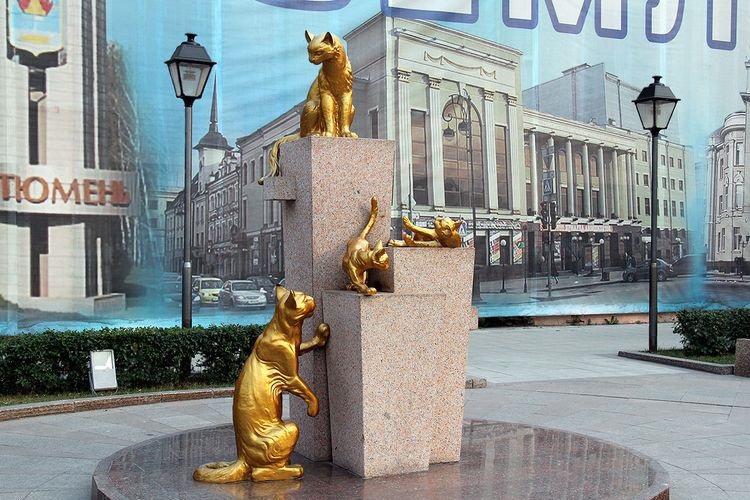
The photo illustrates how the "Siberian Cat Square" monument in Tyumen looks unique yet unobtrusive. The square features 12 sculptures, all covered in gold paint. Together, they form an "alley of Siberian cats."
Cats guard Russian art
Rats wreaked havoc not only on people but also on great Russian art. They crawled into the storage rooms of art galleries, including the Hermitage, and nibbled on paintings and important historical documents.
Cats who "relocated" from Siberia saved the Hermitage paintings from complete destruction and soon became full-fledged residents of Leningrad. Cats are treated with special respect in the city on the Neva.
They have been kept in museums since the mid-18th century to control rodents. Many descendants of the cats brought from Siberia still have "Hermitage registration." They are held in high esteem not only by visitors but also by museum staff. The cats are protected, fed, and treated.
The modern museum on Palace Square houses the Hermitage Cat Friends Foundation. Each tabby resident of the museum has a document—a passport with a photo. The staff maintains a register of furry freelancers.
Every Tyumen resident knows the address where anyone can find the "Siberian Cat Square" sculpture—it's located near 11 Pervomayskaya Street. The cat figurines can be seen in the very center of the city, at the intersection of Respubliki and Pervomayskaya Streets.
The square is a favorite spot for family recreation. Tourists come here every year to see the original and distinctive monument dedicated to the feline heroism.
Read also:


Add a comment