
Scottish Fold
No one would be particularly surprised by a dog with floppy ears, as various forms of folded ears are quite common in them. However, folded ears are rare in cats, so the breed Scottish Fold with neat, forward-curved and downward-curling ears, it has become very popular among cat lovers all over the world.
The Scottish Fold is a completely new breed of cat in Russia.
Content
History of the breed
This breed has already gained incredible popularity in many countries around the world. Scottish Folds first appeared in the UK, or more precisely, as the name suggests, in Scotland.
Over time, this breed spread to America, before resurfacing in Europe. The first mention of the Scottish Fold can be found in nineteenth-century literature. One source from that time claims that a cat most similar to this breed was brought from China to England.
This source provides no further information, meaning we cannot judge the subsequent fate of this particular cat. However, an even earlier mention of cats with floppy ears appears in the "World's Magazine of Knowledge and Amusement" (1796) in China. This entry suggests that the Scottish Fold's ancestors were first discovered at least two hundred years ago.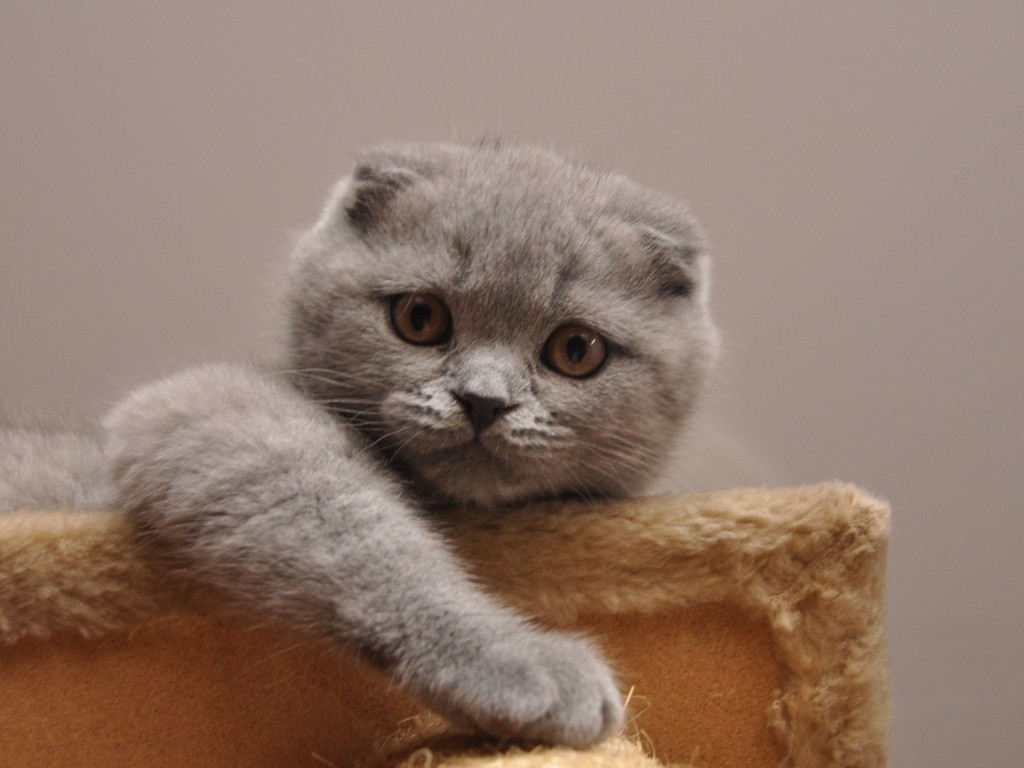
The first recorded sightings of fold-eared cats in Scotland date back to 1959. That's when William Ross, a Scottish farmer, noticed a neighbor's unusual pet. It was a white cat with floppy ears named Susie. Surprisingly, Susie's ancestors were ordinary stray cats. The farmer's wife, who was then a keen Siamese breeder, was extremely intrigued by the neighbor's unusual pet and asked for a kitten from the next litter.
Thus, in 1961, the Ross couple became the owners of a white cat with drooping ears, whom they named Snooks. This is officially considered the beginning of the Scottish Fold's worldwide spread.
General characteristics of the breed
What do Scottish Fold cats look like?
Appearance
Fold-eared kittens are born with straight ears, and at first it's unclear whether they will develop this unusual shape. A kitten may also end up with erect ears, as fold-eared cats are bred by crossing Folds with Scottish Straight (a Scottish Fold cat with straight ears). It's impossible to tell right away what shape his ears will be. Everything will become clearer when the "baby" is 2-4 weeks older.
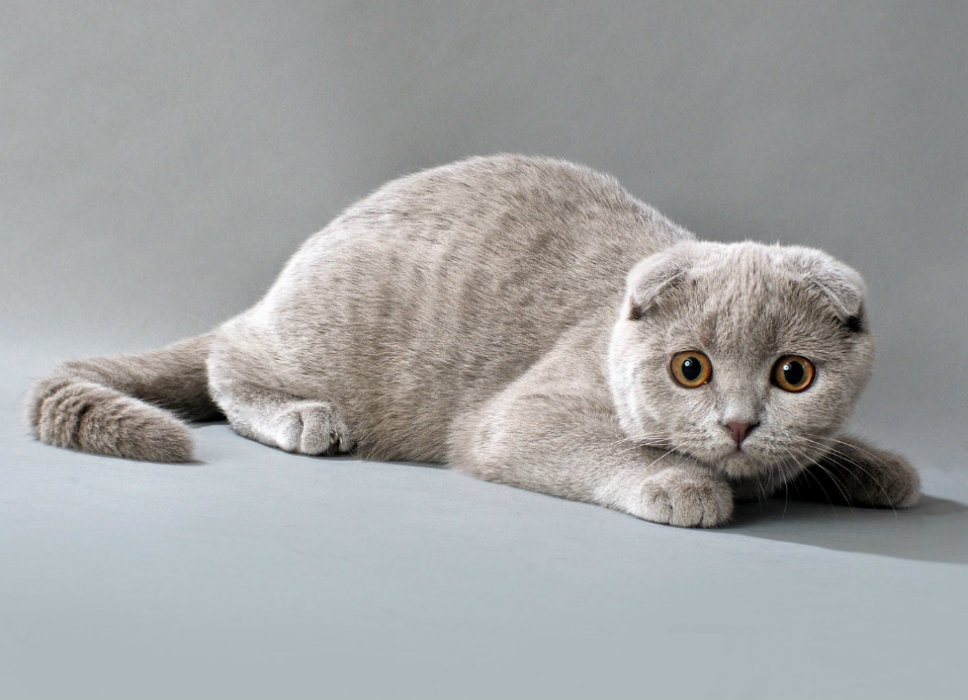
Often Scottish Fold many people get confused Similar to the British Shorthair, but distinguished by the unusual shape of their ears, which appear to curl forward and downward. Scottish Folds have very thick, short fur that feels very dense and soft to the touch. Their body is typically medium-sized, but rounded and of equal width at the shoulders and rump.
Scottish Folds are generally compact and powerfully built. The neat, rounded shape of their paws adds to their charm. Their medium-length tail is thicker at the base. A large, round head set on a thick, short neck, a wide jaw, and large cheeks are essential hallmarks of the true breed, as are the forward-curving ear tips that cover the opening.
Forward-folding ears are the first characteristic of the Scottish Fold. Therefore, the standard requires conformity to this characteristic first and foremost. The ideal kitten is considered to have one or two folds in the outer ear and ears that are pressed flat against the head. They seem to emphasize the circumference of the head and are afraid to straighten. The folded ears in kittens are fully developed by five weeks of age, and the distance between the ears becomes increasingly large. In adult cats, the distance between the ears is wide enough to accommodate a human palm.
Pay attention if your Scottish Fold's ears perk up slightly. This can happen during sudden weather changes, during heat, pregnancy, or mating. It could also indicate stress. Typically, the ears return to their normal position after a while. "Sit-down" ears that don't rise from their position are a hallmark of a show-quality Scottish Fold.
High and drooping brow ridges are a disqualifying feature.
Cats of this breed are somewhat "bulging-eyed".
It is important to mention that true Scottish Folds have large, round eyes that match their coat color.
Color
The coat color of representatives of this breed can be of different types:
- rich solid colors without inserts (black, chocolate, white, etc.);
- lightened or diluted (lilac, marble, blue, etc.);
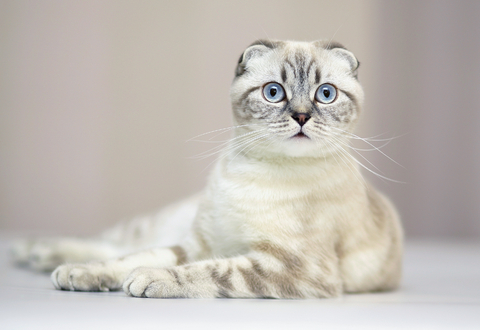
- patterned (tabby is characterized by some kind of pattern and areas of hairs colored in different colors);
- tortoiseshell (imply a harmonious distribution of red and dark (cream) spots);
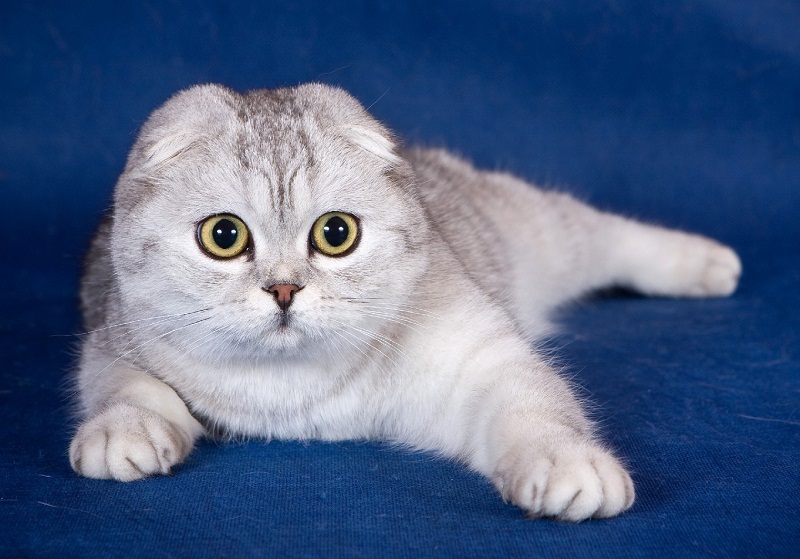
- Chinchillas (can be silver, golden (blue) and gold).
Chocolate, lavender (lilac) and point colors or their combinations with white are not acceptable crossbreeding traits.
Character
Scottish Fold kittens adapt to new environments quite quickly and are just as quick to get used to new faces. They are also known for maintaining remarkable composure during cat shows and presentations.
A Scottish Fold pet does not cause any special problems.
Scottish Fold cats aren't overly active or prone to mischief. This intelligent breed doesn't stoop to petty mischief, and you won't have to worry about them falling off the balcony while walking along the ledge. These pets prefer the attention and warmth of their owners.
Scottish Folds are calm, peaceful, affectionate, and completely non-aggressive. Their even-tempered nature allows them to get along well with various family members and other animals.
Scottish Fold owners confidently state that their pets sometimes possess amazing intelligence.
For example, most representatives of this breed are trained to use both a litter box and a scratching post very quickly and without any problems.
The personality of Scottish Fold cats is impossible to describe; each one has its own unique personality. Some are aristocratic and a bit capricious, others are good-natured, and still others are overly curious.
By regularly training your pet, you can help develop positive character traits in him.
Rules of care and nutrition
What are the care guidelines for a Scottish Fold?
Care
Scottish Folds require near-constant human contact, but they also find plenty to do even when their owner is away. Choosing the right toys for your beloved pet is crucial – small soft balls and small fluffy mice will keep them occupied when left alone at home.
Grooming this breed's coat consists of weekly brushing with a mitten brush. A Scottish Fold can be washed as needed, but should not be done more than once a month, using a high-quality shampoo.
Regular grooming should also include trimming the pet's nails and checking for eye and ear infections.
Nutrition
Cats can be fed either specialized foods or natural products, or a combination of both. A sudden switch from one diet to another can cause stomach upset.
Particular attention should be paid to ensuring that a Scottish Fold's diet contains the required carbohydrates, fats, proteins, vitamins, and minerals in adequate quantities. It is recommended to feed the Scottish Fold twice a day.
Health
Since Scottish Fold ears are a mutation, they are likely to cause health problems.
The most common disorder among them is hemophilia B. Also, Scottish Folds can experience musculoskeletal problems throughout their lives. Because of this, Scottish Folds can develop a serious condition called osteochondrodystrophy.
However, in most cases, with proper balanced nutrition and proper care, Scottish Folds can avoid health problems.
Timely vaccinations, regular veterinary checkups, and preventative measures against potential diseases will help keep your pet healthy.
The lifespan of Scottish Folds is average by cat standards – about 10-15 years.
Video review of Scottish Fold cats
Read also:


Add a comment