
How much dry food does a cat need per day?
Diet and nutrition are no less important for cats than for humans, as their health and appearance depend on their owner's careful attention to these matters. Furthermore, if a cat doesn't get enough food, they will begin to seek it out, which can manifest not only in loud vocal demands but also by wandering across tables and stealing food. To avoid such mistakes, it's important for owners to know how much dry food to feed their cats daily, ensuring they don't go hungry or overfeed.
Content
Choice of food
Dry food is a concentrated and nutritious dehydrated food suitable for cats of all breeds and ages. Our wide range of products allows every owner to find a complete diet for a variety of pets:
- young, healthy individuals;
- elderly animals;
- weakened individuals;
- with physical disabilities;
- with obvious food preferences.
For spayed and neutered pets, more careful consideration should be given to choosing food. This procedure causes hormonal changes in animals, sometimes resulting in a significant increase in appetite. In such cases, preference should be given to specialized lines for spayed pets and regular monitoring of their intake. Special attention should also be paid to choosing food for pets with allergies or food intolerances. Only hypoallergenic, super-premium dry food is suitable for them.
Calculation of feeding rates
The feeding rate for a pet is an indicator that depends on the type of food and the individual characteristics of the animal:
- breeds;
- age;
- health conditions;
- activity level.
Knowing your cat's daily dry food requirement allows you to calculate the required amount for one or two months and purchase a large package at once. This not only saves money but also eliminates the need to purchase new packages every few days.
Influence of feed classes
There are different categories dry foods that differ in composition and recommended serving sizes:
- Economy class – characterized by minimal energy value (250-300 kcal/100 g), so they are typically served in larger portion sizes. They consist primarily of offal and grains and contain virtually no real meat.
- Premium class – have a higher nutritional value (300-350 kcal/100 g) due to the presence of meat components, so the portions of such food will be slightly smaller.
- Super-premium class is the optimal nutritional option for cats, as it contains a balanced composition of high-quality natural meat and virtually no grains. Its energy value is 350-450 kcal/100 g, so a smaller amount is required for satiety.
Since all animals weigh differently, their calorie needs will vary. However, you can calculate these figures yourself. Unneutered adults require 80 kcal per kg of body weight per day, while neutered adults require 60 kcal. Using these figures, you can easily calculate the required amount of food in grams for your pet: divide the daily calorie requirement by the calorie content of the chosen product and multiply the resulting figure by 100.
Manufacturer's recommendations
Most manufacturers list serving sizes for animals of different ages and weights on each package. Average serving sizes based on weight:
- for small pets (2-4 kg) – 40-70 grams;
- for large individuals (4-6 kg) 70-100 grams.
However, please note that these are average recommendations for healthy pets and do not take into account individual needs (for example, pregnant cats or neutered cats). Consulting with a veterinarian will help you choose the optimal diet for your pet.
Important! For animals fed dry kibble, it's crucial to monitor their daily water intake: the amount should be three times greater than the daily dry kibble portion (for example, 50 grams of dry kibble should be consumed with 150 ml of water).
How to measure a portion?
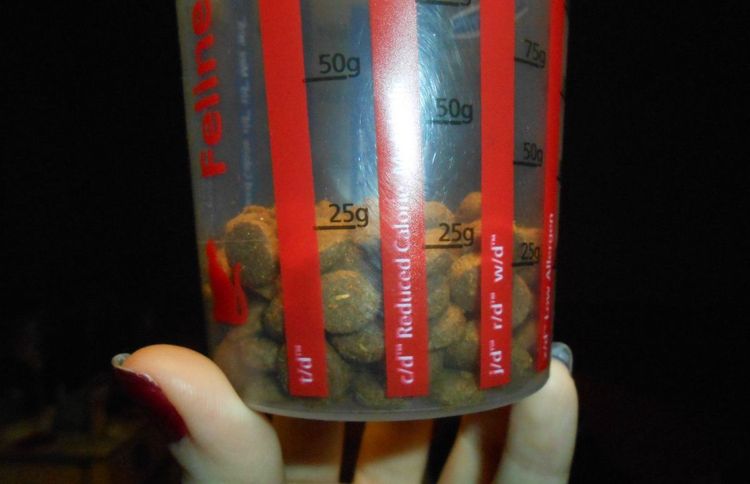
You can measure out the required serving size using a special measuring cup, which some manufacturers include in the packaging (this is especially useful for larger packages weighing 10-25 kg). If you don't have one, you can also:
- use kitchen scales;
- At home, collect the granules in a small glass, then pour them into a bag and weigh them at the nearest store;
- use a measuring cup (sometimes included with the food as a nice “bonus” for the buyer).
Some types of food are sold by weight, so when purchasing at the pet store, you can ask them to measure out the correct amount and pour it into a separate bag. At home, pour the contents into a separate jar and mark the level corresponding to the daily portion. This way, you can avoid having to weigh out your cat's daily portion each time.
The daily portion should be divided into several parts, the volume of which will depend on the number of feedings:
- 2 times – for adults;
- 3 times – for pregnant cats and kittens.
Does the cat have enough food?
It's important to monitor your cat to determine if they're getting enough food. It's possible that the recommended portion isn't enough, causing them to lose weight and constantly seek food, and their coat to lose its shine and thickness. In such cases, it's best to slightly increase the serving size. Alternatively, you can try feeding larger portions, weighing them first. If any food isn't finished, weigh the remainder. By subtracting the smaller number from the larger, you can get an approximate serving size for your cat.
Healthy cats rarely overeat. This phenomenon is typical only for neutered cats. The appearance of fat deposits in the lower abdomen is one sign that the pet is getting too much food. They also become lazier and less active. In such cases, you can choose one of the following options:
- reduce portion sizes;
- reduce calorie intake.

An owner who knows how much dry food to feed a cat not only protects their pet from constant hunger or overeating, but also cares for its health and well-being.
Read also:





Add a comment