
Cat Skeleton: Detailed Anatomy
Cats owe their diverse and unique physical abilities largely to their skeleton. Lightning-fast tree climbing, balancing at great heights, crawling, various jumps, and safe landings—all of this is possible thanks to the unique anatomy of cats, and in particular, their skeleton. Let's take a closer look at its features and structure.
Features of the cat skeleton
The general structure of a cat's skeleton is similar to that of other mammals, with some differences in the shape and arrangement of individual bones, which are due to the horizontal position of the spine and its optimal adaptation to a predatory lifestyle. Furthermore, differences in the shape and structure of individual bones may be due to breed-specific traits. For example, Siamese cats have narrower and longer bones than Persian cats. The photo below shows what a cat's skeleton looks like without regard to breeding factors.
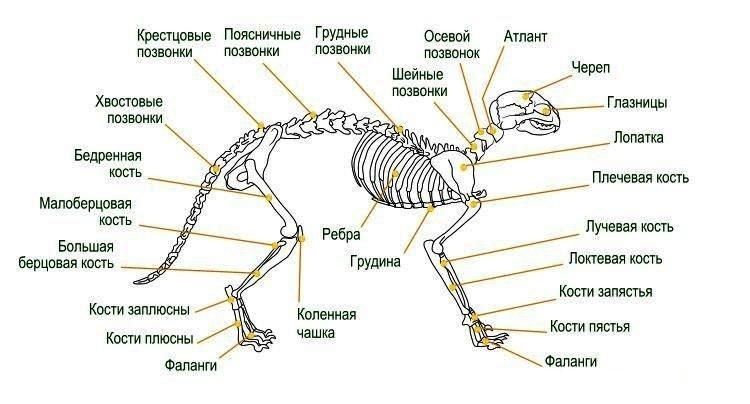
The average cat's skeleton consists of 244-250 bones. Some sources cite the figure as high as 230-236, as some fused bones are counted as one. The number of bones a cat has is determined by its length. tail animal, since it contains almost a tenth of all the bones in a cat's body (a "normal" tail has about 26 vertebrae). Read about what to do if The cat or kitten broke its tail.
Scull
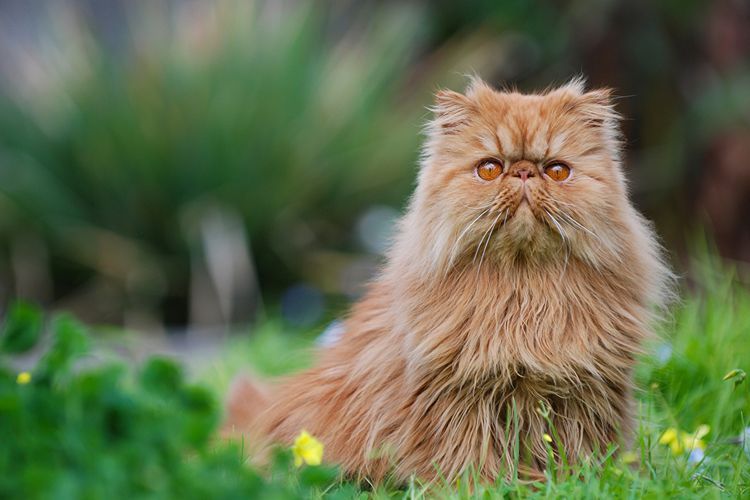
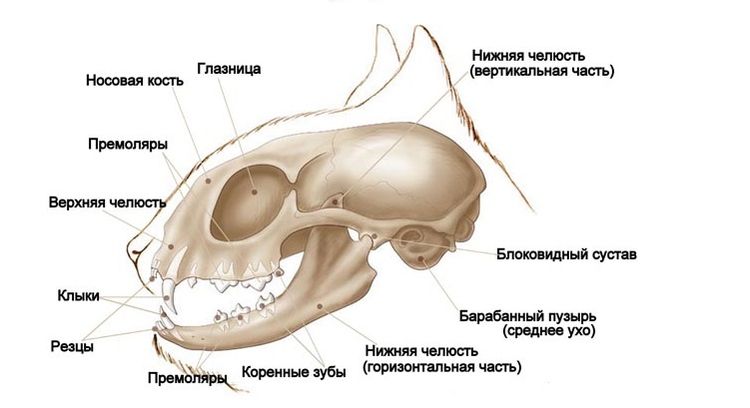
Due to the smaller number of teeth compared to other carnivores, the feline skull is characterized by a rounded shape. Its size will depend on the breed or other hereditary traits. Persian, Exotic, and Himalayan cats are brachycephalic—they have a shortened skull, resulting in an abnormal structure of the palate, larynx, and trachea. This explains the common problems these breeds experience with nasal congestion, snoring, and poor exercise and heat tolerance.
The skull consists of 29 bones, with the cranial region consisting of 11 and the facial region of 13. The cranial bones themselves are larger than the facial bones. Characteristic features also include large eye sockets and narrowly spaced canines adapted for hunting small animals. The primary attribute of a cat's predator is a powerful jaw equipped with various types of teeth. These teeth allow the cat to grasp and hold struggling prey, bite off and grind food, and, if necessary, defend itself.
Spine
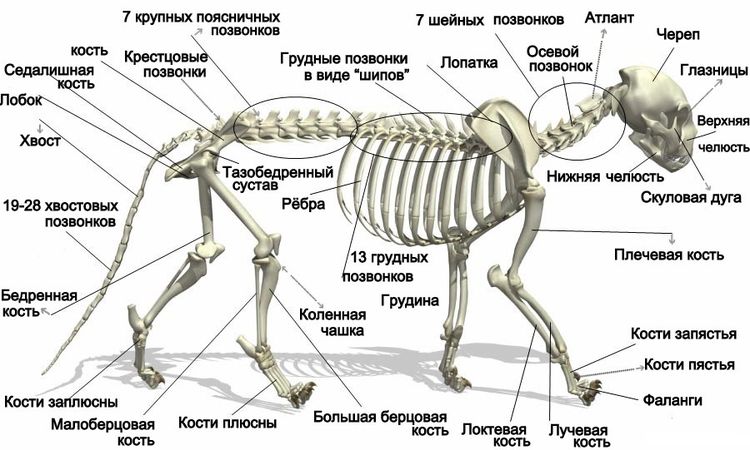
The cat's spine is incredibly flexible, formed from small, mobile bones. It consists of numerous vertebrae, divided into several sections:
- The cervical spine consists of seven larger vertebrae responsible for supporting and moving the head. Two of these, known as the axial vertebrae and the atlas, can rotate 180°. They are connected by a thin process, making them a vulnerable spot in cats: impacts and falls pose a high risk of rupture, resulting in cervical vertebrae fractures and death.
- The thoracic spine consists of 13 vertebrae, to which 12 pairs of rib bones attach on either side. The first five pairs are called true ribs, as they attach to the sternum, while the remaining five pairs are called false ribs, as they resemble arches.
- The lumbar spine is formed by the seven largest vertebrae, which increase in size as they approach the tail. They have special protrusions on their sides that support the muscles and internal organs of the abdominal cavity.
- The sacral region—unlike the highly flexible lumbar region—is characterized by a rigid intervertebral joint consisting of three fused vertebrae. This is necessary because the hind limbs, which bear the brunt of the animal's movement (especially jumping), are attached to this region.
- The tail region plays a key role in maintaining body balance during jumps or falls from heights. Strong muscular ligaments provide these animals with excellent jumping ability, while cartilaginous pads between the vertebrae allow for various movements (bending and rotating). The number of tail vertebrae varies depending on the breed, and some breeds may lack them entirely.
Structure of the limbs
In the skeleton of the cat's limbs, two sections are distinguished:
- The forelimb girdle (shoulder girdle), which features elastic attachment of the limbs, is essential for safe jumping and comfortable landings. It consists of the scapula, humerus, radius, and ulna (which form the forearm), and the hand. The hand consists of the carpus, metacarpus, and phalanges of the fingers, of which there are five on the forelimbs.
Another unique feature of feline anatomy is the absence of a proper clavicle. It consists of two non-functional bones that are not attached to the shoulder joint, but rather float freely within the muscles. The scapulae are attached to the spine by muscles, ligaments, and tendons, allowing the shoulders virtually unlimited range of motion.
Interesting! Due to the unique structure of the collarbone, a cat can squeeze through even the narrowest openings, as long as its head fits through, as the head is the largest, yet most stable, part of the body.
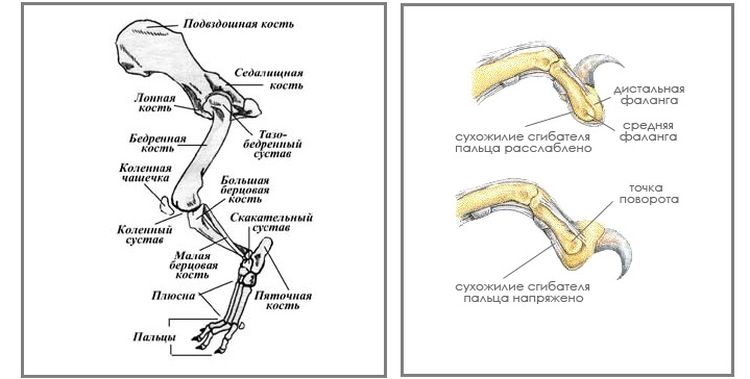
- The hind limb girdle, unlike the shoulder girdle, is rigidly and immobilely attached to the sacrum. It includes the pelvic and femur bones, the patella, the tibia and fibula, the tarsus, and the metatarsal bone, which is where the phalanges of the toes are attached. The pelvic bones of the hind legs are longer and more developed than the forelimbs, and the metatarsal bones are more massive, which is related to the animal's gait (particularly jumping). Due to this limb structure, cats can move quickly in both horizontal and vertical planes, making them excellent tree climbers. The hind legs rest on the phalanges of the four toes. Like other mammals, cats' elbows bend backward, and their knees bend forward. The part of the paw that might be mistaken for a bent knee is actually the heel, with the true knee located in the lower abdomen.
Read also:
- The structure of a dog
- What is the memory of cats: how long does it last?
- Domestic Cat Specialist: What is their name and what does they do?


Add a comment