
Scottish Setter (Gordon)
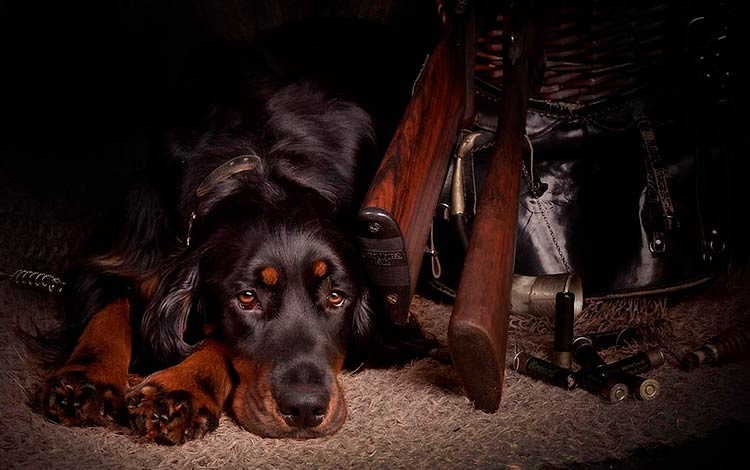
The Scottish Setter is a beautiful, exceptionally scented, and highly skilled island pointer. Another name for the breed is the Gordon Setter. It was developed for bird hunting, is an excellent companion, and is a distinguished show dog. It requires proper training and ample exercise.
Content
History of origin
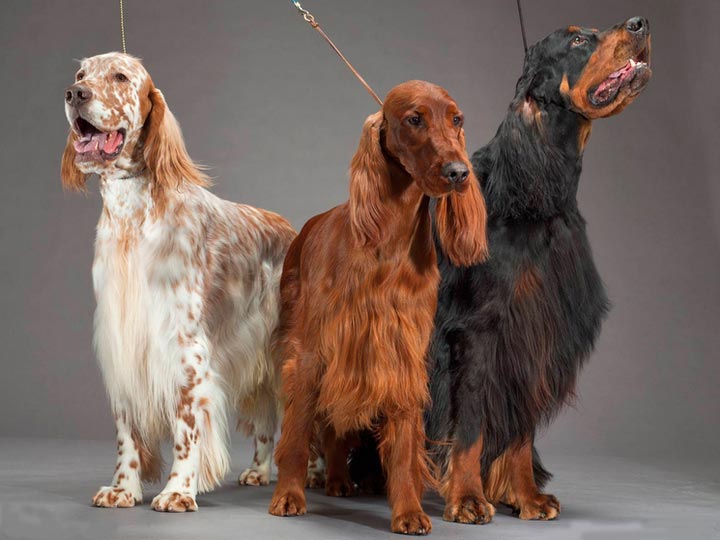
The word "setter" first appears in English cynological literature in 1570. However, at that time, there was no distinction between breeds. Similar dogs were distinguished by the names of breeders who used different breeds to train their hunting dogs. These included greyhounds, bloodhounds, foxhounds, retrievers, pointers, and even poodles. Gradually, three breed groups of setters emerged in different regions: Irish (red), English (white with speckles) and Scottish (black and tan). The breed's origin is considered to be the small town of Fauchabers in northern Scotland.
It is here that the Gordon family castle is located, the name after which the setters were named. However, the origins of the breed were laid by two other men: Thomas Coke and Henry Paget. Both were avid hunters and breeders, and both succeeded in consolidating the breed's qualities and significantly improving the exterior of the Black and Tan Setter. It was from them that several dogs arrived at the Gordon castle, which became the basis for the subsequent breeding work of Alexander and George Gordon. The breed was finally established by 1860.
Owning a dog from the Gordon kennel was considered a source of great pride and luck in England. Beginning in the early 19th century, these dogs began to spread across Europe and reached Russia, where they adapted well to Russian hunting conditions. In the post-war years, the Scottish Setter population declined significantly. The current state of the breed in Russia leaves much to be desired. For many decades, breeding efforts focused on working qualities, which are indeed very good in many dogs, but their conformation suffered greatly.
Video about the Scottish Setter (Gordon) dog breed:
Purpose
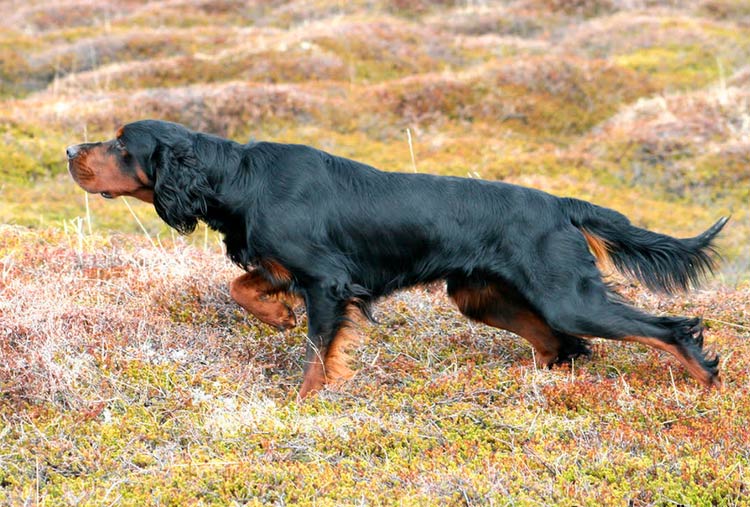
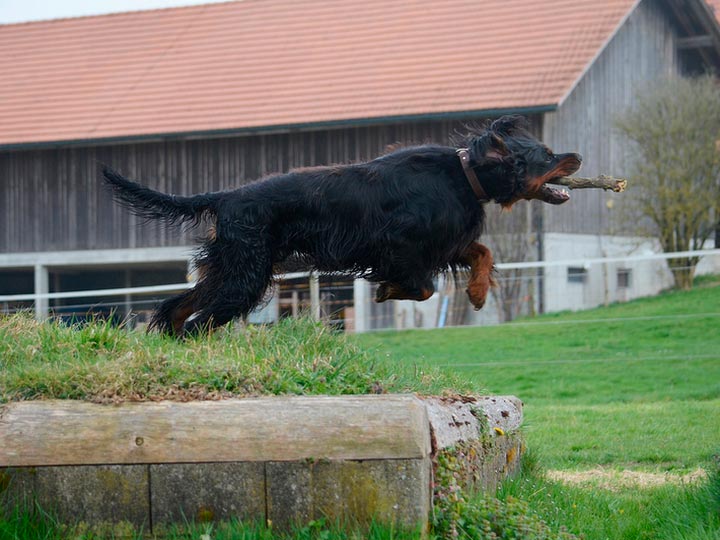
The Gordon Setter was bred to hunt in uneven, challenging terrain and in the most adverse weather conditions. This is precisely what shaped its natural qualities and constitution. The Gordon is a strong, hardy dog, capable of quickly adapting its search to the terrain, vegetation, and game species. Hunters and sportsmen have always noted its excellent sense of smell. In appearance, the Gordon resembles a powerful racehorse, but there should be no heaviness. The gallop is even, very high on the legs, energetic, sweeping, and fast. The muzzle is held parallel to the ground, the head is set high and swings back and forth, allowing the dog to advance in long strides. This gives the canter its characteristic undulating gait.
The Gordon is characterized by a moderately passionate search at a heavy but very fast gallop. The dog uses its upper senses and the scent of the bird itself, not its tracks. It is adept at detecting air currents and wind, so hunting with a Gordon in windless weather is pointless.
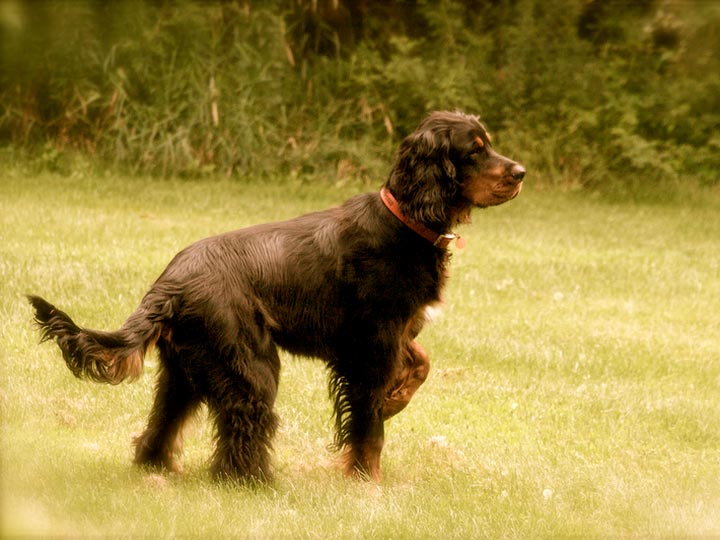
As soon as a Scottish Setter picks up the scent of game, it rears. Gradually, it slows down, moving decisively but cautiously until it reaches a standing position. The position is firm, the legs straight, the neck elongated, and the head a harmonious continuation of the back. When reared, the Setter behaves calmly, keeping the game on scent and moving at a pace that maintains a constant distance from it.
Appearance
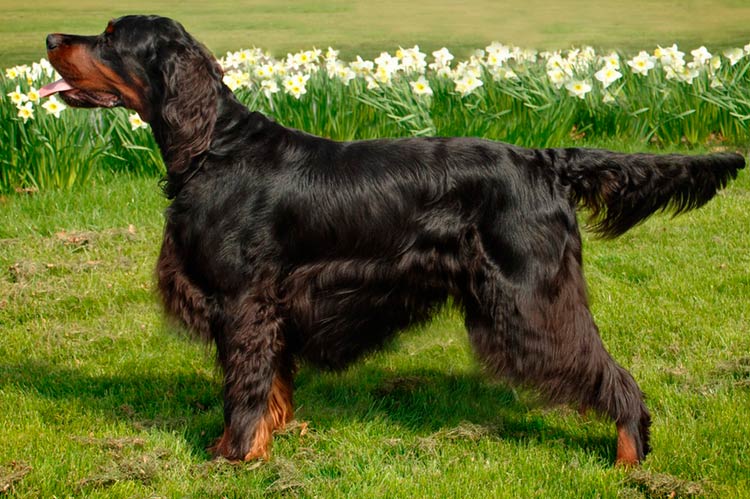
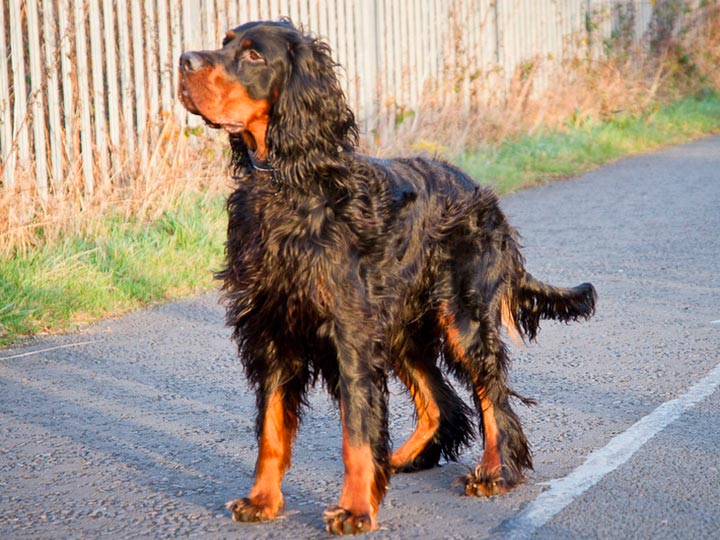
The Scottish Setter's appearance suggests that this dog is suited to galloping; it possesses a harmonious form in every respect. Its build is comparable to that of a well-loaded hunter. Sexual dimorphism is well-defined. The height at the withers of males is 66 cm, and that of females is 62 cm, weighing 29.5 kg and 25.5 kg, respectively.
The head is deep, moderately wide, and dry under the eyes. The length from stop to nose is shorter than from stop to occiput. The skull is rounded, wide between the ears. The stop is well defined. The muzzle is long but not tapering. The lips are clearly defined, with no drooping flews. The nose is wide and large, with well-opened nostrils, and is black. The eyes are set to reveal a penetrating, intelligent gaze. The irises are dark brown. The ears are medium in size, set low, thin, and lie close to the sides of the head.
The neck is long and lean, the body is of medium length, and the loin is slightly arched and broad. The chest is not too wide, but deep, with well-sprung ribs. The tail is saber-shaped or straight, not reaching below the hock, and tapers from the base to the tip. The forelegs are level and straight, with long, well-sloped shoulder blades. The elbows are tucked in and close to the body. The pastern is vertical. The hind legs are long, the thighs are wide, and straight from the hock. The feet are oval, with well-arched toes and abundant fur between them.
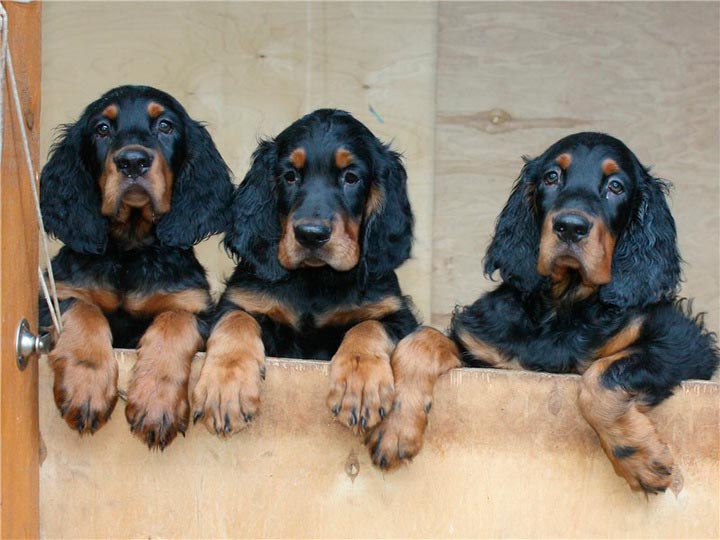
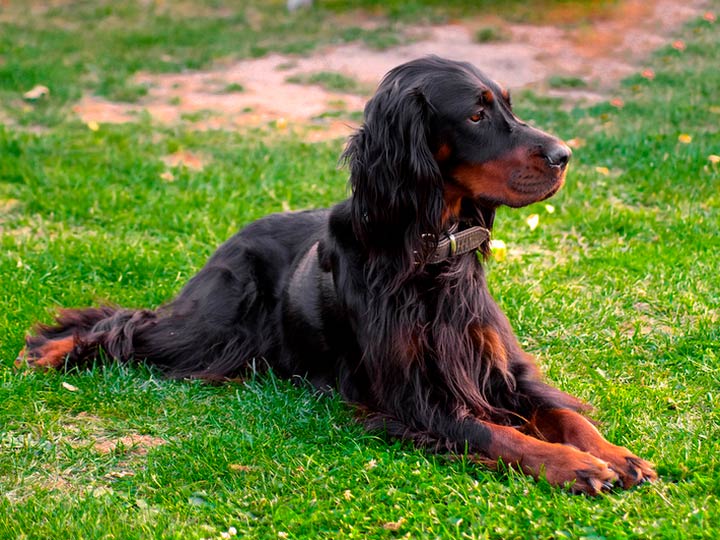
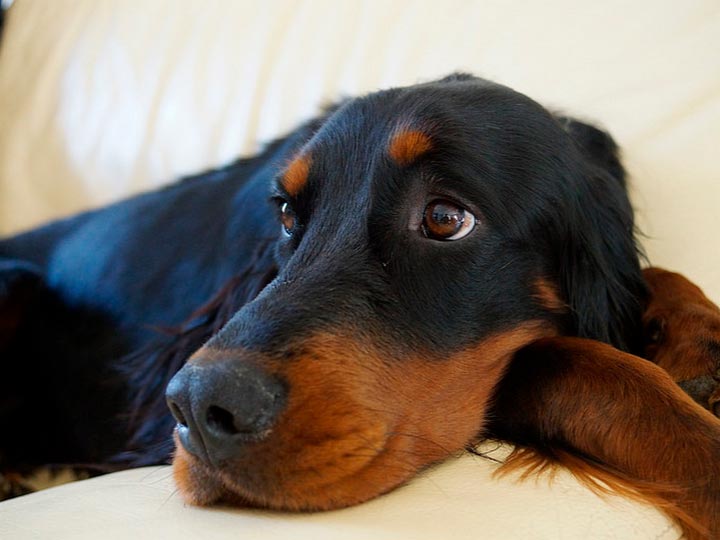
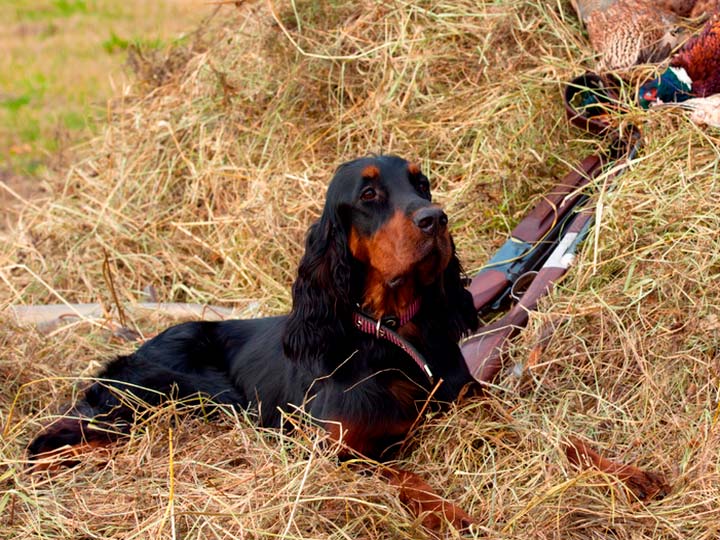
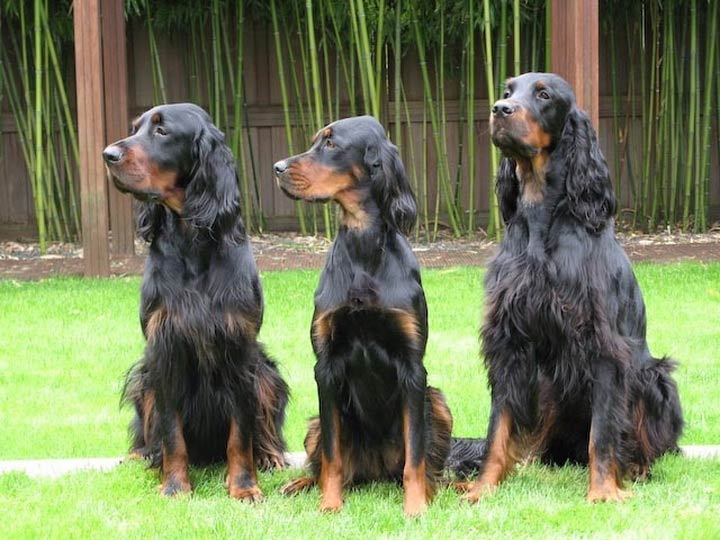
The hair on the front of the head and the tips of the ears is fine and short. On all other parts of the body, it is of moderate length, lies flat, and should not be wavy or curly. The top of the ears and the back of the legs are long, even, and straight. The furnishings under the belly may reach the throat and should be as free from curls as possible. The hair at the base of the tail is longer, becoming shorter toward the tip. The colour is jet black with chestnut markings. Tan markings are located above the eyes (not to exceed 2 cm in diameter), on the sides of the muzzle, on the throat, two large symmetrical spots on the chest, and around the anus. A very small white spot on the chest is permitted.
Character and behavior
The Scottish Setter has an affectionate, even, calm, and balanced character. At least, that's how it should be. Every breed has its exceptions, but these can generally be identified in puppyhood and corrected with proper training. Gordon Setters are sensitive, lively, and cheerful, bonding with all family members, getting along well with children, and wary of strangers. In some cases, they even behave friendly with strangers. They can raise an alarm if their territory is invaded, but that's all.
Throughout their lives, the Scottish Setter remains a "capricious child," requiring a special approach to training, exercise, and education. They are very sensitive and vulnerable, yet courageous and independent in their work. Moderately stubborn and independent, the Setter quickly adapts to various life situations and environments when accompanied by a loving owner.
Compared to other setters, the Gordon Setter requires a great deal of physical and mental stimulation, especially during growth and development. Without it, it develops less-than-stellar qualities. When out for walks, the Gordon Setter should not be left unattended for long periods; seeking out an interesting activity on its own can result in the loss of the dog or a tendency to wander.
Education and training
A puppy's training begins literally from the first days it arrives in the home. The puppy is introduced to its surroundings, shown what is allowed and what is strictly forbidden, and is not relentless in its demands. This is crucial for the proper development of the "child"'s psyche. Command training, which forms the basis for further training, begins at 5-6 months. A carrot-and-stick approach is used, with a focus on rewards. Strict execution of commands is sought: "heel," "come," "stand," "stay," "no," "forward," "down," and others. Some verbal commands are accompanied by whistles and hand signals. Setters constantly listen to the speech and body language of their beloved owner; over time, they are much more willing to obey requests than commands.
Work with a puppy should begin when it's hungry and has had time to run around a bit and do its business. The duration of the session is individual, but in any case, training shouldn't be prolonged and should be stopped when the dog loses interest. Each command is reinforced over several days and then regularly repeated. Don't begin training a new command until the dog has clearly followed the previous one. Commands should be followed not only indoors or in the yard, but also outdoors and in unfamiliar surroundings.
The first field outings begin after the basic commands have been mastered and accurately executed. Training is carried out in several stages: weaning from chasing, practicing endurance, following commands at a distance, shuttle-like searching, practicing the retrieve and stance, teaching the retrieve, and acclimating to the shot. For those who don't have positive experience working with island pointers, it's best to trust the professionals.
Content Features
The Scottish Setter is well suited to apartment life, but only if it receives the necessary amount of exercise, which is especially important for growing puppies. Scottish Setters are not short-haired dogs, so they can be kept in an open-air enclosure with an insulated kennel. The difficulty here is that the Gordon Setter requires close contact with its owner; a lack of this can lead to difficulties in understanding and working with the owner. It is not advisable to keep a show dog outdoors, as the coat structure changes and a thick undercoat develops, which can adversely affect its appearance.
Exercise should be regular and vigorous, regardless of whether the dog lives in an apartment or a private yard. At least once a week, take a trip out of town to let the animal "blow off some steam." Jogging or cycling between 3 and 10 km (3 and 10 miles) is very beneficial for Gordon Setters. These can be started at 9 months of age, gradually increasing the intensity. It's important to ensure the setter trots and doesn't gallop.
Care
An unkempt Scottish Setter is a pitiful sight. Certainly, a show dog requires more complex and regular grooming than a working Scottish Fold, so to speak, for its soul. The dog is quite hairy, so burdock, grass seeds, twigs, and other debris constantly stick to its coat. These should be removed with a wide-tooth comb. To maintain a neat appearance and prevent matting, it is advisable to check and comb the coat every two to three days, and daily if the coat is very thick and the dog spends a lot of time in meadows or fields. It is recommended to bathe a Gordon Setter once a month, using a suitable shampoo and conditioner. Show dogs are washed every 7-10 days. After bathing, it is advisable to use a thermoactive conditioner, which counteracts the damaging effects of hot air on the coat when blow-drying. In addition, cream, oil, or masks are applied to the entire length of the hair to moisturize the skin and nourish the hair. During walks, I protect the ears of show dogs with so-called earmuffs, which are very popular among cocker breeders.
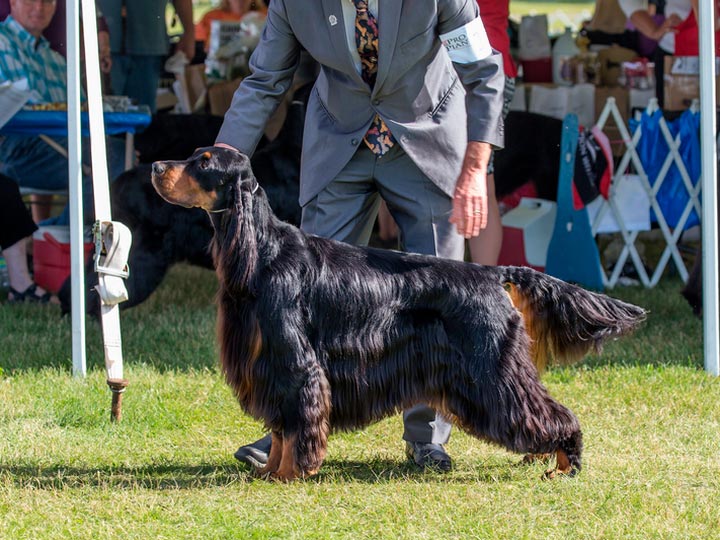
At shows, Scottish Setters are shown in their most natural appearance, but light grooming is necessary. The hair on the feathering, around the anus, and between the toes is trimmed. Working dogs often have their feathering completely trimmed before hunting season, which makes grooming much easier.
And of course, ears and teeth require regular care, brushing at least once a week. Eyes should be cleaned as needed to remove accumulated secretions. Nails should be trimmed as they grow, approximately every 3-4 weeks. A dog with long nails tires more quickly and is more prone to injury.
Nutrition
The owner decides how to provide their dog with complete, balanced nutrition, whether natural food or dry commercial food. When choosing a feeding program, the dog's needs are taken into account, with different diets developed for puppies, juniors, adults, and senior animals. During cold weather, as well as during periods of intense physical activity such as hunting or before competitions, it is advisable to increase the calorie intake by 2-3 times.
It is advisable to regularly take a course to restore the microflora of the stomach and intestines using probiotics and prebiotics.
Gordon is suitable for large-breed dog food. The daily allowance is determined by the chart on the packaging. It depends on the animal's weight but may vary slightly, as each individual's metabolism is unique. The main indicators of appropriate feeding are a healthy appearance, proper body condition, and overall well-being.
Health and life expectancy
Overall, the Scottish Setter is a strong, hardy dog. The breed is susceptible to some genetic diseases, but most are not life-threatening.
- Hip dysplasia;
- Cataract;
- Progressive retinal atrophy;
- Hypothyroidism;
- Dogs with a low chest are prone to gastric torsion.
To maintain the Gordon's health, it is necessary to take a responsible approach to disease prevention, which includes timely vaccinations and treatment for external and internal parasites. A huge problem for working hunting dogs is piroplasmosis, which an animal acquires from a tick bite. Given the nature of their work, setters rarely suffer serious injuries while hunting. Typically, injuries are limited to cuts, scratches, and, rarely, dislocations or strains. Their lifespan is typically 11-13 years.
Choosing and pricing a Scottish Setter puppy
The choice of a puppy should primarily be influenced by the requirements for an adult dog: will it be used for hunting, for a show career, or as a companion for sports and active pastimes? A Scottish Setter is not suitable as a couch potato or a child's dog.
If a working dog is desired, the parents' abilities are considered. In this case, it's not the conformation and show results that are decisive, but the diplomas and scores obtained in working trials. As for a show career, it often takes a long time to find a truly good puppy. In Russia, there is a tendency for shorter stature, and undesirable faults are noted: incomplete teeth, malocclusion, brown coloring, and weak pigmentation. cryptorchidism, as well as viciousness, instability, and timidity. To choose a good puppy, knowing the standard alone is often not enough, and you need to seek help from a canine expert or an experienced breeder.
A "pet for the soul" should match the future owner's personality and experience raising hunting dogs. Calmer dogs are suited to apartment life, while active and energetic ones are best suited to indoor living. It's important to decide on the gender in advance. Males are generally more independent and dominant, while females are cunning but more docile.
Among hunters, it's common to adopt a fully grown puppy. This is very convenient, as it helps inexperienced owners avoid many mistakes during training. Furthermore, at 6-8 months, the potential needed for a working and/or show dog is already clearly visible.
When choosing a puppy from a litter, pay attention to the living conditions. It's crucial that the dogs have plenty of exercise, interact with their fellow puppies, and explore the world around them. All puppies should be healthy in appearance. They should be even-tempered, energetic, and curious, with no hint of cowardice or aggression.
You should never buy a Scottish Setter from a photo on the Internet, especially at a very low price, without knowing anything about the dog's parents and the conditions in which it was raised.
Price
The average price for a Scottish Setter in a breeder is 35,000 rubles. Mature puppies that have proven themselves in hunting can fetch significantly more. Breeders may also increase the price if they expect high-quality puppies from a planned litter with imported sires. Home-bred puppies without papers usually cost no more than 10,000 rubles, but obtaining a hunting passport with such puppies can be quite challenging.
Photos
The gallery contains a dozen photographs of Scottish Setter puppies and adult dogs. One of the photos illustrates the differences and similarities between three Setters from the British Isles.
Read also:


Add a comment