
Seychelles cat
Name of the breed Seychelles catThe name "Seychelles" comes from the Seychelles Islands in the Indian Ocean. It is believed that it was from these islands that the cat arrived in the UK in the mid-1980s.
Let the legend remain a beautiful fairy tale, but the reality is that most experts do not recognize these cats as a separate breed. They justify this by saying that the Seychellois is too similar to the Oriental, Balinese, and Siamese cats. Whatever the case, Seychelles cats certainly feel quite special. It's probably due to the breed's national character.
Content
History of the breed's origin
With the consent of the British Cat Association, efforts were made to create a new breed, but unfortunately, this effort yielded no concrete results. All that was achieved was a breed that was similar in appearance to Bali, Siamese, and Oriental cats. This is likely the reason why the Seychelles cat is unpopular outside of Britain.
Currently, cats of this breed can be found in some European countries, and, of course, in Britain itself. Their similar appearance to other breeds has led to their non-recognition by any feline organization. However, Seychelles cats are included in the FIFe registry.
General characteristics of the breed
What does a Seychelles cat look like?
Appearance
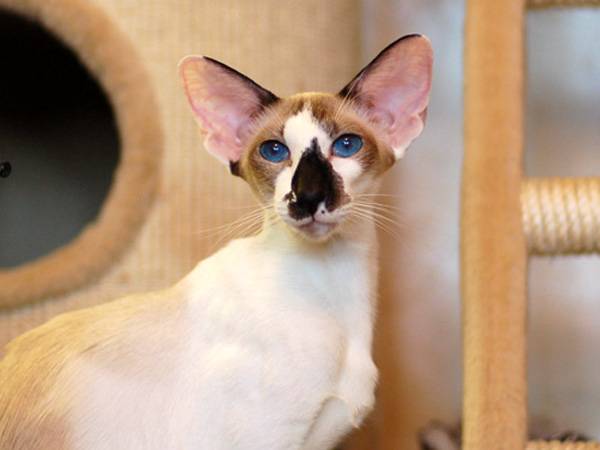
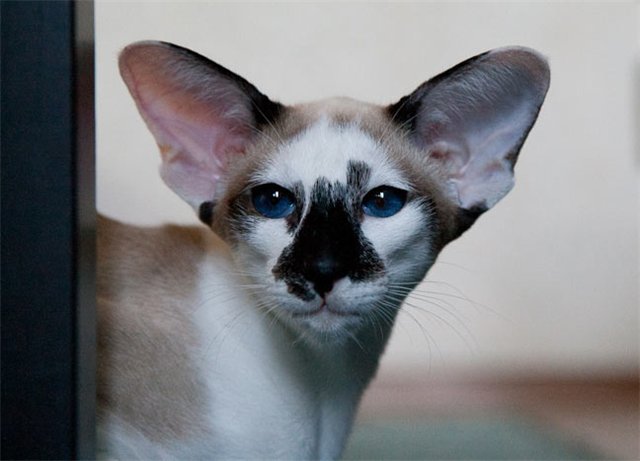
The beautiful Seychelles cat has short fur and is not much different from its Oriental counterparts. It has beautiful long legs, small oval paws, fine bones, and a magnificent gait. Its head is wedge-shaped with a narrow triangular muzzle. It is characterized by a straight, long nose, a small chin, and small, almond-shaped eyes. According to the standard, Seychelles cats should have blue eyes. Its beautiful, wide-set ears are large and slightly rounded at the top.
Seychelles cats love to show off their tails. They are incredibly flexible and taper to the tip. This breed's coat has no undercoat, allowing it to lie flat against the body. It is pleasantly soft to the touch and has a beautiful, healthy shine. The coat is slightly longer around the tail and shoulders.
Seychelles cats aren't exactly a large breed. They're medium-sized and rarely weigh more than 4 kg.
Color
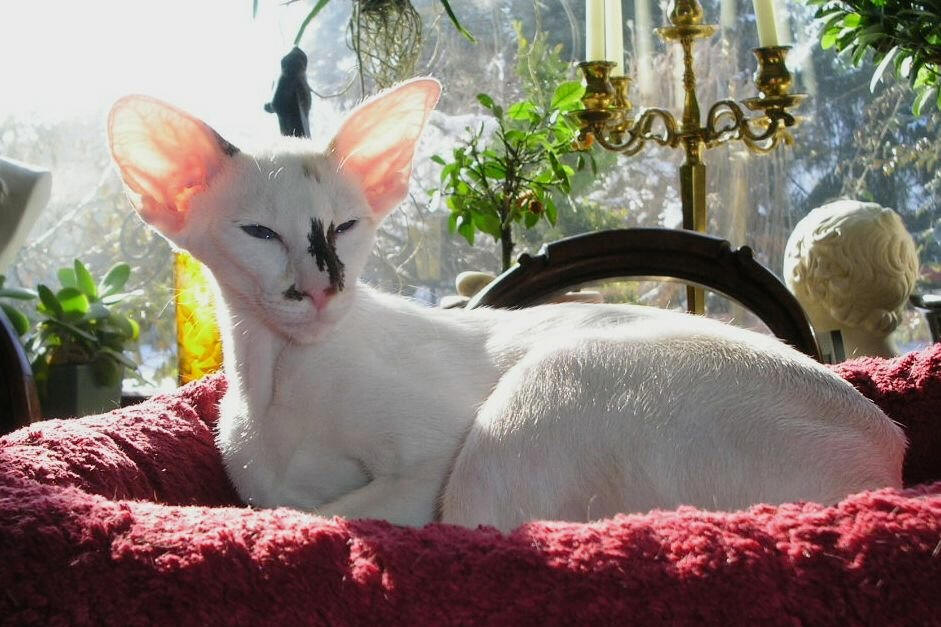
The only difference between Seychelles cats and their Oriental counterparts is their coloring. According to the standard, the point coloring applies to the ears, tail, legs, and mask, though the mask should not cover the entire head. The body coloring should be distinct from the point coloring. The three most common coloring patterns are: neuvieme – a white base color with a small colored spot on the head and a colored tail; septieme – colored spots on the legs and head on a white background, and a colored tail; huitieme – large colored spots on the legs and head on a white background, and a colored tail.
Character
Seychelles cats are affectionate animals.
They love to be given attention. They enjoy active games and can maintain their activity into old age. They are very loyal cats and always enjoy company. They are talkative and love to comment on everything happening around them.
Their voice cannot be called pleasant to the human ear; they will continue to speak even when you are already tired of listening to them.
Seychelles cats are extremely devoted companions. Therefore, they don't tolerate loneliness well. If you've decided to get a Seychelles cat, remember that they make almost every sound. They're extremely talkative, reflecting on everything, whether it's their owner's actions or events happening nearby. They can even "comment" on things with remarkable persistence.
They are not as simple as they may seem at first glance, and often even like to dominate their fellows.
Due to their close relationship with Siamese cats, the Seychelles cat is endowed with the ability to respect their owner. However, caution is essential with this pet. These cats are prone to selfishness, even egocentrism. They dislike sharing their owner's affection with anyone. If another pet, whether a cat or a dog, is already in the household, as the Seychelles matures, it will persistently strive for dominance, which often leads to arguments. The Seychelles cat is one of those breeds that rarely gets along with dogs. With people, the cat will always seek common ground, but the provider is not always the owner. However, Seychelles cats are good with children, love to play with them, and tolerate children's affections well. They are very intelligent and inquisitive cats.
Seychelles cats are easy to train. If you have the time and patience, you'll soon be able to put on short shows with your pet at home, entertaining your family and guests. Training is simplified by their natural playfulness and focus on their owner. This makes the training process as close to their natural behavior as possible.
Seychellois are known for their good memories. And not in a good way. Be careful when welcoming guests and strangers. If the animal is inadvertently offended, it will not forget and will take revenge at the first opportunity.
Rules of care and feeding
Seychelles cats are easy to care for.
Care
The lack of an undercoat makes their fur easy to comb and prevents tangling. However, they do require attention from their owner, so brushing them at least twice a week is recommended.
During shedding season, brushing should be increased. Bathe this breed as needed. After brushing, rinse your pet's eyes and clean their ears.
Make sure your pet has a soft, comfortable place to sleep and rest. You'll also need to purchase the following cat essentials:
- scratching post;
- litter tray;
- bowl for water, food;
- climbing device.
Regarding the last point, specialty stores sell a good selection of climbing equipment that Seychelles cats will happily climb. But you can also create your own with equal success.
I don't think scratched furniture or worn-out sofa corners are a pleasant sight. Therefore, in addition to a scratching post, it's a good idea to invest in a nail clipper and trim your pet's claws periodically (every two weeks). If you don't want to bother with this procedure, consult a professional. Professionals offering such services are readily available.
Nutrition
Regarding nutrition, this breed requires a balanced and varied diet. They enjoy fermented milk products such as kefir, sour cream, and cottage cheese. They also enjoy raw meat.
Remember, meat for cats needs to be cut into small pieces. The most suitable type of meat is chicken and chicken giblets.
Regular kitekat is not suitable for them as dry food - it is better to buy food for them premium or super-premium. Also, remember to always have water in your pet's bowl. Change it at least 2-3 times a day.
Health
The Seychelles cat breed is known for its good health.
At the same time, several cases of problems with cardiovascular function were noted.
Furthermore, as a descendant of the Siamese, the Seychelles cat is predisposed to a number of dental problems, including gingivitis and tartar buildup. You can tell when your pet needs a dental checkup by indirect signs such as excessive salivation, refusal to eat, and so on. This problem is easily addressed early on; the key is to seek prompt medical attention.
Therefore, take your pet to the veterinarian—after all, prevention is better than cure. Love your cat, give them as much affection as possible, and they will delight you with their presence for a long time.
If you're considering buying a Seychelles kitten, think carefully. Evaluate your options wisely; cats of this breed aren't suitable for a "let's try it" situation, and especially don't get one if you don't have cat training skills. If, after some time, you realize a Seychelles cat isn't for you and give it away, you'll deeply hurt the animal and become the worst betrayer it ever has.
Adult animals adapt to new environments and people very slowly and with difficulty. Therefore, adopting an adult Seychellois is a good thing. However, to help your pet open up to you, be patient and don't force your company on them.
Video review of the Seychellois cat breed
Read also:


Add a comment