
Heart failure in cats
In cats, as in humans, heart failure is a serious condition that, without qualified assistance, can lead to the death of the animal.
In heart failure, the heart loses the ability to maintain the intensity of blood flow needed to supply oxygen and nutrients to all organs and tissues.
Today we'll tell you in detail about the main symptoms and treatments for heart failure in cats.
Content
Features of heart failure in cats
For various reasons, a pet's heart may sometimes fail to perform all of its functions. This leads to a "failure" in the functioning of the entire body.
Interesting! Cats suffer from acute heart failure less frequently than humans. This is due to their diet and the specific biochemical processes in their body.
Typically, in cats and dogs, the development of heart failure is associated with a whole range of disorders, as an abnormal heart rhythm disrupts blood circulation throughout the body.
The condition is more common in animals over six years of age. However, symptoms can sometimes appear in kittens as young as six months. Therefore, it's a mistake to assume that only older animals suffer from heart failure. Even owners of young puppies and kittens can be diagnosed with this devastating condition, and there are a number of possible causes.
There are several types of heart failure in cats.
- Depending on the course of the disease, there is acute and chronic heart failure;
- They also talk about a congenital or acquired disease;
- In addition, heart problems can be primary and secondary (arising after infectious diseases).
It's also worth knowing that certain breeds are predisposed to developing cardiovascular diseases. Large cat breeds (such as Maine Coons and others) are more susceptible to developing cardiovascular diseases than others.
Causes of heart failure
The causes of heart failure in cats can be very diverse, but most often the pathology is triggered by diseases such as:
- hypertrophic cardiomyopathy (pathological proliferation of the myocardium);
- hyperthyroidism (thyroid problems);
- hypertension (high blood pressure);
- oncology;
- congenital heart defects.
Types of cardiomyopathy
Most often, veterinarians diagnose various types of cardiomyopathy.
Hypertrophic
The most common form of cardiomyopathy.
With this type of heart failure, the heart muscle increases in size several times, primarily affecting the ventricular myocardium. This leads to a decrease in ventricular volume. As a result, there's less blood in the ventricle, but the body needs oxygen! Therefore, the myocardium has to contract more frequently and rests less. But rest is essential. This leads to muscle fatigue, which leads to heart failure in dogs and cats.
Dilated cardiomyopathy
In this type of heart failure in cats and dogs, the ventricular wall stretches rather than thickens. Despite the increased ventricular volume and the abundance of blood in the heart, normal cardiac function is still impaired. The myocardium cannot contract fully, thereby ejecting all the blood from the ventricle. Some of it "stagnates," further stretching the walls.
Restrictive
In this case, the muscles are as stiff as wood, barely stretching. Their elasticity is lost. And, despite the fact that the ventricular volume remains unchanged, the myocardium cannot function properly due to the loss of elasticity.
Intermediate
This is a very complex type of cardiomyopathy. This is because it is not always easy to diagnose, as changes from different types of cardiomyopathy are intertwined.
At-risk groups
Those at risk for developing cardiomyopathy include:
- Cats and dogs over 6 years old. This is all simply explained by the fact that organs "tire" over a lifetime and become "targets" for infectious disease pathogens. And the heart experiences increased stress.
- Large breed animals. This characteristic is due to the fact that the heart, like a pump, needs to pump a large amount of blood under high pressure.
- Representatives of miniature breeds. Their miniature hearts have to beat at a much higher rate, which wears out the heart muscle faster.
- Animals that have recovered from infectious diseases, as well as those suffering from high blood pressure or an overactive thyroid gland.
- Cats and dogs after severe treatment (many medications can cause complications with the heart)
- Having a genetic predisposition (that is why it is so important to know the pedigree of a kitten or puppy).
- Animals suffering from malnutrition!
Symptoms of heart failure in cats
Symptoms of heart failure in cats depend on many factors, one of which is the animal's age.
Kittens
The most common cause of heart failure in kittens is a congenital heart defect. Typically, this condition may not cause any symptoms during the first months of life.
The following symptoms in a kitten should be a cause for concern:
- loss of appetite;
- severe fatigue;
- lethargy and apathy;
- shortness of breath after any physical activity, even minor ones;
- paleness of the mucous membranes (gums and tongue);
- loss of consciousness.
In kittens, the condition can deteriorate very quickly after the first symptoms appear, so the animal must be taken to the clinic as quickly as possible.
Adult male and female cats
Symptoms in an adult animal are largely similar to those described for kittens, but additional manifestations may also appear, such as:
- intense thirst;
- rapid weight gain;
- "cardiac cough", which often occurs at night;
- wheezing when breathing;
- vomiting (sometimes occurs during severe coughing fits).
Chronic heart failure in catsThe condition develops gradually. Symptoms don't appear all at once and progress slowly. Therefore, even the most attentive owners may not notice the condition right away. Swelling of the limbs and the dewlap area is common.
Elderly animals
In older animals, the disease is most severe and symptoms can no longer be missed.
The first cause for serious concern would be:
- unsteady gait;
- loss of orientation in space;
- frequently recurring fainting spells;
- almost constant "heart cough".
The disease also makes itself known by an enlarged abdomen and a characteristic positioning of the front paws.
Diagnostics
To ensure successful treatment, diagnosis must be performed by an experienced veterinary cardiologist. The following is required for diagnosis:
- Collecting a complete medical history (information about the pet from the owner). It's important to be prepared and provide the veterinarian with detailed, comprehensive information. It's best to bring this information to the appointment in writing to avoid missing important details about your pet's health and vital functions.
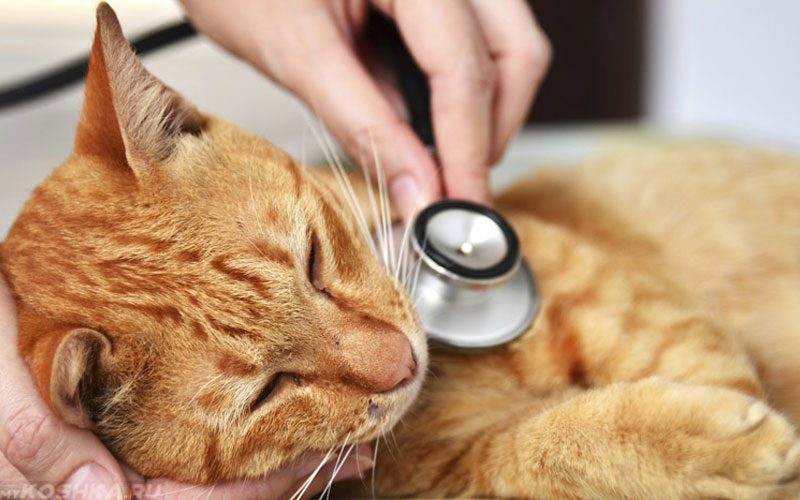
- Listening, palpation and other visual examination methods.
- Blood pressure measurement. Low readings usually indicate serious heart problems.
- ECG.
- Ultrasound of the heart.
- Chest X-ray.
- Blood and urine tests.
Important! If a cat or kitten is diagnosed with heart failure, the animal is prohibited from breeding.
For cats, the process of pregnancy and birth itself can be dangerous, as it places significant strain on the cardiovascular system. Male cats are sedated due to the high risk of inheriting a predisposition to heart failure.
How to provide first aid for heart failure
If you do not immediately come to the aid of your pet during an acute attack of heart failure, it may die suddenly.
You need to act measuredly but quickly, as follows:
- lay the animal with its head on its side;
- remove the tongue from the mouth;
- apply a cool compress prepared in advance to the cat’s head;
- try to bring the animal back to its senses by holding a cotton ball soaked in ammonia to its nose;
- In this case, the paws should be kept above the head to increase the blood flow to it.
Treatment of cats with heart failure
Any treatment of a cat with symptoms of heart failure should be carried out under the strict supervision of a veterinarian! Self-medication can not only worsen the course of the disease, but also lead to the death of the animal! The cause of the malaise must be determined!
Important! Ignoring this problem over time can lead to irreversible changes in the heart and blood vessels.
If acute heart failure is diagnosed, treatment for your cat may include:
- maximum rest and minimization of physical activity;
- oxygen therapy (oxygen chamber or blood oxygenation procedure);
- intravenous administration of drugs (cardiac glycosides, steroids, antibiotics, electrolytes, diuretics, potassium preparations, anticoagulants, etc.);
- symptomatic and supportive therapy;
- pumping out fluid that accumulates in body cavities (when diuretics are insufficiently effective).
Unfortunately, with this diagnosis, the animal will require lifelong supportive care. Even after the acute danger has passed, these cats still need:
- stress minimization;
- correct activity regime;
- special diet (no salt);
- limited access to water (drinking a large amount of water will provoke swelling);
- Regular visits to the veterinarian and monitoring of the condition.
It's essential to strictly follow all doctor's orders and recommendations. Even the slightest deviation from the treatment plan will negate any progress toward restoring heart rhythm. Taking medications for too long can also, in some cases, be dangerous to your health.
Prevention of heart failure
How to act to never encounter this disease?
- Make sure that affected cats do not produce offspring.
- When choosing a pet, check its pedigree for registered cases of heart abnormalities, and if any are discovered, do not buy a “pig in a poke.”
But even a healthy animal requires care, ensuring it eats a balanced diet and leads an active lifestyle. A balanced amount of nutrients will help avoid obesity in pets, often observed in lazy neutered cats, which require closer monitoring. Regular walks and outdoor playtime also help prevent obesity, as they are also beneficial for the respiratory and, therefore, cardiovascular systems.
Furthermore, cardiac problems can worsen in adult cats after general anesthesia. Therefore, the animal must be thoroughly examined before undergoing any surgery involving general anesthesia.
The survival rate of a cat with heart failure depends solely on the severity of the heart damage and the quality of veterinary care provided to the animal. Self-medication is extremely dangerous. Incorrectly prescribed medications can lead to the development of edema lungs, which, combined with heart failure, leads to death. It's important to understand that medications for treating a cat or dog with heart failure will need to be administered for the rest of the pet's life.
We also suggest watching a video about hypertrophic cardiomyopathy in cats:
Any questions? You can ask our website's staff veterinarian in the comments below, who will answer them as quickly as possible.
Read also:
- What is the heart rate of cats?
- My cat's hind legs are failing: why and what to do
- Chronic renal failure in cats: symptoms and treatment


20 comments
Vladimir
Hello! I have a 20-year-old cat with heart failure. He's been prescribed Vetmedin and Veroshpiron for life. But at night, the pain gets worse—he has trouble lying down and is short of breath after eating. What else can I do to help?
Larisa
Hello!
The kitten I adopted had severely infected eyes, practically "bulging out." He was probably about a month and a half old. I found him right before leaving for surgery. I spent two months in the hospital (oncology). I left him with my husband. He's also disabled after a stroke, so I carried him to the clinic as best I could. Then the kitten got injured. I wasn't home, and my husband said he pinched his paw and applied Fastum gel to it. When I arrived, I saw that the kitten was breathing heavily, sleeping with his mouth open, and sleeping suspended (he'd cling to the back of the sofa with his paws and sleep stretched out like that). Somehow, I got ready to go to the hospital. One of his eyes was literally "bulging out," or rather, there was some kind of lump above it. They did an x-ray at a human hospital, since we don't have that at the veterinary clinic.
They said he has a huge heart. Give him Vasosan. The doctors say they don't give it to cats. He's active, eats well, and even started pestering other cats. They previously prescribed prednisone injections. We went back to the doctor, and they couldn't say anything about his heart, and his eye needs surgery, but he could die. With his breathing like that, I know he won't survive. Can you recommend anything, and was the treatment prescribed correctly? Thank you. I understand that a thorough examination is needed, but unfortunately...we're short on that.
Daria is a veterinarian
Hello! Let's start from the beginning. With the eye. If the eye is enlarged and extends beyond the orbit (and is painful), there is discharge (including purulent), and the cornea is cloudy, then there is a risk that the animal has developed panophthalmitis. In this case, surgery is the only option, as there is a high risk that the inflammation from the eye will spread to surrounding tissues (and the brain is not far away).
Second, why was prednisolone prescribed? It's a steroid (a short-acting glucocorticoid), so it should be used with caution (withdrawal after a long course should be gradual and careful to avoid withdrawal symptoms).
Long-term use can cause adrenal problems, hormonal imbalances, spontaneous skin breaks, or skin that becomes too translucent (blood vessels will be visible on the abdomen), curled ear tips, alopecia (hair loss), gastrointestinal ulcers, and sometimes hypertrophic cardiomegaly! Is anything else prescribed or is it just the GCS?
Next comes the heart. Is it just cardiomegaly, or are there any other details? Changes in axis or wall width? Is it possible to perform an ECG to assess heart function? Why was Vasosan prescribed? Was prednisone prescribed first, and then heart problems were discovered, or was prednisone prescribed after the X-ray? Somehow, the side effect of prednisone (namely, an enlarged heart) coincided with the diagnosis from the X-ray. This raises some rather unpleasant questions.
Olga
Hello, could you please tell me if my cat can be given subcutaneous saline for cardiopathy? He has stage 2 valve regurgitation, aortic maximum flow rate of 0.9, moderate pleural effusion, and no pericardial fluid. There is a small amount of fluid in the abdomen and moderate fluid in the chest. He has a concomitant diagnosis of chronic renal failure, creatinine 264, urea 29. Potassium is normal (4.1). The question is related to urinary retention. Will additional fluid (saline) increase the pleural effusion? He has been receiving subcutaneous saline for the past two months, with an average daily volume of 60-80 ml. He is 20 years old.
Anna
Hello. My cat has chronic congestive heart failure (right and left-sided, with reduced output). The prognosis is extremely poor. I was prescribed Vetmedin 2.5, half a tablet twice a day, furosemide 40 mg, 1/6 tablet twice a day, and clopidogrel 75, 1/4 tablet once a day. About eight hours later, I noticed the cat lifting his front paws as if about to groom himself and then freezing in that position as if he were being restrained. What is this and what could be causing it?
Daria is a veterinarian
Hello! This paw raising is most likely related to your pet's diagnosis. The heart is bothering them, so they're raising their paw. The swollen heart is putting pressure on it, causing discomfort. When they raise their paw, their chest expands slightly, allowing their heart to beat more easily. Unfortunately, living with this diagnosis is very difficult for an animal. Treatment is lifelong and will only provide temporary relief. Diuretics can help manage the swelling, but caution should be exercised with furosemide, as it affects the kidneys and causes a lot of potassium to be lost in the urine, which is bad for the heart (which is already causing problems).
Alexandra
Hello! Please help me! My cat died the day before yesterday. It all happened so quickly, we didn't expect it at all. I love her so much and I don't know how to cope with all this. I wasn't home all day. I arrived around 8 pm, but at first I didn't go near her and now I don't even remember how she behaved. Then I gave her a piece of sausage. Then I noticed that she didn't eat it, but only nibbled a little. Maybe another half hour passed, my boyfriend and I were in the living room, it was dark, I didn't see what state she was in. When I tried to pick her up, she pulled away. I was surprised, I touched her nose, it was very dry. I tried to pick her up again, she pulled away again. She jumped to the floor and lay down on her stomach, a position I had never seen her in before.
That's when I realized something was seriously wrong. I turned on the light, and she was breathing heavily. We tried picking her up again, but she ran to the other end of the couch, lay down, and rested her head on the armrest. She looked very lethargic, her eyes half-closed, and it was obvious she was having a hard time. But she didn't open her mouth, didn't cough, and was completely quiet. She didn't even meow, didn't make a single sound, just breathing heavily. We immediately called the vet and took her there. She examined the cat in the car, in poor lighting. I tried to help her, tried to pick her up, but she suddenly bit me very hard on my finger.
Then she resisted for a long time, wouldn't let me hold her, and was screaming. First, the vet put her hand in her mouth, saying she was choking on something. She couldn't get anything out with her hand, so she went to get tweezers. The young man held the cat upright, I shone a flashlight into her mouth, and the vet put tweezers in her mouth, but I couldn't see anything, and neither could she. I only noticed that her mouth was bleeding; the vet must have cut her with tweezers. She immediately lowered her onto her stomach and said that the cat would die. After about 10 seconds, she was no longer moving. I don't understand what happened to her. I blame myself so much. Please help! I've read so much information, but I haven't found anything concrete. We can't take her for an autopsy because the cat was buried that same evening.
Daria is a veterinarian
Hello! Please accept my sincere condolences on the death of your beloved pet. However, based on what you've described, it's extremely difficult to make a definitive diagnosis. You don't really know what the animal was going through or how long ago it happened. It could be pulmonary edema, cardiac or respiratory failure, or perhaps a foreign body got lodged (it wasn't removed for a long time, causing the larynx to suffocate), or allergic edema. Anything goes. It's impossible to make a postmortem diagnosis that way. Only an autopsy will provide the necessary information for a definitive diagnosis.
Alexandra
Thank you so much for your reply! I've been thinking about this for two days and remembered that maybe the last two days before she died, I noticed her in an unusual position, almost lying flat on her stomach. She did the same on a chair and on the bed. I was surprised, but decided it was nothing serious; she'd just started sleeping in a different position. Maybe she had a heart condition? Or could she have choked on a chicken bone? It's just that four days passed between the day she ate the chicken and the day she died. And we didn't hear her cough. I also suspect that we made things worse for her by taking her to the vet. I had just carried her out of the apartment and she immediately started to panic. She was ill in the car; she also lay flat on the seat, and it was visibly hard for her to breathe, especially in an unfamiliar, enclosed space.
And when the vet started examining her in the car, she was very scared, she resisted a lot, she was probably in pain, and the vet hurt her even more. I still remember her eyes, so dark (although she had light ones), scared, as if they weren't hers. I'm also very shocked by the way she died. The vet climbed around in her mouth for about 3 minutes, lowered her onto the seat, and in about 10 seconds or even immediately, she was already dead! How could this happen!? I don't understand anything at all. Could her heart have stopped because of such a stressful situation? We were in a state of shock and buried her almost immediately; we can't do an autopsy anymore. But I won't be able to calm down until I find out what happened to her. I understand that the exact cause of death can only be determined after an autopsy, but I don't have that opportunity anymore. I really hope you can answer me! I will be eternally grateful to you!
Daria is a veterinarian
I repeat: the final cause of death of an animal is ALWAYS determined by the results of a postmortem examination. Anything else is just guesswork. A bone could have pierced the stomach or intestines (severe pain shock, peritonitis, and the resulting death of the animal). It could have been the heart, or something else entirely. A visit to the vet has nothing to do with it. The animal would have died anyway. If not that day, then a couple of days later, the pet slowly perished. The cat, based on the symptoms you described, was already in agony. Calm down and let the situation go. The animal cannot be brought back, and blaming anyone is useless.
Anastasia
Hello, please tell me, my neutered male cat, over 10 years old, was taken to the veterinary clinic with a cough. After an X-ray, they diagnosed pulmonary edema, drained the pinkish fluid, and sent it for analysis, but no cancer cells were found. We've been treating him for almost two months now, and during this time, we've been given numerous diagnoses and treatments: hydrothorexia, chylotorexia, chronic renal failure, FIP... We've been treating and treating, but to no avail. The only thing is that the fluid has begun to accumulate less in his lungs, but in large quantities in the abdominal cavity. We've had blood tests done a long time ago (I'm listing the abnormalities and important values): urea 10.6 (normal 5.4-12.1), creatinine 224 (normal 48-165), and alkaline urea. Phosphatase 19 (normal 49-90), phosphorus 2.6 (normal 1.1-2.3), hemoglobin 92 (normal 93-153), MCHC 222 (normal 300-380), MCH 12 (normal 13-21), MCV 53 (normal 39-52), platelets 542 (normal 100-500), segmented neutrophils 93 (normal 35-75), lymphocytes 5 (normal 20-55), ESR 2 (normal 0-13).
Urine tests showed only abnormalities: ketone bodies 1.5 (normal 0), specific gravity 1.020 (normal 1.035-1.060)... By now, the cat had lost a lot of weight, wasn't eating, and was prescribed subcutaneous injections of Ringel-Locke solution. His body couldn't cope, and it all ended up in his abdomen, making him feel like a balloon. So, everyone seems to be thinking chronic renal failure. Recently, at the veterinary store, I shared our situation with our cat. Surprisingly, there was a woman who had a similar problem with her cat, in terms of fluid accumulation, and she said it might be heart failure... We'll be doing a cardiac ultrasound...
But here's the question: my cat has pink skin on his belly and recently had a bluish tint in the groin area... Based on my guess and your article, this is subcutaneous hemorrhaging... My question: is heart failure really the culprit? If blood vessels are bursting, can we give him cardiac medications, like Vetmidin? It will make the heart pump faster, so logically, if blood vessels are bursting, there will only be more subcutaneous hemorrhaging? Thank you in advance for your answer, and I apologize for my lack of professionalism: I'm just a student, not in the veterinary field. Perhaps you're familiar with these symptoms and could tell me what's going on with my cat?
Daria is a veterinarian
Hello! You also need to look at the mucous membranes. With heart failure, they should have a bluish tint (cyanosis), and by evening, the animal will be more lethargic, there may be swelling of the extremities (hard to notice under the fur; you'll need to feel the paws), and shortness of breath. If it's FIP, then oh-oh-oh, my condolences. There's no real treatment for it. But with it, the visible mucous membranes will turn yellowish, and the abdomen will be painful (ascites, that is, dropsy of the abdominal cavity, is very common, and effusions in the abdominal and thoracic cavities are almost regular). FIP is essentially the same as coronavirus, but while the "regular" coronavirus can be managed, FIP is a real disaster. Lymphocyte counts are very low, indicating a viral infection. All that remains is to find out what kind of pathogen the animal is carrying. A good lab at the clinic is needed for that.
Julia
Your question* My cat died unexpectedly at the age of 6. There were no signs of trouble. In the morning, as usual, he ate, went to the toilet, and after 15 minutes he screamed, fell on his left side, convulsed, wheezed, and stopped moving. His eyes became glassy, his tongue was sticking out, and the mucous membranes in his mouth were pale blue. Before this, he felt great, always had an appetite, went to the toilet twice a day, jumped, ran, and played. The only thing was that at night he periodically snored, snored, and sighed heavily a couple of times. A year before, he was diagnosed with urolithiasis, but we treated it and there were no more attacks, he was on special veterinary food. Tell me what could have happened to him and whether I could have provided any help at that time. At 7 am, when everything happened, all the veterinarians were still closed, and at 8, when we got to the appointment, they pronounced him dead.
Daria is a veterinarian
Hello! Please accept my sincere condolences. I sympathize with your loss. However, the exact cause of death can only be determined after an autopsy, as bizarre as this may sound (many owners consider autopsies sacrilege and an atrocity to the animal's body). But only then can one understand what happened, as every organ and major vessel can be seen. Based on the symptoms described, I would assume that death was caused by rapidly developing heart failure (cardiomyopathy – a type of heart attack), possibly a blood clot. ICD is clearly not to blame. You would have been unable to do anything. Even at the clinic, without intensive care, it's unlikely you would have been able to save the animal. Was the cat a purebred or a nobleman (some breeds are predisposed to cardiovascular disease)?
Elvira
Today at the veterinary clinic we were diagnosed with cardiopulmonary insufficiency. Is it treatable? I have a two-year-old Scottish Fold.
Daria is a veterinarian
Scottish and British Shorthairs are prone to cardiomyopathy (CMP). This is an incurable condition (a type of heart defect). The animal will need lifelong supportive care. Try to find a cardiologist to make a definitive diagnosis and prescribe appropriate therapy. If left untreated and the attack is not stopped in time, the animal will die. However, with proper care and regular medication, the animal can survive.
Elvira
Good evening, my two-year-old cat was diagnosed with fluid in her lungs today. Is this dangerous and is it treatable?
Daria is a veterinarian
Hello! Fluid in the lungs is very bad news. Thoracentesis and symptomatic therapy are indicated. Don't let it get worse, otherwise the respiratory surface area of the lungs will shrink. Pulmonary edema, pleurisy, and, unfortunately, death can develop. Feline leukemia virus (FLV) must be ruled out, as it can cause this symptom.
Anastasia
How can I take my cat to the vet if there are no real cardiologists in my city and my cat faints at the sight of the carrier?!
Daria is a veterinarian
Hello! Start administering sedatives in advance. Use KotBayun or Fospasim for about a week. Place the carrier on the floor with the door open. Let the cat get used to it for a week. Maybe he'll come in, look, and sniff it (interest will take over; he'll come up and sniff it anyway, and maybe he'll come in). He'll also get used to the carrier psychologically; he might even sit in it, touch it with his paw, and the sedatives will build up, making it easier to transport. Avoid valerian! It initially calms, but then overstimulates the nervous system in cats. This can have the opposite effect.
Add a comment