
The smallest wild cat in the world
The feline family has numerous representatives throughout the world. Among wild predators and domesticated animals, there are individuals with a wide variety of physical and physiological characteristics. For example, the largest wild member of the family is considered to be the tiger, which grows up to 3.8 m in length and can weigh up to 400 kg. But what is considered the smallest wild cat?
Content
Appearance features
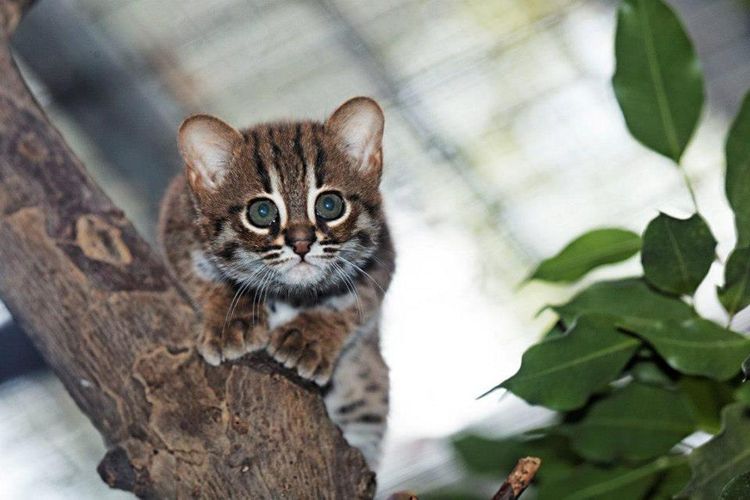
The official name of the smallest wild cat in the world is the red-spotted cat (Latin: Prionailurus rubiginosus), but it is often simply called rusty cat.
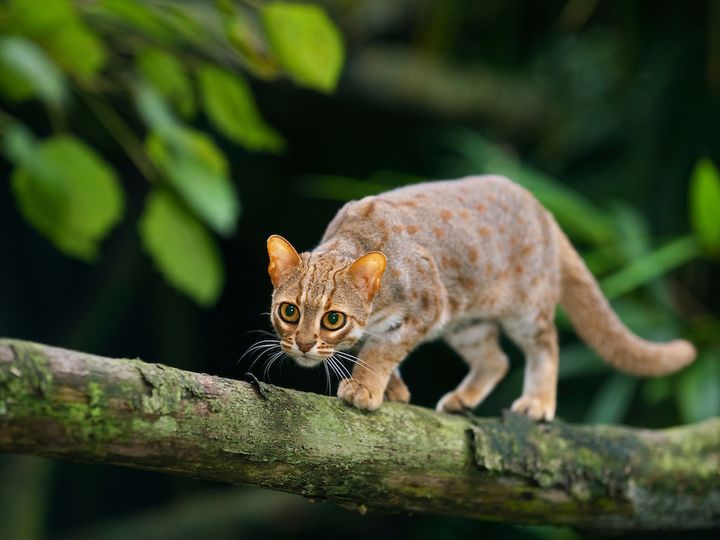
Despite one of its names, this feline typically has a gray coat, less commonly a reddish one, or a mixture of both. Only on the paws, back, and sides can one see faint outlines of rusty spots. The chest and belly are lighter in color, and the face is adorned with stripes: dark lines on the animal's forehead, and white lines on the inside of the eyes and around the nose. The coat itself is soft and short, and the animal's meow resembles the soft call typical of domesticated pets.
Note: The rusty-spotted cat's appearance resembles the Bengal breed, but a more "faded" version.
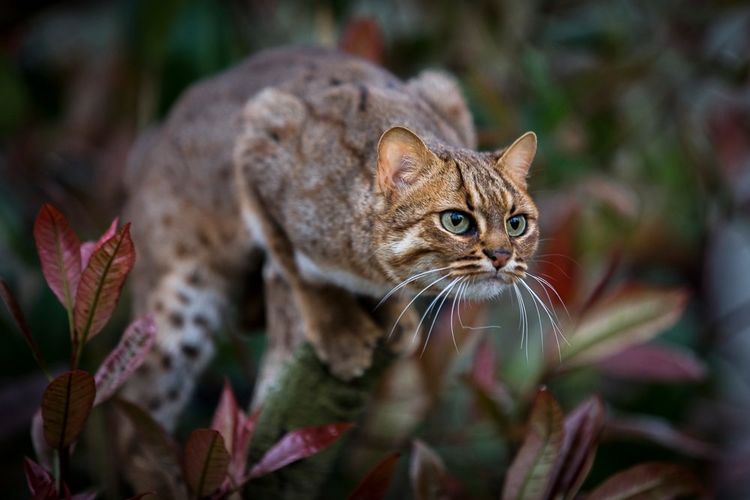
The smallest wild cat measures 50-80 cm in length, 15-30 cm of which is the tail, and weighs no more than 1.6 kg for males and 1.1 kg for females. Its round head is topped with small ears and large honey- or gray-colored eyes, giving the animal a unique expression. Looking at photos of this predator, you might think a domesticated cat has gotten lost in the forest, wandering alone and frightened through the undergrowth. But that's a misconception. Despite its diminutive size, this wild animal thrives in its natural habitat and is every bit as agile as a lion in hunting, despite being 200 times smaller.
Lifestyle
There are only two countries on Earth where the largest populations of orange-spotted cats are found. In Sri Lanka, they choose to inhabit dense tropical forests and mountainous areas, while in southern India, they prefer open areas with dry scrubland.
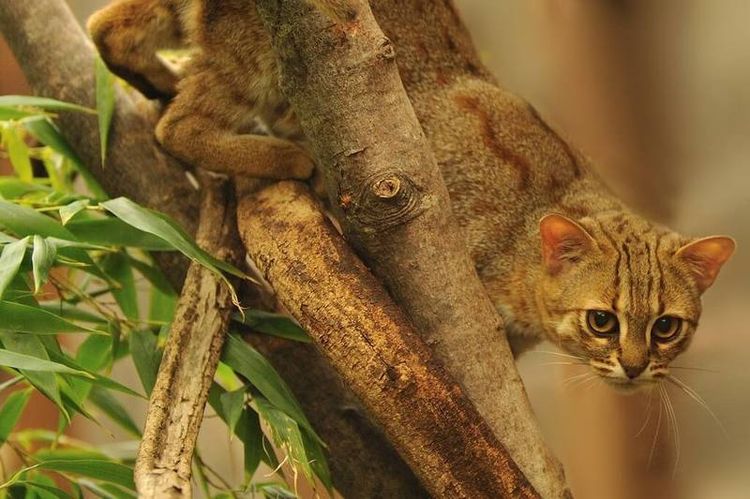
Unlike most domestic cats, their wild, miniature relative is not at all afraid of water and easily swims across small rivers and streams if they are encountered along the way.
These small predators must always be on guard in the dangerous forest, where they must not only find food but also avoid being seen by larger predators. They are solitary and prefer to hunt at night, as it's safer. Another characteristic of their lifestyle is that they prefer to move along the ground close to the trees, so that in case of danger they can immediately climb up the trunk. Moreover, the branches of the trees offer food for insects, birds, or lizards. Their diet also includes small rodents and frogs, which they can feast on during the rainy season. Domestic birds are rarely harmed by rusty-spotted wildcats, but given the opportunity, they will not refuse a domestic chicken.
The rusty-spotted cat cannot tolerate strangers in its territory. Each animal maintains its own permanent home range (approximately 15-18 square meters), the boundaries of which it carefully and regularly marks. The only exception is the breeding season, when males can tolerate strange females in their territory. The courtship period is quite intense, similar to the "March festivities" of domestic cats. However, to gain the attention of a female, the male must spend considerable time showing affection.
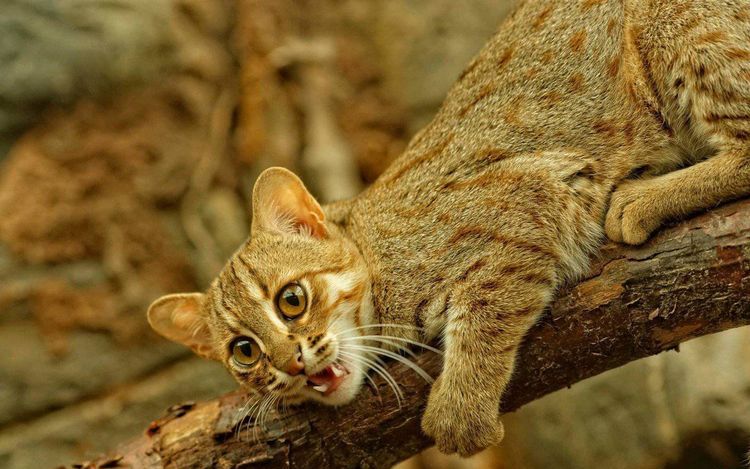
Numerous matings result in pregnancy, which lasts 2-2.5 months and results in the birth of 1 to 3 kittens. By the time the kittens arrive, the mother has created a comfortable den. Kittens are even more at odds with their popular name than adults: there is virtually no red in their coloring. By about six months, their appearance begins to take on the typical adult features, and they become completely independent.
The smallest wild cat's natural enemies include dogs (including strays) and other larger forest predators. Their gradual disappearance from the face of the Earth is also being driven by human deforestation for agricultural land, as well as by farmers themselves. With no more than 10,000 individuals remaining in the wild, the rusty-spotted cat is listed as endangered. Red Book, and hunting for it is strictly prohibited.
More photos in our gallery:
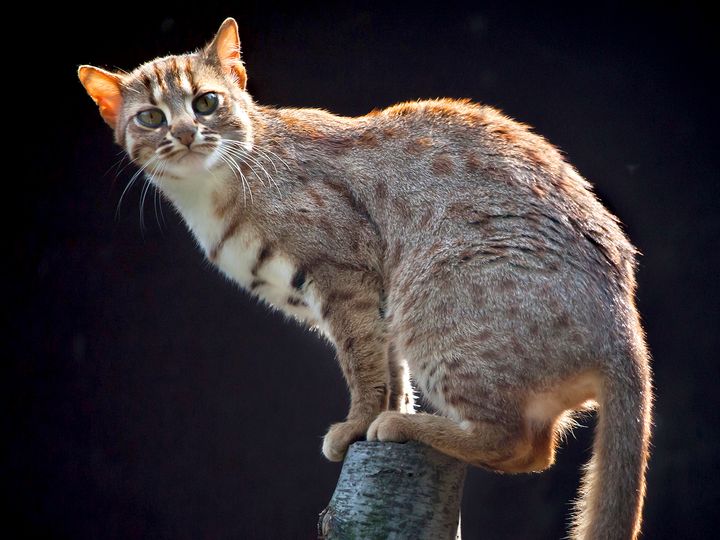
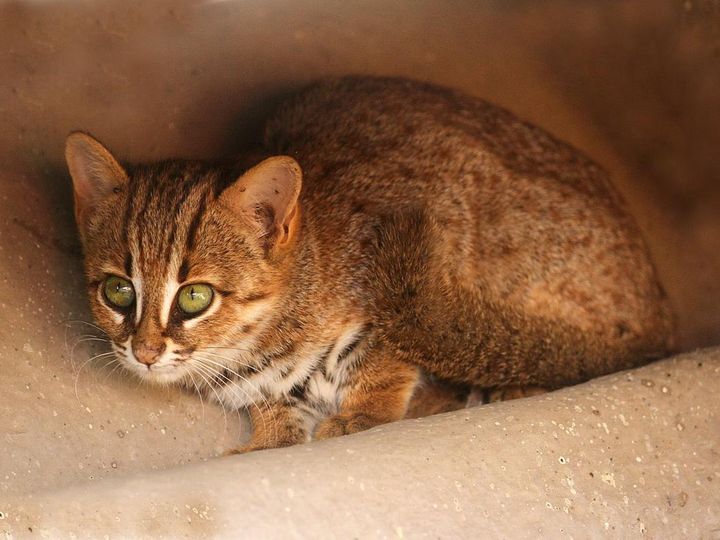
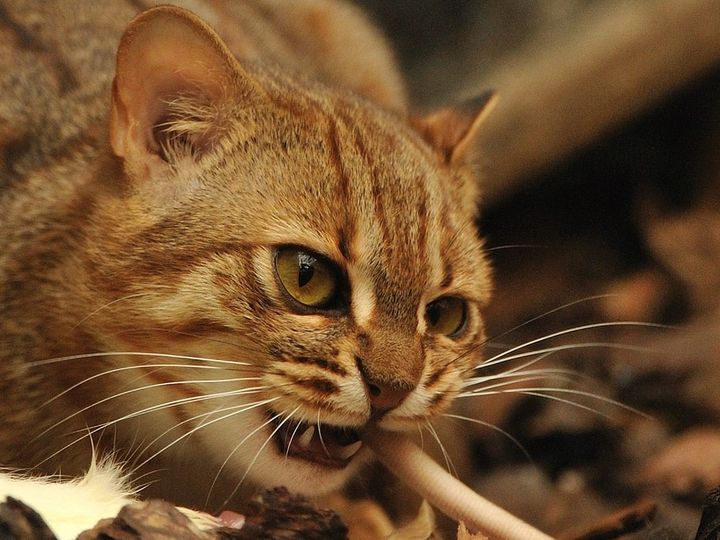
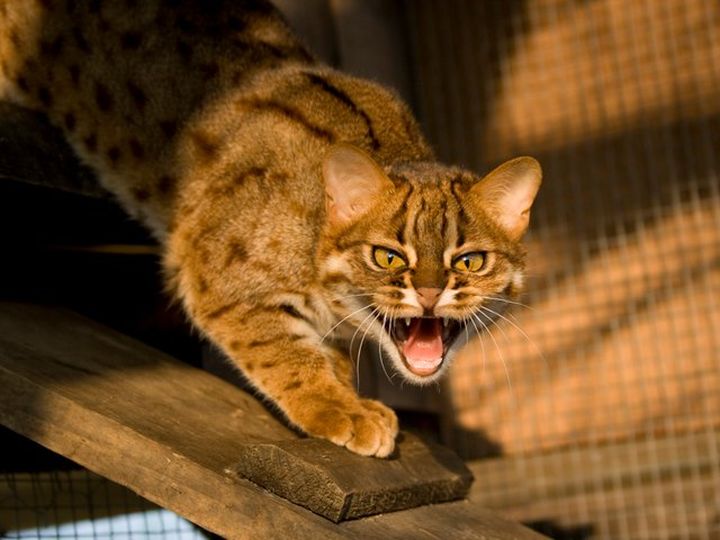
In addition to their native habitat, these predators can be seen in several zoos around the world, and some enthusiasts even purchase them as pets from breeders. Despite their predatory nature and independent nature, spotted-red cats easily adapt to being kept in close proximity to humans, delighting their owners with their cheerful and affectionate disposition.
The most unusual small cats in the world
The cat family comprises many unique species, each with distinct sizes, habits, and hunting skills. Let's take a look at the most interesting wild cats.
Rusty cat (Prionailurus rubiginosus)
One of the smallest wild cats, the rusty-spotted cat weighs only about 1.5 kg (3.3 lb), and its body length, including tail, rarely exceeds 40 cm (16 in). It lives in India and Sri Lanka. Despite its diminutive size, the rusty-spotted cat is a daring hunter, feeding on rodents, frogs, and small birds. Observing it in the wild is difficult, as it is secretive and nocturnal and avoids humans.
Interesting fact: Rusty cats are often captured in camera trap photos with prey that is significantly larger than themselves.
Caracal (Caracal caracal)
A graceful and agile predator native to Africa and the Middle East. A distinctive feature is the long black ear tufts used for camouflage and communication.
Caracals are capable of leaping over 3 meters, catching birds mid-air, while their body length rarely exceeds 70 cm. In the wild, they hunt hares, birds, and small antelopes.
Interesting fact: In Ancient Egypt, caracals were depicted on frescoes as a symbol of grace and strength.
Serval (Leptailurus serval)
A slender African cat with long legs and large ears that allow it to hear the slightest rustle under the grass. The serval hunts with spectacular effect: it stalks, makes a precise leap, and dives down on its prey.
Interesting fact: The success rate of a serval's attacks reaches 50%, while for a lion this figure is about 30%.
Pallas's cat (Otocolobus manul)
The Pallas's cat looks like a miniature "bear": a round muzzle, thick fur, and short legs. It inhabits the harsh steppes of Mongolia, Kazakhstan, and the Tibetan Plateau, where temperatures drop to -50°C.
The Pallas's cat does not chase prey, but sneaks up or waits in ambush.
Interesting fact: The Pallas's cat's pupils are round, like those of humans, and not vertical, like those of most cats.
Black-footed cat (Felis nigripes)
The smallest, yet extremely effective African cat: an adult weighs just over 1 kg. Despite its diminutive size, it can catch up to 30 small animals in a single night.
It uses three hunting strategies: stalking, slow stalking, and ambush. Even large predators such as jackals are not always able to take the black-footed cat's prey.
Interesting fact: In terms of percentage of successful attacks, the black-footed cat is the most successful hunter of all wild cats, with a success rate of about 60%.
Video about a spotted cat:
Read also:
- Wild cats: breeds with photos and names
- Serval is a domestic wild cat.
- Ashera is the most scandalous cat breed.



Add a comment