
What to do if a cat is vomiting?
Vomiting in cats is a fairly common occurrence, and every owner has experienced it at least once. We often dismiss it as a minor annoyance, assuming our whiskered pet simply ate something unsuitable. However, in many cases, vomiting in cats can be a sign of a serious illness. In this article, we'll discuss what to do in this situation, how to determine the cause of the vomiting, and whether home treatment is possible.
Content
Manifestations and causes
Why does a cat vomit? This condition is one of the most obvious signs that something is wrong with the animal's body. Vomiting can occur for various reasons and indicate various illnesses. Let's look at the main causes of vomiting in cats.
Starvation
When it comes to pets, hunger vomiting most often occurs in the morning, when the stomach is empty after sleeping. As soon as the animal is fed or even given something to drink, the vomiting stops.
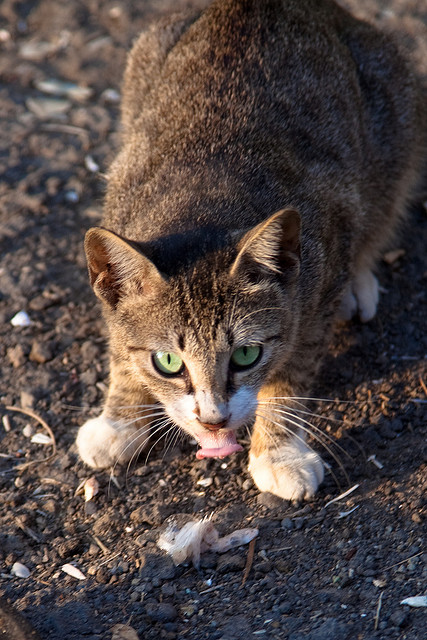
Overeating
Cats often vomit after eating. And that's the downside. When the stomach is full, its contents can't pass into the intestines (since the food needs to be digested) and return. This is when the cat vomits after eating. Naturally, since the food couldn't fit in the stomach, the cat vomits the food or undigested food.
The cat is vomiting hair
Almost every cat owner has experienced vomiting hair. It's nothing to worry about. While pets groom themselves, hairs inevitably end up in their gastrointestinal tract, which is unable to digest hair.
This hairball won't pass through the entire intestine, so the vomiting center (which is present in every mammal's brain) will give the command, and reverse peristalsis will begin (meaning all intestinal contents will move toward the mouth instead of the anus, as they should). This causes vomiting. This is how the hairballs are expelled from the cat.
If this does not happen, then Over time, a pilobezoar, a dense, hairy ball that blocks the digestive tract, forms in the intestine. Food will no longer be able to move through the gastrointestinal tract, and severe intoxication of the body may occur. The animal will be in great pain. Often, a cat vomiting food or undigested food, since the food has nowhere to “move”.
Removing such a hairball is only possible surgically. Therefore, it's crucial to feed your pet special foods that help remove licked hair from the digestive tract. Regular brushing is also essential, especially during heavy shedding periods.
Poisoning
Vomiting in cats is a protective reaction. If a pet is poisoned, vomiting helps flush out toxins as quickly as possible, preventing them from being absorbed and causing harm. However, vomiting in cats that have been poisoned is usually accompanied by diarrhea. The intestines are being rapidly cleansed from all sides.
However, there's a high risk of dehydration. The cat needs urgent help! Poisoning is especially dangerous for young animals and pregnant cats. If this is your case, we recommend reading... What to do if your cat is poisoned.
Vomiting in a pregnant cat
It's no secret that the uterus increases in size during pregnancy. Because the abdominal cavity is so tight, other internal organs become compressed and displaced. Furthermore, during pregnancy, the expectant mother experiences a hormonal upheaval. This is why vomiting is sometimes observed in pregnant cats.
But don't blame everything on a tight stomach or hormonal changes, especially if your cat vomits frequently. This can often be a serious symptom. Your pet could have an infectious disease or parasites. While diarrhea and vomiting can sometimes begin just before labor—a kind of precursor—this isn't always the case. Therefore, if you notice your pregnant cat vomiting, it's best to consult a veterinarian to avoid risking the lives of either the mother or the kittens.
Infectious and parasitic diseases
Don't forget about them either. Intestinal parasites are often the culprit behind a cat's seemingly constant diarrhea and vomiting. It's important to pay attention to other symptoms. If your pet has an infectious etiology, you'll notice a fever, behavioral changes, and discharge from the eyes and nose. A cough and runny nose may also be present.
It all depends on the pathogen and its location. Examining the cat's vomit is also important. Don't be squeamish, as any blood or bile in it can provide clues as to what the animal might be suffering from. Furthermore, when the veterinarian collects a medical history, such details can really narrow down the range of possible illnesses.
Is vomiting dangerous for cats?
Vomiting in cats can be quite a dangerous symptom, especially if it occurs frequently and in large quantities. In such cases, the animal's body loses significant amounts of fluid and electrolytes, as well as essential nutrients.
Frequent vomiting can lead to complications. In particular, there's a risk of aspiration pneumonia if vomit particles enter the respiratory tract. Additionally, your pet may experience diarrhea, loss of appetite, and a general deterioration in health.
Different types of vomit in cats: what do they indicate?
Acute or sudden vomiting
It can occur for various reasons: gastritis, pancreatitis, viral infections, intestinal obstruction or blockage, and other conditions. Vomiting typically occurs once or more per day. Most often, cats vomit food residue, water, or stomach contents.
Chronic vomiting
Characterized by a prolonged course—more than three to four weeks. Vomiting typically occurs once or twice a day. The consistency and appearance of the vomit may vary, including foam, mucus, undigested food, and other impurities.
Yellow vomit in a cat
Extremely rare yellow vomit in cats, it appears due to the coloring of vomit with dyes from food (often due to feeding industrial dry food). Often the cat vomits yellow not because of the food, but because of the bile.
The cat is vomiting bile
Unlike plain yellow vomit, bile-containing vomit is a bright color. This makes it extremely difficult to confuse. It usually occurs in animals with liver and biliary tract diseases. Avoid feeding your pet fatty or stale food. This is very harmful and puts enormous strain on the liver.
The liver also suffers after infectious diseases or drug overdoses. In some cases, antibiotics can destroy hepatocytes. In some animals, even the most basic antipyretic medications slowly "kill" the liver, which can lead to bile-containing vomiting in cats.
The cat vomits food or undigested food.
Either the animal overate or ate too quickly, resulting in swallowing very large pieces of food, which are then regurgitated. However, in cats, vomiting in this case is a one-time occurrence.
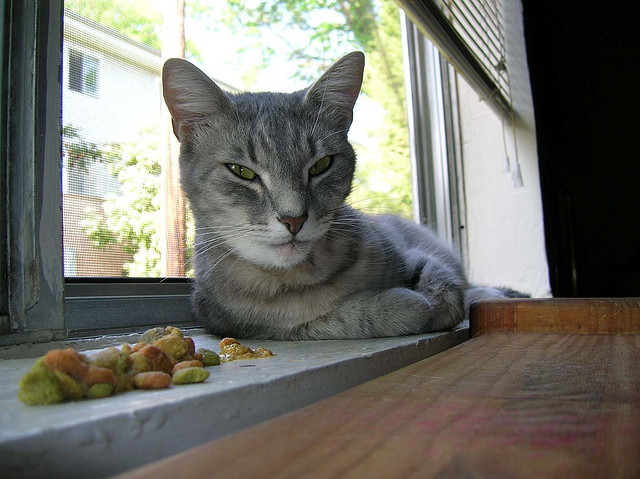
If you notice your cat vomiting frequently, especially undigested food, you should visit your veterinarian. Sometimes regurgitation of food can be a sign of an inflammatory process in the digestive system.ulcer (or gastritis, pancreatitis, colitis, etc.). It hurts the animal to eat; the stomach cannot properly digest so much food, which is why cats begin to vomit.
Sometimes such vomiting in cats indicates intestinal obstruction or volvulus.
Vomiting that is red or pink
Indicates damage to the gastrointestinal mucosa. This condition is common in gastric and intestinal ulcers, cancer, anticoagulant poisoning, and injuries resulting from swallowing foreign objects. It is often accompanied by diarrhea.
Black or brown vomit
It occurs for the same reasons as bloody vomit and resembles coffee grounds in appearance. This color indicates internal bleeding in the gastrointestinal tract, as the blood darkens when exposed to gastric juices.
The cat or male cat is vomiting foam, white vomit
If this happens only once, there's no need to worry too much. This happens to animals (and even people) on an empty stomach. This foam is just mucus that protects the stomach lining. Without it, an ulcer will develop.
But if your cat vomits foam repeatedly, it's best to consult a veterinarian. The animal may have gastritis, an ulcer, or other inflammatory processes in the digestive system. And these inflammations aren't always non-contagious. The cause could be an infection (viruses, bacteria) or helminths.
Vomiting blood in a cat
There are two types of bloody vomiting in cats. If the bleeding is from the stomach or intestines (for example, due to an ulcer or tumor), the vomit will have brownish streaks. However, if the vomit is scarlet, the blood is from a wound in the esophagus or mouth. In either case, be sure to contact your veterinarian immediately! Bleeding is very dangerous and doesn't always stop on its own.
Treatment for vomiting in cats
Treatment of vomiting in cats should only be carried out under the supervision of a veterinarian! Self-medication can lead to a sharp deterioration in your pet's health or even death. So, what should you do if your cat is vomiting?
The veterinarian will first take a medical history. This means you should tell them how long ago the cat started experiencing this, what happened next, how long it's been going on, whether there are any other symptoms (many owners prescribe painkillers and antipyretics before visiting the vet, which can alter the clinical picture), and what kind of vomitus there was.
Owners often panic when their cat vomits after spaying. However, in most cases, the cause is simple: either the pet is very sensitive to anesthesia and recovers from it in a specific way, or you fed the animal while it was still recovering from the anesthesia. You can only give your cat water after spaying a couple of hours after it can stand and walk. The throat and stomach "recover" much later than the legs. Therefore, if you feed your cat too soon after the procedure, there's a high risk of vomiting.
If the veterinarian determines that the pet has been poisoned, adsorbents will be prescribed (they will absorb the toxins onto their surface, preventing them from being absorbed into the bloodstream). If the poison was specific, the cat will be given an antidote. Medications that restore the cat's water and electrolyte balance are essential.
Don't forget about gastritis, ulcers, colitis, and other inflammations. Your doctor will prescribe therapeutic diets and medications (anti-inflammatory, astringent, and others). Surgery is rarely required. If helminths are found to be the cause of vomiting, deworming will be mandatory (remember to take preventative measures in the future).
It's far more dangerous if the cause of vomiting is an infection. It's not always easy to recognize quickly. Many owners think the infection will resolve itself and don't seek veterinary care. As a result, the pet can die within a few days. For a cat to recover, specific immunoglobulins or serums are required. Choosing the right one "at random" is virtually impossible; test results are needed.
Any questions? You can ask our website's staff veterinarian in the comments below, who will answer them as quickly as possible.
Read also:


144 comments
Tatiana
Hello! I have a 9-year-old cat. Six months ago, his skin turned yellow. Now he vomits after eating.
They took me for an ultrasound and said all my organs are healthy, except for a cyst in my abdomen that's pressing on my internal organs. They said nothing can be done; they only do surgery in Samara, and I'm from Saratov. My cat is wasting away right before my eyes. What can I do to help him?
Daria is a veterinarian
Hello! Your pet had yellow skin for six months, and it didn't bother you? Clearly there's a problem with the liver or gallbladder (in any case, a simple biochemical analysis would have revealed the underlying issue that led to the jaundice).
You took your pet for an ultrasound, and they gave you a prognosis based on the scan, but you weren't satisfied with the veterinarian's answer, so you're now looking for another one. The organs can't be healthy if your pet has had jaundice for six months and has also started vomiting (likely due to liver problems). What's the size of the cyst that's putting pressure on the organs?
If it's operable, remove it. If not, you'll just have to hope the animal survives as long as possible. Without knowing the nature of the cyst, it's impossible to prescribe treatment. But in 9 out of 10 cases, no medication will remove the growth.
Alina
Hello. My four-year-old cat is vomiting chunks of undigested food. He eats dry food, and we even switched him to a different brand, but it's still the same. He vomits intermittently. Today, he might be sick, then he'll be fine for a week, then he'll start again.
There's no loss of appetite. No matter how much you put in the feeder, he'll eat it all, so we try to feed him small portions and avoid overfeeding.
Daria is a veterinarian
Hello! What kind of food are you feeding her now, and what did you feed her before? Is the vomit just undigested food, or is there also licked-up hair? How long has it been since she was dewormed? Is there any bad breath? Are her stools normal?
First and foremost, we'd rule out gastritis and pancreatitis. Have you noticed vomiting occurring after feeding a certain food or eating anything other than food? How are your pet's thirst and urination (are they more frequent, or has the volume of fluid intake and excretion increased)? How old is your pet (is it elderly)? Has your pet ever had kidney problems?
Larisa
My 5 and a half year old Siamese cat has been vomiting once in the morning at 4 am for a week. He feels well and has a good appetite.
Svetlana
A 19-year-old adult cat vomits yellowish fluid once a day at night. Her appetite and activity are normal. She eats raw ground meat and Whiskas, and has started drinking milk. A specialist recommended feeding her 5 cm of hair removal paste daily.
Daria is a veterinarian
Hello! Did the specialist recommend you start feeding your pet a normal diet other than malt paste? Feeding raw meat, especially ground meat, is dangerous, especially to an elderly animal with a weakened immune system.
Whiskas isn't the best option either. Plus, mixing "natural" food with commercially produced food is a big deal. And milk... Adult cats can't digest it anymore (only fermented milk products, and in small quantities). Oh, a veterinary nutritionist would be shocked. Start with the diet! Switch to a good food for animals with gastrointestinal issues.
Sima
Hello, I have a question: my cat hasn't gone to the toilet for 6 days, hasn't eaten anything, and is burping in his stomach. What should I do?
Larisa
Details to what was sent earlier. Siamese cat, domestic. Eats only boiled chicken, boiled fish, pollock, and cod. Sometimes I give him raw fish. I give him a little trout. I started giving him raw turkey on advice about 10 days ago. I gave him 2-3 times. He has good dry food, as a supplement. I rarely give him that.
Irina
Hello! My cat is 9 months old and we're eating Optimil dry kitten food. She's started vomiting a yellowish mess with green mucus. She doesn't vomit often, maybe three times a day. She's active and playful, but she's stopped eating. This has been happening for two days now.
Daria is a veterinarian
Hello! I'm on a 12-18 hour fast. However, water should be freely available (chamomile tea or Vetom 1.1 are also an option). Replace the food with the Gastrointestinalis series (for animals with gastrointestinal issues). Have you dewormed them? Is he not stealing natural food from the table? Is anyone feeding him supplements in addition to the commercial food? The color of the vomit may indicate liver problems.
Therefore, ideally, a blood chemistry test is needed at least to start. If liver function tests are elevated, then an ultrasound will be necessary. Could the kitten have ingested a foreign object? Three times a day is too much for vomiting.
Daria
Hello! I have a six-month-old cat. He ate boiled chicken bones (taken out of the trash) and now he's been vomiting all day. He's lethargic, lies down or sleeps all day, won't come to be picked up, and hasn't eaten or drunk all day.
The vomit is bloodless, brown with bone fragments, odorless, runny, and small. He doesn't choke or cough when he vomits. Please help! Tell me what to do! Should I take him to the vet or just observe for now? Should I give him something, or at least give him some water?
Daria is a veterinarian
Hello! You should definitely see a veterinarian and get an x-ray. This is necessary to rule out the presence of bone fragments (which are, after all, foreign bodies) in the stomach and intestines. An x-ray will also help rule out perforations (breaks in the integrity) of the stomach and intestinal walls (to prevent peritonitis later).
The brown vomit is due to the stomach contents being stained with blood (bone fragments are damaging the stomach wall), which has darkened due to oxidized iron. Drinking fluids will help flush out the fragments even more through vomiting.
Catherine
Hello! My cat is 7 months old and has been vomiting for four days now, 2-3 times. The first time he vomited, it was water and fur mixed with undigested food, then just greenish water and then just water. His behavior hasn't changed; he's playful, but his appetite has decreased. On the third day, we started giving him Vetom 1.2. Today marks the fourth day he's vomited water.
Three hours after work, he came to the bowl and ate some of his dry food, but 15 minutes later he threw it up... I don't know what to do or what to do with him... I'm giving him dry "Hils" kitten food. Four or five days ago, I gave him some sour cream.
Daria is a veterinarian
Hello! Have you had your cat dewormed lately? The standard advice that no one wants to hear, much less follow: visit a veterinarian in person to confirm or rule out the diagnosis. I would first suspect gastritis (not necessarily due to poor feeding; it could be mechanical irritation, like from fur).
Never mix natural food with commercial pet food, especially high-quality food. Pancreatitis cannot be ruled out. If the sour cream was high in fat, it's possible the liver "didn't like it." As you can see, there are many possibilities, and a definitive diagnosis can only be made after an examination.
Sasha
Hello! My 4-year-old cat has been vomiting for four days now, first with fur mixed with bile, and now with just bile and undigested food. He had green diarrhea, but now his stool has formed a bit, but it's still green. He only started drinking water on his own today; before that, we were giving him water and syringe feeding. We gave him activated charcoal, but he's still vomiting it up.
The cat lives in my parents' apartment; he's never been outside. We feed him liver, raw liver, and sometimes Royal's food (he doesn't eat the food well. We've tried boiled meat, poultry, and baby canned meat, but he won't eat anything except liver and liver from a certain factory). His fur is always shedding profusely, but he's not going bald. My parents refuse to take him to the vet, and I live hundreds of kilometers away and don't know how to help.
Daria is a veterinarian
Hello! How do your parents imagine being diagnosed and prescribed medication without a doctor's examination? Wouldn't they have gone to the doctor if they were vomiting and having diarrhea so often? Hardly; they'd have gone straight to the infectious diseases hospital. So why isn't the same attitude toward animals? The feeding isn't balanced! Feeding raw meat and by-products to animals is dangerous!
It is not possible to mix natural feeding and industrially produced feed.
Based on the symptoms, I would suspect liver and pancreatic pathology. That is, without an ultrasound and a biochemical blood test, a definitive diagnosis will be impossible.
And an animal doesn't have to go outside to become infected with parasitic or infectious diseases (it's easy to bring a pathogen from the street on shoes and clothing).
How long has it been since you've been cleared of worms (not just tapeworms, but roundworms as well)? What color are the visible mucous membranes? Is there any yellowing or excessive pallor?
Olesya
Hello, my cat is 14 years old, he vomits all day, is weak and even falls on his right side, what could it be?
Daria is a veterinarian
Hello! Anything could happen. From poisoning to an infectious disease. No one can make a diagnosis based on just one symptom without an in-person examination and a thorough history (feeding, housing, treatments, how long ago it started, what was given, any other symptoms, access to houseplants/garbage/household chemicals, injuries, past illnesses, including recent ones, etc.).
He's falling on his side and is weak from constant vomiting. He needs IVs urgently before he dies from dehydration! If poisoning isn't the cause, antiemetics are necessary.
Tatiana
Hello, my cat started vomiting. She's so exhausted, she'll eat, and then some time will pass, and then she'll be gone. At first, I thought it was hair, but the vomiting didn't stop. She's hungry, but all the food comes out. She returned from a business trip (after four days), and she's barely able to walk due to being so thin.
I took her to the doctor, where they did blood tests, an ultrasound of her liver, kidneys, and bladder. The diagnosis was early renal failure, suggesting the kidneys were causing toxicity. They gave her a Disol IV for three days, an antibiotic injection under the skin for three days, and for some reason, only two days of antiemetics. So, on the last (third) day, she had an IV and antibiotics.
The cat came back to life, even her fur became shiny. She ate (she's on a strict diet—she bought the most expensive food the doctor recommended). I gave her this pate every two hours, and after three days of IV drips, she even went to the bathroom (she hadn't had anything to do with it before). But on the morning of the fourth day, she vomited again.
I was on my way to work and the same thing was happening. I offered her a piece of pâté (the recommended food). She sniffed it, walked away, and vomited up yellow water, which I think was bile. I called the clinic—they told me to come see us.
I have no idea what to do with her. You can't just keep dripping forever, especially when they pulled the catheter out of her vein. She screamed at me. She limped the rest of the day.
Daria is a veterinarian
Hello! Did you expect such a complex condition to resolve in four days? It doesn't develop overnight, and sometimes treatment takes months (especially if the kidney tissue has been destroyed).
Patients most at risk of developing acute renal failure are those with kidney disease, severe trauma, systemic disease (pancreatitis, diabetes mellitus, cardiovascular disease, liver disease), decreased circulating blood volume, electrolyte disturbances, hypo- or hypertension, fever, sepsis, use of nephrotoxic drugs (especially if self-medication was experimented with), anesthesia, hypercalcemia, lymphoma, leptospirosis.
These are among the few conditions that trigger the development of acute renal failure. IVs are necessary (especially those with sodium and chloride, as large amounts of these ions are excreted in the urine due to increased diuresis). Potassium, on the other hand, is retained in the body because its renal excretion and gastrointestinal elimination are impaired in acute renal failure.
Administering potassium supplements without monitoring blood levels is dangerous! It can also trigger heart problems. But you shouldn't pour sodium on yourself by the liter; everything is good in moderation. Diuretics and medications to improve renal blood flow should be prescribed very carefully (under a doctor's supervision). Antiemetics can be administered with caution. Have you had a biochemistry test to assess the current condition of your kidneys and liver?
Larisa
Vet clinics are incredibly expensive. My cat vomited for two days, then they gave him an injection and the vomiting stopped. Now it's started again. I'm giving him water from a syringe. An ultrasound costs 2,000, a blood test costs 1,000, and the appointment costs 2,000. So we're considering treating him at home.
Marina
Hello! Please help my little Manechka. She ate a plastic Christmas streamer two days ago. She hasn't eaten or drunk for two days, and is vomiting 2-3 times an hour. The vomit was clear mucus, but a couple of times it was dark brown.
She screams loudly before each attack. Is there any way to get this nasty stuff out of her stomach at home? Please help my girl.
Daria is a veterinarian
Hello! Under what home conditions??!!! Get to the clinic immediately! Foreign bodies are removed either endoscope-wise or surgically! The stuff could be in the stomach, or it could be in the intestines. In any case, only a doctor can help the animal. Don't rely on vomiting it out on its own. The longer you wait, the less likely it is to succeed.
Julia
Hello. I have a Maine Coon cat. Last night she vomited several times, and after that she didn't eat anything, even in the morning, and she was lethargic. Could you please tell me what could be causing this? She wasn't vomiting fur, but undigested food.
Daria is a veterinarian
Hello! What are you feeding? When was the last veterinary treatment, and what was it? He needs a checkup. They'll rule out gastritis, pancreatitis, and liver problems. A biochemistry panel is also needed. Kidney and thyroid problems should also be ruled out (pathologies of these organs can also sometimes cause vomiting).
In general, additional examinations are needed if you want to get an accurate diagnosis, and not just by eye.
Elena
Hello, my cat is 18 years old and hasn't been walking for two years. He has back and hind leg problems. He also has kidney stones and asthma. We care for him, give him medication, and massage him.
The cat has a good appetite and goes to the bathroom normally, but sometimes we have to give him a laxative. Our vet recommended euthanizing him six months ago. In recent months, he's gotten worse—he's started shrinking and vomiting. He vomits after eating, grinds his teeth when chewing, and then seems to choke, either because he can't swallow or because food gets caught in his teeth. He regurgitates everything, along with white foam. One of his teeth is broken.
He eats dry Purina and Felix packets. His current medications are Cyston and a Flixotide inhaler. He vomits almost constantly, so he doesn't eat much, but he has an appetite.
Is there any way I can help him at home? What antiemetics can I give him? Or maybe antibiotics? He's had two courses of Sinulox 50 mg in the fall and winter. Taking him to the vet is pointless; he might not make it because he's so scared. Is there anything else I can do, or is it better to euthanize him instead of torturing him?
Daria is a veterinarian
Be careful with glucose, since the condition of the liver is unknown.
Saline solutions can be administered subcutaneously to prevent dehydration due to vomiting and to restore fluid and electrolyte balance. Vitamin injections can be given (mineral complexes, or simple hematopoiesis stimulants such as katosal, phosphosal, uberin, and their analogs containing butophosphan and vitamin B12).
Regarding euthanasia: you need to watch to see if the animal is suffering. As bizarre as it may sound, sometimes this is the most humane way to end a beloved pet's suffering.Hello! Give him wet food; it might make him easier to chew (there are wet foods for weak animals). But not Felix. You're mixing budget food with premium food. This shouldn't be done (it can lead to kidney stones).
Therefore, feed only one type of food and one manufacturer (super-premium or holistic class of the urinary line, since problems with the genitourinary system already exist).
Vomiting can occur with kidney failure or thyroid disease, not necessarily with gastrointestinal problems. For vomiting, use either cerenia (if you can find it in veterinary pharmacies or clinics; sometimes even clinics have trouble finding it) or cerucal (available in human pharmacies).
Why give him antibiotics? They'll put even more strain on his liver and kidneys. You can give him saline solutions (Rehydron and similar medications are easy to find at human pharmacies). Give him small amounts often. Be careful with glucose, since the condition of the liver is unknown. Saline solutions can be administered subcutaneously to prevent dehydration due to vomiting and to restore fluid and electrolyte balance. Vitamin injections can be given (mineral-rich complexes, or simple hematopoiesis stimulants such as katosal, phosphosal, uberin, and their analogs containing butophosphan and vitamin B12).
Regarding euthanasia: you need to watch to see if the animal is suffering.
As crazy as it may sound, sometimes this is the most humane way to end the suffering of a beloved pet.
Elena
Thank you very much for the consultation!
Galya
A 17-18 year old cat, neutered, lies once a day without fail, usually 2-3 hours after eating. This has been going on for almost a month. He vomits not digested food, but liquid, such as mucus or water. We feed him Felix cat food, cooked meat, and occasionally raw meat. He drinks milk and water.
Daria is a veterinarian
Hello! 90% of the time, your pet has an inflammatory process in the gastrointestinal tract (if it were gastritis, vomiting would have occurred within half an hour). Since the vomiting is occurring later, it's most likely a pancreatic or liver problem (although, based on your description, there's no bile in the vomit). The diet definitely needs to be changed. Felix isn't the best food; I'd say it's one of the worst.
Raw meat should not be given, milk is not recommended for adult cats (especially older ones).
Switch to a super-premium or holistic Gastrointescinalis food (for animals with gastrointestinal issues). Ideally, have your cat have a biochemistry profile, and an ultrasound in addition to the biochemistry profile is the best diagnostic option. It's important to determine what's causing the vomiting. Perhaps gastritis medications (omez/omeprazole + mezim, etc.) are needed, or perhaps additional enzymes (Creon, at least pancreatin) are needed, or perhaps the liver needs help restoring.
Sometimes kidney problems can cause vomiting. Have you had a dewormer recently? It wouldn't hurt to deworm them as a preventative measure. But in general, a diagnosis is necessary: a complete blood count, a biochemical blood test, and an ultrasound. By the way, how is the child drinking and urinating? Has the thirst increased?
Elena
Hello. My cat is 9 years old. He was vomiting undigested food all day. On the second day, he vomited saliva once. He went to the toilet and fed as usual. He is not lethargic. His stomach is soft and painless. He is a little restless, but still cuddles. We don't give him anything other than special food (Royal Canin for picky eaters and urinary tract infections, dry and wet).
Diagnosed with urolithiasis and pyelonephritis in 2010. He's been in remission for two years. He often sits near flowers, and I suspect he sometimes nibbles the flowers, or rather the soil. We also sowed cat grass in the sawdust, but we don't let it grow properly; he chews it. He has no diarrhea. He's a stressed cat, so taking him to the vet is difficult. We only take him to the vet in exceptional cases to avoid further trauma. What can be done at home?
Daria is a veterinarian
Hello! If your cat has kidney problems, vomiting may indicate not only gastrointestinal issues (gastritis, pancreatitis, for example), but also deteriorating kidney function. Sometimes vomiting also occurs with kidney failure. Have you noticed any changes in urination? Has it become more profuse? Remove the flowers.
Maybe he ate a houseplant that's poisonous to animals? Your cat has a medical condition, so it's essential to give him a full examination: blood work, an ultrasound, and a gastroenteroscopy.
Peace
Hello,
Please help save the cat.
Age about 14 years.
He's been vomited up food he's eaten frequently for the past month. We thought he was poisoned.
But in the last week he started to burp up what seems to be bile (because it is a dull yellow color).
He drinks little water. We feed him with a syringe. His pupils are large. His fur is dull. He has lost half his weight.
He just lies there. He has an appetite, but it's very weak. He eats a little about five times a day. His eyes are dull. He's severely dehydrated.
We'll be able to get to the veterinary clinic in 2 days.
Please tell me how I can ease his condition.
Or how to restore water balance, at least for 2 days
Thank you
Daria is a veterinarian
Hello! Why did you observe the vomiting for a month? Gastritis, pancreatitis, cholangitis, hepatitis, kidney problems, parasites—anything is possible. It's best to treat a cat after vomiting with special saline solutions (Rehydron or similar products available at human pharmacies). You can also give injections of saline solutions (sodium chloride or Ringer's solution).
I don't recommend glucose, as liver problems may be suspected, and glucose should be used very carefully in such cases. Feed wet food (not dry)—canned food or pouches—to increase the amount of moisture entering the body. Has your cat been treated for parasites lately?
Alena
Hello. My kitten is about 4 months old. She vomited undigested food three times within an hour, with short breaks in between. Her condition hasn't improved since then. She's not drinking. She's breathing rapidly. She's lethargic. What could be causing this? What should I do?
Daria is a veterinarian
Hello! Has the kitten been dewormed? What was the deworming method used, and how long ago? Vaccinations? What does he eat? If he doesn't drink, force him to drink (preferably with rehydron), as vomiting causes water loss, which disrupts his water-salt balance. Just make sure to give him small, frequent drinks. Could he have been poisoned? Has his temperature been taken? Ideally, he should be examined.
Tatiana
Hello!
My cat is 10 years old. He starts vomiting periodically (every few months) after eating. The doctor prescribed Cerucal. Today, after the injection, my cat had a strange reaction. I googled it and found out it was an overdose. What should I do? Should I wait for it to go away on its own? Or is there anything I can do? My cat seems lost, complaining, disoriented, not sleeping, complaining.
2. How can we diagnose my cat? Every time he starts vomiting, we go to the vet, and they always say they can't diagnose him without a biopsy, and to do that, they'll need abdominal surgery under general anesthesia. Is this really the only way?
All the troubles started when IAMS disappeared. Now we're suffering. Currently, he's taking Purina ProPlan for gastrointestinal problems.
Thank you!
Daria is a veterinarian
Hello! There is no specific antidote, so symptomatic therapy and IVs are the only treatment. It's possible you're allergic to the medication, not overdosed. Or maybe you gave more than prescribed? Replace it with Serenia (it will stop vomiting and improve appetite).
Why do you need abdominal surgery for a biopsy? Laparoscopy at most. But couldn't you have done an ultrasound, X-ray, or gastroenteroscopy? Or has this already been done, and based on the examination data, a tumor is suspected?
Change the food; it might not be suitable. There are plenty of other good super-premium and holistic foods for animals with gastrointestinal issues. Try feeding wet food. Have you ruled out gastritis, pancreatitis, or hepatitis? Have you had a biochemistry test?
Dmitry
Good day! My cat is a Scottish Fold/Middle-Wing mix. My urine is acidic. He has struvites and oxalates. He recently had urinary problems; they inserted a catheter once every 24 hours and twice every 2 days. When they removed the 2-day catheter, it got stuck (as the doctor put it, "the catheter was stuck by a stone in the urethra").
The course of treatment is the antibiotic Baytril, 50 ml of saline solution under the skin occasionally, serenity once every 7 days, papaverine for 8 days, we are still giving cystophane, and Putin's Urinary food (pate).
A 4-year-old neutered cat. He was given antibiotics for 10 days. On the sixth day of antibiotic treatment, vomiting began. He is still vomiting. Treatment began on November 28 and ended on December 6. He vomits undigested food on average within 3 hours, but sometimes faster. He is lethargic and asks for food, drinking about 20 ml per day plus food diluted with water.
Daria is a veterinarian
Hello! He's drinking very little! It's incredibly little! Eliminate dry food completely and replace it with medicated wet food (canned food). Dry food cuts water intake in half, but canned food already has moisture, so animals drink more.
Have your stomach examined. It's possible you're reacting to the antibiotics, which is causing the vomiting (gastritis has developed, or pancreatitis, or a liver complication—"drug-induced" hepatitis). Get a biochemistry panel and a gastroenteroscopy (if possible).
According to biochemistry, at least problems with the liver and pancreas will be excluded or confirmed.
Tatiana
Hello! We have a problem: our cat ate a piece of thick plastic wrap. Her appetite remained the same throughout the day (she eats and drinks), and she feels normal. At night, she tried to vomit, releasing a small amount of fluid. On the second day, she went to the bathroom, and there was no film. Another two days have passed, and there is no change in her behavior. Yesterday, she had another hard stool, but there is no film in it.
The cat tried to vomit again, but nothing happened. Her stomach isn't tight or painful. She's eating and drinking. I'm concerned about the urge to vomit and the lack of this film in her stool. Please tell me what to do. Thank you!
Daria is a veterinarian
Hello! X-rays are the only way to detect a foreign body in the intestines (especially one so soft). And don't wait for an intestinal obstruction or volvulus. Death from a volvulus can occur within a few hours.
Christina
Hello! I don't know what to do. My British cat has been vomiting all day. First, in the morning, she threw up a big, white, thick pile, and then about every two hours she throws up a little bit of something, sometimes white foam, sometimes clear like drool, sometimes slightly yellowish. And by evening, she threw up a little bit of curdled milk, but it was a fountain.
This is the first time this has happened to her. She stopped going for walks yesterday, and the cat wasn't taken to the mating station. She was dewormed a year ago. She lives in an apartment. I feed her dry Kitekat, liquid Friskies, or Kitekat. She loves milk.
Daria is a veterinarian
Hello! Britannica, Kitekat, and Friskies? That's not food, it's junk food. Change the diet! Now on the Gastro series (no milk, especially now). Charcoal/Enterosgel, chamomile tea, or Vetom 1.1 instead of water, Fortiflora, and see a doctor. Rule out gastritis, pancreatitis, and other inflammatory processes in the gastrointestinal tract. Deworming is necessary every three months!
Even if the cat is completely indoors, it needs to be vaccinated (you can bring infectious disease pathogens into the house on your shoes and other items). A visit to the clinic for a diagnosis is essential.
Alexander
Feed your cat fresh meat and fish, raw beef liver, milk and homemade sour cream, and he will live to old age and won't need a vet.
Maria
Hello! My cat is 13 years old, small, short-haired, and domestic. She was last dewormed last fall. She eats PerfectFit dry food or the same brand's jelly food. We recently brought some grass from the dacha, and she ate it and vomited grass leaves. Then she rotted the food and vomited undigested food.
She then ate nothing for 12 hours, drinking only water. Then we gradually spoon-fed her liquid food, then dry food, and all was well for two days. Now, in the evening, she started vomiting again for no apparent reason. One burp was dark brown. Then two small, clear burps with foam.
She then went to the toilet, peeing and then pooping, but with difficulty. She sat and strained for a long time. The stool was normal. Then she drank only water. And then she vomited a second time, clear foam.
Her behavior is quite normal: her nose is cold and wet, her temperature is 38.4 (measured in the groin area), her pulse and breathing rate are normal, and she's constantly asking for food. What could this be? Should I see a doctor? Please help...
Dasha is a veterinarian
Hello! Firstly, temperature is measured rectally (in the rectum). Secondly, the nose is not an indicator. Now about the animal itself. Deworm it, and don't forget to deworm it every three months from now on. These symptoms strongly suggest gastritis, pancreatitis, or another gastrointestinal inflammatory condition.
To accurately differentiate the disease, diagnostic tests are necessary: a complete blood count and biochemical analysis, an ultrasound, and a gastroenteroscopy. Don't delay.
Irina
Hello. My Scottish Fold cat is 5 months old. After eating, she regurgitates her food almost immediately and then eats it. She occasionally goes outside, but under supervision. She has never had diarrhea. She is always active. Is this dangerous?
Dasha is a veterinarian
Hello! My cat needs a checkup. Are you ruling out overeating? Gastritis should also be ruled out. Does she vomit foam on an empty stomach? Do you deworm her regularly? What exactly are you feeding her? If dry food, what kind? Does she shed a lot? Does she vomit hair?
Irina
We dewormed her before her vaccination. She vomits after eating. I feed her soup, sometimes boiled fish, pâtés, and I indulge her with baby food, meat, and dairy products. She barely chews her food; she swallows it right away. Her tongue is always hanging out.
Irina
Her fur is not long, but she sheds, and sometimes she vomits up hair, but that only happened a couple of times.
Nikita
Good afternoon, this evening as I returned from work
My cat started vomiting yellow liquid.
At the same time, he screamed very loudly and vomited about 6 times in an hour, then it stopped.
The cat itself is lethargic, when I try to pet it, it moves away from me and meows.
He screams loudly when he vomits. The cat is 2.5 years old.
Scotsman
We feed them dry Whiskas for castrates and deworm them.
The cat is short-haired.
What to do?
What could it be?
And is it dangerous for his health?
Dasha is a veterinarian
Hello! Let's start by saying you're feeding your pet incorrectly. Get rid of the Whiskas. Give your pet a different, good-quality food immediately! Get your pet examined! Vomiting bile most likely indicates liver problems. Your pet needs a full blood count and biochemistry. Get an ultrasound of the liver and digestive system. Did the vomiting happen on an empty stomach, by any chance?
Was there any foam? Did you take his temperature? Did you treat him with anything before? Does he go outside? Maybe he's been in contact with other cats? Is he vaccinated?
Sergey
Hello! My cat is 16 years old, I feed him Hills k/d kidney food, before that 2 years ago I went to the vet at the clinic, the tests were not very good, so they prescribed this food.
Lately, however, the cat has been vomiting undigested food, sometimes passing hairballs along with the food. Now, after every meal of dry food, he vomits mucus with a reddish tinge. However, if I feed him wet food of the same brand, everything is fine and there are no problems. Should I change his diet? He doesn't drink water often, his eyes are not draining, his nose is cold, and he's not upset, but he has lost a little weight.
Dasha is a veterinarian
Hello! Have your cat examined by a veterinarian. Rule out gastritis, ulcers, and other inflammatory processes in the digestive tract. An ultrasound, complete blood count, and biochemical analysis are recommended. Give malt paste to prevent hairballs (after using malt paste, hairballs are passed in the stool rather than forming clumps in the gastrointestinal tract).
Typically, a medicated diet is given for six months, and then the animal is monitored. If there are noticeable improvements after a course of medicated food, we may recommend switching to a regular (non-medicated) diet. What was the cat's diagnosis?
Sergey
Hello! They didn't give a diagnosis, but they said that creatinine (217.74) and urea (13.28) are high, based on blood tests. They also said to feed the cat a therapeutic k/d food for the rest of its life because of kidney problems. But that was two years ago.
Dasha is a veterinarian
Well, based on these numbers, it's clear there's a kidney problem. But we need to look for the underlying cause. It could be nephritis or pyelonephritis or something else. Once the animal has been treated, we can stop the therapeutic medication and give it preventatively every six months (for a 3-6 month course). Blood tests should be repeated, and ideally, an ultrasound should be done to determine if there's any kidney damage.
A dietary adjustment may be necessary. A urine sample should also be analyzed, and the pH checked. Then, decide whether Renal or Urinary is the right food. Some are alkalizing, while others are acidifying. Renal failure should be ruled out. Medication may also be necessary.
Anna
Hello, we feed our pets Royal Canin.
They vomit periodically, both in the morning and during the day. Could this food not be suitable for the animal (one-year-old male and female cat, breed - Burmese)
Dasha is a veterinarian
Hello! Do you deworm regularly? What kind of vomiting occurs? Before or after meals? If after, is the food digested? How often does vomiting occur? Before assuming it's definitely the food, you need to learn as much about your pet as possible, ideally taking her to a vet and getting tested. My cat also didn't respond to RK (any, even hypoallergenic).
We switched to a different food, and the problem went away. But I knew my pet's condition and was confident in his health.
Tatiana
Hello! I switched my cat from Gemon food (he developed an allergy) to Gina Elite grain-free food. He's eating well, the itching has subsided, the scratches have healed, and he eats both dry and wet food of the same brand. He occasionally vomits, and the food contains hair. Is this normal?
Dasha is a veterinarian
Hello! Vomiting is never normal. First, do you deworm your cat regularly? When was the last time? Is your cat a shedder or does it have long hair? Give her malt paste daily. It not only helps strengthen the coat (there are now malt pastes with dual action), but also helps the licked hair that gets into the stomach pass naturally.
Cats fed malt paste rarely vomit hairballs. You can visit a veterinarian to rule out gastrointestinal inflammation (especially gastritis).
Lyudmila
My cat has been vomiting foam and clear liquid for about 7 times now. He's not eating or drinking, and he doesn't pee. He pooped a little last night. When I pick him up, he growls. He constantly licks his balls. I can't get to the clinic anytime soon. What should I do?
Dasha is a veterinarian
Hello! Your pet needs to be examined before making a diagnosis and prescribing treatment. What is its age, what was it fed (diet, name of food, if not natural)? When was the last time it was dewormed and vaccinated? Does it go outside? How did it urinate (size of urine, how often, was it painful or normal)? Was its temperature taken?
Have you gently felt the animal's belly? Understand, you can't make a diagnosis without an in-person examination by a veterinarian. You can assume anything, but you can't just randomly choose treatment. You need to force-feed (at least a little) water, otherwise dehydration will occur.
You can give water (using a syringe without a needle or a spoon, if you can), herbal infusions (chamomile is best), or special solutions that restore fluid and electrolyte balance after vomiting and diarrhea (like rehydron). And see a doctor as soon as possible. Get a complete blood count and biochemistry panel, an X-ray, an ultrasound, and a gastroenteroscopy.
Catherine
Hello. My two-year-old cat hasn't eaten or drunk anything for two days now. Her vomit is clear and greenish. She's been lying there all day. What should I do?
Dasha is a veterinarian
Hello! My pet needs a physical examination by a veterinarian. How are her bowel movements and bladder? Is she wandering outside? Could she have been poisoned? What color are the mucous membranes of her mouth and conjunctiva? Is there a yellow tint?
Is your cat's stomach soft and painless? Understand that the fact that she hasn't been drinking for so long is extremely bad. She'll need IVs to restore her energy, thin her blood, treat dehydration, and relieve any intoxication (especially if she's been poisoned). What if an intestinal obstruction or a foreign object in her gastrointestinal tract is causing her to refuse food and water? The cat won't be able to be saved without surgery.
But without an ultrasound, X-ray, blood tests, and an in-person examination by a veterinarian, it's virtually impossible to diagnose and prescribe treatment for this symptom. While there may be a ton of guesses, this isn't a definitive diagnosis, meaning time is wasted on potentially ineffective treatment.
Varya
My cat is 5 years old and he's been vomiting lately, not every day, of course, but still. What could be the cause? He's bald and has no fur. Should I take him to the vet?
Dasha is a veterinarian
Hello! Of course, take your pet to the vet! If you were vomiting, even if not every day, you would probably have already sought medical attention and had it examined. Your pet needs professional help.
It could be worms or an inflammatory process in the gastrointestinal tract (gastritis, enteritis, pancreatitis, etc.). During your appointment, be sure to describe in detail the vomiting to your vet: when exactly it occurs (before or after eating), what the vomit looks like (foamy, white, yellow, green, undigested food, blood, mucus, etc.), and the animal's general condition.
Natalia
Hello, my cat is one year old. He recently started eating digested food in the mornings. His behavior hasn't changed; he's happy and eats Purina dry food well, and I feed him raw food twice a day. What could be going on?
Daria is a veterinarian
Hello! What does "raw food" mean? Do you mean wet, commercially produced food, or natural food (raw, unprocessed ingredients)? How long ago were the parasites treated, and what was the method used? Gastritis, pancreatitis, and other gastrointestinal inflammatory conditions need to be ruled out.
Has there been a change in diet? Are there any other symptoms? Does the dog vomit immediately after eating? Is there vomiting before feeding (with foam or bile)? Is the vomiting regular (daily) or intermittent (weekly/monthly)? Are there any problems with bowel movements? Are there any hairballs in the vomit?
Rose
Please help! There's no veterinary clinic in town. He's a male Thai cat, 4.5 years old, not neutered, weighs 4.5 kg, is fully vaccinated, and is fed Royal Canin dry food. He had no previous health problems. On the evening of February 9th, we applied Vitamax flea drops to his withers (the list only lists natural plant oils).
On the morning of February 10th, we noticed the cat was bothering his genitals, constantly licking them. He hadn't eaten or drunk during the day. In the morning, he defecated in the litter box—no change. During the day, he vomited some yellow matter. By evening, he began sitting on the litter box and sitting for long periods of time, as if he were urinating. But not a drop was found in the box. By late evening, he became lethargic and motionless. He meowed in a strange voice. He began not only sitting in the litter box, but also lying down.
He lay like that all night, until 5 a.m. He refused food and water. On February 11th, we tried to find a veterinary clinic. There aren't any in our city. We went to every pharmacy and they gave us a vet's phone number. We called and were told they couldn't examine the cat until Monday. They said flea drops weren't the cause. It was most likely cystitis or urolithiasis. It's important for the cat to pee, otherwise it will get worse. To do this, we need to give him an injection of baralgin and popaverine, at a rate of 0.1 ml per 1 kg of the animal.
We administered a 0.4 ml injection of baralgin into the thigh with an insulin syringe. After 3-4 minutes, the cat began vomiting white foam and mucus. He shook his head, refused to let us approach him, and tried to clear the mucus from his muzzle with his paws. Then, scarlet blood appeared in the white foam, and he began vomiting bloody foam.
We called the vet, and he told us to go to the pharmacy, buy Hegalon, and give it an injection. He said the cat was toxic. We didn't do that, and we didn't give him papaverine either, because we were afraid it would get worse. Before the baralgin, he'd at least just sit in the litter box. Yesterday, the blood vomiting stopped. He was lying down. Towards nightfall, he vomited white foam. That night, he jumped up on the table and lay there. This morning, February 12th, he vomited water with something yellow in it.
It's obvious he's exhausted. Taking him to that vet is scary, and we have no other choice. Can anyone suggest anything?
Dasha is a veterinarian
Hello! Based on the symptoms, I also immediately suspected a genitourinary issue. Papaverine/No-Spa/Riabal are antispasmodics that not only relieve spasms in the urinary sphincter and ureters but also relieve pain. Please understand that without a veterinary examination, it's impossible to make a diagnosis or prescribe treatment.
And going that long without urinating really does pose a risk of severe intoxication. A catheter, IVs, and detoxification therapy will be necessary. Take your cat to a veterinary clinic immediately! Preferably one with an ultrasound machine and a lab. Surgery may be necessary (if the stone is very large).
Anastasia
Good morning! I feed my cat Royal Conine for British Shorthairs and a soft Whiskas. He vomits fur every two to three months, but sometimes when he vomits, his legs go paralyzed and his eyes go glassy, but he regains consciousness after 10-20 seconds. What's wrong with him? And how serious are these fainting spells?
Dasha is a veterinarian
Hello! Get rid of the Whiskas. Why are you mixing Royal Canin with budget, unhealthy food? You wouldn't eat marbled beef with instant mashed potatoes, would you?
The food should ONLY be super-premium or holistic. That's one. Now, two. For spit-up, give malt paste. It's caramel-flavored now, and cats eat it with pleasure (my cat has long hair, 7-8 cm of fur, and she happily licks it straight from the tube).
The hair will no longer vomit (it will come out with the feces, without clumping, and there will be significantly less shedding).
Anton
Hello, my cat is 2 years old. Last year, during the summer, he ate children's puzzles. We had surgery, but the cat either didn't understand or something else. After a while, another incident happened: he couldn't go to the toilet. We did an X-ray and an ultrasound for a foreign body, but thank God, nothing was found except gas in the stomach. We bought children's Microlax enemas and after 3 days the problem went away.
Yesterday and today he vomits, sometimes mucous water, sometimes foam with water that is not quite white, but also not quite clear. Tell me what to do. Yesterday he vomited 5 times a day, and today the first time was at 5 am and half past 5, the second time was clear water, the second foam!?
Dasha is a veterinarian
Hello! Your pet is prone to eating small inedible objects, so I recommend contacting a veterinarian immediately if any of these clinical signs appear (vomiting, abdominal distension, abdominal tenderness, or the sensation of something hard or foreign). Especially if your pet vomits five times a day, this is a concerning symptom.
Perhaps a veterinarian's intervention is needed again. Or there may be gastrointestinal issues, but without an examination, it's impossible to say exactly what your pet has.
Julia
Hello. My cat is almost 10 months old. He hasn't eaten or drunk anything for two days. He only sleeps and occasionally gets up, meows, and vomits a yellow liquid, probably bile. He doesn't go to the toilet. His nose is warm.
They told us he had worms. We gave him a pill, but it didn't help.
What to do? 🙁
What is it and what could cause it?
Dasha is a veterinarian
Hello. What worms??? Who said that? I doubt it was a veterinarian. If a "doctor" said that, and in those exact words, then run away from them and change vets. No self-respecting veterinarian would call helminths worms.
What kind of pill did they give you? What's the name of the medication? What's the dosage? Did they take your temperature?
The nose isn't an indicator, so use a rectal thermometer to measure the temperature. If it's higher than normal, rush to the vet (either inflammation or infection). Don't expect a miracle from one pill.
Rafis
Good afternoon, my cat is a little over a year old, and he hasn't eaten or drunk for 4 days. He's nauseous, but he doesn't vomit. When I touch his stomach, he growls and kicks his paws. He lies there all day and doesn't get up! What should I do with him?
Tatiana
Get to the vet immediately! What are you waiting for?
Dasha is a veterinarian
Hello! Why are they treating animals like this? If a person hadn't eaten or drunk for four days and was feeling nauseous, they'd definitely be rushing to the vet. But pets are often kept at home until the last minute, not taken to specialists, and then expected to experience a miraculous recovery. That doesn't happen. Sometimes they bring them in too late. The cat needs to be examined.
It could be a foreign body stuck, a gastrointestinal issue (an inflammatory process), an infection (they probably didn't take your temperature), a parasitic infection, or something else entirely. Understand, guessing is a long process. A definitive diagnosis will only be made after an in-person examination. And treatment will begin immediately (IVs will likely be necessary).
Anna
Hello.
The kitten is 2.5 months old and has been vomiting bile for two days.
Today is the third day, the cat drinks only water and mother's milk.
She doesn't eat anything, she went to the toilet, 50/50 liquid and solid.
I tried giving her kitten food in jelly today, she only licked the jelly, but she doesn’t eat the pieces, she chews them and then spits them out.
I checked the mouth, there is nothing foreign.
Her mouth smells and her eyes are a little watery (they only started to water today). She's lethargic, sleeps all the time and asks to be picked up, and she's started sleeping with me too.
The vet clinic opens on the 9th, but I don't know what to do with her anymore (I gave her activated charcoal).
The cat is not vaccinated or dewormed, we planned to start after the holidays.
Dasha is a veterinarian
Hello! How long have you had the kitten? Has it been this way from the start? Perhaps the previous owners didn't introduce it to normal food? And now it's having trouble digesting the food you feed it.
What brand of jelly is this? Super-premium and holistic dry food are best. Choose it now for animals with digestive issues (4-6 months), then transition to the same foods intended for kittens.
Deworming, and especially vaccinations, should be done while the animal is weakened, experiencing diarrhea, or vomiting. Such poor health can be caused by a sudden change in diet, unbalanced food, parasites, infections, or inflammatory processes in the body (particularly in the digestive system). Determine the cause during an in-person consultation with a veterinarian and follow the prescribed treatment plan.
Marina
Hello. My cat is 2.5 years old. We deworm him once a season. The last one was December 1, 2017. He's a fluffy, neutered cat. He eats Proplan and dry food, and we brush him once a week. He was left alone during the holidays, so we checked him once a day.
When we returned home, we discovered vomit consisting of thick wool, parts of a foam toy, and a blade of grass. The vomit then became straw-colored and turned yellow. He had an appetite and went to the bathroom. After two days of yellow vomit, we brought him to the clinic and did an X-ray. It showed nothing.
They said the gastritis was due to improper feeding (food is poured in as he eats, regardless of his weight). They gave him an IV with Renger's Lock, saline, a subcutaneous antiemetic, and antibiotics. The vomiting has gotten worse, he's projectile vomiting a lot, he doesn't go to the bathroom, he completely refuses food, he drinks little and doesn't pee.
We brought syringes with antiemetics and antibiotics to the house. We set up a saline drip ourselves. During the day, we gave him four pieces of wet food (the store suggested Hills therapeutic food for gastrointestinal problems) and water from a syringe. He started vomiting heavily again, and all four pieces came out undigested. The cat has lost a lot of weight. His mucous membranes are pale. He's going to the hospital tomorrow. It's a small town, so they don't do a lot of tests. Can you tell me what the possible causes are? What should I do at the hospital?
Dasha is a veterinarian
Hello! It's a small town, but they do x-rays. Don't they do tests at the same clinic? I can recommend malt paste for hairballs—it's excellent. I give it to my cat and she's very happy with it (my cat has 7-8 cm of fur and constantly licks herself, so she often eats the hairballs. Since I started giving her the paste, her hairball vomiting has stopped).
If we talk about gastritis treatment, I can recommend the following regimen:
1. Super-premium or holistic food for animals with gastrointestinal diseases.
2. Replace the water with chamomile tea (it has anti-inflammatory properties). Use just 1 teaspoon of dried flowers per 1 liter of water.
3. Almagel, 2 ml orally three times a day (course up to 3 weeks). Administer about an hour before meals.
4. Emprobio 3 ml orally twice a day for up to 10 days, or Hilak 6 drops per 1 tbsp of water orally twice a day for up to a week
5. Nux Vomica 4 drops per 1 teaspoon of water orally three times a day for up to one week
6. as a metabolism accelerator Katozal 1 ml intramuscularly twice a day - up to 10 days
7. To help restore the gastrointestinal mucosa, apply Verakol 1.3 ml subcutaneously 2 times a day for up to 10 days.
8. antibiotic, for example, Lincomycin 0.6 ml subcutaneously 2 times a day - up to 7 days.
9. as an antiemetic Cerucal 0.6 ml subcutaneously twice a day - up to 5 days
10. Ranitidine 1/5 tablet orally 2 times a day for up to 2 weeks
maksimova-anastasiya@mail.ru
Hello, we have the following problem: our cat has been vomiting for three days, isn't eating or drinking anything, and the vomit is yellow. His nose was dry and warm, but today and yesterday it's cold. What should we do? Please tell me how to feed my cat after he vomits.
Dasha is a veterinarian
Hello! The nose is not an indicator of health. It's like when a person has a fever, their hands, feet, and even their nose may be cold. That's why we always measure animals' temperatures rectally (in the rectum).
It's best to take your pet to a veterinarian for a physical examination. Vomiting bile, especially over such a long period, can be a symptom of a gastrointestinal disorder. Infectious and parasitic diseases must be ruled out. Feed your pet a light diet. Instead of water, it's best to give chamomile tea or special saline solutions (like Regidron). However, treatment will only be prescribed after a definitive diagnosis.
Faith
Good day! My cat has been vomiting undigested food for the past 24 hours, breathing heavily, and coughing intermittently. However, he's not refusing to eat. What could this be?
Dasha is a veterinarian
Hello! If your cat vomits more than five times a day, it should be taken to the veterinarian for a physical examination to determine the cause. Could there be a foreign body in the throat? Could the cat have swallowed a fish bone, a sharp chicken bone, a needle, or some other toy? Could there be a foreign object in the stomach that's putting pressure on it? There could be other possible causes.
If it is a foreign object, then the longer you delay visiting a doctor, the more difficult it will be to remove it (swelling will develop).
Hope
Good evening. My cat has been very lethargic for two days now, not eating, and not going to the bathroom. He tried a little, but only produced small pea-sized poop. Today he vomited a couple of times, some greenish liquid. What can I do to help him?
Dasha is a veterinarian
Hello! Your cat is most likely constipated (I hope it's not an intestinal obstruction, but since your cat has recovered somewhat, constipation is more likely). However, for a more accurate diagnosis, your cat needs to be taken to the vet (they'll palpate the abdomen, order an ultrasound, and blood tests). For constipation, they'll prescribe laxatives, detoxifying IVs, and often an enema.
But if there's an obstruction, this treatment plan could cause an intestinal rupture. What are you feeding them? Age? Is the cat long-haired or short-haired? Has it been a while since they've been dewormed? Doesn't they go outside? Could they have eaten something inedible (at this time of year, animals can eat tinsel)?
Margarita
We were taking a female cat to a male cat for mating. When we arrived to pick her up, she was incredibly angry, her fur standing on end, hissing and attacking everyone. I think she was already feeling unwell. We took her to the car, and there she started vomiting yellow.
When we got home, she was defecating yellow liquid. She would immediately vomit yellow liquid whenever she was fed. We thought she was stressed from the move, but this lasted for three days, which raised serious concerns. She barely ate (only drank water) and lay lethargic. On the fourth day, when we decided to take her to the vet, she improved. She was eating, not vomiting, and going to the bathroom normally, but she still slept a lot.
Here's a question. What could it be? Are there any possible after-effects, and if so, what are they? Is it worth going to the vet? My cat is nervous and doesn't handle travel well.
If it’s important, I can also tell you about the cat: she’s 6 years old, 3 kg, and is a Thai breed (this breed has a weak liver, which worries me).
Dasha is a veterinarian
Hello! If you're concerned about liver problems, check the mucous membranes (in the mouth, the sclera of the eye, the conjunctiva). If the liver is "failing," you'll notice a yellowish discoloration (in any case, you'll see a deviation from the normal pinkish hue). But it wouldn't hurt to take your pet to the vet anyway.
If you don't want to take her to the clinic, consider a house call. But most likely, she's just under a lot of stress (maybe she didn't eat there, which is why she was vomiting bile, or maybe she was mistreated there). That's why she had an upset stomach (remember the bear fever in people when they're nervous; some animals also react to nervous tension).
She may be sleeping a lot for the same reason (she's restoring her energy, as she hasn't eaten in a while and has been feeling unwell). Observe her well-being for a day or two. If you notice any alarming symptoms, then sound the alarm.
Margarita
Thanks for the reply! She's fine now. I thought it was stress, though. The yellowing was just a bit disconcerting.
Olga
My cat is 14 years old. He's neutered. For all these years, I've been feeding him Whiskas, Felix, chicken breast, and occasionally some well-boiled fish, pollock, or hake. He's fluffy and constantly licks his fur, refusing to let me brush him. He does vomit, of course, but for the last six months, he's been spitting up thick, pink mucus, like blood.
For a week now, his stool has gotten worse, becoming the consistency of semolina porridge or sour cream. The cat is constantly lying down and has become inactive. I can't figure out what's wrong with him.
Dasha is a veterinarian
The diet, to put it mildly, isn't great. Whiskas and Felix aren't the best foods for a cat's health (especially for a long-haired cat). If your cat doesn't allow you to brush it, consider a special hair removal paste or a specialized super-premium or holistic cat food.
If a cat vomits pinkish stool, it indicates minor bleeding (there may be ulcers in the stomach, or the esophagus may have been injured during vomiting). In any case, this is a reason for examination.
This type of change in stool is a truly unpleasant symptom. Unformed stool or a change in color (loss of pigment, for example) indicates problems with enzymes, the liver, and the gastrointestinal tract in general.
Valentina
British shorthair cat. He's been vomiting for two days. At 6 a.m., he vomited a large amount of fur and some food scraps (not much). He asked for food and ate half a pack of Royal Canin. After a while, he vomited everything. At 9 a.m., he finished the other half, and an hour and a half later, he vomited the partially digested food. His nose is cold and runny. He walks around confused.
It's been a while since we dewormed him. He loves to lick all the plastic bags and lie on his shoes. P.S. He rarely vomits to clear his stomach. Once every six months, sometimes more. I read that they give him Cerucal. Maybe it's worth it?
Dasha is a veterinarian
Cerucal is an antiemetic. Yes, it's prescribed for vomiting that's frequent and can lead to dehydration. It would be a good idea to find the underlying cause of the vomiting before treating the symptom. The nose isn't an indicator. It's like someone with a high fever and cold hands.
Therefore, always measure the temperature with a thermometer, not by feeling the cat's nose. It's possible that not all the fur has come out, so the cat is still unwell. Deworming is essential. Since your cat is such a licker, deworming should be done every three months. Check the cat's general condition: is it lethargic or are there any other symptoms? Give it plenty of water. Keep an eye on your cat; if it continues to feel unwell tomorrow, it's best to take it in for an in-person examination.
Infectious diseases are insidious—they can kill a pet in a matter of days. They'll likely prescribe anthelmintics, a hair removal paste, and a diet (prescribed after vomiting or diarrhea to avoid gastrointestinal distress).
Evgeniya
My cat is 3.5 years old. A few days ago (3-4), he suddenly started vomiting, sometimes even spitting up saliva. His overall condition was satisfactory. His appetite remained unchanged. I suspected a hairball in his gastrointestinal tract, so yesterday I administered 15 ml of Vaseline oil, and several pieces of hair passed in his stool. I breathed a sigh of relief and waited for improvement, but the urge continued, so I administered another 10 ml.
The cat went into the litter box a couple more times with loose, light yellow stools, without fur.
Last year, my cat had calicivirus, and the doctor prescribed Gamavit along with other medications. This time, I administered 1.0 gamavit subcutaneously myself.
Towards the evening I noticed that the cat's condition had worsened: he ate little, and an hour later he vomited undigested food once, became weak, lethargic, and had frequent urges to vomit.
Please tell me how I can help at home, what tactics should I use at least until the morning, until the vet.
Dasha is a veterinarian
Hello! Well, let's start by saying that if the hairball was very dense in the gastrointestinal tract, then giving such elephantine doses of oil won't always result in such bezoars being passed.
The liquid portion of the stool may "slip through." Secondly, Gamavit is essentially "water," administered to reassure the owners, so no miracle occurred. And thirdly, why self-medicate if the animal has been feeling this bad for several days? Are you sure you administered everything correctly? Have you ruled out a foreign body in the esophagus or stomach? Something may be lodged in the throat, but after so many days, it's unlikely to be removed without surgery.
Your only action until morning is to give your pet water. Don't give any other medications. Then, in the morning, rush to a clinic with an X-ray machine or, at worst, an ultrasound scanner. An X-ray will rule out or confirm a foreign body in the digestive tract. A blood test will check for an infectious or parasitic disease.
Irene
Good afternoon.
The cat has been vomiting for the second day immediately after eating.
Yesterday she ate, and a couple of minutes later she vomited the food she'd eaten. She had fish for dinner, but since she'd been acting normal during the day, I didn't think dinner would turn out like this.
In the morning I decided to give her some oatmeal without spices (she loves oatmeal) and the cat drank some water, but after a couple of minutes she gave it all back again.
Could you tell me what the cause might be and how I can help her? She goes outside to the bathroom, so there's no way to monitor her bowel movements (whether they're liquid or not).
Dasha is a veterinarian
Hello! If your cat had diarrhea, you would have noticed it because she would be defecating all over the house. Repeated vomiting after eating is an indication for a visit to the veterinarian. Your cat has free access to the outdoors. There, she could have picked up parasites, an infectious disease, or simply been poisoned.
As you can imagine, each illness requires its own treatment plan. For poisoning, charcoal (but it should be administered within the first two hours), IVs, laxatives, and saline solutions for dehydration are recommended. Antiemetics are not recommended, as this is how the body eliminates toxins from the gastrointestinal tract.
For parasites, anthelmintics and detoxifying medications are used. For infectious diseases, specific therapy (serums, antibiotics, antivirals) and symptomatic treatment (antiemetics, antidiarrhea medications, general tonics) are used.
Victoria
Hello! We adopted a kitten from a bird market on November 13th. He's 1 month and 2 weeks old. At first, he was fine; he was lively but barely eating. We thought he was adjusting to his new home.
But he stopped eating completely, drinking too, he's very lethargic, doesn't play, and sleeps all the time. Yesterday he started vomiting, and last night he vomited yellow water and a little white foam.
I tried to make him drink water because he was vomiting a lot, so that he wouldn't get dehydrated, but he wouldn't have it. I gave him water from a syringe, and some kefir from a syringe (the woman who took the kitten from said that he eats kefir, cottage cheese, boiled chicken, and kitten food), and that's all we fed him.
He had diarrhea after drinking kefir, and I stopped giving him kefir, only water. After we got the kitten, we consulted a friend who's a veterinarian over the phone. She said the same thing about nutrition as the woman who gave him away, but she also said there was an infection going around at that "bird market." Unfortunately, we only found out about it after we'd already adopted him. Friends of ours had a similar case; they'd adopted a kitten from that same market about five years ago. He lived with them for a week. He had similar symptoms, but we didn't think anything of it, as it was a long time ago and it could have been an isolated incident.
The kitten is very lethargic, we're going to the vet today. But could you please tell me what this is? A virus?
Dasha is a veterinarian
Hello. Infections are always rife at markets like these because the sellers have only one goal: to quickly sell the animal. They don't take care of it or treat it if something goes wrong.
They don't disinfect their facilities, and the "everything is empty, everything is occupied" principle isn't followed (young, unvaccinated, and weakened animals are placed in the old shelters of sick animals). As a result, their "products" become sick in cycles. Pets purchased there should be taken to the vet immediately.
For prevention, administer serum injections (to create passive immunity), then deworm according to the schedule, and be sure to vaccinate (provided the cat is clinically healthy and has good test results). Unfortunately, such puppies and kittens can't always be saved (they seek help too late, or the animal is simply weakened). I hope you contacted the veterinarian in time and saved your little whiskered family member.
Evgeniya
Hello, my cat has been vomiting for two days now, five times. She only vomited food on the first day and the first time, and it was all yellow. She's vomiting yellow water and foam.
She eats and drinks a little at the end of the day. She eats Pro Plan Delicate, which is liquid and dry. She's become lethargic, but she walks and lies down, and she doesn't have a fever. She went to the bathroom normally, but at the end, it felt like yellow water wiped away a bit, and there was a very strong smell. She doesn't eat, but she drinks a little water. I don't even know how to take her to the vet; we've been there a couple of times, and both times she bit everyone.
Dasha is a veterinarian
Hello! It doesn't matter what she was bitten. They should give her a small sedative to prevent her from struggling too much. But with these symptoms, you MUST see a vet as soon as possible. Such frequent vomiting is dangerous in itself (and dehydration is a risk). The cat is vomiting bile. There's no food in the vomit because she's no longer eating.
The cause could be liver problems or an inflammatory process in the gastrointestinal tract. Check the mucous membranes (in the mouth) and conjunctiva, and examine the whites of the eyes. Is there any jaundice? An ultrasound is essential. IV fluids and detoxification therapy are already necessary.
Catherine
Hello, my cat is one year old. A couple of days ago, she started vomiting undigested food, then started coughing and had a runny nose. She hasn't lost her appetite, but she's been a bit lethargic since yesterday. Today, her eyes started running and she has a runny nose. Doctor, could you please tell me what this could be?
Dasha is a veterinarian
Hello! Urgently take your pet to a veterinarian for an in-person examination and tests. Repeated vomiting is cause for alarm. And now you've also noticed a runny nose and conjunctivitis (I wouldn't be surprised if it's purulent). Infectious diseases need to be ruled out (or confirmed) and specific treatment started immediately!
I don't think the animal is vaccinated. Therefore, there's a risk that the cat has a viral or bacterial infection (rather than a common cold).
Hooligan
Hello ,
Two days ago I threw the fish out of the refrigerator, after which our cat ate them, and now for three days, he doesn’t eat or drink, the cat is vomiting, he’s already vomited 2-3 times. What should I do?
Dasha is a veterinarian
Hello! Why didn't you take him to the vet on the very first day? He needed a gastric lavage, activated charcoal, and an IV to detoxify him. He's not drinking, but he's vomiting.
Dehydration is a close call. Not eating isn't as scary as refusing to drink. Get to the vet as soon as possible, so they can pump the stomach, give you IVs, and administer detoxifying medications. Enemas, if needed (even though all the toxins have long since been absorbed into the bloodstream). But emergency veterinary care is essential.
Julia
Hello! We adopted a month-old kitten and fed him milk and semolina porridge. He didn't drink any water. On the sixth day, he had a seizure with screaming and howling. He felt ill for almost the entire day. The next day, he was fine, playing and eating.
Four days later, it happened again. First, he vomited milk, and immediately his gaze became glassy (his eyes were open but unresponsive), then he started shaking and screaming again. It felt like he was dying. He recovered by evening. What's wrong with him?
Dasha is a veterinarian
Hello! You can't feed a month-old kitten this! He also needs to be given cat milk replacer. Semolina is definitely not suitable for feeding pets. It's simply not digestible and becomes a "stub" in the intestines. And milk often causes diarrhea.
Most likely, the kitten had severe colic because it couldn't digest what you gave it. Read up on how to properly feed such a small kitten. At two months, deworm it and take it for vaccinations. Better yet, take it to the vet for an examination to rule out any digestive issues.
Natalia
Good afternoon! My cat is already 17 years old. On Friday, she vomited. I couldn't see what exactly it was, since I wasn't the one cleaning it up. We decided it was due to stale food. We gave her some kefir. After a while, she vomited up the kefir mixed with bile. We gave her Enterofuril. We cooked her some chicken, and she mostly ate broth. She felt better afterward. She also ate some cottage cheese, a little bit of carbs, and some black bread.
And her behavior showed she was doing better. Today, Monday morning, she threw up again. What could it be? How can we help her? We feed her Whiskas, both wet and dry. We also give her homemade food. She has long fur, but I've never seen her not vomit. And lately, her eyes have started watering. But the only symptom of aging we see is that it's become more difficult for her to jump anywhere, and even her eyes started getting cloudy just a couple of months ago. And even then, just a little bit.
Dasha is a veterinarian
Hello! Cloudy eyes indicate the onset of cataracts, and vision will deteriorate. Old age is associated with age-related changes. Difficulty jumping is likely due to age-related arthritis, likely affecting the joints. As for food, I've been told many times that Whiskas is not cat food. Especially for a long-haired cat.
Mixing natural food from your table (probably with salt, oil, spices, etc.) with such low-quality industrial food is not the best option even for a young pet, let alone an older cat.
It's good that you gave her light foods (kefir, broth, cottage cheese). Avoid giving her meat, milk, or bread.
Sausages, hot dogs, smoked meats, and dishes prepared for humans are prohibited.
Observe your cat. If vomiting occurs again, or there's a fever, lethargy, diarrhea or constipation, or abdominal pain, rush to the vet. As a preventative measure, give a special hair removal paste. How long has it been since the anthelmintic was given?
Alla
A Scottish fold cat, 61 days pregnant, is vomiting a yellowish mixture with white foam. She's vomited twice today. She frequently hiccups, smacks her lips, and swallows, opening her mouth slightly.
Please tell me what this could be and whether I should sound the alarm and urgently contact a vet.
Dasha is a veterinarian
Hello! Your cat's smacking and swallowing saliva, as you described, is a sign of nausea and impending vomiting. This is her attempt to hold back the vomit. Your pet is already well into her pregnancy, so don't take any risks—a veterinary examination is essential. Vomiting could be a sign of labor.
But it could also be a sign of poisoning or inflammation of the digestive system. Observe her behavior. Is she refusing to eat, or trying to find a quiet spot? Are there any signs of labor beginning (our website has an article detailing all stages of labor).
However, to be on the safe side, take the kittens to the vet to make sure nothing serious is happening to the expectant mother and her babies.
Julia
Hello! I have a one-year-old cat. She vomited several times this morning. The vomit was clear, dark in color, and foamy on top. Should this be a sign to take her to the vet?
Dasha is a veterinarian
Hello! Yes, you heard correctly. Repeated vomiting is always a reason to seek veterinary help. Especially with foam. It could simply be indigestion or poisoning. Or it could be gastritis.
Dark-colored vomit—could it be blood? Then it could also be a stomach ulcer. As you can see, there are countless causes. Let a veterinarian diagnose the underlying condition and prescribe treatment during an in-person examination. Wishing you a speedy recovery!
Nastya
Hello, my cat is six months old. Three days ago, he started refusing to eat. He was vomiting white foam with worms. We went to the vet today, and she said it was because of the worms and gave him some injections. Three. I don't know which ones, but my husband went with him and didn't ask anything. She prescribed vitamin injections. She also said his temperature was down to 36.
By evening, things hadn't gotten any better. He still refused to eat, only drank a little. He vomited twice again. There are no worms now. He doesn't go to the toilet. What should I do next? Is this how it should be, or should there already be visible improvements?
Dasha is a veterinarian
Hello! Well, I can't say whether injections help or not if I don't know what they are. Pets (even if they don't go outside) need to be dewormed every two months, starting from weaning (2 months). I would recommend Drontal for cats or Milbemax for cats (they're a bit pricey compared to Prazitel and Praziquantel, but they're effective, killing both roundworms and tapeworms even on the first dose).
Once vomiting has started, water should be given manually (using a syringe without a needle) to prevent dehydration. An antitoxin injection could also be given subcutaneously to detoxify.
If the infestation is severe, dead parasites in the intestines can begin to decompose, leading to severe intoxication. The most important thing is to rule out intestinal obstruction (dead or alive helminths can curl into a ball and block the intestinal lumen).
Faith
Good afternoon
We have a 10-month-old male cat. He's not spayed. He's an indoor cat. He doesn't go outside. Sometimes he eats grass (we buy it for him) and vomits up hair and grass. Yesterday he ate grass too. This morning he vomited a yellow liquid, without any hair or other impurities.
He threw up once and is now sleeping. He didn't eat this morning. What should I do? Should I be alarmed? What could it be?
Dasha is a veterinarian
Hello. If vomiting was a one-time occurrence and there are no other symptoms, there's no need to worry. Just keep an eye on it. The yellowish fluid could be gastric juice, colored by dissolved dry food, or even bile. Try to brush your kitten at least once a week to prevent hair from choking and causing stomach upset. What do you feed them?
Could he have eaten something stale? Did he vomit on an empty stomach, or did he eat just a few hours before? What kind of grass are you feeding him? Sprouted oats? Keep an eye on him. If vomiting, diarrhea, or any other symptoms develop, or if his temperature rises, take him to the vet immediately.
Daria
Hello. We have a 3-year-old Scottish Fold cat. Yesterday everything was fine, she was playing and running around. This morning and last night, she started vomiting. All her food came out. She's asking for food again. At first, I didn't even suspect it, since she was just passing hairballs. As a result, now she's vomiting every 20-30 minutes. She sleeps, then jumps up and runs. Yellow water comes out and nothing else.
She was given a lump of food in bags the day before. She also has dry food, and we give her chicken, both boiled and raw, porridge, and vegetables. Her glass is normal. She was recently spayed and given a dewormer. That was on September 2nd. She has no diarrhea and doesn't go outside. She's completely indoors. By the way, vomiting started right after she was given the bagged food. I understand you're saying that she needs to go to the vet immediately. But what could this be, based on her system? She also sometimes opens her mouth and breathes through it, but this doesn't last long. Please help!
Dasha is a veterinarian
Hello! You understand correctly that I recommend consulting a veterinarian, as it's impossible to diagnose and prescribe treatment over the internet. The animal needs to be examined.
Yellowish fluid could be either vomit containing bile or remnants of dissolved food (if the dog ate dry food and it wasn't fully digested). After deworming, was the anthelmintic given a second time? Or just a single dose? Such frequent vomiting is a bad sign. It could be poisoning (the food may be expired, spoiled, or improperly stored).
Give activated charcoal and remove the food. Leave only water (feed yourself with a syringe without a needle), possibly with special saline solutions that help restore the electrolyte balance during diarrhea or vomiting (there are plenty of these in human pharmacies, like Regidron and its analogues. Give frequently—literally every 15-20 minutes, a teaspoon—about 5 ml).
In the morning, feed only oatmeal or broth (no meat or vegetables). Monitor your pet's condition. What brand of food is it? It's not recommended to mix commercial and natural foods. It's either one or the other. Remember, don't add salt or spices when cooking (this can trigger gastritis and irritate the liver). If your pet doesn't feel better by the morning, take it to the vet.
Elena
Hello.
A cat came into the yard. Apparently, it belonged to someone before—she eats dry food and knows her litter box. I started feeding her and treated her for parasites (Parasitex). It took me a while to notice that she was constantly vomiting. That's probably why her previous owners got rid of her.
She vomits either undigested food (which is understandable, by the way - she's starving and eats without measure), or food, but almost digested.
I took her to the vet - they looked at her and said they didn’t see any abnormalities...
They recommended treating her with Parasitex again. I did. Not only is she vomiting again, but she's also started dragging her back legs.
I took her to the vet again. Again, no serious abnormalities. Her eyes were slightly red, her tummy was a little tense. They said her legs were dragging due to abdominal pain. They prescribed vitamins and No-Spa.
I'll keep an eye on things, of course, to see how things go.
I don't intend to spend crazy money on vets, nor do I intend to "adopt" a cat (my husband is allergic, and I don't like cats). New owners are not being found. Winter is just around the corner.
What to do?
If I could at least deal with the constant vomiting, I would let her into the vestibule. She's already puked all over my yard.
Dasha is a veterinarian
Hello! If you've been to the vet multiple times and they can't find anything, how can I tell you what's wrong and how to treat it without seeing the animal? I'm not a fan of Prasitex, as I'd rather prescribe a stronger medication (Drontal, Milbemax), which only need a single dose and target several types of parasites at different stages of development.
The animal may have liver or pancreatic problems. It may have gastritis, which is why it's vomiting undigested food (omeprazole or Almagel A can help). It could be neurological. If you don't intend to treat the animal yourself, find volunteers who will calmly handle the animal's treatment and find a new home.
Julia
Hello! I previously wrote to you that my cat vomited undigested food and hair, and he felt fine afterward. Today, however, he vomited a completely colorless, hairless liquid, and immediately ate and played.
I read online that it's not normal for the fluid to be colorless. What do you recommend? Should I get a complete blood count and biochemistry? And is Praziquantel tablets effective against worms? (The last time he was treated with them was in July.) He might have worms, although there are no signs.
Dasha is a veterinarian
Hello! Praziquantel can be administered (but twice, 10-14 days apart), but there are stronger medications (Milbemax, Drontal for cats, and others; check out our website for plenty of articles with detailed instructions). Prefer tablets (weaker suspensions).
I'd recommend not only getting blood tests, but also, if possible, getting an ultrasound and X-ray of the abdominal and pelvic organs. The main thing is to rule out intestinal obstruction (like hairballs; pilobezoars are only removed surgically).
Diagnosis by simple palpation can be extremely difficult, which is why equipment is necessary. Does the cat defecate? Does it fuss when you pick it up and gently feel its belly? What are you feeding it now?
Sergey
Hello, my kitten is a year and a couple of weeks old, doesn't go outside, is quite strong and large, about 5 kg. He loves to eat. Yesterday afternoon, he started vomiting, first food, then pink foam, then blood (red), at intervals of 10-15 minutes.
For about four hours, there was no diarrhea. Since we live in a small town, we only have one veterinarian, and he doesn't have much equipment. He examined the kitten (in the mouth), took her temperature, and said everything was normal.
He said the cause was possible poisoning with rat poisoning, or perhaps some spices. We don't have rats, mice, or even cockroaches, so we don't keep poisons at home. It could have been spices, since he was given grilled chicken about 3 hours before he started vomiting. Everyone who ate chicken is fine.
The kitten lay motionless from evening until lunchtime. At lunchtime, he stood up and started asking for food. I fed him a small amount of soft food, a teaspoon, as I'd read that you shouldn't feed him too much at once. He began to behave normally and walk. About an hour later, he vomited food again, and more blood. He was walking calmly, and his eyes were clear.
I know that without tests and a good examination, it is very difficult to make a diagnosis, but please at least tell me approximately what it could be, and at least approximately how I can help him.
Dasha is a veterinarian
Hello! If the veterinarian suspected rat poisoning, did they give an antidote (vitamins K)? Did they perform a gastric lavage, prescribe IVs, or prescribe adsorbents? What treatment was prescribed? With rat poisoning, there will also be abdominal tenderness upon palpation (although this is also present with gastritis, enteritis, and ulcers).
Blood will not only appear in the vomit (diarrhea will also occur). Animals usually die very quickly after poisoning with zoocoumarins, a component of rat poisons.
Why give your pet table food at all? Especially smoked and spiced foods? It's a real bummer (if you've spoiled your pet like this more than once, it probably already has gastritis). It's impossible to say for sure how to treat it.
An antidote may be needed for rat poisoning, specific serums and immunostimulants may be needed (for infectious diseases), antibiotic therapy may be needed, or treatment as for gastritis or stomach ulcers may be necessary. Recommending charcoal is pointless. Too much time has passed. The only solution is to find a veterinarian who can make a definitive diagnosis. The animal needs a fast for 24 hours (water only). No food from your table!
Irina
Hello, what could this be? My cat has been vomiting all day. He's been vomiting foam and brownish-red water. He's one year old.
Dasha is a veterinarian
Hello! There are many causes for this type of "bloody" and foamy vomiting. It's impossible to make a diagnosis or prescribe a treatment plan based solely on the nature of the vomiting. The animal requires a full and comprehensive examination.
And treatment for vomiting like this must be started as soon as possible! If it's poisoning or an infectious disease, the cat could die in a matter of days (or even hours). Has the cat's temperature been checked? Has it been dewormed? When was the last vaccination? Is there diarrhea? Does the cat go outside? Is it hunting mice? These and other questions will need to be answered during an in-person examination with a veterinarian as soon as possible.
Alexander
Hello, my kitten Dasha is vomiting brown poop and peeing.
Julia
Good evening! My British shorthair is one year and a month old. He vomited once while being transported in the car when he was six months old (he got motion sick), but he hasn't vomited since. Today, he vomited again, the first time undigested food, and about five minutes later, a second time, a small hairball. I'm really worried now, isn't this scary?
Or is it just the fur? I brush him with a furminator every other day. Maybe I should give him some malt paste? Or is it some kind of poisoning? Although after vomiting, he drank and ate, played a bit, and is sleeping (since it's already night). I really hope you'll answer, I'm really worried.
Dasha is a veterinarian
Good evening. Did the animal have any chance of ingesting anything that could have poisoned it? If the cat no longer shows any symptoms (repeated vomiting and diarrhea, lethargy, excessive salivation, refusal of food and water, fever), then there's probably no need to worry.
Even brushing your cat doesn't guarantee that it won't get too much of its fur. The next shedding season is about to begin (before the fall/winter season), so brushing will need to be more vigorous.
Give your pet a toothpaste to remove any hair from the gastrointestinal tract. Observe your pet in the morning. If you notice any unusual behavior, take them to the vet for a checkup. If everything is normal, continue feeding them food and a toothpaste to remove hair as a preventative measure.
Raisa
Please answer
Raisa
My cat vomited once last night with scarlet blood. What could be the cause? The cat is 15 years old.
Dasha is a veterinarian
Good afternoon. This type of vomiting is not a "good" symptom. Crimson blood often indicates fresh bleeding. Most likely, gastric bleeding has begun (especially if there is a lot of vomit). An infectious disease could also be the cause (few owners vaccinate their domestic cats annually against bacterial and viral infections).
In any case, see a veterinarian immediately. IVs should be administered after an in-person examination and additional testing (to rule out a foreign body in the stomach, rupture, or injury). An ultrasound and in-person examination at the clinic are essential!
Elena
I was vomiting, and it turned out to be food poisoning. First, I gave her a double dose of EnteroZoo, and she felt better. Then I gave her this medicine as directed, and the vomiting stopped completely.
Mine refused to eat, so I didn't mix it with her food; I just diluted it with water and fed it to her with a syringe. It's good to know that this product doesn't harm her microflora at all.
Dasha
In case of poisoning, it is necessary to administer adsorbents, as well as intravenously administer isotonic solutions of glucose, sodium chloride, Ringer-Locke to relieve the symptoms of intoxication.
It's also important to know what the animal was poisoned with: food, plants, medications, chemicals, etc. And to monitor for any complications. The liver, like the kidneys, processes all poisons. It's best to make sure no organs were damaged by the poisoning... A visit to the veterinarian is essential, and not self-medication.
Irina
My cat vomits yellow, foamy fluid twice a day and also has loose stools. She eats Hill's food with vegetables. How do I treat this?
Dasha
Take the animal to the veterinarian. A diagnosis is made first after an in-person examination, and then treatment is prescribed. General supportive and symptomatic therapy may provide temporary relief, but without addressing the underlying cause, the animal will continue to suffer.
Natalia
The cat has been vomiting yellow liquid with foam for 6 days. Treatment: Cerucal 0.2 ml once a day, Gamavit 1 ml once a day, Ringer-Locke solution 15 ml twice a day.
We've been giving her injections for 5 days, no improvement. She's still vomiting, we've stopped her food, she's drinking water, urinating normally, she's lethargic, and sleeps constantly. What can be added to the treatment? The cat is 15 years old, weighs 3.5 kg.
Dasha
What was the diagnosis? How did they prescribe treatment without a diagnosis? Did they check the liver and pancreas? If the animal isn't eating, then glucose infusion therapy should have been started long ago.
Liver restoration medications may be needed. Is there an infection? Fever? Stool changes?
Add a comment