
Russian Toy
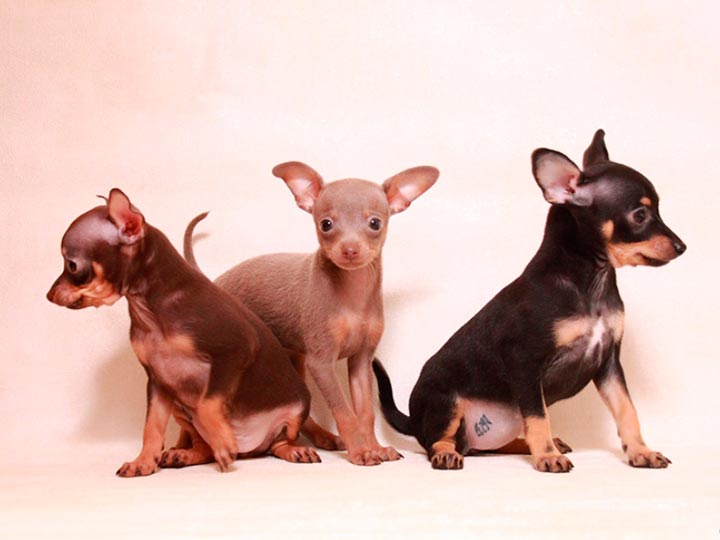
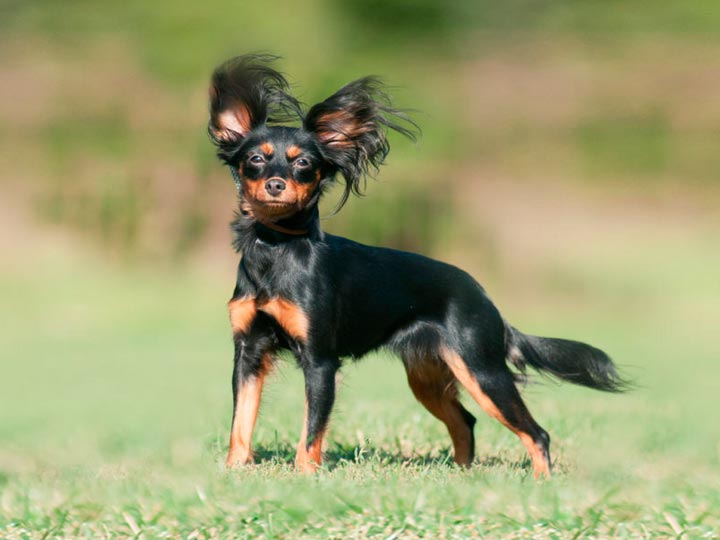
The Russian Toy is a miniature dog breed developed in Moscow in the second half of the 20th century from the descendants of English Toy Terriers. The Russian Toy is jokingly called a "lazy person's dog." It doesn't require long walks, haircuts, or complex grooming, eats little, has an even temperament, and is easily trained. It can be smooth-haired or long-haired.
Content
History of origin
At the beginning of the 20th century, they were popular in Russia English Toy TerriersThese adorable, tiny creatures were the adornments of wealthy homes and companions of many aristocrats. Since the 1920s, breeding has been virtually nonexistent, and by the 1950s, their numbers had declined dramatically.
In the mid-1950s, cynologists decided to restore the breed and gather the remaining Toy dogs together. However, it turned out that almost all of them lacked pedigree, and many were even mixed breeds. The standard drawn up for the breed differed sharply from the English one. Since then, the breed's development in Russia has taken its own course, leading to the emergence of a new breed: the Russian Toy.
The breed group was originally called the Moscow Toy Terrier. It was later changed to Russian Toy Terrier. However, representatives of the Fédération Cynologique Internationale (FCI) found no terrier traits in the dogs and removed the inappropriate term, retaining the name Russian Toy.
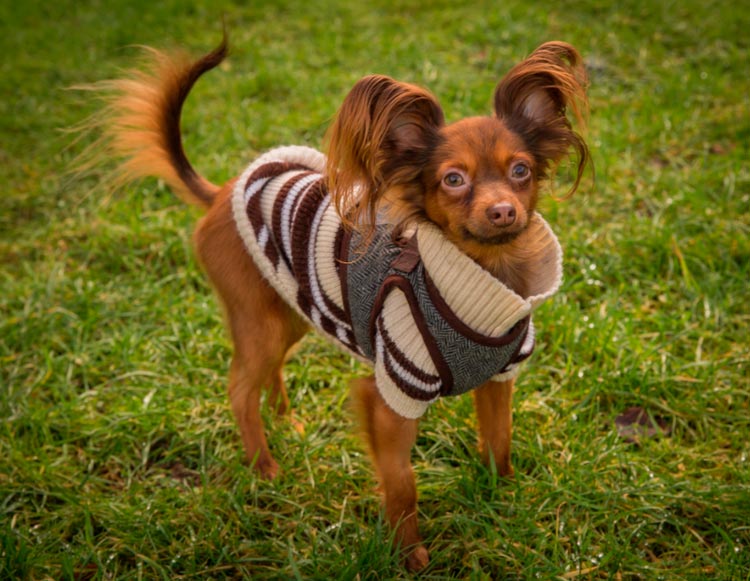
The long-haired variety arose by accident when a pair of smooth-haired Toy Terriers produced a male with striking feathering on his ears and legs. Breeders decided to consolidate this characteristic and mated him with a female with slightly longer hair. This resulted in a long-haired variant of the Toy Terrier, named the Moscow Longhaired Toy Terrier. Through isolated development and selective breeding, the new breed was developed in two varieties: long-haired and smooth-haired. Cynologist E.F. Zharova played a major role in the breed's creation.
Appearance
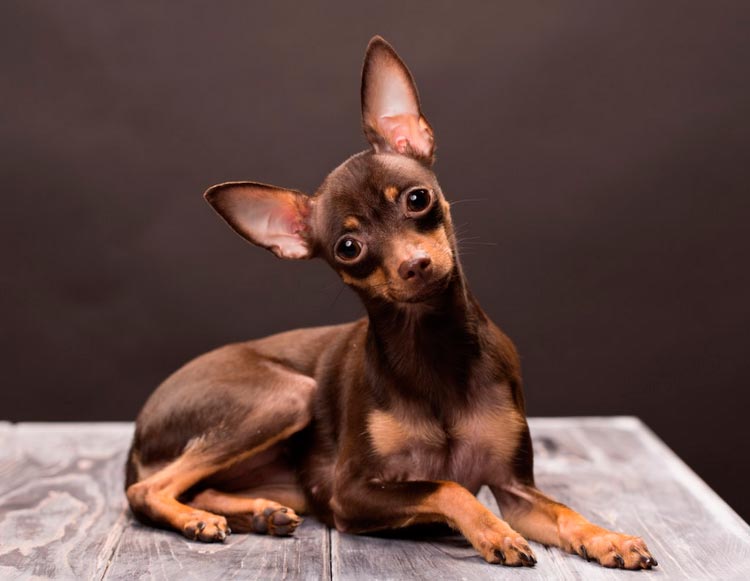
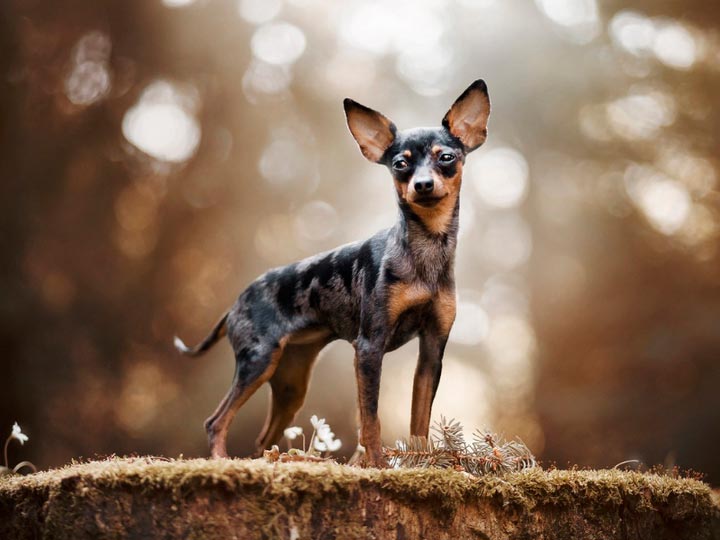
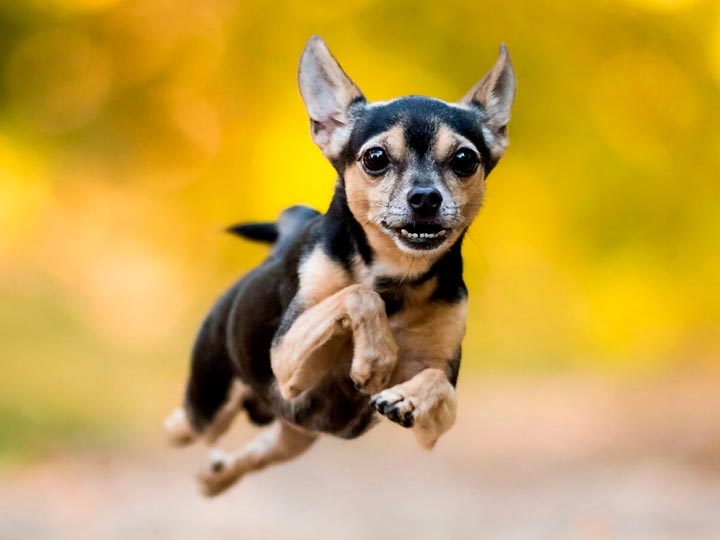
The Russian Toy is a small, long-legged, elegant dog with lean muscles and fine bone structure. It is proportionately built and very harmonious. Sexual dimorphism is weak. In many ways, the Russian Toy resembles its distant relative, the English Toy Terrier, but it does have a number of key differences.
- Height at withers: 22-27 cm;
- Weight: up to 3 kg.
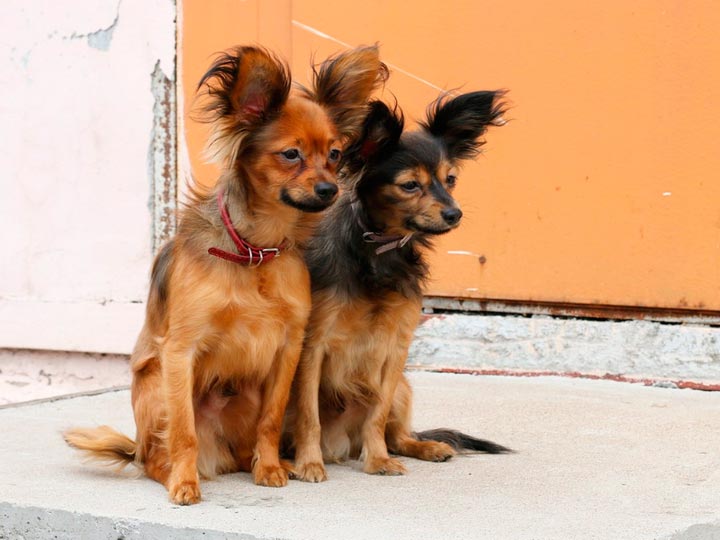
The skull is high with a slightly rounded forehead. The muzzle is shorter than the skull, pointed, dry, gradually tapering toward the tip. The tip is small, well-developed, black or matching the coat color. The bridge of the nose is straight. The lips are thin and tight. The bite is scissor-shaped and straight. The eyes are quite large and expressive, set wide apart and straight, rounded, and as dark as possible in color. The ears are thin, large, set high, and erect. The pinna has the shape of an isosceles triangle. In the long-haired variety, the ears may hang slightly. The neck is high-set, dry, and long.
The body is square, with the length almost equal to the height at the withers. The chest reaches to the elbows. The topline slopes smoothly to the set of the tail. The back is straight, with a slightly arched loin. The croup slopes approximately 15 inches from the horizontal, is moderate in length, and is of medium width. The underline is beautifully arched. The belly is tucked up, and the flanks are tucked up. The tail is saber- or sickle-shaped, set moderately high, and of medium length, and may be docked. The length of the docked tail is 2-4 vertebrae. The limbs are long, straight, and slender, with dry muscles. The paws are small, oval, and pointed forward. The hind legs are slightly narrower than the front legs.
The skin is thin. There are two varieties based on coat length:
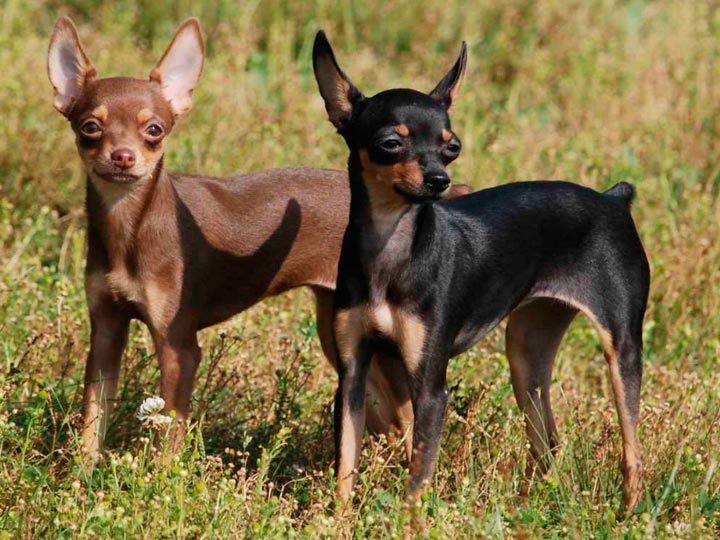
- Smooth-haired - the coat is short, close-lying, shiny, without undercoat or bald spots.
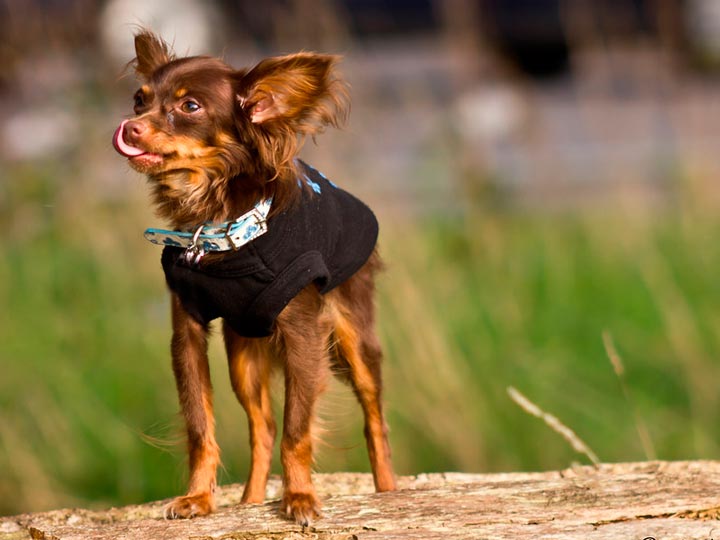
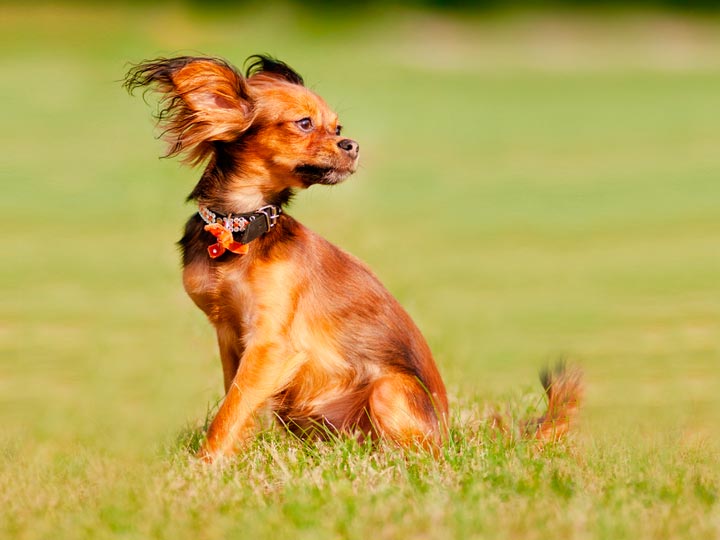
- Longhaired - The neck and body are covered with moderately long hair (3-5 cm), straight or slightly wavy. The hair lies close to the body. The head and front of the legs are short. The back of the legs, tail, and ears are covered with decorative hair. Few dwarf breeds can boast such fringes on their erect ears, only the Russian Toy. papillon And Chinese Crested.
Colors:
- Black and tan;
- Brown and tan;
- Blue and tan;
- Lilac and tan;
- Red with black;
- Red with blue;
- Ginger;
- Pale yellow;
- Red with brown;
- Red with purple;
- Cream.
Character and behavior
The Russian Toy is an active and cheerful dog that is ready to become a loyal companion for anyone. It gets along well with all family members, but chooses one person whom it adores more than anyone else. The dog makes its own choice and is usually unable to influence it. Toys are affectionate, playful, and sociable. This makes them easy to get along with dogs of different breeds, cats, and other animals.
Some small dogs don't forget their terrier past and happily hunt butterflies, moles, and mice at the dacha.
The Russian Toy adores attention, always trying to be close to its owner and please them in every way. However, it tolerates short periods of loneliness relatively well and will sleep peacefully while waiting for its family to return from work. On walks and during playtime, it is very active, but doesn't fuss around all day long.
The Russian Toy has a flexible nervous system, meaning it's easy to train, learns skills quickly, and adapts easily to its owner's lifestyle. It's a true friend with children, and a gentle and loving companion with the elderly. It tolerates travel and changes of environment well. The Russian Toy can be taken for walks around the house, out into nature, and even on hikes. Despite its diminutive size, it's an excellent guard dog, never abandoning its owner in trouble and always alerting them to any intruders with a resounding bark.
At a young age, they can be overly curious, mischievous, and always looking for adventure. But even the most active Toy Terriers usually calm down by the age of 2-3 years and become obedient, easily managed dogs. Overly calm dogs are very rare. From birth, they lack a particular desire to explore their surroundings. They don't react to stimuli and give the impression of being cuddly. It's worth noting that the Toy Terrier doesn't consider itself a baby at all. This is one of the reasons why it's important not to spoil it.
Education and training
Russian Toys are highly trainable. They can even successfully complete a general training course, participate in agility competitions, or learn trick training. This is very important for a small Toy. diversified socialization and training. He needs to be taught basic rules and norms of behavior just like any other large companion dog.
There's still a widespread belief that these are small dogs that are afraid of everything, constantly barking and biting. This belief isn't without reason. In the 1980s and 1990s, Toy Terriers were often acquired by people who had no idea about socialization or training. And how could you possibly raise such a tiny dog? You could only spoil it. The puppies rarely went outside. As a result, these spoiled and pampered puppies grew up to be ill-mannered or hysterical dogs. Nowadays, such owners are becoming increasingly rare.
The Russian Toy has proven itself to be an active, intelligent, and self-confident dog that is easy to train.
Features of keeping a Russian Toy
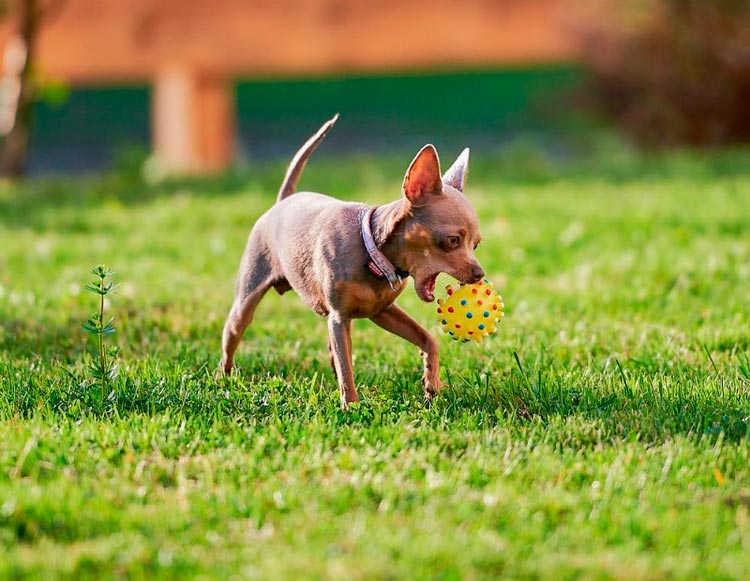
The Russian Toy is ideally suited to apartment life. It doesn't require frequent walks, is easily litter-trained, knows its place in the house, gets along well with people and other pets, and is good with children.
However, don't neglect walks. Even such a tiny dog needs exercise to satisfy its need for movement and curiosity, maintain muscle tone, and gain new experiences.
Dwarf dogs get cold faster. With the onset of cold weather, they need warm clothing and footwear. During hot weather, they should be kept hydrated and protected from overheating.
The Russian Toy is not a good choice for families with very small children. There have been numerous cases of the dog falling from a child's hands and breaking limbs. A fall from an adult's height can be fatal.
Care
Grooming is simple, but requires regular basic hygiene procedures. The owner must:
- Pay close attention to your teeth. Remove any remaining baby teeth promptly and monitor the condition of the tooth surface. Tartar builds up quite quickly.
- Trim nails regularly. Excessive length can lead to paw deformities and broken toes.
- Keep ears clean. Inspect them weekly and clean as needed.
- Pay attention to the condition of your eyes. Remove tears from the corners of your eyes promptly and wipe them as needed.
- A smooth-haired pet's coat only needs to be brushed once a week with a fine-toothed brush. A long-haired pet's coat should be brushed almost daily to keep it looking beautiful and tangle-free.
- Russian Toys need to be bathed about once a month. Use only special products for dogs with the appropriate coat type. During bathing, plug the Toy's ears with a small piece of cotton wool to prevent water from getting in, as this can cause inflammation.
Nutrition
The Russian Toy is generally not a picky eater. Most owners prefer super-premium or holistic dry food. This small dog eats very little. A balanced natural diet is also possible. Meat products should make up at least 15-30% of the total diet (approximately 50-60 g). Lean lamb, chicken, and beef are preferred. Beef by-products (such as liver, stomach, spleen, and kidneys) and seafood and lean fish are also excellent sources of protein. Egg yolk can be given 3-5 times a month. Vegetables should make up 20-25% of the total diet. You can treat your pet with berries and fruits, for example. Porridge should make up 30-35% of the total diet, with rice and buckwheat with a few drops of sunflower or unrefined olive oil being the best choices. You can also diversify your pet's diet with fermented milk products, such as fermented baked milk, kefir, and low-fat cottage cheese.
It is also important not to overfeed a toy terrier, as instead of a tiny, slender "deer" you could end up with a small "elephant".
Health and life expectancy
Compared to other miniature breeds, the Russian Toy is a healthy breed and less prone to most dwarf dog health issues. Naturally, it requires regular veterinary preventative care (vaccinations, parasite treatments), good care, and nutrition. Life expectancy is 13-16 years.
Choosing a Russian Toy puppy
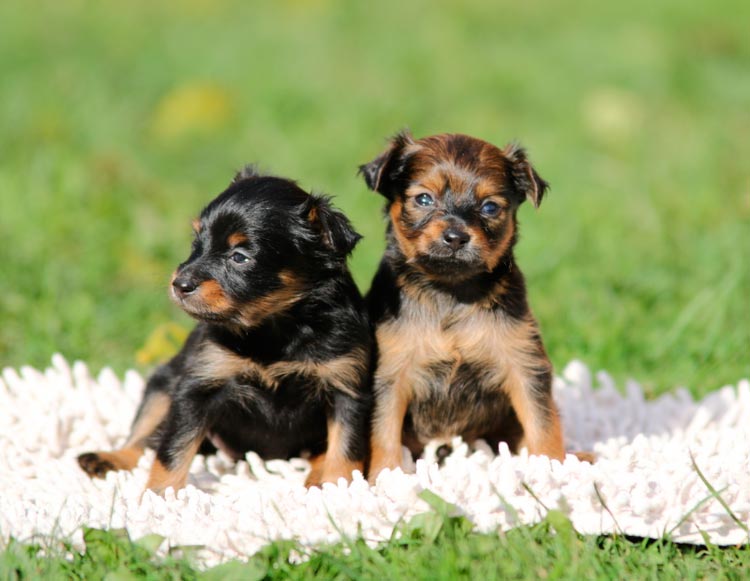
The average buyer is looking for the cheapest deal, which often leads to mixed-breeds, mongrels, and sick dogs being sold as good Russian Toys. Don't be intimidated by a breeder who asks a lot of questions. This demonstrates their responsibility. Such a person will always help with advice or action. Avoid getting a puppy from a kennel without seeing the parents, or from an aggressive or timid mother.
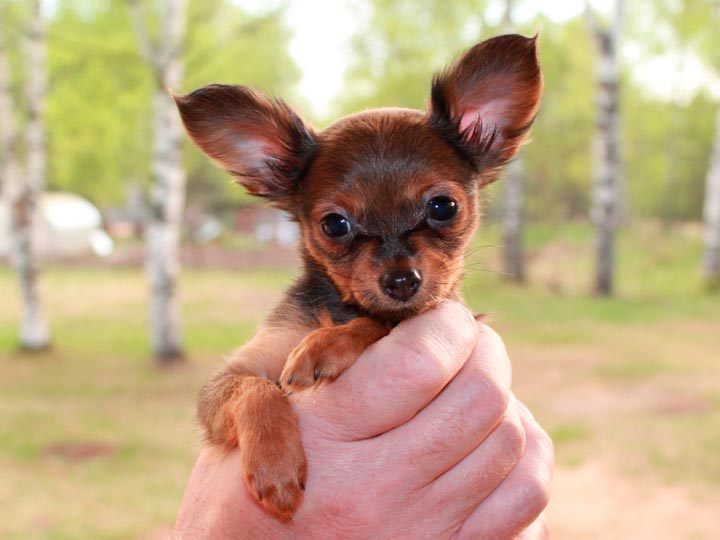
Be careful when reading ads. The advantages of "rare" colors are often beautifully touted, but they later turn out to be faults of the breed. For example, pure white, tricolor, or pink. Furthermore, many breeders aim to make the Toy even smaller, and many people consider owning the smallest dog a privilege. The cost of such "rarities" is much higher than that of normal-sized puppies, but the smallest puppies in a litter generally don't bring much joy. They are very weak, more difficult to raise, and have a short lifespan. And even if the "embryo" survives, it is not suitable for breeding. The optimal weight of an adult dog is 2.5-3 kg.
Contact information for breeders and nurseries can be found at the National Breed Club, and you can use thematic forums to communicate directly with owners and learn more about the breed, its representatives, and its challenges.
Price
The price of a purebred Russian Toy currently ranges from $500 to $1,000. Of course, you can buy a dog for half that price, but no one can guarantee that the puppy will be purebred and healthy.
Photos and videos
The gallery contains more photos of Russian Toy dogs.
Video about the Russian Toy dog breed
Read also:


Add a comment