
Russian Borzoi
The Russian Borzoi has been used for centuries for unarmed hunting of hares, foxes, and wolves. It has a typical sighthound build, sleek yet robust. Calm and even-tempered in everyday life, it quickly becomes excited at the sight of game. Russian Borzois are truly special dogs; only a true sighthound fancier can truly appreciate them and help them reach their full potential.
Content
History of origin
The Russian Borzoi is a very ancient breed, so no precise information about its origins and development has survived. It is believed that the first sighthounds were brought to Rus' by the Tatars and Mongols, who adopted the Persian and Arab method of hunting with them.
According to written records, a specific type of Russian Borzoi had already emerged by the 16th century, but the high cost of puppies hindered the breed's widespread adoption. For centuries, Laikas were considered peasant hunting dogs, hounds were available to landowners, and greyhounds were reserved for the very wealthy.
The breed got its name from the words: “psovina” - soft, long hair, and “borzoi” - frisky, fast.
In different provinces, sighthounds differed in character and appearance and were named after their owners. By the end of the 19th century, the type had become more or less uniform. Sighthound shows began in Moscow in 1874. The first standard was adopted in 1888. From this point on, the Russian Borzoi began to develop as a breed. At the beginning of the 20th century, a stud book was opened at the Alexander I Moscow Hunter's Society. In 1902, the first volume was published, listing only 15 dogs. By the 1980s, there were approximately 3,000 sighthounds in Russia, of which approximately 2,000 had a pedigree. The breed was accepted by the International Cynological Association in 1956. Throughout most of history, other sighthound breeds were used in breeding, so the older type differs greatly from the modern one. Below in the gallery you can see a photo of a Russian Borzoi from 1902.
Purpose
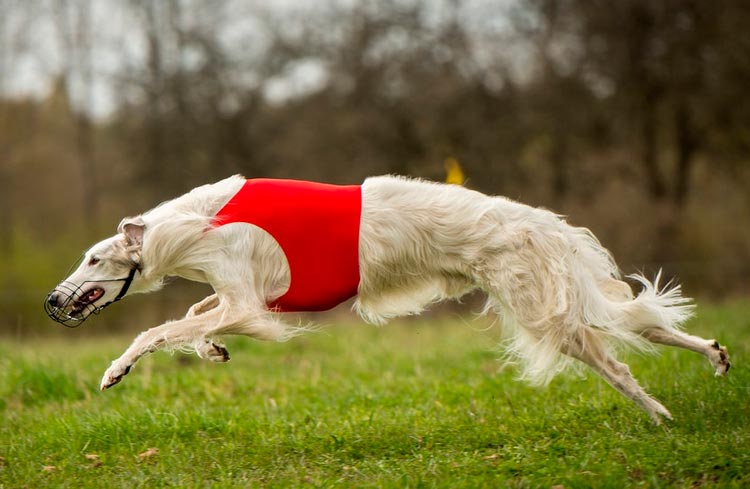
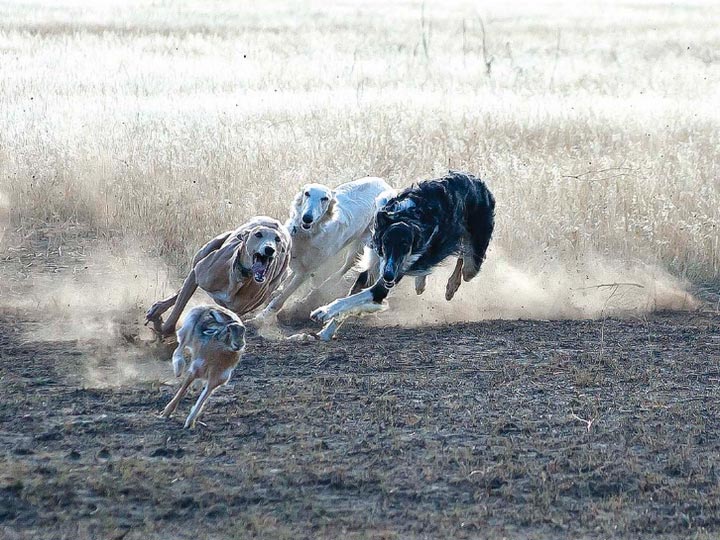
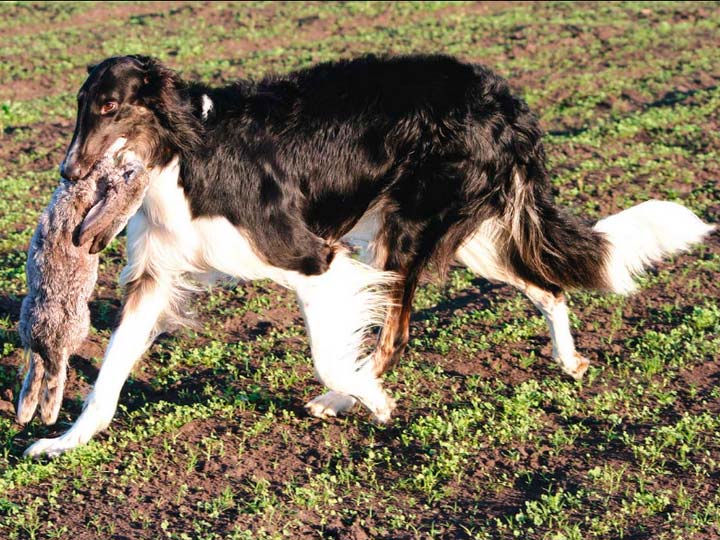
The Russian Borzoi is used to hunt wild game while it's still sighted, in open terrain. The dog's job is to quickly catch the animal while keeping a short distance, keeping it in sight, and preventing it from escaping into a ravine or bushes. The Borzoi locates the animal, chokes it, and remains nearby until the hunter arrives. Mounted hunting with Borzois has long been popular. Hounds were often used alongside the hunters to locate and flush out the game.
The Russian Borzoi is considered to be unrivaled in its reaction speed. It possesses an astonishing ability to quickly spot a raised or fleeing animal.
At the last moment of approaching the prey, a good greyhound makes a short, lightning-fast leap. It's worth noting that these dogs possess excellent agility, strength and endurance, quick reflexes, passion, and a fearlessness often referred to as "fierceness." They are also known for their excellent hunting skills; few animals can escape them.
Peculiarities of hunting with a Russian Borzoi
Borzois are used for hunting in rugged terrain, primarily in temperate climates. A dog needs 300-400 meters of open space to take down a fox, wolf, or hare. Hunting begins in the fall, when temperatures drop below 15 degrees Celsius. Hotter conditions will make the dog difficult to work with.
It's no coincidence that the Russian Borzoi is called the "shot dog." It has lightning-fast arousal when it spots an animal. This inner drive drives it to rush into pursuit at maximum speed and maintain its speed for up to 500 meters. This is usually more than enough to reach and capture the animal. The fastest of the sighthounds is considered greyhound, but the Russian greyhound is not much inferior to it in speed.3-4 full-fledged jumps on the animal per day with breaks of 30-40 minutes is a very good result for a greyhound.
Unfortunately, most hunters don't train their dogs off-season, so they use untrained dogs, or dogs that don't even know what they were bred for. Good training and education, even with simple natural abilities, can produce better results than a poorly trained, high-bred dog.
Video about the Russian Borzoi breed:
Appearance
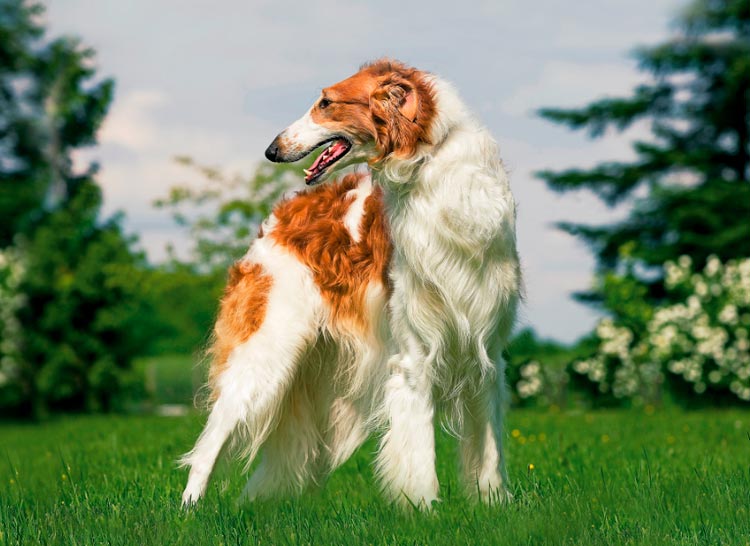
The Russian Borzoi is a large dog with a lean, strong body of slightly elongated proportions, strong but not massive bone structure, and flattened bones. The muscles are lean and well-developed, but not prominent. The harmony of forms and movements is of decisive importance. Sexual dimorphism is well-defined. Males stand 75-85 cm tall and weigh 34-47 kg. Females stand 68-78 cm tall and weigh 25-40 kg. The standard highlights several important proportions:
- The height at the withers is equal to the height at the sacrum or slightly exceeds it; in females the measurements are the same;
- The height at the withers is slightly less than the length of the body;
- The depth of the chest is approximately 1/2 the height;
- The length of the cranial part is approximately equal to the length of the forceps.
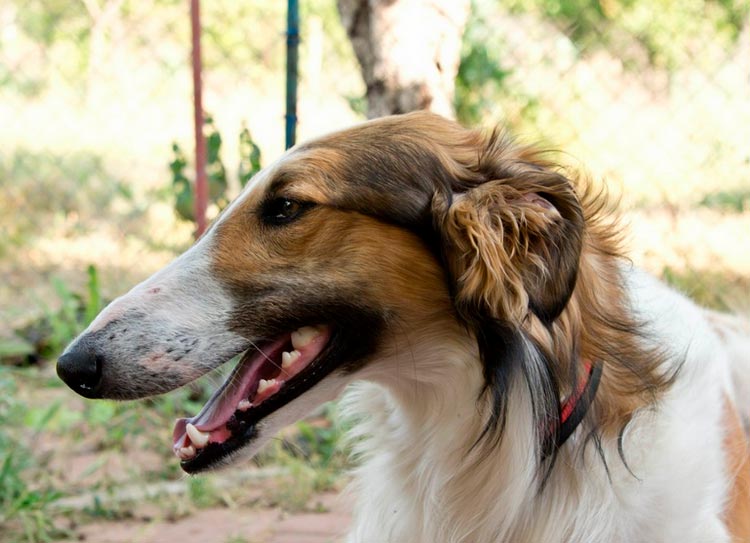
The head is long, narrow, and so dry that veins are visible in some places. The cranium is narrow. The stop is smooth and weakly defined. The nose is protruding relative to the lower jaw. The bridge of the nose is long with a slight hump. The pincer is full. The lips fit tightly to the jaws, dry, and thin. Regardless of color, the pigmentation of the lips, eyelids, and nose is black. The teeth are large, a complete set, meeting in a correct scissor or straight bite. The eyes are large, dark brown or hazel in color, almond-shaped, and set obliquely. The ears are thin, small, very mobile, set above the line of the eyes and pulled back toward the back of the head. The tips of the ears lie close together, pressed firmly to the neck. When excited, they are raised on cartilage, with the tips directed to the side or forward.
The neck is dry, long, flattened at the sides, and slightly arched upward. The withers are not prominent. The back is broad and muscular. The topline forms an arch with the croup. The highest point is located at the 1st and 2nd lumbar vertebrae. The loin is arched, long, and moderately wide. The croup is long, slightly sloping, and wide. The width between the hip bones is at least 8 cm. The chest is oval in cross-section, not wider than the croup, deep, long, and voluminous, reaching to the elbows. The ribs are slightly arched and long. The belly is well tucked up. The tail is saber-shaped or sickle-shaped, set low, thin, long, and reaching under the groin to the hip bone, with a rich dewlap. When at rest, it is lowered; when moving, it is raised, but not higher than the back. The forelegs are dry, muscular, and when viewed from the front, parallel and straight. The height of the elbow is approximately equal to half the height at the withers. The hind legs, when viewed from behind, are parallel and straight, set wider than the front legs. The paws are narrow, dry, oval-shaped, with arched toes that are tightly pressed. The claws are long and strong and press into the ground.The Borzoi's excellent working qualities are facilitated by its physiological characteristics. The Russian Greyhound has a narrow chest and well-sprung ribs. The narrow muzzle and slanted eyes provide a wide field of vision. The front legs, positioned in a straight line, allow for sharp changes in direction, even at high speed.
The skin is elastic, thin, and free of folds. The coat is silky, soft, curled or wavy. It is shorter on the head, ears, and front of the legs and lies flat. It is long and wavy on the body. It usually forms a fine curl around the shoulder blades and croup. It is shorter on the hips and ribs. The feathering forms feathering, breeches, dewlap, muff, and undercoat. Combinations of all colors are permitted, except blue and chocolate, as well as their shades. All colors may be colored or piebald; the feathering should be significantly lighter than the base color. A darker muzzle is typical for dark-colored dogs. To define color, greyhound breeders use old Russian terms rather than modern ones. For example, a red hound is called "red" or "sexy," a brindle hound is called "dapple," and a burmatny hound is called "gray" or "sexy" with a black tint.
Character and behavior
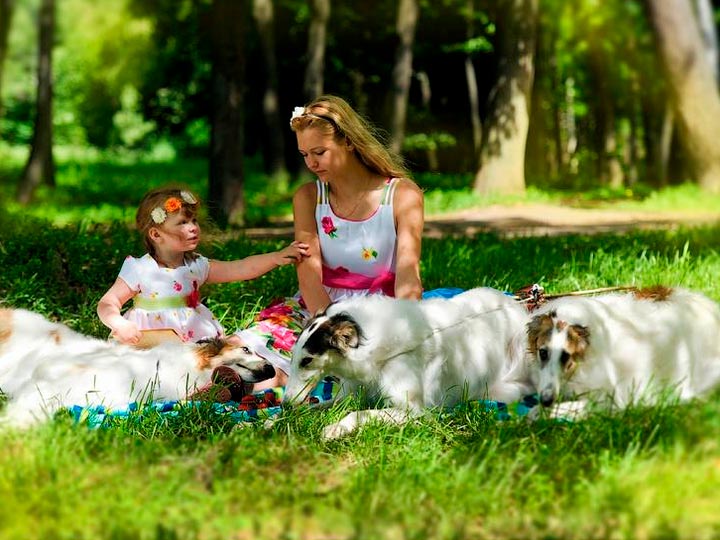
The Russian Borzoi has a balanced temperament: friendly, alert, and calm until it spots potential prey. It is active and playful when working. Its feeding behavior is separate from its hunting behavior; it does not eat prey; after choking it, it calms down and loses interest. It is independent but knows its place in the family. It gets along well with other pets, including small ones. Small dogs and cats outside the yard are often seen as potential prey. Its aggression is completely suppressed; it guards its territory from other dogs, but not from people. It is very trusting and may leave with a stranger. It gets along well with children of all ages, but is not a good playmate.
The Russian Borzoi combines two natures. On the one hand, it's a calm, affectionate family companion who thrives on comfort and attention, but on the other, it's a tenacious hunting dog who, upon seeing a wild animal, transforms into a ball of energy, swiftly pursuing its target and attacking with ferocious viciousness. At home, it constantly seeks companionship, but in the wild, it takes to the run at the first opportunity, seemingly oblivious to its owner's existence. However, many Borzois do return when called.
In principle, the working greyhound is self-sufficient. It is capable of feeding itself, or at least was capable of doing so when the breed was being developed. This is reflected in its disposition and proud independence. Modern greyhounds are often freed from hunting duties, but it is not so easy to free oneself from a temperament that has been formed over centuries. She only agrees to a partnership relationship with the owner.
Sometimes, owners of Russian Borzois face a problem commonly referred to as "herding." In other words, this is the dogs' tendency to chase small domestic animals, including farm animals. To some extent, this is due to their hunting instinct, but more often, it stems from insufficient exercise and poor socialization. It's rare, but there are dogs that can't be weaned off this behavior, no matter how much professional training or persuasion is required; the only solution is total control. A dog's participation in hunting, coursing or racing does not affect its attitude towards small dogs, cats and other animals, except wild ones.
Education and training
It will take at least a year and a half for this small, awkward creature to transform into an elegant Russian greyhound, and its training is comparable to that of a small child. The greyhound is distinguished by its natural intelligence, independence, refined sense of justice, and pride. Each individual dog is an individual, and therefore the approach to it must be individual. From an early age, relationships should be built not from a position of force and discipline, but from a position of partnership and mutual understanding. Of course, not without occasionally trading the carrot for the stick.
The issue of raising and training greyhounds has always been a controversial topic. The main goal is to teach the dog politeness and maintain its innate qualities: energy, excitement, and a thirst for prey. The puppy is taught that only wild animals in the field are considered prey, and never a small dog or the neighbor's cat.
By six months, a greyhound puppy should be able to walk well on a leash, obey commands such as "heel," "come," and "stay," and avoid picking up anything on the floor or taking things from strangers. Despite its vibrant personality, a greyhound must be manageable. Bonding with a dog is established during the period up to six months. Later, it will be very difficult to correct habits and behavior.
The period from 6 to 10 months can be called transitional, a time for the puppy to assert itself. Disobedience, running away, and stubbornness are possible. Punishments should be reasonable, and the best remedy is increased exercise and playtime. Closer to the age of one, you can begin to get acquainted with the field and prepare for work. To begin with, no more than one race is allowed, preferably in the company of well-trained adult greyhounds.
Field work with sighthounds is a very broad topic. From 8 to 10 months, the "baby" is allowed to handle an animal independently. Ideally, it should be a wounded hare or rabbit. It doesn't matter if it doesn't run away. If participation in shows is planned, by 10 months the dog should already be trained in basic commands, walk correctly on a leash, show its teeth without problems, and react calmly to large crowds of people and dogs.
Content Features
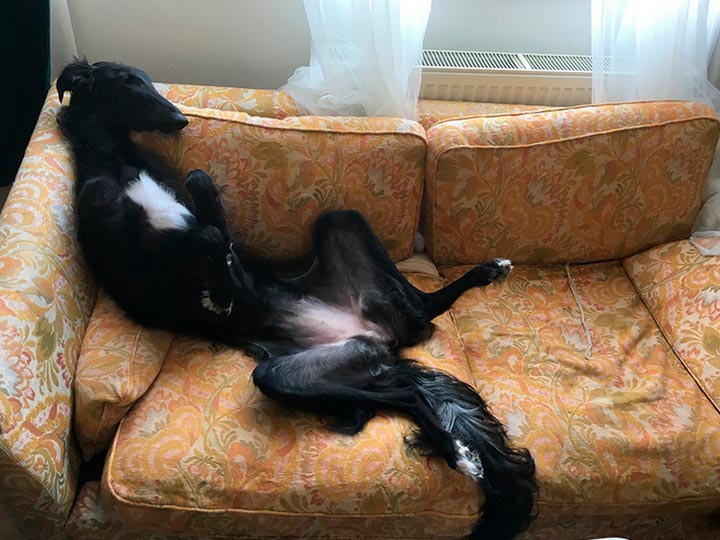
Some see the Russian Borzoi as a restless and fidgety animal, making it difficult to keep in an apartment or house, but the opposite is true. In the house, the dog is calm and even lazy. It will spend days lying on the couch or floor, its presence virtually unnoticed. It does everything calmly and unperturbed, even stealing from the table with its characteristic aristocratic grace. It is also suitable for year-round keeping in a yard or enclosure.
In cold weather, a greyhound won't be walked for long periods. During walks in freezing temperatures, it needs to be constantly moving. For additional warmth, some owners wear blankets, sweaters, and other weather-appropriate clothing. Most models feature a high collar.
Physical activity
Contrary to popular belief, a greyhound doesn't require long daily walks. You don't need to cover dozens of kilometers with it. It thrives on explosive exercise, a sudden burst of energy that it can control, such as a couple of laps around a field. This ability to burn off energy is the main problem with keeping dogs in the city. A greyhound will thrive if its owner can take it out into the field at least a couple of times a week.
Even 4-hour walks on a leash are not enough for a greyhound.
Preparing a dog for the season deserves special attention. It must be in good physical condition. Borzois living in the countryside have a much easier time preparing for hunting. Participating in coursing or racing during the off-season helps keep the dog in shape.
Care
Grooming a Russian Borzoi is simple. Simply brush the dog once a week with a fine-toothed brush and wash as needed. After walks in tall grass, it's a good idea to brush the coat and remove plant debris. Using a degreaser is not recommended, even during the shedding season.
The owner should also monitor the condition of the eyes, ears, and teeth. Ears are checked weekly and cleaned as needed. To prevent tartar buildup, give the dog special toys, beef tendons, or train it to brush its teeth. A greyhound's long nails should reach the ground, but if they aren't filed down regularly, the paw position changes, requiring manual trimming.
Nutrition
A greyhound's development and condition depend on proper nutrition. It's important for a growing dog to receive sufficient animal protein. Protein is the building block for muscles and ligaments. If a greyhound doesn't get enough protein as a puppy, it will have underdeveloped muscles or abnormal limb structure. Other components of the diet are equally important. The approximate ratio of protein, fat, and carbohydrates in the diet should be 2:1:2. A higher protein intake is desirable.
Most greyhound breeders prefer to feed their dogs natural products with the obligatory addition of vitamin and mineral supplements.
The amount of food for a growing puppy is determined simply: as much as it can eat. A properly raised dog is not prone to overeating as an adult. Meat and offal are fed raw or cooked. Cooked meats are easier to digest, while raw ones are more nutritious. Ground meat is mixed with cereals and grated vegetables.
The Russian Borzoi is prone to gastric torsion, so owners should be very careful about preventing this acute condition.
If desired, you can introduce your greyhound to commercial dry food. Premium-grade foods for large breeds are suitable. During periods of intense physical activity and before hunting season, portions can be increased or a high-calorie diet can be introduced.
Health and life expectancy
The lifespan of a Russian sighthound is typically 10-12 years. According to researchers led by British veterinarian Maria Hamilton, the causes of sighthound mortality are as follows: heart disease – 25%; cancer – 25%; cerebrovascular disease – 12%; trauma – 7%; and other causes – 20%.
The list of hereditary diseases characteristic of the breed is quite short, and the risk of their occurrence depends on the breeding line. The most common ones in nature are:
- Ophthalmological diseases (progressive retinal atrophy, cataracts);
- Compression of the cervical vertebrae;
- Volvulus of the stomach and intestines;
- Malignant and benign tumors (mainly in adulthood);
Greyhound puppies are susceptible to infectious diseases and should therefore be vaccinated from an early age according to generally accepted schedules. In disadvantaged areas, it is advisable to administer serum prior to vaccination. Greyhounds are also known to be more sensitive to anesthetics and some antiparasitic medications.
Choosing a Russian Borzoi Puppy
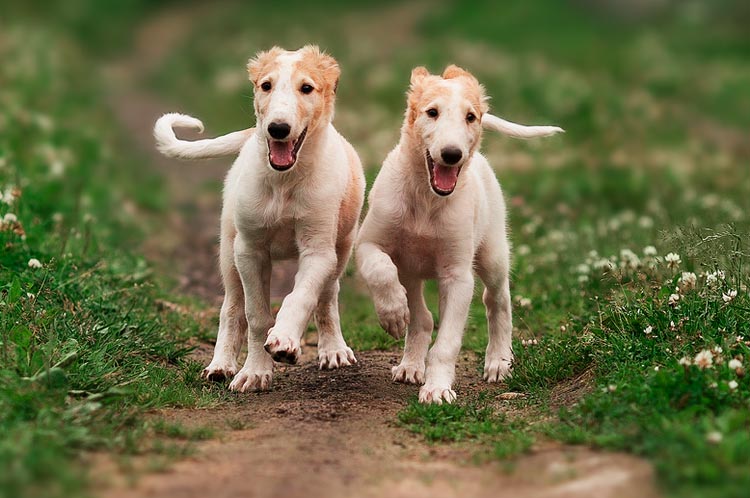
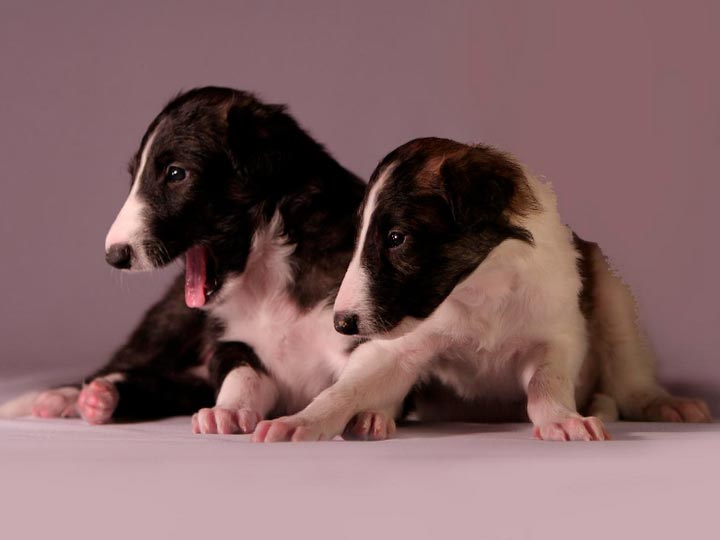
Russian Borzoi puppies grow quickly and are born large (700 g-1 kg). By the time they are a month old, they weigh up to 5 kg, and by three months, 10-12 kg. It is important to get a puppy from a breeder who understands the importance of free range and proper nutrition for a growing body.
The parents' prestigious titles don't guarantee a puppy will achieve the same success. Any minor issue (bite changes, incomplete dentition, cryptorchidism) can cut short a puppy's show career. A greyhound's development is complete by age three, and only then can its show career be confidently predicted. It is also almost impossible to determine the hunting abilities of a small puppy based on any signs. Sometimes dogs that kill cats, hamsters, and other livestock don't even move in the fields, and vice versa. The hunting instinct awakens at different ages: for some, it awakens as early as 5-6 months, for others, closer to two years. It can also become dormant at any time, for example, after piroplasmosis, an injury, or another illness.
When choosing a puppy, consider its appearance, health, and character. But it's equally important that the puppy be "liked." It's unclear how its show and hunting career will pan out.
In addition to the puppy card, which is later exchanged for a pedigree, the puppy must have a brand and a veterinary passport with vaccination records.
Photos
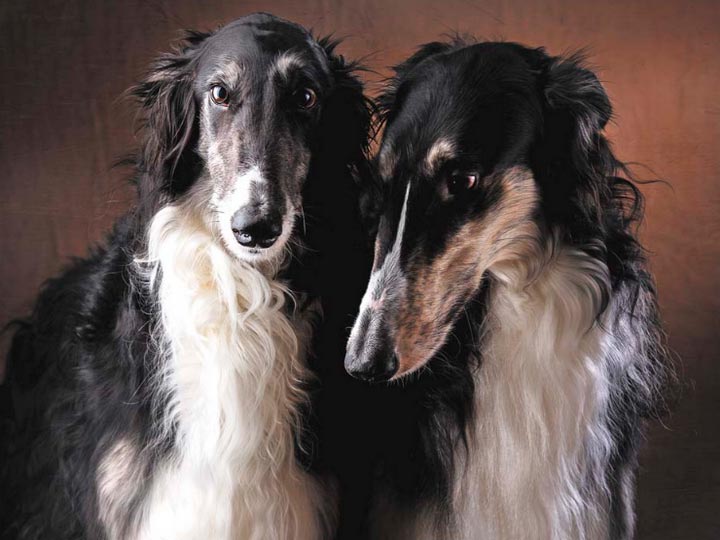
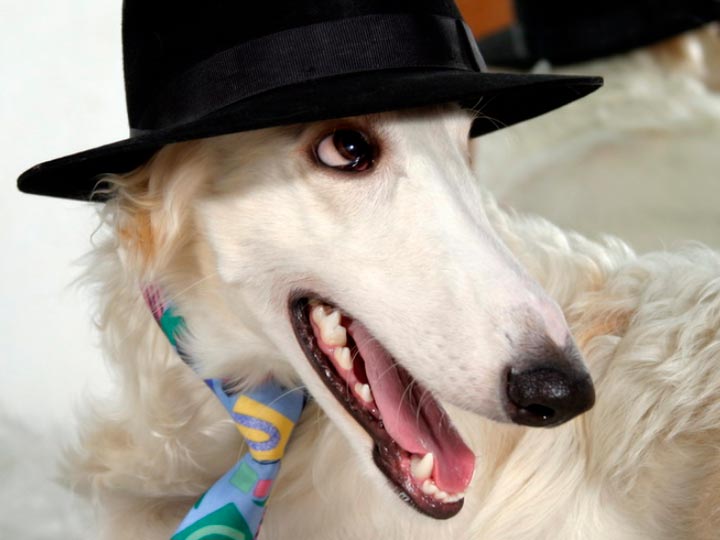
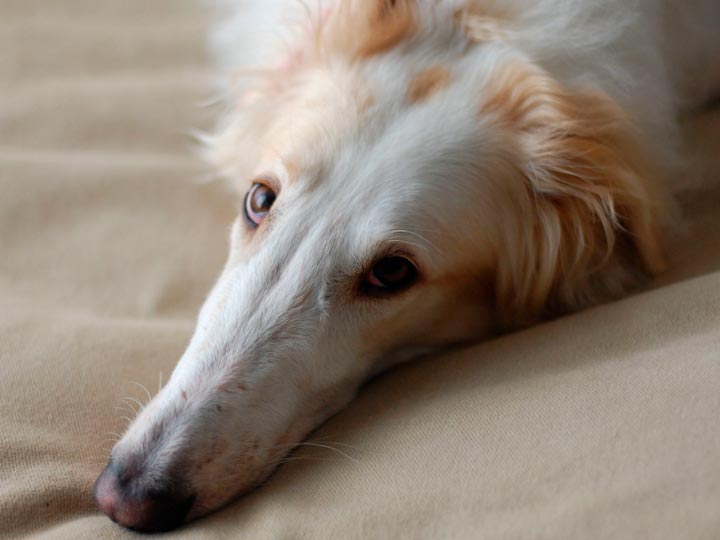
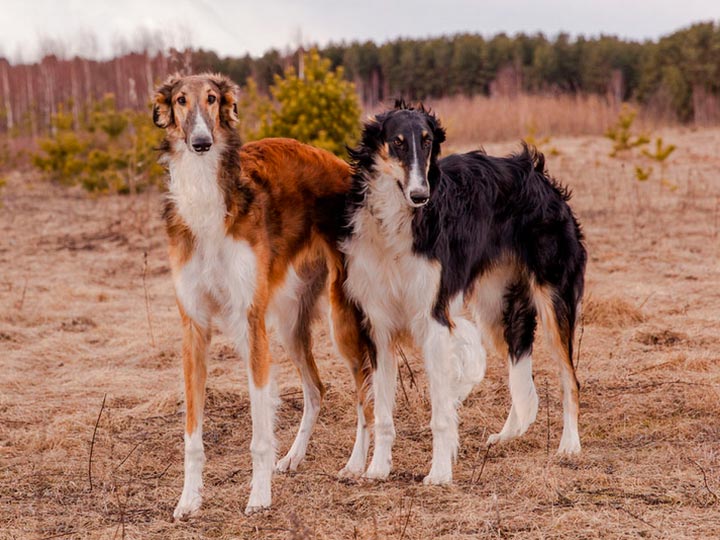
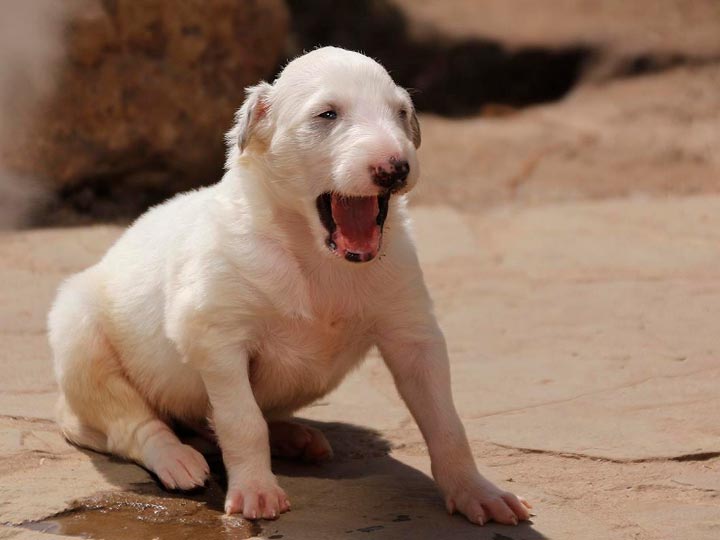
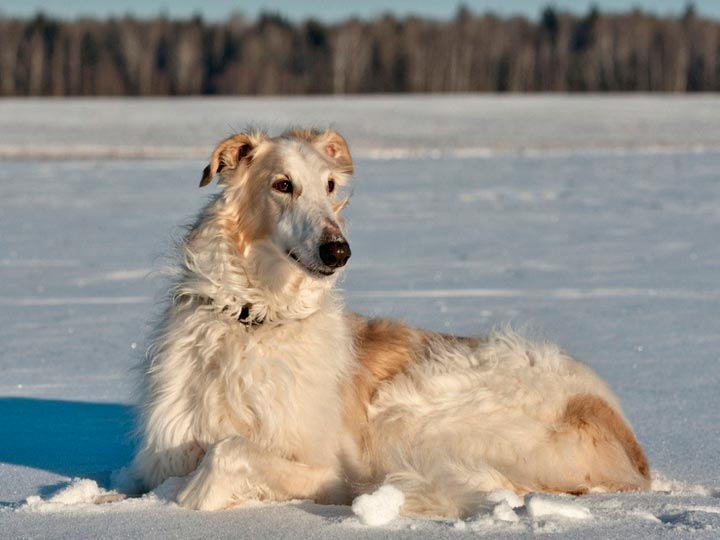
The gallery contains vibrant photos of Russian Borzoi puppies and adult dogs.
Read also:


Add a comment