
Cat labor: signs, complications, and how to help your cat give birth
A cat's gestation period lasts 65–72 days. By the end of this period, the owner should know how to provide their pet with the necessary assistance if necessary. The first signs of impending lambing (as labor is properly called in cats) appear approximately a week before the due date, and preparations for this important event should begin from that moment.

Content
Preparing for lambing
As the time of delivery approaches, the cat changes her behavior:
- becomes restless;
- constantly licks his belly and the area under his tail;
- looking for a secluded place, trying to climb into the closet and make a bed.
These changes begin about a week before lambing. If you notice them, you should adjust your feeding schedule, reducing portion sizes and increasing the number of feedings. This is because the kittens inside prevent the stomach from expanding to its normal size.
The second step is a visit to the veterinarian for a prenatal examination and the necessary consultation. The vet may also trim the hair near the tail and nipples of a long-haired cat, but this is also easy to do yourself.
If any deviations from the normal course of pregnancy are noted, it is better that I delivered a cat A specialist. If your pet is in good condition, you can manage this process yourself.

Another preparatory step is setting up a place for the expectant mother. There's no need to purchase anything extra, as the animal will prefer a secluded spot to any special bed. Therefore, it's recommended to take a regular, but appropriately sized (and fairly spacious) box with a lid, cut a hole in the side, and line the bottom with a clean cloth. It's best to place it in a separate room where people rarely enter. Place food and water bowls nearby, and a litter box a little further away.
Signs of the onset of labor
A day before labor begins, a cat's previously observed signs are supplemented by another: a 1°C drop in body temperature. If the cat is accustomed to regular temperature monitoring, this method will help accurately determine the approach of labor. If this procedure is new to both the owner and the mother, it's best not to initiate it at this point and simply leave the cat alone.
Before assisting a cat in labor, it is essential to prepare a "rescue" kit of tools and supplies, including:
- antiseptic and disinfectant;
- scissors, dental floss;
- pipette, baby syringe, disposable syringes
- surgical gloves
- gauze napkins;
- petrolatum;
- toilet paper;
- garbage bags;
- diaper;
- heater;
- stopwatch.
You should also have a veterinarian's phone number handy. While you may not need all of this, it's best to be prepared for any situation.

The immediate onset of the labor process will be indicated by rapid breathing and the first contractionsDuring this stage, the mother typically meows and bites her back. This stage can last from several hours to a day. During this time, avoid disturbing the animal, especially not arranging crowded viewings, as excessive attention can cause the mother to eat the newborn kittens.
The appearance of kittens
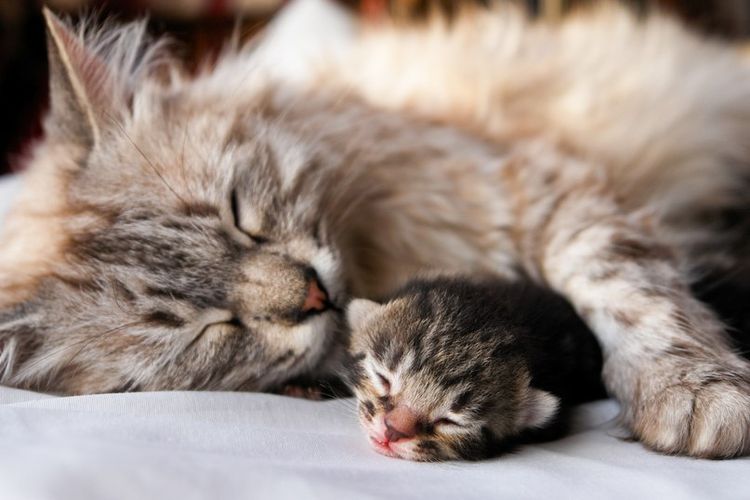
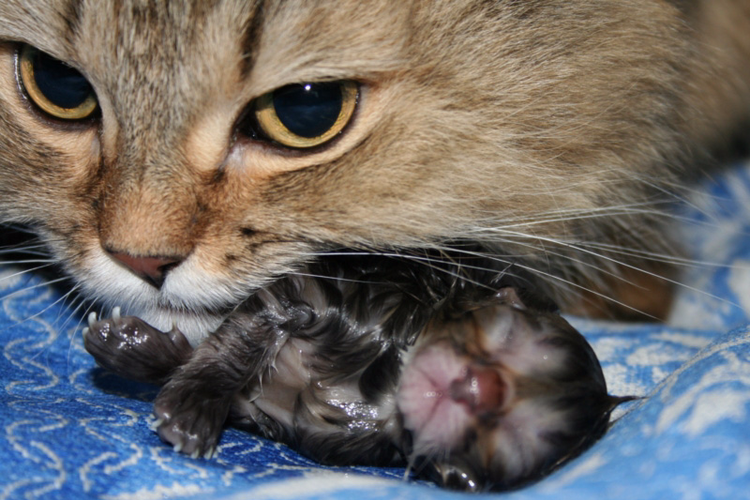
Let's explain how labor occurs in domestic cats. The first sign of impending birth is light-colored discharge, followed by darker discharge, and a little later, contractions. The kitten is born approximately 25-35 minutes after these signs begin. The kitten is born in the amniotic sac, which the cat bites through and then licks its face to remove mucus and open its nose for breathing. After this, it bites through the umbilical cord and licks its entire body, activating blood flow and other vital functions.
Depending on how the birth is progressing, you should either avoid interfering or begin assisting. If the mother is able to "handle" each kitten before the next one arrives, then nothing needs to be done. If she hasn't managed to handle one kitten yet, and the birth of another has already begun, then the following course of action should be taken:
- carefully release the kitten from the film and gently rub it with a sterile cloth;
- tie the umbilical cord with dental floss, cut it and treat it with an antiseptic solution;
- Make sure the newborn is breathing and place him next to the mother.
If the baby isn't breathing, clear the airway with a baby syringe. If that doesn't help, gently turn the baby upside down, supporting the head, and bend it slightly to encourage fluid drainage.
Stages and duration
On average, labor in cats can last up to 26–36 hours if there are no complications. The entire process is divided into two stages:
- within 24 hours the first signs are observed, the water breaks, the animal meows and licks itself;
- then the actual birth begins, the duration of which depends on the number of kittens.
After each kitten is born, the placenta must be expelled, which the mother usually eats immediately (as well as any stillborn kittens). This process must be monitored, otherwise, after consuming several placentas, the cat may develop an upset stomach.
Furthermore, monitoring is necessary to ensure that the number of placentas corresponds to the number of babies born. A retained placenta can cause internal inflammation.
Possible complications
Lambing doesn't always go smoothly. Potential complications during birth in cats can arise from a variety of causes. While some complications can be dealt with at home, most require immediate veterinary attention.
You should call your doctor immediately if any of the following situations occur:
- the duration of pushing exceeds 1 hour, and the kittens have not yet begun to be born;
- the animal has become weak, apathetic, lies motionless or meows incessantly, experiencing severe pain;
- the number of placentas is less than the number of newborns;
- pure bloody discharge appeared;
- body temperature differs significantly from normal in one direction or another;
- contractions are weak and rarely repeat (with an interval of 30 minutes or more);
- The amniotic sac ruptured and the kitten became stuck in the birth canal.
Most of these signs are symptoms of uterine dystonia or atony, which require immediate veterinary care, often including a cesarean section. Any delay can be fatal for the mother and her kittens. However, in more straightforward situations, you can assist the mother in labor yourself.
Stuck Kitten
In such cases, the clinic resorts to a cesarean section. To facilitate spontaneous delivery, rub the abdomen in time with the pushing movements. Pulling the newborn by the head is strictly prohibited, as this can easily break the neck. Pull the baby by the skin or body. The movement should be from side to side, not perpendicular to the animal's body.
Premature birth
To determine the lambing date, it's important to consider the animal's breed and certain subjective factors. In non-pedigree cats, premature birth usually occurs without negative consequences for the mother or the newborn kittens. A pedigree cat may not only lose her kittens but also die herself.
To avoid missing this moment, it's important to constantly monitor your pregnant pet, keeping in mind the high risk of intense labor. In this situation, you can save your cat by using special medications to reduce the stress, and then consult a veterinarian.

Weakness/absence of contractions
Weak or absent contractions are usually caused by poor nutrition and a deficiency of certain nutrients (calcium, oxytocin). Oxytocin supplements or calcium borogluconate solution are used to address this issue. However, inducing labor this way is too risky, as it can cause uterine rupture. Therefore, a cesarean section is performed in most cases, but only when the procedure is deemed appropriate.
A cesarean section itself poses no risk to the animal's life. It is performed under general anesthesia and can save both the mother and all her offspring. Some complications are possible only in cases of severe placental abnormalities or intrauterine decomposition of the deceased fetus. In such situations, there is a high risk of a complete hysterectomy, which will render the cat infertile but can save her life.
After childbirth
So, the cat has given birth, what next? Babies begin sucking their mother's milk immediately after birth. It is especially important that all newborns latch on immediately, as the first milk, called colostrum, is essential for normal development of kittensIt contains special antibodies that are passed from mother to baby and support its immunity until it develops its own.
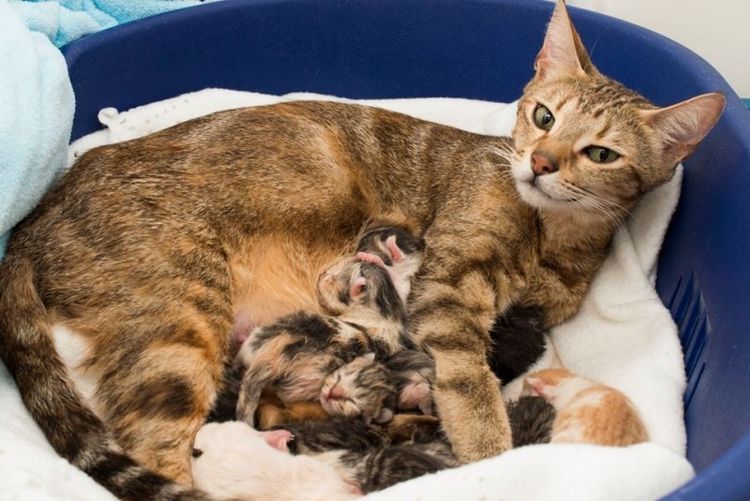
If the puppies' health deteriorates or the mother refuses to allow them to nurse, urgent veterinary attention is needed. Tube feeding may be a solution.
In any case, the cat should be examined by a veterinarian the day after giving birth to check her condition. The vet will also examine the kittens and determine whether they are receiving enough milk, both in quantity and quality.
If everything is going well between the mother and her litter, they should be left alone for at least a month. The only exceptions should be cleaning the box, feeding, and periodic checks on the new family.
Read also:
- Can a cat eat her kittens?
- Discharge in a cat during pregnancy
- How long does it take for a cat to give birth?


6 comments
Natasha
My water broke yesterday, the contractions stopped, my cat isn't eating, she's old, she's bleeding, what should I do, how can I stimulate her, maybe a pill? Can you suggest me?
Daria is a veterinarian
Hello! What pill? What are you talking about? You need to take your cat to the veterinary clinic immediately! Based on the ultrasound results, they'll decide whether to induce labor with medication or perform an emergency Caesarean section to save the cat's life. Self-administering medications to induce labor can lead to uterine rupture and the cat's death from severe bleeding and pain shock (the kitten may "go" abnormally, which can trigger a uterine rupture; an overdose can have the same consequences). You won't be able to calculate the dosage, and you won't be able to get these medications at a pharmacy without a prescription. Get to the vet immediately!
Julia
Urgent!!! Please help! My cat has gone into labor (her fourth). The previous ones were uncomplicated and didn't require my intervention. This morning around 10:00 AM, she gave birth to her first kitten. First, she gave birth to a strange lump, similar to a blood clot, about 5 x 7 cm in size. She ate it and licked the kitten. At first, she wouldn't let the kitten come near her breast; she was very restless, preparing for the birth of the next kittens. But the labor stopped. It's now 12:00 AM, and the labor hasn't resumed. She was restless at first, then became very aggressive towards me and our family members. She lunges, growls, won't let me near her, bit me, and scratched my daughter.
She hasn't abandoned the kitten, though; she's staying with it in its "house." But she still has at least two kittens in her belly (I felt her when the first kitten was born). What should I do? Her belly isn't moving right now, and I'm afraid the kittens have probably died. Calling a vet now is impossible, only in the morning. Will she die by morning? By the way, the cat experienced stress during her pregnancy—moving to a new home and then having a strange kitten in the house, to which she reacts very negatively.
Dasha is a veterinarian
Urgent issues like these should be resolved in real life by calling a veterinarian to your home or visiting a 24-hour veterinary clinic! Searching for answers online in such a complex situation is life-threatening. It's impossible to give a single, correct answer without seeing the animal. In one case, contractions are weak and need to be strengthened. In another, administering such medications (for example, if the kittens are positioned incorrectly) will lead to uterine rupture. In such a dilemma, a Caesarean section is best. And no one can say for sure whether the animal will survive. I hope your cat survived and was finally seen by a veterinarian, who provided qualified, albeit delayed, care.
Xenia
Hello. My cat, who has diabetes, is pregnant. She's nine years old, and this is her first pregnancy. She's just over three weeks along. They're suggesting spaying her, saying it's less risky. But I'm terrified of the surgery. Could you tell me if spaying is really less risky than giving birth? What risks (beyond those typical for healthy animals) await us if we decide to continue the pregnancy and give birth? And how can we minimize them? Thank you in advance.
Dasha is a veterinarian
Hello! While she's still in her early stages, the surgery will be performed with minimal risk of complications. The uterus and ovaries will be completely removed (this can help prevent future complications such as pyometra, ovarian cysts, mammary tumors, and others). My question: why didn't you spay her earlier, and why did you keep her for so many years? You weren't planning on having kittens, but you didn't spay her either. It's bad for her health (constant hormonal surges during heat, which, unlike in dogs, are much more common). Your only problem is diabetes. It will take a little longer to heal than in otherwise healthy animals, and you'll need to take extra care of the stitches. But how can you guarantee a healthy first birth at such a late age? What if she starts giving birth at night? Will you be able to bring a vet to your home that night? What would you do with kittens from a diabetic cat (consider for a moment that the tendency to diabetes is hereditary, so you'll be producing kittens that could either develop the disease themselves or produce weakened litters), and you'll likely know nothing about the "father." How can you be sure he's completely healthy? It's not worth the risk. Decide to have him spayed. And the longer you wait, the greater the risk. I'll just add that spayed animals live a couple of years longer, and their quality of life is improved (just be careful about their diet).
Add a comment