
Can dogs distinguish colors?
The existence of color vision in dogs has long been a topic of debate among cynologists, veterinarians, and dog owners. Some say, "Yes, canines can distinguish colors. This is evidenced by the fact that many dogs cross the street by following traffic lights." Others counter that, since dogs are quite intelligent, they can learn to distinguish the right signal not by color, but by its position on the traffic light.
Serious zoologists are also studying canine vision, studying whether these animals see in the dark, whether they can distinguish colors, and whether these closest relatives of the wolf are farsighted or nearsighted. The most recent large-scale studies on this topic were conducted in the United States under the direction of Professor Gerold Jacobs at the end of the last century. The results were published in a journal by Cambridge University Press. They showed that dogs have color vision different from humans, but are not completely colorblind.

Content
- 1 What provides color vision
- 2 The difference in the structure of the human and dog eyes
- 3 Color preferences and behavioral studies
- 4 The importance of contrast, not color
- 5 Regional differences in color vision in dogs
- 6 Technical characteristics of the canine visual system
- 7 Do dogs have ultraviolet vision?
- 8 Practical use of canine vision features
What provides color vision
The mammalian brain receives images via nerve cells located in the retina—sensory neurons. There are two types of these photoreceptors: rods, which detect light levels, and cones, which are sensitive to long (590–630 nm), medium (500–590 nm), or short (430–500 nm) wavelengths of light. Some cones detect red wavelengths, others yellow and green, and still others blue-violet. The presence of these photoreceptors enables color vision.
The difference in the structure of the human and dog eyes
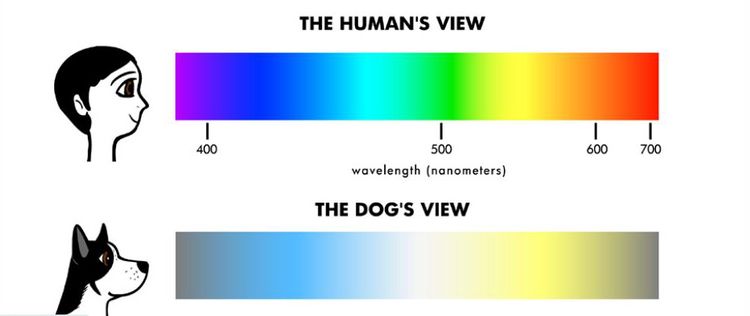
Humans have all three types of sensory neurons responsible for color, allowing us to perceive the entire color spectrum. Dogs have two of these three types but lack photoreceptors sensitive to the red spectrum, so these animals see the world without distinguishing between yellow-green and red.
This perception of color shades is called dichromatic vision, or partial color blindness. With this type of vision, the entire color spectrum is distorted. For example, any shade of red appears dark gray to a dog, yellow or green objects appear yellowish, and the entire spectrum from blue to violet appears to them as a single color—simply blue. However, these animals are excellent at distinguishing the finest shades of gray.
To compensate for partial color blindness, a limited color range, and poor visual acuity, nature has endowed dogs with other visual advantages. Dogs' eyes have a larger number of rod receptors, a reflective membrane in the upper half of the retina, and a dark pigment in the lower half. At night, light hitting the retina is reflected by the membrane, increasing the sensitivity of the neuroreceptors. During the day, excess light is absorbed by the dark pigment.
All this allows dogs to see better than humans in any lighting conditions and clearly focus on moving objects. These abilities were bestowed upon canines by evolution: they belong to the so-called "transitional animals," a group between diurnal and nocturnal mammals, and therefore must navigate well in any lighting conditions. However, dogs' visual acuity is much lower than humans'—they simply don't need to examine particularly small objects.
Color preferences and behavioral studies
Recent studies have shown that dogs not only differ in color perception but also exhibit preferences for certain shades. In one experiment, Indian stray dogs chose a yellow bowl significantly more often than a blue or gray one, even when the yellow bowl contained no food. This suggests a strong instinctive or learned preference for shades that are easier for their visual system to detect.
The importance of contrast, not color
Dogs value contrast more than color. Studies have shown that they respond more readily to changes in brightness. In play and training, this means that toys with a strong contrast (for example, blue on a yellow background) will be more noticeable. Color signals often take a backseat to shape, minimal movement, and brightness.
Regional differences in color vision in dogs
Veterinarians have discovered that the color spectrum perceived by dogs spans two regions: violet-blue and yellow-green. Interestingly, the range between 475–485 nm is neutral and perceived as gray. This aspect should be taken into account when designing facilities, such as training areas or playgrounds.
Technical characteristics of the canine visual system
-
A dog's field of vision is about250°, which is significantly wider than that of humans (180°). This is an adaptation to a hunting lifestyle, allowing for tracking movement in the periphery.
-
Visual acuity is significantly lower - approximately20/75, which means that a closer distance is required to recognize an object as clearly as a person can see from 23 meters.
Dogs have significantly more sensitive night vision thanks to a larger number of rod cells in their retina and a layer called the tapetum lucidum, which reflects light back onto the photoreceptors. This allows them to see in conditions where humans are virtually blind and explains the luminous effect their eyes have in the dark.
Do dogs have ultraviolet vision?
Unconfirmed reports suggest the possibility of ultraviolet light perception, as some mammals have a spectrum shifted toward this region. Dogs have a color spectrum shifted toward this region, but direct studies on UV perception are lacking.
Table: Differences in color perception between humans and dogs
| Peculiarity | Human | Dogs |
|---|---|---|
| Cones (color receptors) | 3 types (blue, green, red) | 2 types ("blue" and "yellow/red") |
| Color vision | Trichromatic - wide spectrum | Dichromatic - limited shades of blue and yellow |
| Field of view | ~180° | ~240–250° |
| Visual acuity | 20/20 | ~20/75 |
| Night vision | Meager | Excellent, thanks to the sticks and tapetum lucidum |
| UV perception | There is no reliable data | Possible but not confirmed |
| Color preferences | Subjective | Prefer yellow (according to one study) |
| Contrast sensitivity | Average | High - shape and brightness are more important than color |
Practical use of canine vision features
Numerous publications in dog breeding journals confirm that dogs have color vision, not monochrome. For example, there are cases where a pet, expecting food, approaches its own bowl, which differs from others only in color, not in shape or brightness. Or, trained to consider a person in yellow dangerous, a dog behaves aggressively only toward people wearing yellow.
Knowing how dogs see can be used to make the process easier. trainingTo help your pet navigate exercise equipment and find it quickly, it's a good idea to paint the equipment blue or yellow. Your pet might simply not see a red ball or ring thrown into green grass—both the grass and the ball will appear gray to them.
Why is this important for dog owners?
-
Selection of toys and accessories
A bright red ball on the grass can be almost invisible; a dog sees it as a gray spot. Yellow and blue toys are most noticeable, especially when played with outdoors. -
Training and education
Use contrasting colors to help your dog learn to react faster. Blue and yellow combinations work best—these backgrounds allow movement to be seen easily. -
Orientation in space
Understanding that a dog perceives movement and form better than detail allows you to choose the right exercises and conditions—for example, avoiding small details that the dog won't see from a distance. -
Low-light behavior
Dogs outshine humans in dim light—keep this in mind when walking. Use contrasting light elements on your dog's clothing or leash to help them navigate and remain visible.
Read also:
- Can dogs see in the dark?
- Animals of the Red Data Book of Russia and the world
- How dogs see our world


Add a comment