
Signs of rabies in cats
The first mention of this dreadful disease appears in surviving Babylonian legal documents dating back to the 2nd millennium BC. Rabies in cats is an infectious disease that affects the nervous system. It belongs to the group of anthropozoonoses, meaning they are common to both humans and animals. Rabies kills approximately 50,000 people and millions of animals each year: the disease is fatal in almost 100% of cases. Therefore, anyone who keeps pets should know the signs of rabies to detect this deadly disease in cats early and protect themselves from infection.

Pathogen and routes of infection
Rabies is caused by a neurotropic virus of the Rhabdoviridae family, the Rabies virus. It is a cylindrical microorganism measuring 180 x 75 nm, with an envelope and a ribonucleoprotein core containing genetic information. Rabies virus is resistant to subzero temperatures and remains viable for several months when frozen. However, it is quickly killed, within minutes, by exposure to ultraviolet light, disinfectants, and heating to 100°C.
The pathogen is transmitted from an infected animal through a bite or contact of saliva with broken skin or mucous membranes. From the site of infection, the virus penetrates the spinal cord and brain, where it localizes, replicates, and causes damage to nerve cells. This results in severe disruption of the central and peripheral nervous systems, and then other organs. The infection is most often transmitted by wild animals (hedgehogs, foxes, bats), and in populated areas, by stray cats or dogs.
Signs of rabies in domestic cats
The disease manifests itself only after the Rabies virus has actively multiplied and is present in sufficient numbers to spread throughout the body. The latent period lasts from 10 to 40 days; in kittens, this incubation period can be 6-7 days.
The first signs of rabies in a cat are changes in its behavior: the animal becomes hypersensitive to any external stimuli—sounds, light, touch. The pet's mood is very unstable, rapidly changing from calm to aggressive. Depending on the form of the disease, rabies progresses through several stages.
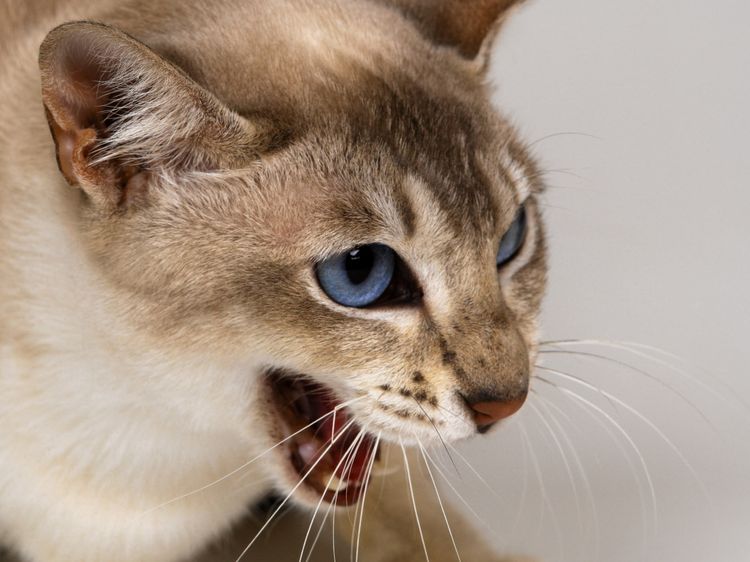
When rabies develops in its classical form, the disease proceeds as follows:
- At the initial stage (called prodromal and lasts about 4 days), the cat becomes capricious, refuses to play, and eats poorly.
- The next stage (its duration is approximately the same) is manifested by irritability, aggressiveness, a desire to be alone, and impaired coordination of movements.
- The final stage, the paralytic stage, is characterized by profuse salivation, hydrophobia, paresis of the pharyngeal muscles, and ends with the death of the animal.
In the non-furious form of rabies, the excitation stage may "drop out," and then the cat, which had seemingly been "out of sorts" for a few days, suddenly stops drinking water, makes swallowing movements as if choking, drools constantly, and its gait becomes unsteady. The cat then dies of general paralysis.
There is also an atypical form of rabies, which is the most dangerous in terms of diagnosis. The cat's condition periodically improves, then worsens again. This can last from several months to a year, with the animal experiencing progressive exhaustion, followed by gastrointestinal atony, general paralysis, and inevitable death.
If your cat exhibits these symptoms, it should be immediately isolated, preventing any contact with people or other pets. Then, contact your veterinarian and report suspected rabies. If your cat has injured you (bitten or scratched you), immediately wash the area thoroughly with warm, running water and soap.

Domestic cats suspected of having rabies are kept in quarantine for 2 to 8 weeks. If the central nervous system disorder is caused by, for example, Aujeszky's disease, or the inability to swallow and excessive salivation are the result of a foreign body in the throat, other symptoms of rabies virus infection will not appear in your pet. In the event of death, the diagnosis is made postmortem based on histological or immunofluorescence examination of brain tissue. Unfortunately, there is no cure for this disease.
If you suspect a stray cat living in your yard has rabies, you should report it to the veterinary service. It will be captured and quarantined for observation. The animal is considered free of rabies if it has not died within two weeks.
Rabies prevention
The only way to prevent rabies in cats is through vaccination. The rabies vaccine was developed in 1885 by Louis Pasteur, and it has helped save thousands of people and hundreds of thousands of animals. Cats can be vaccinated against rabies free of charge at any city veterinary clinic. The following vaccines are popular in Russia:
- Rabikan, RabifelMonovalent rabies vaccines.
- QuadricatCombination vaccine against rabies, panleukopenia and respiratory viruses. The composition consists of two preparations that are mixed immediately before use.
- Nobivac Rabies, dry combination vaccine against rabies, viral rhinotracheitis, panleukopenia and calicivirus infection.
- Leucoriphelin, a combined vaccine against rabies, panleukopenia and feline respiratory viruses.
Rabies in a cat: video
The first vaccination for cats is recommended at three months of age. Two weeks before this, kittens are vaccinated against worms. After the vaccination, kittens should not be bathed or allowed outside for two weeks. A booster vaccination against Rabies virus is given once a year; pregnant or sick animals are not allowed to receive this vaccination.
Read also:


Add a comment