
Do cats sweat?
Watching cats bask in the sun and always seek out a warm and cozy spot, one can't help but wonder: do they sweat at all? And if so, how does it happen?
In reality, animals don't have a perceptible sweating function. Because their entire bodies are covered in fur, sweat glands aren't as active as in humans. In fact, they have virtually no glands, except for areas on the inside of their paw pads, around the nipples, and around the anus.
In hot weather, you might notice that a cat leaves wet paw prints, but even this can't be directly linked to sweating. This physiological secretion is intended for marking territory, not for cooling the body.
Content
General principles of thermoregulation
Unlike dogs and birds, which breathe through their mouths when hot, cats almost always inhale air through their noses. They use their own saliva to regulate their temperature. It sounds a bit odd, but nature is too smart to make mistakes.
In hot weather, mucous membranes secrete increased amounts of fluid. The nose becomes very wet, the eyes sparkle brighter, and more saliva appears, which the cat distributes throughout its fur as it licks itself. Saliva contains not only water but also enzymes and salts. Because the salty liquid evaporates more rapidly, the body cools much more rapidly.
Along with saliva production and evaporation, the body experiences a salt deficiency, which slows metabolism. As a result, the rate of carbohydrate breakdown decreases, less heat is produced, and body temperature naturally drops. This explains why cats feel so comfortable even when the thermometer reads 30-35°C (96-98°F) and there's not a cloud in the sky.
Cats also regulate their body temperature by changing the direction of their fur. When it's cold, they fluff it up, creating an improvised air cushion that keeps out chilled air. In hot weather, the ventilation mechanism is slightly different. The cat alternately lifts and presses its fur, allowing air to circulate in different directions and thereby cooling its skin.
Where are sweat glands located in cats?
There are two types of glands:
- Eccrine — are responsible for the secretion of water on the pads of the paws and around the nose and chin.
- Apocrine — secrete an oily substance with pheromones around the anus, in the armpits and groin area, in the skin all over the body, but are not used for thermoregulation.
Why do cats sweat? How does it work?
Catssweating is used too rarely, here the main methods complement each other:
| Place/Type | Function in thermoregulation | Efficiency |
|---|---|---|
| Paws | Sweating moisture remaining on the floor (traces) | Low |
| Nose/chin | Similar, but the effect is weaker | Low |
| Apocrine | Marking and emotional reaction (stress) do not cool | Almost none |
| Wool | Sebum secretion, moistening when licking | Average |
| Language/grooming | Integrated method of evaporative cooling | High |
| Behavior | Lie on a cool surface, shelter from the sun | High |
| Breathing/heavy breathing | Panting is a last resort measure in case of heat overheating. | Indirect |
Other methods of self-cooling
The cat itself senses that it might be overheating and uses various tricks to improve its well-being. For example:
- Moves little, seeks shade, or lies on a cool floor somewhere in the bathroom. All these methods help slow down metabolism and reduce heat production.
- Drinks a lotThe body produces more saliva, which is then used for licking.
- Fanning its tail. This movement activates the sweat glands around the anus.
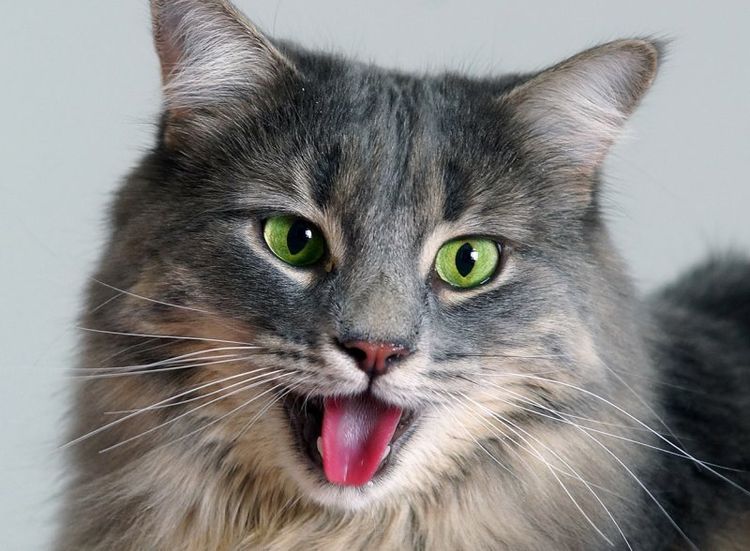
- Open-mouth breathing. Animals resort to this method in exceptional cases, when they're practically on the verge of heatstroke. The tongue will be tense and slightly raised, and the breaths themselves will be very sharp and abrupt. Breathing in this rhythm quickly cools the nasopharynx and lungs, blood vessels dilate, blood flows faster, and body temperature drops.
Important: Mouth breathing is a bad sign, indicating that your cat is seriously overheated. Immediate assistance is required. Read more on our website. How to help a cat in a hot apartment.
When do cats actually sweat?
Excessive sweating may be a sign of problems:
-
Heat stress: high humidity, heat, heat + lack of airflow → wet paw pads, dripping chin
-
Emotional stress: visit to the vet, noise, aggressive environment
-
Fever and disease: a sudden rise in temperature, accompanied by humidity and an increase in body temperature
Heatstroke: Diagnosis and Home Treatment
Ideally, a cat's body temperature ranges from 38-39°C (100-102°F). It can fluctuate throughout the day depending on season, weather, mood, and even age. When the body becomes unable to independently regulate its temperature, toxicity begins.
How to recognize overheating
-
Watch the pads — wet marks on the floor may indicate that the cat is sweating.
-
Excessive licking and grooming, especially on the sides and armpits - an attempt to cool down.
-
Panting, heavy breathing, open mouth and jaws — the onset of overheating. Urgently help and take the cat to the vet.
-
General lethargy, vomiting, refusal to eat — a reason to immediately consult a doctor.
Blood thickens, slowing its circulation through the vessels. As a result, accumulated toxins are not removed promptly, leading to a risk of blood clots. As a result, a cat can suffer a heat-related stroke or heart attack. To prevent this, it's important to promptly recognize the symptoms of heatstroke and prevent it as much as possible. Specifically:
- Take the cat to a shaded area or a closed, well-ventilated area.
- Give her some cool/cold water, and if the animal avoids it, force it to drink.
- Wrap the ears with damp gauze or a towel, or spray the fur with water. You can also gently apply something cool to the ears: a cloth, a household item, or a food item.
- Dunk the cat in cool water. This is a drastic measure when the cat is close to fainting or has a fever.
Additional ways to cool cats
-
Provide a warm tent, tiles, and a cool floor;
-
Cool the paws with wet cloths;
-
Provide air flow with a fan or air conditioner;
-
Always provide fresh water in several places.
If the animal improves within 20-30 minutes, there's no need to take it to the vet. In more severe cases, where the heart rate slows, disorientation occurs, or other unusual behavioral signs are observed, you should seek immediate veterinary care.
Read also:


Add a comment