
Podenco Ibizanco (Ibizan Hound, Ibizan Hound)
The Ibizan Hound is called the hunting pearl of the Mediterranean. Other names include the Ibizan Hound or Ibizan Hound. It's immediately clear where this breed originates and what its purpose is. This sturdy, elegant dog is attracting more and more sighthound enthusiasts worldwide with its appearance and pleasant temperament. However, it remains a very rare and scarce breed.
Content
History of origin
The Ibizan Hound is a primitive type of sighthound. Its closest relatives are the Portuguese Podenco, Canary Island Podenco, Andalusian Podenco, and Cirneco dell'Etna And pharaoh houndHistorians believe that dogs of this type were brought to the Blearic Islands from North Africa by the Phoenicians, who founded a settlement on Ibiza in the 8th century BC. The Carthaginians and Romans likely also played a role in the spread of dogs from the Middle East. The ancient ancestors of the Podenco Ibizanco are believed to be the pointed-eared dogs depicted in Egyptian frescoes. Therefore, it is safe to say that the Podenco Ibizanco is an ancient hunting dog breed that developed on the islands of the Blearic Islands (Mallorca, Ibiza, Menorca, Formentera), where they were used for unarmed hunting of birds, rabbits, and even larger game. In its native land, the breed is known by its original name, "ca eivissec." Modern genetic research conducted in 2004 gave reason to believe that the Ibizan Hound as a breed was formed relatively recently and is similar to ancient Egyptian dogs only in appearance.
The Ibizan Hound was one of the first Mediterranean dogs to attract cynologists, primarily due to its appearance. Noting its resemblance to ancient Egyptian dogs, the Podenco was nicknamed the "Pharaoh Hound." The FCI approved a standard for it, which was in effect from 1963 to 1977. In the early 1970s, the British became interested in the Maltese sighthound and registered it with their English Kennel Club under the same name—the "Pharaoh Hound." Naturally, confusion ensued. The FCI bowed to the authority of their British colleagues and abolished their standard. Fortunately, the breed was not forgotten. In mid-1956, the first Ibizan Hounds arrived in America (Rhode Island), which subsequently played a significant role in their popularization. At the same time, they continued to be bred in their homeland and in neighboring countries. In 1982, the FCI again recognized the breed, but under a new name: Podenco ibicenco. Today, the majority of the breed is concentrated in southern Europe and the United States.
Purpose
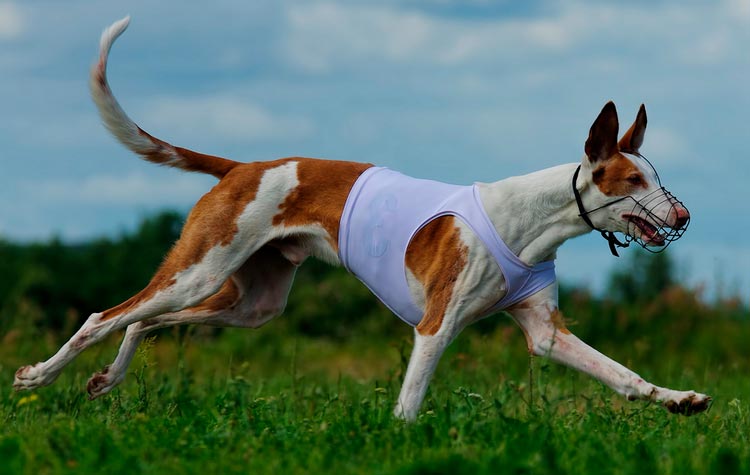
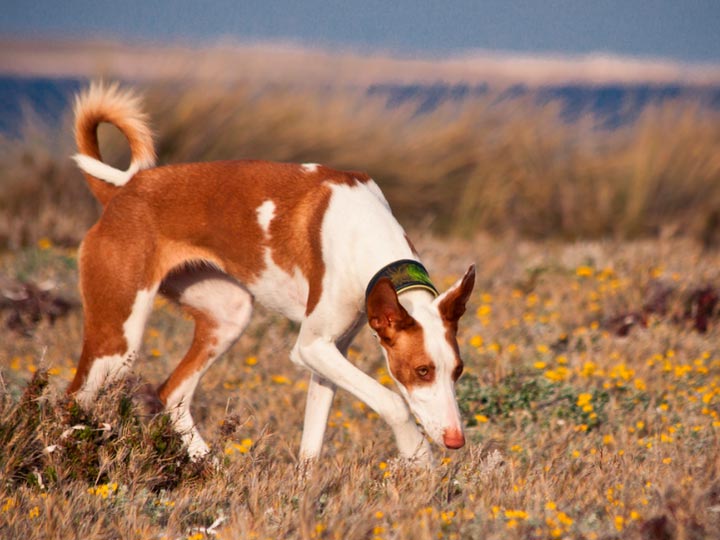
The Ibizan Hound is a sighthound used for unarmed hunting of rabbits at any time of day, as it hunts not only with sight and hearing but also with its keen sense of smell. Upon seeing or smelling an animal, it immediately becomes excited. It is very fast and eager in pursuit, yet has a gentle grip. Unlike other sighthounds, it can bring in its prey alive rather than strangling it on the spot. Thus, the Ibizan Hound is a sighthound with some of the qualities and behaviors of hounds and retrievers.
The Ibizan Hound can hunt alone or in a pack of up to 15 dogs. Only females and no more than one male are allowed to work in packs, as they are known to be quarrelsome and can be distracted by arguments even during the hunt.
When one dog spots prey, the others surround it and wait for the right moment to join the hunt. Podencos require a long rest; after a successful hunt, they may refuse to work for a while.
In addition to being a hunting dog, in many countries around the world the Ibizan Hound is considered a wonderful companion and a spectacular show dog.
Video about the Podenco Ibizan Hound dog breed:
Appearance
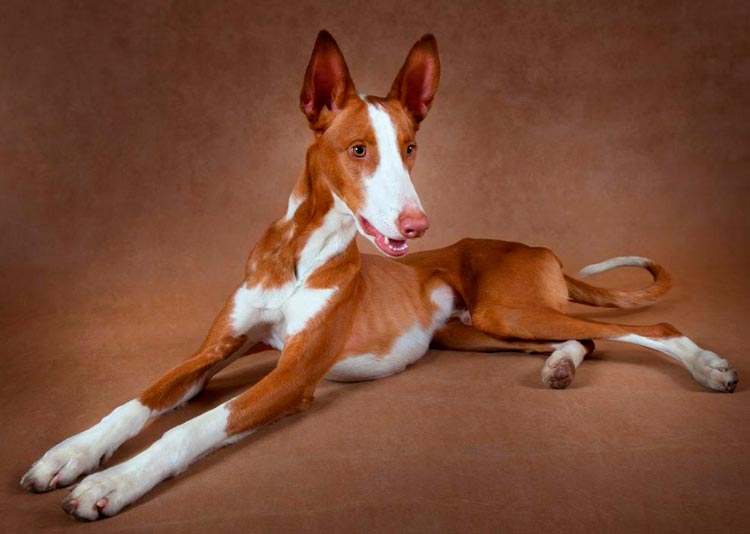
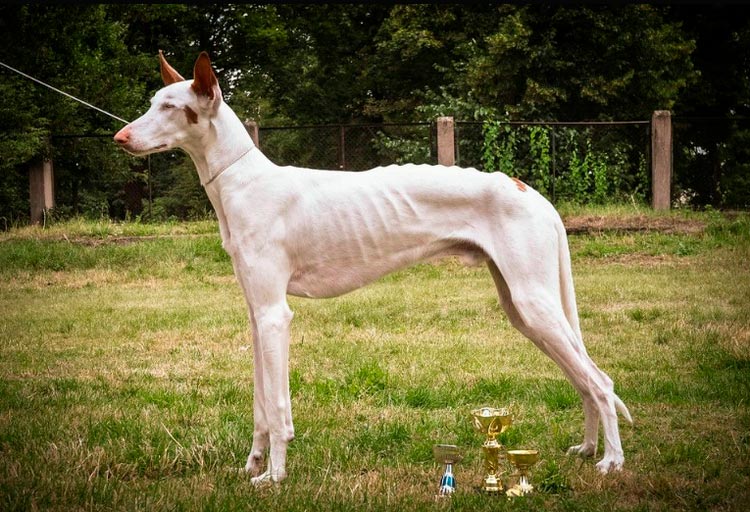
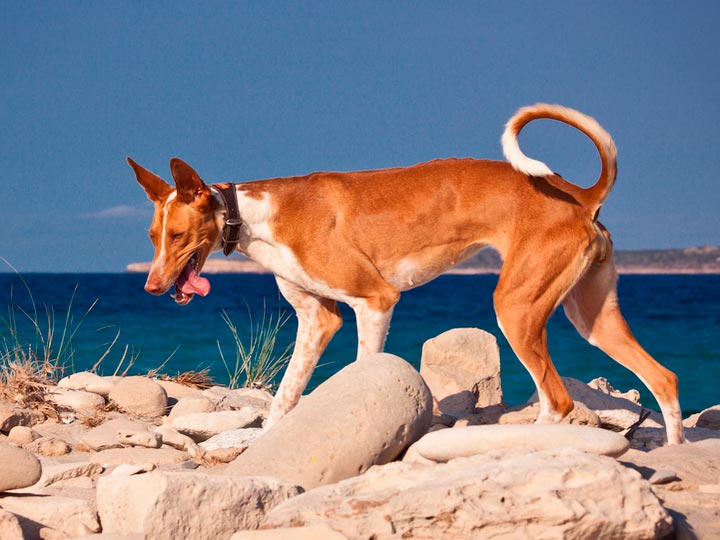
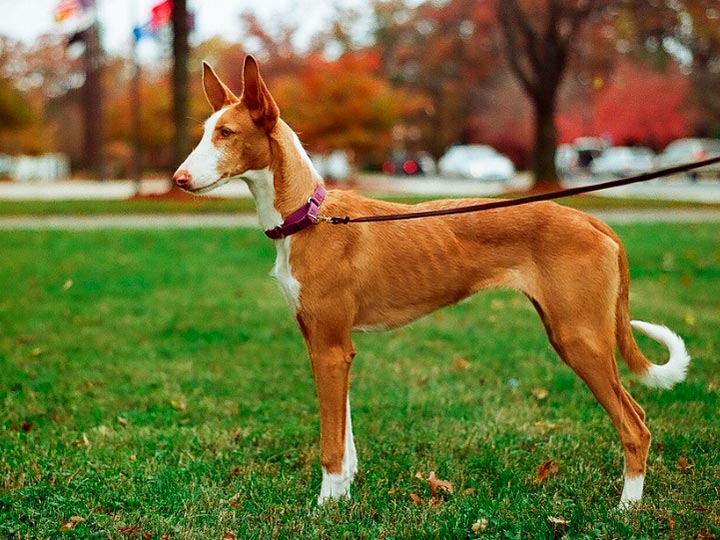
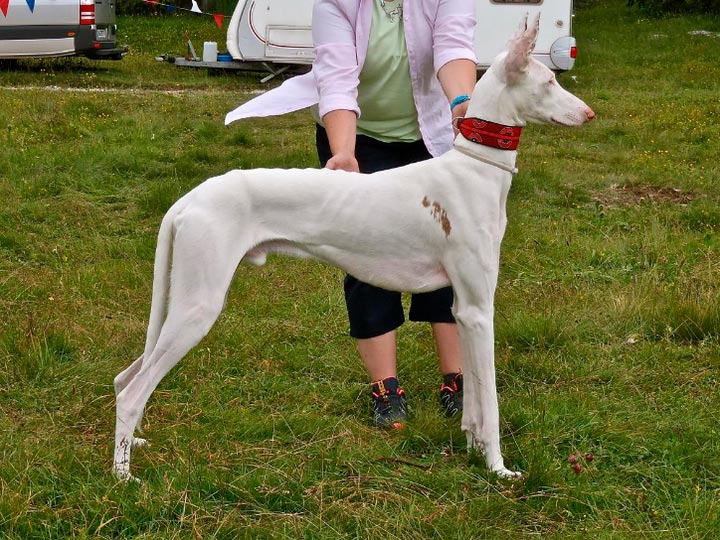
The Ibizan Hound is a tall, strong, but not heavy sighthound. It has a slightly elongated build and a lean frame, with large, erect ears and a long muzzle. Sexual dimorphism is moderate. Males are somewhat larger and stronger than females. Height at the withers ranges from 60 to 72 cm, and weight ranges from 19 to 25 kg.
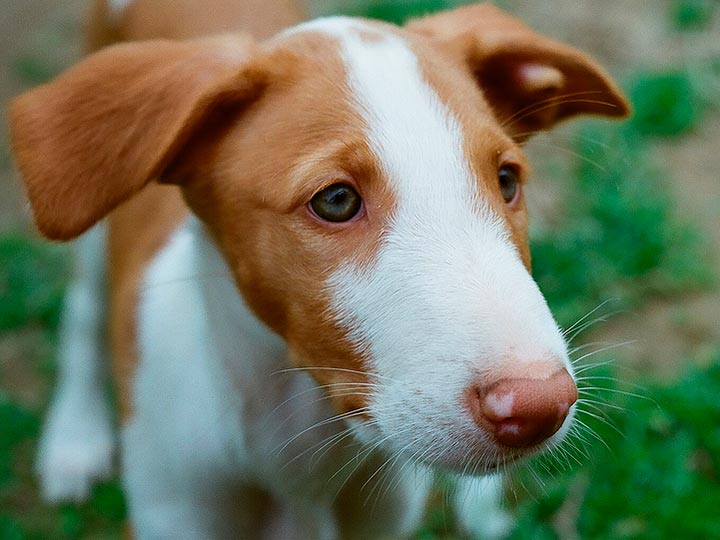
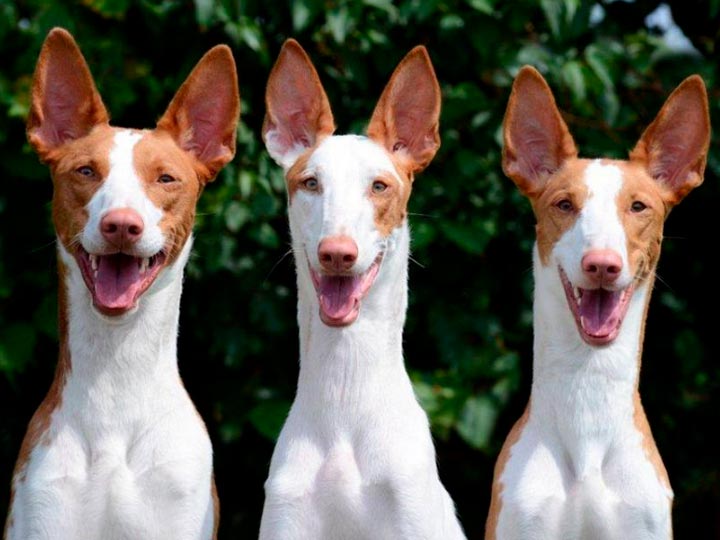
The head is long, thin, and dry. It is small in proportion to the body. The skull is flat and long, with a prominent occipital region. The forehead is flat. The stop is weakly defined. The muzzle is long; the distance from the tip of the nose to the eyes is equal to the distance from the eyes to the back of the head. The lips are thin and close-fitting. The teeth are strong, white, and complete, meeting in a correct scissor bite. The eyes are almond-shaped, set slightly obliquely, small, and amber in color, varying in intensity. The ears are very mobile and rigid. The center of the auricle is level with the eyes. The auricle is relatively large, diamond-shaped, with the base cut off by two-thirds. The nose leather is medium in size and protrudes above the lower jaw. The color of the nose leather is flesh-colored, as are the lips and eyelids.
The neck is very dry, its length equals a quarter of the body length. The body is symmetrical and compact. The length slightly exceeds the height. The withers are well defined, high, long, and dry. The back is long and straight. The loin is arched, strong, and of medium width. The croup is well sloping, showing strong, hard muscles. The chest is deep, long, and narrow, not reaching to the elbows. The ribs are flat. The belly is tucked up, but not too much. The forelegs are symmetrical, straight, set very close together, long, and dry. The hind legs are straight with long, flat muscles. The feet are very well knit. Read about dog structure on our website.
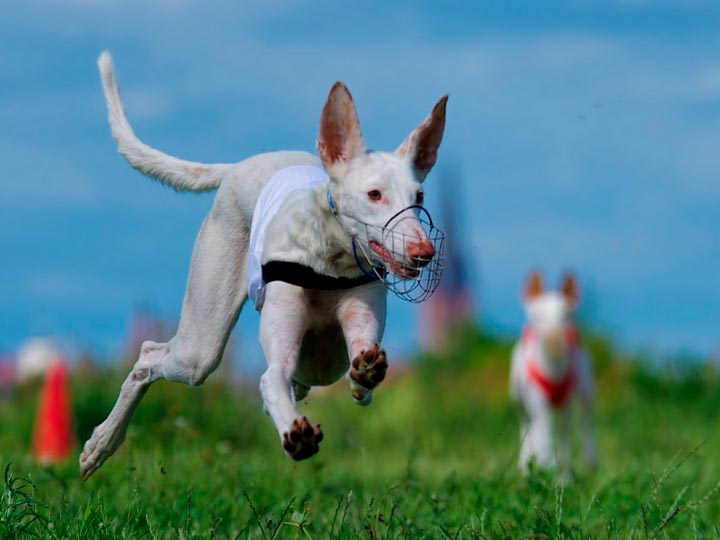
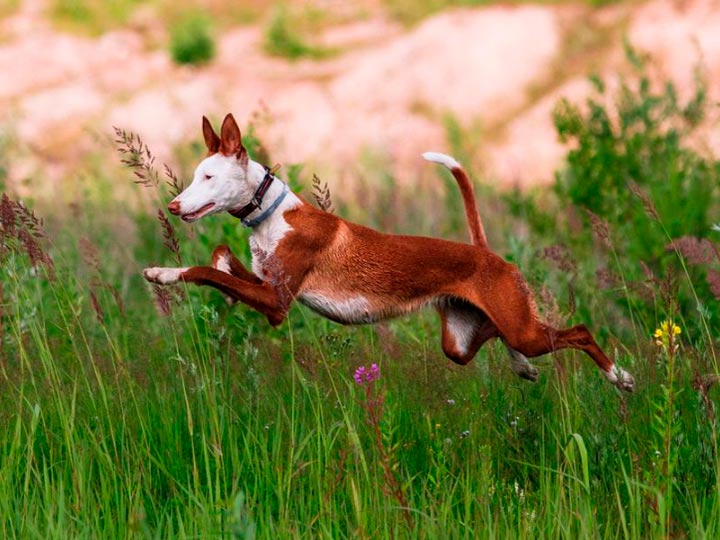
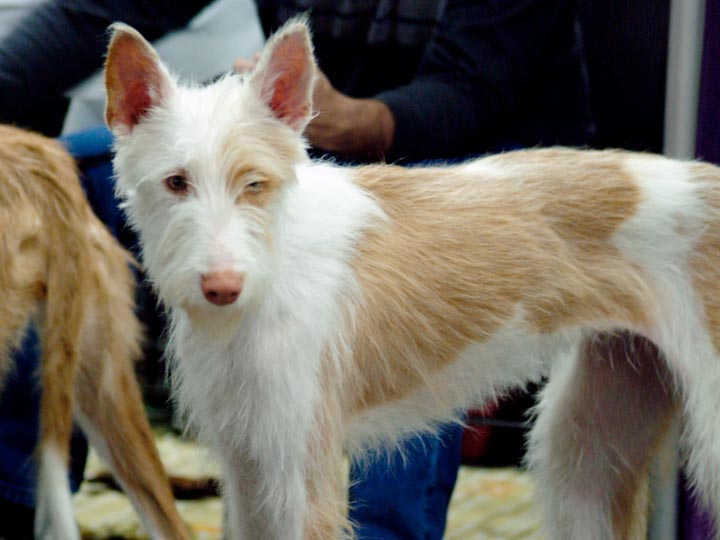
The skin is dense and reddish in color, but may have a different shade in lighter areas. The coat is smooth or harsh. Smooth coats should not be silky; they are very thick and shiny. Harsh coats are rough to the touch, very dense, and at least 5 cm long. The coat color is red and white, solid red, or white. The red should be a bright chestnut color. Fawn is undesirable and prohibited in smooth-coated dogs.
Character and behavior
Ibizan Hounds are very gentle, affectionate, sensitive, and friendly dogs. They get along well with all family members. They develop unique relationships with everyone, but usually favor one over the other—their owner. They are good with children. Podencos are not typically aggressive toward people, making them unsuitable for guard or protection roles. They are wary and distrustful of strangers. If they are regular guests, friends, or relatives, they become welcoming and friendly, but maintain a distance and do not show intense affection. Podencos are very curious, mischievous, and resourceful, making life with them interesting, if sometimes unpredictable.
Podencos are very sensitive, they understand the mood of their owner and sincerely empathize, they are rarely overly intrusive, and therefore are considered excellent companions.
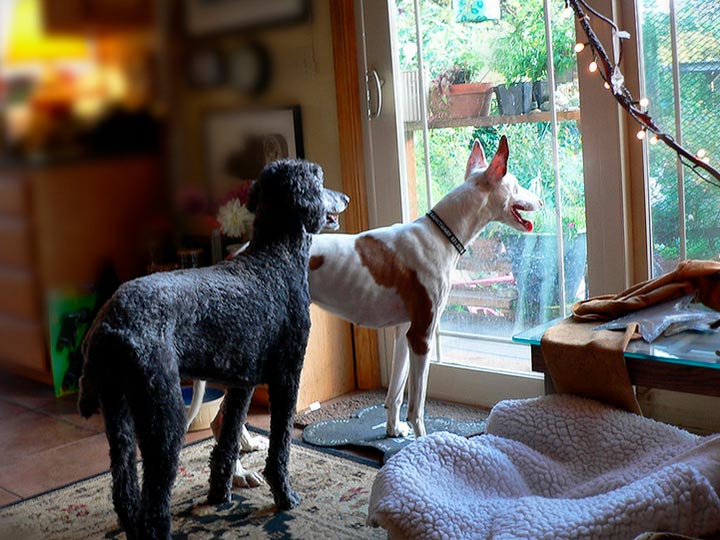
They generally get along well with other pets. However, it's important to remember that small animals and birds can trigger a dog's hunting instinct, even with good socialization. Conflicts may arise between male dogs, including on walks.
The Podenco has a strong pursuit instinct, but is better trained than other sighthounds to ignore small dogs. Neighborhood and stray cats are more difficult to deal with. And given that the sighthound has a quick burst of speed and can reach speeds of up to 60 km/h, escaping from it will be difficult. It's important to remember that Podenco Ibizanians are bred for running and hunting.
Education and training
Ibizan Hounds are quite sensitive. They may refuse training if they are embarrassed, frightened, or have lost trust in their owner. Therefore, it's crucial to establish a friendly relationship with the dog from puppyhood. Avoid punishment and negative reinforcement as much as possible, using only positive methods, praise for tasks completed correctly, good behavior, and so on. Generally, Ibizan Hounds are intelligent enough to quickly understand and follow house rules.
If a close bond between dog and owner is established during puppyhood, the Ibizan Hound will be a very obedient and understanding companion. Otherwise, you could end up with an unruly, willful dog that lives by its own rules.
Content Features
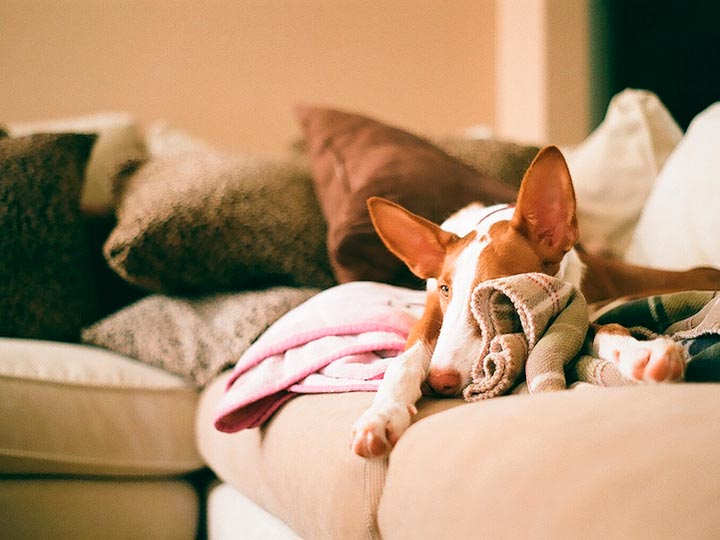
The Ibizan Hound is well-suited to apartment life due to its cleanliness, neatness, and docile nature. However, this is only possible with adequate exercise. At home, it is calm and quiet. As for outdoor living, kennels, and especially chained dogs, are strictly contraindicated for this breed. Free-range living is complicated by the Ibizan Hound's reputation for escapism. They find all sorts of ways to overcome fences. If they can't jump a fence, they climb and clamber over it. They are even believed to be able to climb trees. The Ibizan Hound's coat has no distinctive odor and sheds little if it is kept in a cage. trim regularly.
The Ibizan Hound is suitable for those who enjoy unarmed hunting and long walks in the forest, as well as a companion dog for cycling or running. Apartment living is possible, provided it provides sufficient exercise. Living in a private home does not preclude the need for a good walk, and the fence around the property must be impassable for the dog.Podencos require a great deal of exercise. Not only the duration but also the intensity are important. Walks should always be supplemented with energetic games and opportunities for free running. Of course, it's best to let the dog off-leash in open areas rather than in city limits.
Care
Ibizan Hounds require minimal grooming, which varies slightly depending on their coat type. Short-haired dogs are brushed periodically with a special brush or mitten. Wire-haired dogs are trimmed once or twice a year, usually in spring and summer. In winter, the topcoat is allowed to grow long, which improves the dog's protection during cold weather. Walks in frosty and windy weather are minimized, and the dog is provided with additional insulation. Clothing should be chosen according to the weather. It should be comfortable and not restrict movement, as active walks are the primary way to keep the dog warm.
Other regular maintenance that Ibizan Hounds require includes periodic ear and teeth cleaning, as well as nail trimming for dogs that, for some reason, do not wear down their nails on their own.
Nutrition
Ibizan Hounds are often picky eaters, making it difficult to provide them with a complete, natural diet. They won't eat everything, but will choose the most delicious items from what's offered. If their favorite foods include meat and organ meats, some cereals, fruits and vegetables, as well as eggs and dairy products, a balanced diet can be easily created. Quarterly courses of mineral and vitamin supplements are given. Otherwise, it's best to consider feeding them commercial dry food. Ibizan Hounds thrive on diets designed for medium-sized dogs with normal or active lifestyles.
Ibizan Hounds are not prone to overeating and therefore rarely suffer from excess weight. This is unless owners indulge their dog and feed it only high-calorie treats like biscuits, cheese, and the like.
Health and life expectancy
The Ibizan Hound is considered a relatively healthy breed. Most dogs are hardy and healthy. With proper care, nutrition, and timely veterinary preventative measures, they rarely get sick. Ibizan Hound puppies are susceptible to infectious diseases and often experience complications from worm infestations. Adult dogs can suffer from various illnesses, including hereditary ones, which occur with varying frequency in different lines:
- Congenital deafness (more common in all-white dogs);
- Epilepsy;
- Cataract;
- Progressive retinal atrophy;
- Allergy;
- Axonal dystrophy.
Life expectancy is typically 12-15 years. Ibizan shepherds remain active and willing to work well into old age.
Choosing a Podenco Ibizan Hound Puppy
Only a few breeders in Russia and neighboring countries are breeding this rare breed. There are often long waiting lists for puppies. If you want a dog for your own enjoyment, you can choose any dog you like. If you plan on showing or breeding, you might want to consider buying a dog abroad, for example, in Spain.
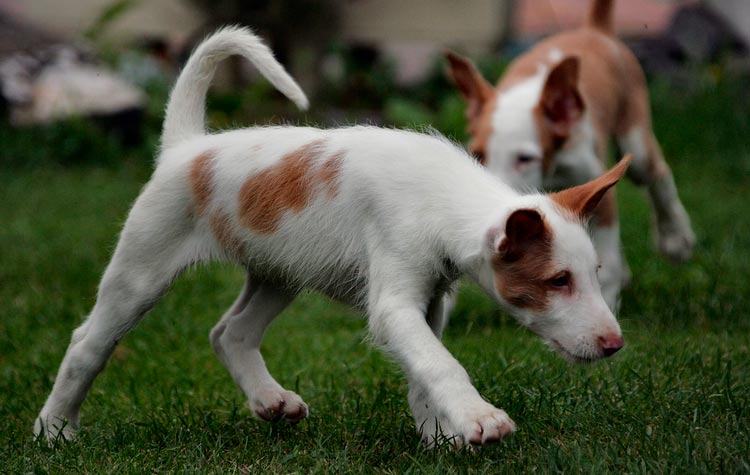
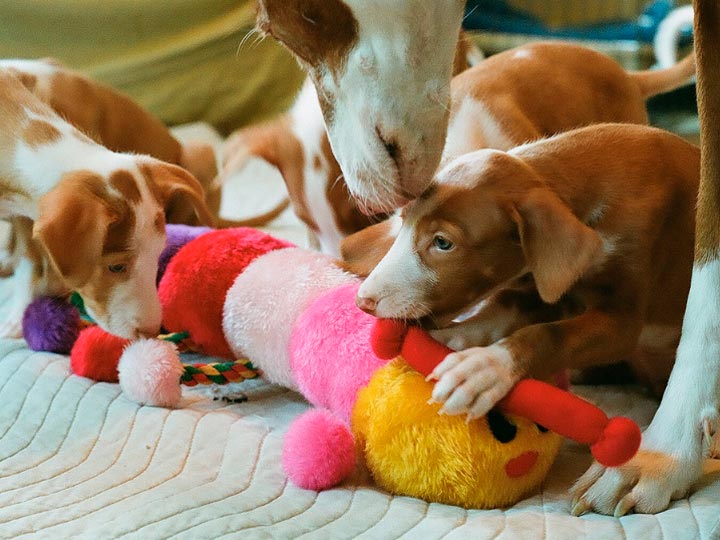
Attention is paid to the litter's parents, their temperament, working qualities, and health. The same applies to the young puppies. They should be curious, active, not shy or aggressive, and show no signs of illness. The dogs' living conditions, diet, and the breeder's attitude toward them are also assessed. Given that the breed is not commercial, most people who breed Podenco Ibizancos are responsible in their work, providing support in matters of raising, feeding, show careers, and other matters. At three months, when the puppies go to their new homes, it is difficult to reliably predict their future conformation to the standard. Their show career may be cut short. malocclusion After teething, a flat ear, and other unpleasant little things. But even at this age, puppies must meet the Standard on many points: body type, ear set, eye shape and placement, body proportions, color, coat type, etc. For those unfamiliar with the breed, it's best to entrust the selection of a puppy to a breeder or dog trainer.
It's recommended to pick up a puppy no earlier than 2-3 months of age. At 45 days old, puppies undergo a veterinary examination, receive a tattoo and a certificate, which is later exchanged for a pedigree. They must also be vaccinated according to age, as evidenced by a passport with stickers and a vet's stamp.
Price
The price of a Podenco Ibizan Hound varies greatly depending on the breeder's geography, the value of its stock, and demand. In Russia, a Podenco puppy costs an average of 35,000-50,000 rubles. In Europe, it costs 800-1,500 euros, while in America, the price for a rare breed can reach up to $3,000.
Photos
The gallery contains vibrant photos of Podenco Ibizan Hound puppies and adult dogs.
Read also:
- The fastest dog in the world
- Tazy (Kazakh Greyhound)
- Podenco Canario (Canary Hound, Canary Warren Hound)


Add a comment