
Why do cats' eyes glow in the dark?
Many pet owners have noticed that at dusk or in complete darkness, cats' eyes begin to emit a mysterious glow. This effect is fascinating not only for children but also for adults, especially when the cat suddenly turns its head and its eyes reflect a bright light. The reasons for this phenomenon lie in the characteristics of structure of cats' eyes, their ability to see at night and some biological mechanisms.
Content
- 1 The structure of the cat's eye and the role of the tapetum lucidum
- 2 Why is the glow not always visible?
- 3 The difference between cats and other animals
- 4 Glow and cat health
- 5 The evolutionary benefits of eye glow
- 6 Myths about eye glow
- 7 What should the owner do if the eyes don't light up?
- 8 Practical application of knowledge about eye glow
- 9 Frequently Asked Questions (FAQ)
The structure of the cat's eye and the role of the tapetum lucidum
The main reason cats' eyes glow in the dark is due to the presence of a special layer in the eyeball called the tapetum. It is located behind the retina and acts as a reflector. Light rays entering the eye pass through the retina, are reflected by the tapetum, and then pass back through the photoreceptors, amplifying the image. This mechanism helps cats see in low light conditions 5-6 times better than humans.
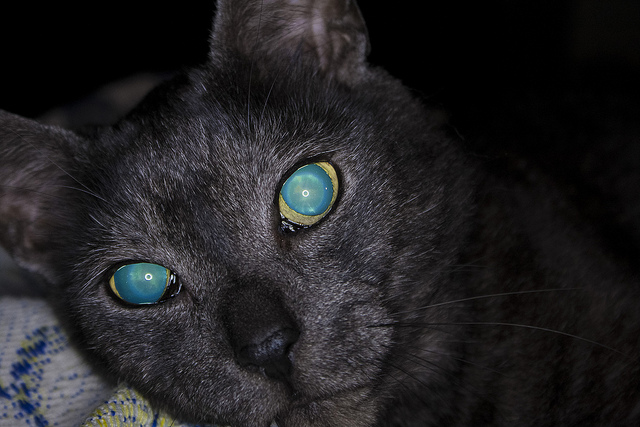
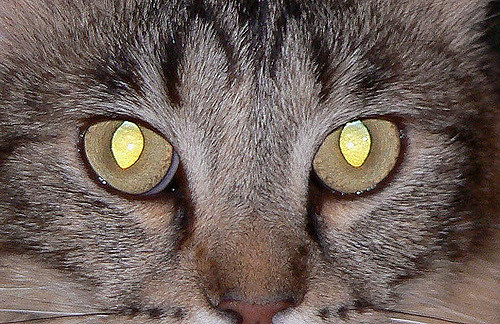
The tapetum lucidum consists of cells rich in guanine crystals, which act like a mirror. The color of the light can vary between breeds and even between individual cats, from yellow-green to blue.
Why is the glow not always visible?
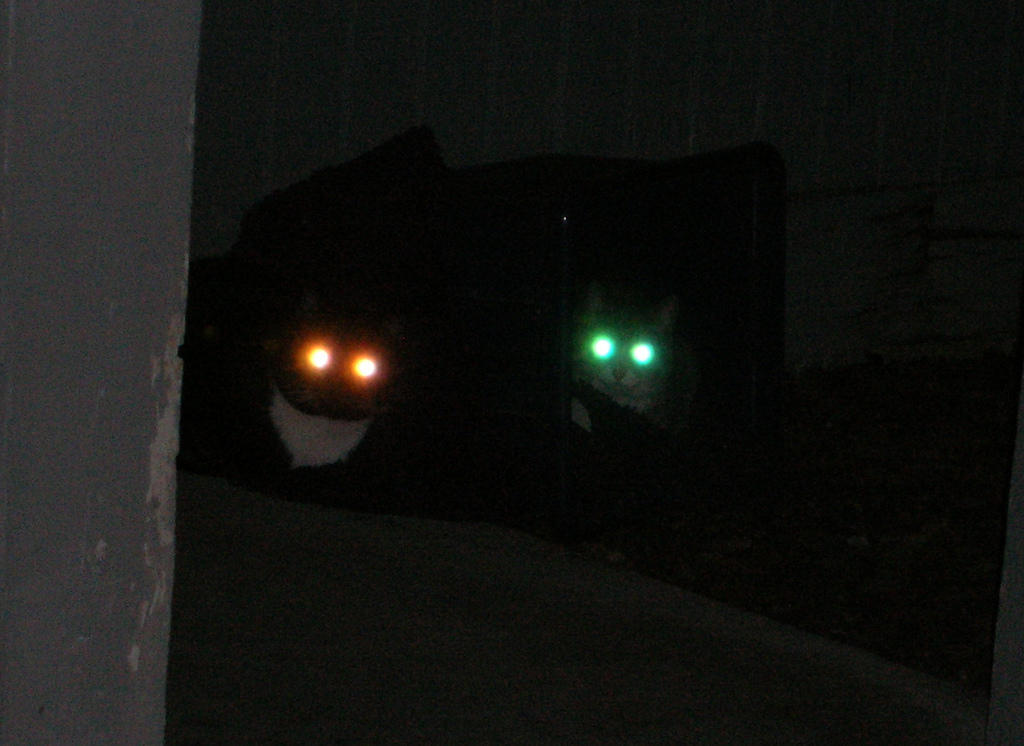
Eyes glow only when exposed to a direct light source: car headlights, a flashlight, or even sunlight at a certain angle. In the absence of any light, cats' eyes remain dark. Therefore, many owners wonder why the glow is particularly noticeable at night in dim light, but not during the day. The reason is that the pupils dilate in the dark, and the larger area of the reflective tapetum makes the effect more pronounced.
The difference between cats and other animals
Cats aren't the only animals that reflect light; many nocturnal animals do too: dogs, foxes, raccoons, and cattle. However, the hue of the light can vary. For example, in dogs, it's more often blue or white, while in cats, it's greenish or yellow. This is due to differences in the chemical composition and thickness of the tapetum lucidum in different species.
Comparative features table:
| Animal species | Eye glow color | Structural feature |
|---|---|---|
| Cats | Green, yellow | The tapetum lucidum is highly developed, and night vision is highly acuity. |
| Dogs | Blue, white | Less pronounced tapetum |
| Raccoons, foxes | Reddish | Thin tapetum lucidum, an adaptation for nocturnal hunting |
| Cattle | Yellow | Wide viewing angle, but poor detail |
Glow and cat health
While it's normal for eyes to glow in the dark, changes in intensity or color can indicate problems. For example, cataracts or glaucoma can cause the eyes to become cloudy, while retinal detachment can cause an unusual bluish tint. If an owner notices unusual visual changes in their pet's eyes, they should consult a veterinary ophthalmologist.
The evolutionary benefits of eye glow
The glow of the eyes is not a decorative feature, but an evolutionary advantage. The ancestors of domestic cats were nocturnal or crepuscular, hunting in low-light conditions. The tapetum lucidum allowed them to utilize even the slightest rays of light reflected from the moon or stars. This increased their chances of spotting prey or evading predators.
Modern domestic cats have lost the need to forage for food in the dark, but their vision has been preserved, which explains why they are active at night.
Myths about eye glow
Since ancient times, the glowing eyes of cats have been associated with mysticism. Some cultures believed that cats saw spirits or possessed supernatural abilities. In reality, the phenomenon is explained by purely physical and biological causes and has no mystical nature.
Common myths:
-
Cats light up their eyes because they have electricity in them;
-
the glow signifies the "evil power" of the animal;
-
Only black cats have glowing eyes.
All these statements have no scientific basis.
What should the owner do if the eyes don't light up?
Some owners worry if their pet's eyes don't glow brightly. This isn't always a sign of illness: the intensity of the reflection depends on the angle of the light, age, and the condition of the tapetum lucidum. In older cats, it may be less pronounced. However, if deteriorating vision, clouding of the lens, or discharge from the eyes are also observed, an examination is necessary.
Practical application of knowledge about eye glow
Knowing why a cat's eyes glow in the dark can be helpful in everyday life:
-
when walking in the evening, the owner will notice the pet more easily;
-
you can determine where the animal is looking, even in low light;
-
The use of reflective collars increases safety, as the light from car headlights is additionally reflected from the eyes and accessories.
Frequently Asked Questions (FAQ)
Why do my cat's eyes glow different colors?
The color of the glow can vary even in the same animal. This depends on the composition and structure of the tapetum lucidum, as well as the angle at which the light falls. In some cats, one eye may glow brighter or have a different shade due to individual pigmentation differences.
Why do cats' eyes glow in photographs?
The "glowing eyes" effect in photographs is caused by the use of a flash. Light from the flash reflects off the tapetum lucidum and returns to the camera lens, creating the impression of a bright glow. A similar effect is observed in humans, but in them it appears red due to reflection from the blood vessels in the retina.
Do all cats have glowing eyes?
Almost all cats have a tapetum lucidum, but its reflectivity can vary. Some breeds or individual cats have a weaker fluorescence, which is not considered abnormal.
Is it possible to determine a cat's age by the glow in its eyes?
No, the intensity of the luminescence is not an accurate indicator of age. In older animals, it may decrease slightly due to natural changes in the lens and retina, but it is not a universal indicator.
Why do kittens' eyes glow differently than adult cats'?
In kittens, the tapetum lucidum and retina are not yet fully formed, so the hue and intensity of the fluorescence may vary. As kittens mature, the color usually stabilizes.
Read also:
- What are whiskers and why do cats need them?
- Do cats see themselves in the mirror?
- Do cats see the other world?


Add a comment