
Why is the owl called the feathered forest cat?
The owl is a nocturnal bird of prey, with feather colors varying depending on its habitat. But no matter where it lives, you might encounter another name for it: "forest cat." Why is that?
Characteristics of owls
Owls range in size from 17 to 70 cm, and weigh from 50 g to 4 kg, depending on the species. Their lifespan is 10 years in the wild, and up to 40 years in captivity. This is because in the wild, owls often go hungry and are preyed upon by larger predators, such as hawks and golden eagles.
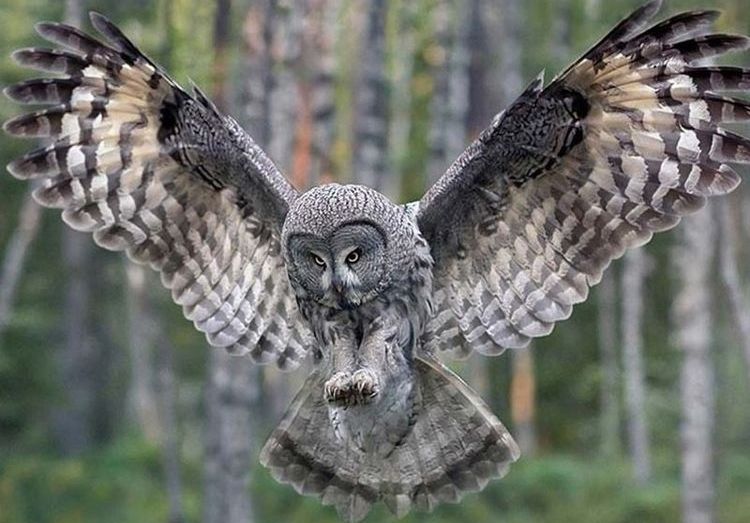
Owls' feet are extremely strong and prehensile, and their talons are curved and sharp, allowing them to quickly grasp and hold onto prey for a long time. Owls fly virtually silently thanks to their feathers and wing structure, which can reach a span of up to 200 cm. Some species can reach speeds of up to 80 km/h.
The predator's eyes are located forward and look only straight ahead, so nature has given it the ability to rotate its head up to 270 degrees without harming itself. Its field of view is 160 degrees.
Owls have excellent night vision because their lens is located in the cornea, not the eyeball. Owls have acute hearing, four times greater than cats. Therefore, even the slightest rustle of a mouse will be a significant cause for concern for them.
Forest birds of prey hunt mainly mice and other small rodents, as well as small birds and small animals.
To understand why owls are called feathered forest cats, let's look at the characteristics of felines that live in houses.
Cat behavior patterns
Even though cats have long since become beloved and affectionate pets, the hunting instinct is always present. That's why even small kittens love chasing flies or sunbeams.
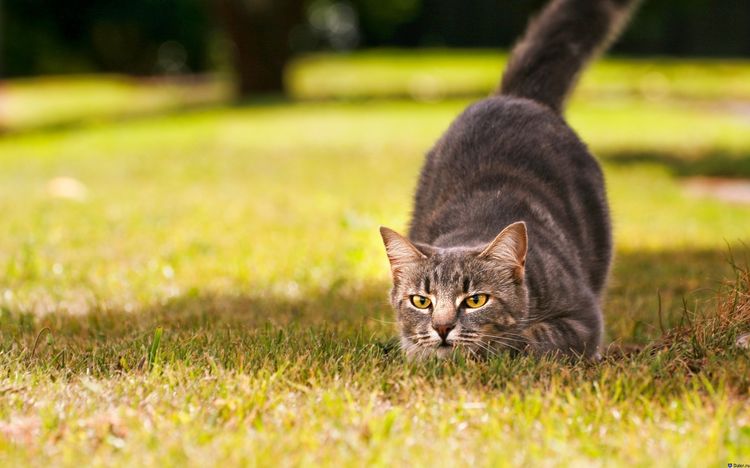
In the wild, cats hunt small rodents, insects, and small birds. Their agility and gracefulness allow them to handle even birds their own size.
The average length of a domestic cat reaches 60 cm excluding the tail, and the weight of an adult is 2.5 – 6.5 kg.
Domestic predators have strong paws designed for fast running and the ability to snatch prey in mid-flight. Their claws are sharp and semicircular, allowing for a deadly grip. They can also retract their claws for comfortable and quiet movement.
The cat has excellent eyesight, at night They require minimal illumination, even a single beam of diffused light, to navigate perfectly. They have acute hearing, and their ears can move like locators, focusing on various sounds.
The combination of sight, speed, hearing, and smell makes cats excellent hunters. Their hind legs are designed to quickly gain speed from a standing start. They move virtually silently, hunting primarily at night when camouflage is easier.
It's impossible to turn a cat into a completely domesticated animal and eliminate its hunting instinct. Therefore, in villages or private homes, the animal serves two functions: as a "furry sedative" and as a rodent protector.
What do owls and cats have in common?
It's no wonder the owl is called a feathered cat. Like a domesticated animal, it hunts small rodents, animals, and birds. It is silent and strikes its prey swiftly.
Both representatives of different animal communities have well-developed claws and have the same shape, allowing them to hold on to prey until they themselves want to release it.
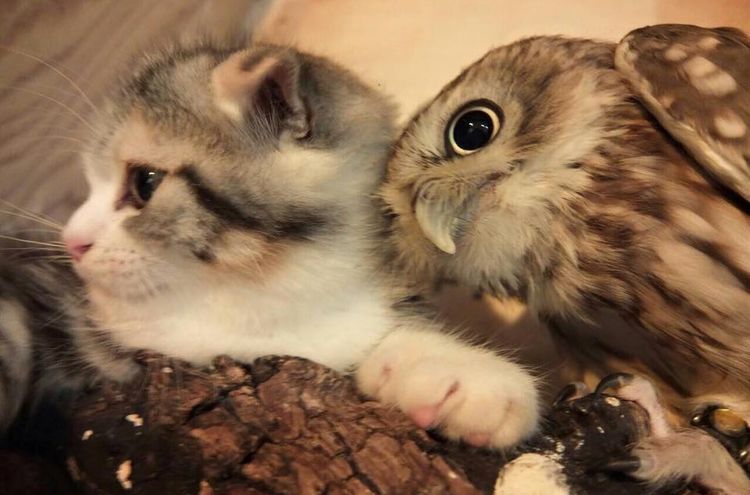
Owls are nocturnal birds, and cats are not averse to hunting in the dark.
Birds have four times better hearing than cats, but lack the sense of smell of domestic predators. The physiological structure of owls and cats is ideal for hunting, enabling them to quickly gain speed and quickly dash after their prey.
Both predators stalk their prey and choose the perfect moment to strike. They won't go hungry. However, both have plenty of larger enemies. The owl's immediate danger is the hawk, while the cat's is the dog. Therefore, the bird and the animal have much more in common than meets the eye.
Thus, for its silent flight, ability to hunt in the dark, keen hearing, quick reflexes, and sharp claws, the owl was nicknamed the forest cat. Its prey primarily consists of small rodents, so keeping an owl near a private home provides good protection against attacks from these small pests.
Cats and birds share another common feature: their eyes. Pupils constrict and dilate not only in response to bright light but also in response to other factors. A domestic hunter's pupils become large and round during play, while an owl's dilates when inhaling.
Don't be surprised if someone says they saw a feathered cat in the forest, meaning an owl. After all, these inhabitants of the home and the forest have more in common than meets the eye.
Read also:
- The fastest cat in the world
- Why do cats bring their prey to their owners?
- Why do cats love valerian?


1 comment
Paul
Funny! 🙂
Add a comment