
Why don't dogs like cats?
There are many myths about why dogs dislike cats. Animal behaviorists can explain the true reasons for this. They believe there's a logical explanation for the hostility between pets.
Content
- 1 Differences in behavior
- 2 Legacy of the past
- 3 Division of territories
- 4 Unpleasant memories
- 5 There is no beast more terrible than a cat
- 6 Misunderstanding
- 7 Differences in verbal signals
- 8 Exceptions to the rules
- 9 Scientific research on cat and dog relationships
- 10 How to Make Friends Between a Dog and a Cat: A Step-by-Step Plan
Differences in behavior
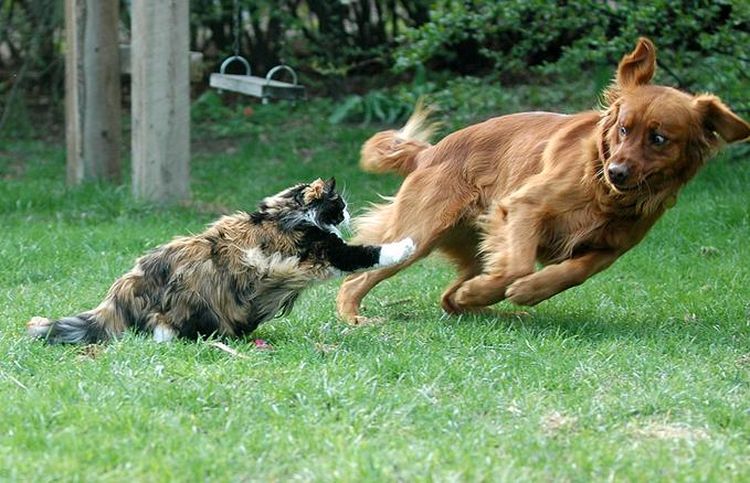
Dogs and cats are completely opposite creatures in every way. Dogs are quite inquisitive and active, preferring to interact with others and frolic. Adult cats are calm and composed. They are naturally reserved, tending to avoid any contact, playing the role of observer. The dog's impudence, thrusting its muzzle into their personal space, deeply upsets the cat, and it tries to escape. However, this behavior only further provokes the dog, resulting in a chase. If a dog chases a cat, it doesn't necessarily mean it harbors negative feelings toward the animal. More often than not, it's simply curiosity that's at play. Having caught up with the fleeing animal, the dog becomes confused, unsure what to do with it.
Legacy of the past
Animals have different worldviews and lifestyles. Dogs are genetically wired for pack instinct, so bonding with their fellow animals is crucial. Cats value solitude above all else. They find their prey independently and are unwilling to share it.
But these animals also have something in common. They are predators, and therefore territorial. It is especially important for them to protect the boundaries of their hunting grounds. Territoriality is the main reason why cats and dogs fight.
Dogs, accustomed to living in packs, assumed a dominant position. While weight advantage helps, it doesn't play a crucial role. The ancestors of the modern cat were much larger than canines, but they suffered defeat due to their self-imposed solitude.
Division of territories
Often, dogs' hatred of cats is a reaction to the violation of "dog territory."
-
Bedrooms, bowls, doors: If a cat gets into an area where a dog sleeps or eats, negative reactions are possible.
-
Solution: clear zoning - the cat has a separate room, bowls at different levels.
Unpleasant memories
Sometimes, even with a perfectly peaceful cat, a dog refuses to befriend it. This reaction can be caused by negative associations. If a puppy was once hurt by a cat scratching its face, a fear of pets becomes ingrained in the dog's subconscious. Even after the pain has long subsided, unpleasant memories surface at the sight of a cat.
There is no beast more terrible than a cat
A confident cat can certainly prove the truth of this saying. Although dogs dislike felines, felines, in turn, are not at all afraid of them. This is one reason why cats often engage in physical confrontations with dogs. Instead of immediately running away at the sight of an approaching dog, the pet will lower itself to the ground and carefully analyze the situation. It's not uncommon to see a cat gracefully and leisurely strolling in front of a dog, as if teasing it. When threatened, it will easily retreat to the nearest tree without appearing at all frightened.
Misunderstanding
It's a well-known fact that animals communicate with each other through sounds and gestures. And observation has led me to believe that dogs and cats don't understand each other. A dog, for example, wags its tail with joy, while a cat wags its tail to show anxiety and aggression. The same parallels can be drawn with the sounds characteristic of animals.
A dog's growl is known to be a warning and a sign of aggression, while a cat's purr usually expresses trust and gratitude. Dogs and cats have different motives for similar actions, and they have poor communication skills, which means they tend to treat any actions directed at them with caution or even aggression until all conflicts are resolved.
Differences in verbal signals
When studying animal behavior, one cannot help but notice a characteristic known as verbal communication. The same movement can have completely opposite meanings:
- For dogs, wagging their tail means they are friendly, but for cats it is a signal of irritation.
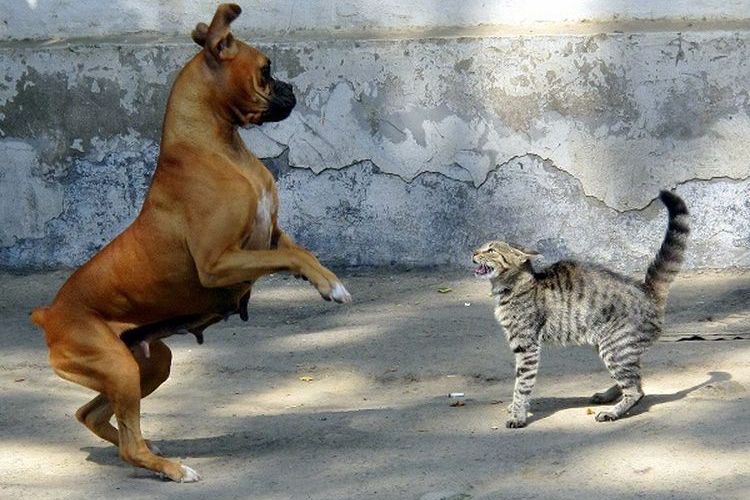
- The cat arches its back, preparing to attack. The dog doesn't understand the signal and reaches out to sniff, earning a clawed slash to the nose.
- By raising its paw, a dog demonstrates its desire to play. For a cat, this action appears threatening.
- A cat's purr signifies pleasure. A dog's growl warns of an attack.
Misunderstanding of verbal signals is another reason for the lack of love between these animals.
Exceptions to the rules
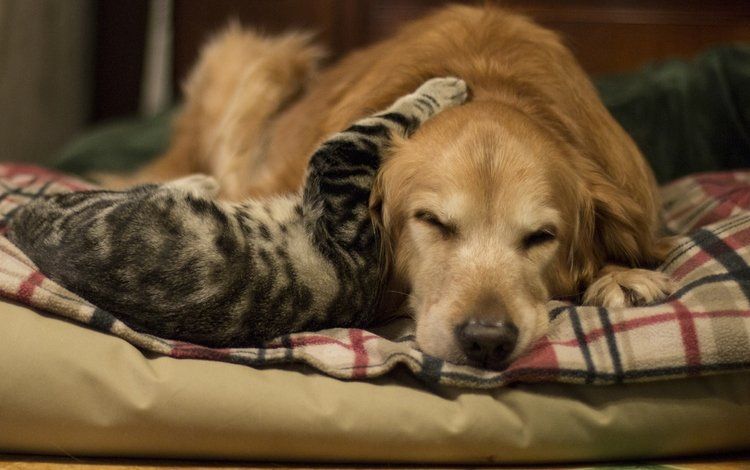
It turns out that not all dogs dislike cats. There are breeds that adore their furry companions. These include:
- Papillon.
- Bichon Frise.
- Maltese lapdog.
- Basset Hound.
- Pug.
- German boxer.
- Newfoundland;
- Golden retriever.
Some breeds have hunting and fighting instincts that cannot be suppressed through training. Owners of pit bulls, greyhounds, and Parson Russell terriers will need to train their pets to ignore cats and resist their provocations.
Scientific research on cat and dog relationships
-
A 2019 study conducted an MRI scan of a dog's brain when it encountered a cat: its emotion and fear regions were activated. This suggests that the reaction is not only physiological but also emotional.
-
Ethological observations have confirmed that every third dog that reacts aggressively is not experiencing fear, but a state of excitement.
-
A game experiment: a dog trained to react calmly to a cat and receiving treats for this, after 4 weeks retrained to a neutral reaction.
How to Make Friends Between a Dog and a Cat: A Step-by-Step Plan
Owners dreaming of peace between a dog and a cat should understand that true friendship between these animals is possible, but it requires patience, a systematic approach, and knowledge of behavioral psychology.
1. Preparatory stage
Before introducing pets:
-
Check your temperamentIf the dog has a history of aggression or a developed hunting instinct, the introduction should take place under the supervision of a dog trainer.
-
Make sure your cat has hiding areas.: shelves, houses, high places where the dog cannot reach.
-
Divide the territoryAt first, everyone should have their own area (room, corner), especially for eating, resting, and going to the toilet.
2. Acquaintance by smell
Pets get used to the smell faster than the sight:
-
Swap things: put the towel the dog was lying on in the cat's bed, and vice versa.
-
Use pheromones (sprays, diffusers) to reduce anxiety.
3. Eye contact
After 2-3 days, you can move on to the first acquaintance:
-
Through the barrier(gate, glass door, carrier) - animals should be able to see, but not have physical contact.
-
Observe behavior: if the dog freezes, growls, or tenses up, remove it and return to exchanging scents.
-
If pets ignore or react calmly, this is a good sign.
4. First meeting on the same territory
-
A leash is requiredfor the dog to prevent sudden throws.
-
The cat must be able to escape or climb above the dog's level.
-
Give a treat for calm behavior. Ignore aggression—don't punish, just lead the dog away.
5. Gradual rapprochement
Acquaintances should be short: 5-10 minutes a day, then increase the duration.
-
Cooperative games, but only under control.
-
You can feed nearby, but from a distance (for example, through a children's fence).
-
Don't rush - it takes 1 to 4 weeks to establish a neutral relationship, and up to 2-3 months to become friends.
Table: Signs of normalization of relations
| Sign of behavior | What does it mean | Recommended actions |
|---|---|---|
| Pets sniff each other | Interest, not aggression | Praise and offer treats |
| The dog reacts calmly | No agitation, reduced anxiety | You can remove the leash under control |
| The cat remains in the room | Accepts the presence of a dog | Gradually reduce the distance |
| Co-sleeping, play | Attachment established | Let them spend more time together |
What not to do
-
Don't leave them alonein the first weeks - especially if you are not sure about the reaction.
-
Don't give reason for jealousy— attention must be balanced.
-
Don't scold for growling or hissing— these are normal signals, not aggression, but communication.
What to do if friendship doesn't work out
Sometimes pets don't become friends, but they can live peacefully. In such cases:
-
Continue dividing the space;
-
Set clear rules;
-
Contact a specialist - a zoopsychologist can help correct the behavior.
When representatives of warring families live in a house, the owner will have to make a lot of efforts to make them friendsThe following recommendations from experienced owners will help you achieve this:
- It's best to have babies at the same time. Growing up together, the pets become lifelong friends.
- Once you have an adult cat in the house, it's best to introduce a puppy to it. The introduction should be gradual. Don't force an adult pet to be around a puppy.
- If you have an adult dog in the house, when you bring a kitten home, you should muzzle the dog and explain to him that he shouldn't harm or frighten the kitten. It's best not to introduce them right away.
- It's recommended to feed the animals separately at first. The presence of a stranger during mealtime can irritate the dog.
The owner is required to carefully monitor the animals' behavior, preventing any conflict situations from arising.
Read also:
- Coloring Page: Dogs and Cats
- Why do cats wag their tails?
- How long do dogs of different breeds live?






Add a comment