
Why are dogs afraid of fireworks and how to calm them down?
Fear of loud noises of unknown origin is a completely normal reaction not only for dogs but for any living creature. Such sounds include fireworks, exploding firecrackers, and the crackling of fireworks, which are especially common during the New Year holidays. For a pet, this time can be quite stressful. To help your dog in this situation, you need to understand why animals react this way and how to calm them down.
Content
Main reasons
Fear of fireworks is a common occurrence for most dog owners, as their pets have a difficult time coping with the festive cannonade. It's important to know that most animals are born with this fear, rather than developing it later in life. Fear can be exacerbated if the puppy experienced a traumatic event during puppyhood that involved a loud bang or a sound reminiscent of fireworks.
To overcome this fear, the animal undergoes corrective training, and only in rare cases does the fear develop into a severe phobia that is difficult to overcome.
Another reason why a dog might be afraid of fireworks, firecrackers, or other displays is that canine hearing differs from human hearing and is much more sensitive to a wider range. Human hearing is limited to frequencies between 16 and 20,000 Hz, while dogs can perceive frequencies from 12 to 80,000 Hz. What a human ear perceives as insignificant noise is much more pronounced to a dog.
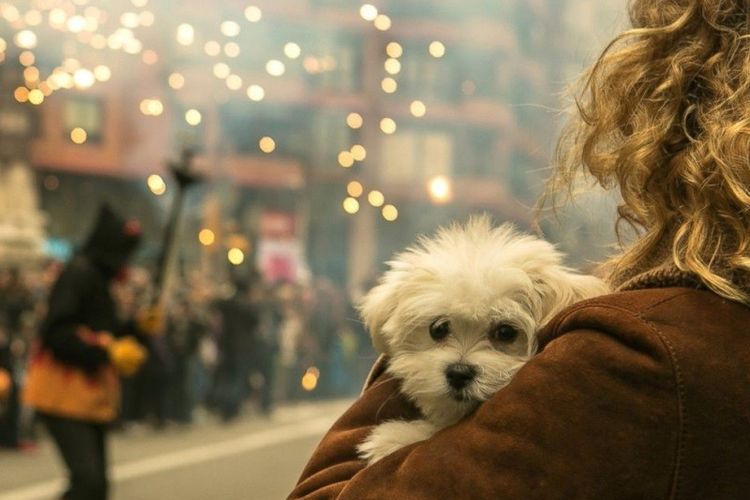
Even if an explosion, crack, or rumble is loud enough for a human, it can be quite painful for a dog. This can damage the eardrum, and sometimes even the dog's organ of Corti. Besides the sound stimuli, fireworks are also frightening because of the sharp, colorful flashes, which don't provide dogs with the same pleasure as a human might think.
Degrees of fear
The animal's reaction can be more or less intense. The choice of corrective measures depends on the dog's degree of fear, so experts have divided all reactions into three main categories.
- Mild fear. This manifests itself as simple anxiety, in which the pet actively twitches its ears and then tries to locate the source of the noise. Despite this anxiety, the animal remains manageable, responds to its name, and may even eat if given tasty food.
- Moderate fear. Severe fear develops, during which the dog may flee under a bed, chair, or other hiding place. Sometimes there is no response to its name, the pet is disobedient, calm does not return for a long time, and appetite may be absent for a couple of hours until the stress partially subsides.
- Severe (phobia). All-consuming panic sets in, with bulging eyes and heavy breathing. Sometimes uncontrollable urination occurs, and the dog tries to escape or breaks the leash. There are cases where, after a barrage of fireworks, the dog with this level of fear refuses to go for a walk, defecates in inappropriate places, and stops drinking and eating.

How to calm down
First, help your pet calm down. It's important to remember that a dog can instantly read its owner's mood from their face and even their movements, so remain calm and composed; this will reduce fear. If the fireworks are seen outdoors, hold the leash firmly to prevent your pet from escaping.
The best thing an owner can do in such a situation is to ignore the gunshots. You can calmly approach the dog and give it a treat to alleviate its fear. If your pet is so afraid that it runs around the house and even whines, don't scold it. You need to do everything possible to remain calm.
What not to do
Most owners make significant mistakes when their pet is consumed by fear of fireworks and salutes, which only makes the situation worse.
The list of things that are strictly prohibited is short:
- Don't pet. The natural urge to pet and talk to the dog in a soothing voice will backfire. This can only entrench and intensify the behavioral response.
- Avoid hugging or picking up your pet. Restricting the animal's freedom of movement when it's frightened is unacceptable. This will only increase discomfort. The only exception is for a small puppy.
- Don't yell or punish. Yelling, hitting with the leash, or other physical abuse won't reduce the fear, but will only increase it.
- Don't panic. The best thing a person can do in a moment of fear is to "ignore" the dog and its fear.
How to overcome fear
It takes more than one day for a dog to overcome its fear. But the effort invested in training will make life easier for the owner and relieve the dog's stress.
The lesson algorithm is as follows:
- Record the sound of fireworks on a sound device and, in a home environment, determine at what volume level your pet becomes afraid. Work on overcoming the fear from that level should begin.
- Before training, you need to take a long walk.
- Place a sound source (phone, music player, etc.) in the center and turn it on. When the fireworks start to frighten the dog, it will want to run away. Don't discourage this urge; simply run in a circle around the alarming sound. Once it's clear the fear has subsided somewhat, you can slow down to a walk.
Such classes are held once a week, and after a while the reaction to loud fireworks will no longer be so acute.

How to prevent potential problems
If the New Year holidays have already begun and there is no time left to train your dog, you need to do everything possible to avoid aggravating the stress and harming your pet's psyche.
- The ideal option is to go out of town together, where holiday fireworks displays are less frequent and less intense.
- A week before the holidays and another week after them, you shouldn't let your dog off the leash while walking.
- Just in case, you should attach a tag to the collar with the name, address information, owner's phone numbers, etc.
- When walking, it's best to stay away from teenagers who might suddenly throw a firecracker at your feet or set off a firecracker.
- If the animal suffers from an overwhelming fear, it is better to give it in advance sedatives.
Read also:


Add a comment