
Why does a dog chase its tail?
When first noticing unusual behavior in their pet, many owners begin searching for an answer to the question of why a puppy or adult dog chases its tail. We suggest taking a closer look at what might be causing an animal's increased interest in its tail and whether it's cause for concern.
Content
- 1 Analyzing your pet's behavior
- 2 Possible reasons for this behavior
- 2.1 Reason #1 – It’s just a game
- 2.2 Reason #2 – Getting to Know Your Body
- 2.3 Reason #3 – Increased emotionality
- 2.4 Reason #4: The dog is trying to get your attention
- 2.5 Reason #5 – Skin problems
- 2.6 Reason #6 – Parasites
- 2.7 Reason #7 – Discomfort in the anal area
- 2.8 Reason #8 – Back pain
- 2.9 Reason #9 – Brain dysfunction
- 2.10 Reason #10 – Psychological disorder
- 3 How to break a dog of an undesirable habit
Analyzing your pet's behavior
To understand why a dog is chasing its tail, analyze the associated factors and the animal's behavior at that moment by answering simple questions:
- How often does a dog chase its tail? (occasionally or often)
- What is the pet's behavior at this moment? (playful, excited, scared, worried)
- Does your dog bite its tail or just run in circles without stopping? (If a dog bites its tail while reaching out, it means something is definitely bothering it)
- When does a dog chase its tail most often? (in the morning, during the day, in the evening, jumps up during sleep)
- Does she somehow relate these actions to the owner and his presence? (a pet chases its tail when no one is watching or only in the presence of people)
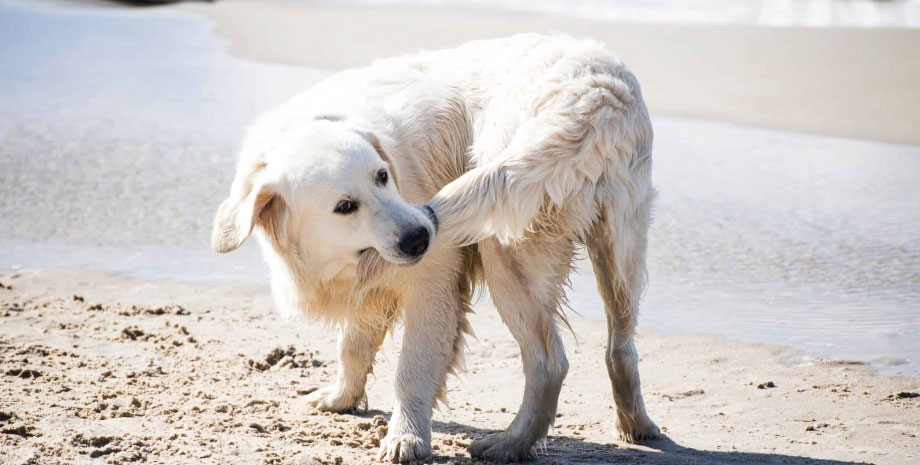
Possible reasons for this behavior
By analyzing your pet's behavior, you can try to understand why the dog is chasing its tail and what is the reason for this new habit.
Reason #1 – It’s just a game
Many people who have cared for a cat know that these animals love to play with their tails or the tails of other cats. In fact, dogs can sometimes entertain themselves in this way, too.
Interesting fact! If a puppy lives in a house with cats and constantly observes them playing with their tails, they may also adopt their behavior.
If a dog is chasing its tail in an understandably playful mood, there's no obvious physiological reason for the animal's distress, and it's easily distracted, then you're most likely observing one of these variations of the game. Puppies with long, fluffy tails are most likely to engage in this kind of play.
What exactly attracts dogs and cats to their tails is a great mystery. The important thing is that this play is completely harmless and is not a symptom of any disease, as long as it occurs occasionally and is not accompanied by damage to the skin of the tail from bites.
Reason #2 – Getting to Know Your Body
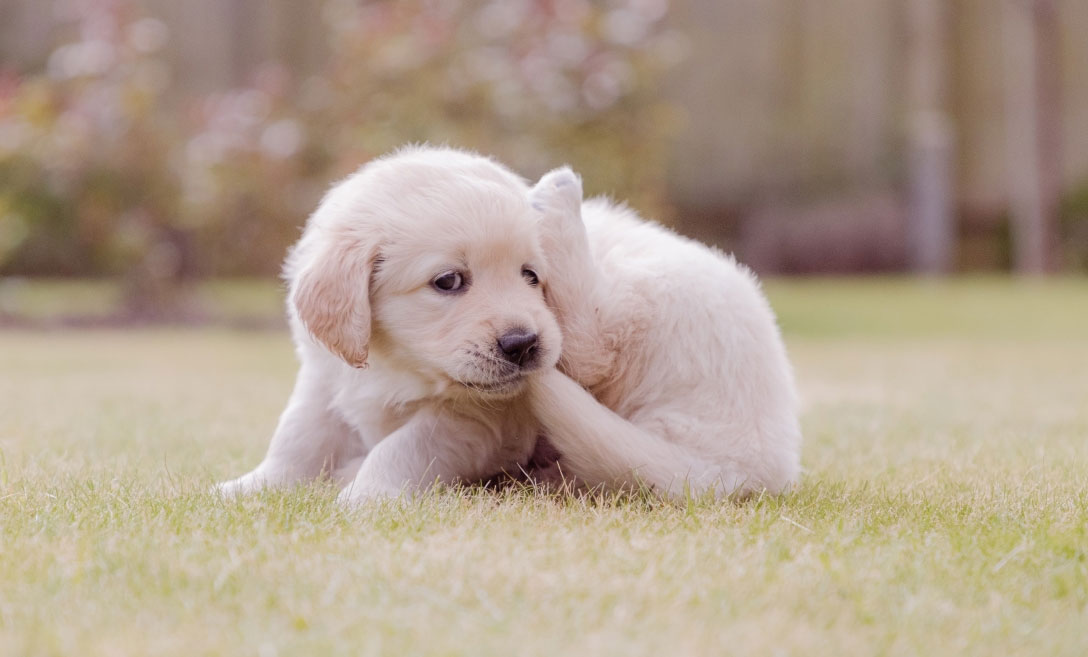
Typically, every puppy experiences a moment in early puppyhood when it shows a particular interest in its tail. However, this period typically passes quickly, and the dog stops trying to retrieve or chase it, finding other, more interesting activities.
Reason #3 – Increased emotionality
Tail chasing can occur as a manifestation of intense emotions. For example, a puppy isn't allowed to jump on its owner when they return home. Instead, it may become overjoyed and begin spinning around, trying to catch its tail.
If the behavior occurs solely in the context of strong emotions, it is necessary to work with your pet on obedience and endurance.
Reason #4: The dog is trying to get your attention
If the behavior occurs only in the presence of a person, and after performing a "pirouette" the pet demands positive reinforcement from the owner, one can suspect that the dog has learned to attract attention in this simple way.
Perhaps the pet remembered that this behavior attracts the owner's attention, or perhaps at some point it received emotional reinforcement from a new type of activity and drew the wrong conclusions.
Reason #5 – Skin problems
If your pet has any skin diseases, symptoms such as severe itching, rashes, and flaking skin will appear.
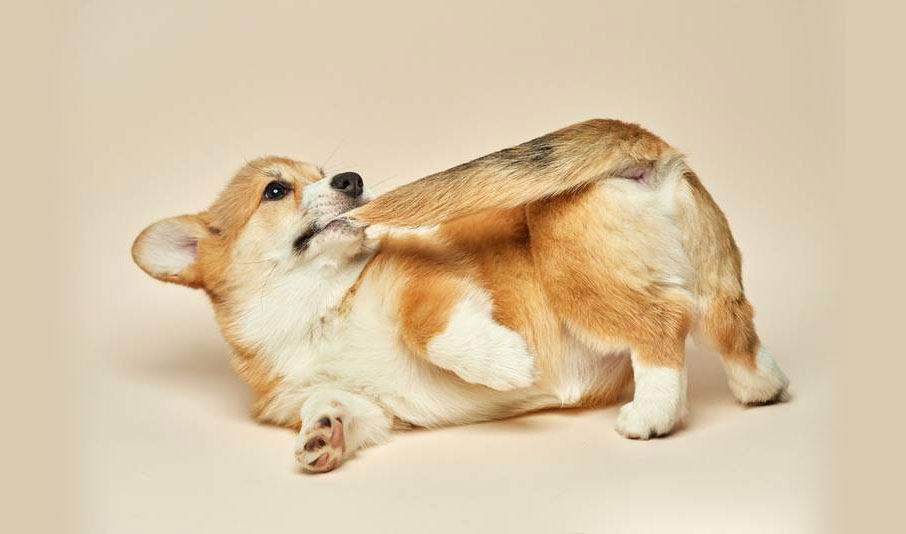
You can suspect discomfort is the cause if your dog not only chases its tail but also bites it if it can reach it with its teeth. Damage to the skin can lead to inflammation and sores, which can further irritate the animal, creating a vicious cycle.
There could be many root causes:
- allergic dermatitis;
- fungal infection;
- secondary inflammation of any minor scratches or wounds;
- pyoderma, etc.
If you suspect that the cause is a skin disease, be sure to contact your veterinarian and determine the cause of the symptoms.
Reason #6 – Parasites
Fleas and ticks can cause significant discomfort to your pet anywhere on the body, and the tail is no exception.
If you notice your dog's increased interest in this area, examine your pet thoroughly for parasites. It wouldn't hurt to treat your pet preventatively. We've previously discussed various flea and tick treatments available on the Russian market.
Reason #7 – Discomfort in the anal area
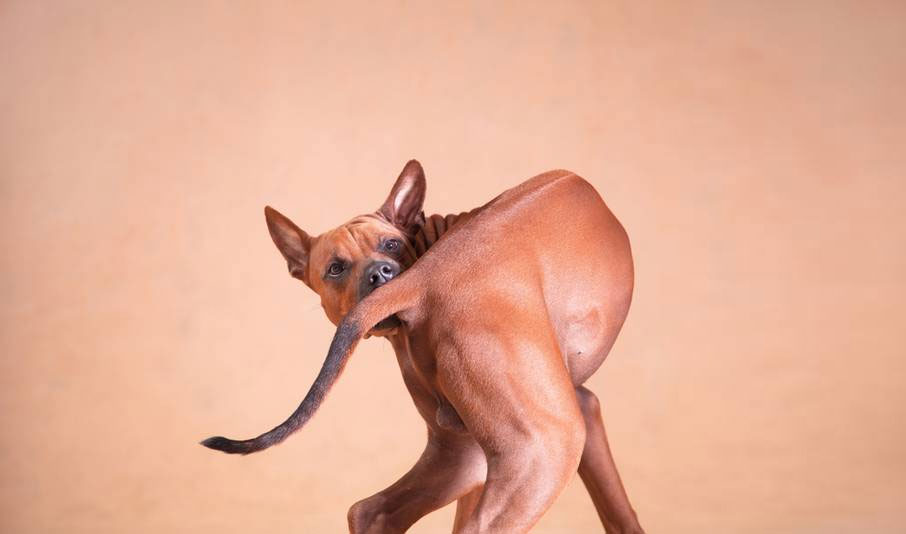
Another reason why a dog chases its tail may be itching or inflammation in the anal area.
Most often, this symptom occurs due to problems such as:
- helminthiasis;
- inflammation of the anal glands;
- gastrointestinal tract dysfunction accompanied by inflammation;
- constipation.
Please note that not all of the problems listed can be seen during an external examination, which means that if you suspect a problem of this nature, a visit to the veterinarian is recommended.
Reason #8 – Back pain
It's difficult for the animal to assess the source of the pain. Feeling discomfort in the back, the dog tries to reach for the problem area, which can create the impression of chasing its tail.
If, when the dog does the tail-twist, it doesn't appear playful, but rather frightened, disoriented, or nervous, sometimes suddenly jumps up while sleeping, or whines or shakes (shaking is one sign of severe pain), it's important to check for any musculoskeletal issues. Naturally, this can only be done in a clinical setting.
Reason #9 – Brain dysfunction
It's not often, but it does happen that the answer to the question of why a dog runs in circles or sideways is a diagnosis associated with serious disturbances in the functioning of the brain.
Complications may develop against the background of:
- congenital defects;
- injuries (sometimes symptoms may develop hours after the incident);
- tick bite;
- any severe viral, bacterial or fungal infection.
If you see your dog become disoriented while circling, staring blankly, or losing coordination, take your pet to a veterinary clinic as soon as possible.
Reason #10 – Psychological disorder
Compulsive disorder is a psychological condition characterized by changes in the functioning of the brain, as a result of which the animal involuntarily performs repetitive meaningless actions.
Manifestations of compulsive disorder may include:
- walking in circles;
- tail chasing;
- obsessive licking;
- gnawing of skin areas;
- hunting for imaginary objects, etc.
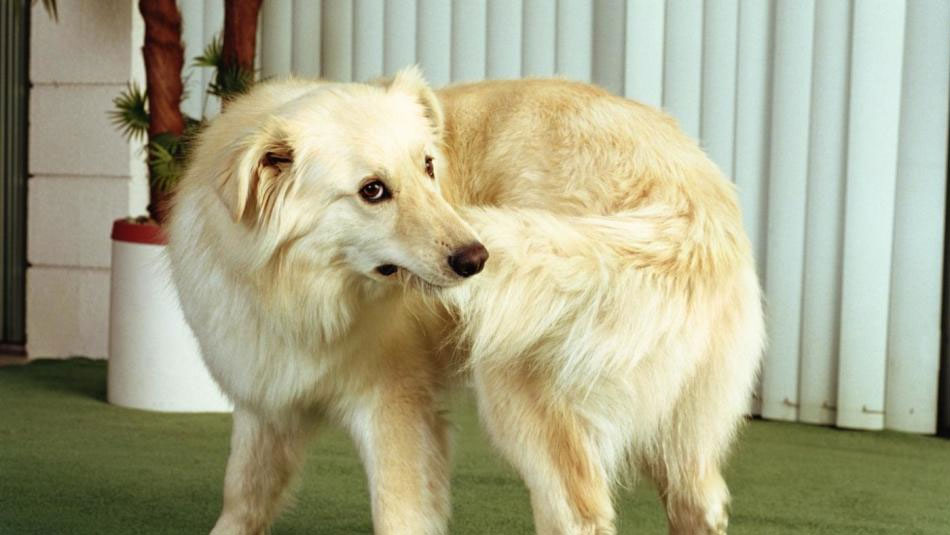
The problem may be genetically determined or arise as a result of chronic stress.
The diagnosis is made by ruling out other physiological problems and by a specialist observing the animal's behavior over a period of time.
How to break a dog of an undesirable habit
Before taking any steps to overcome unwanted behavior, it is necessary to understand why and for what purpose the dog behaves this way.
If the dog remembers about its tail quite rarely, you can take no action at all, simply do not encourage such behavior, so as not to receive positive reinforcement.
If the examination reveals your pet is completely healthy and the behavior is driven solely by psychological factors, but occurs frequently and causes you discomfort, then the following actions can be recommended:
- Spend more time with your dog.
- Make your walks longer and your training more varied.
- Increase your dog's mental stimulation.
- Offer your pet a wider variety of toys.
- Ignore or stop unwanted behavior with negative commands.
- Once you notice that the dog has remembered its tail, distract it with something.
Naturally, if any underlying medical condition is detected that's causing your pet's discomfort, treatment is necessary. Most likely, once the dog's discomfort subsides, the tail-twitching problem will resolve on its own.
Read also:
- Why does a dog twitch in its sleep?
- The dog doesn't want to go for a walk: why and what to do
- How to transport a dog on a train


Add a comment