
Why do cats wag their tails?
Cats have long been beloved by humans as the most affectionate and docile pets. But these furry creatures aren't always so gentle and obedient. It seems like just yesterday your pet was snuggling and purring at your feet, and today they're unresponsive to your calls. At first glance, their behavior and demeanor seem unchanged, calm, except for their tail twitching strangely. It becomes curious why cats wag their tails, whether they consciously control it, and what these movements mean. Let's clarify this question.
Content
Why do cats need a tail?
Roughly speaking, the tail is the end of the spine in felines. It's a cluster of vertebrae, blood vessels, and nerve endings. Because of their large number, this part of the cat's body is particularly weak and sensitive to touch, and can easily be injured by abuse. This is why cats dislike being touched, or worse, pulled.
Thanks to the presence of a tail, cats maintain coordination of movements when moving along narrow surfaces and jumping from heights, and also navigate perfectly in space, dexterously and quickly climb to the tops of trees, and successfully track small animals.
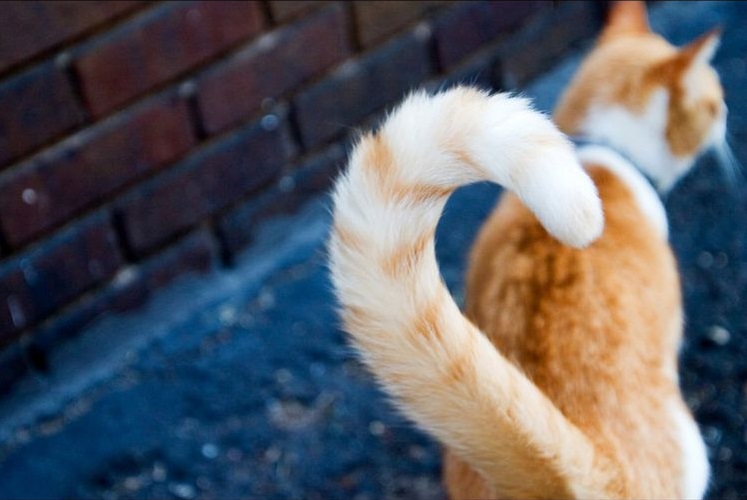
But the most important thing for owners is that by observing their pet's tail wagging, they can discern their mood and even guess their plans. By learning what a cat's tail wagging signifies, you can understand your pet, maintain a trusting relationship with them, and respond appropriately to their needs.
Why do cats wag their tails?
Ethologists claim that pets can move their tails in a variety of ways, expressing their feelings and emotions—both positive and negative—at the moment. The more intensely a cat twitches its tail, the more intense its emotions.
Of course, every cat has its own personality and behavioral characteristics. Therefore, while relying on established interpretations of nonverbal "body language" signals animals convey through their tails, it's best to rely on your own feelings and experience interacting with your pet.
Now it’s clear why cats wag their tails – this is how they try to describe their state and mood at a certain period of time.
Tail wagging can indicate a variety of emotions in animals, depending on its speed and the part of the tail involved in the "communication": a slight twitch of the tip indicates a relaxed state, while a gradually "unwinding" tail indicates the pet is ready to pounce and attack its prey.
- A slow vertical wagging of the tail will mean that the cat is very interested in something.
- Slowly wagging its tail, the pet is trying to make a choice and pondering the options.
- An animal displays satisfaction by raising its tail high. If the tip trembles slightly, it indicates a feeling of joy or anticipation of pleasure. A cat greets its owner or a fellow cat by slightly arching its back and extending its head forward, while raising its tail like a pole.
- The chaotic wagging of a cat's tail when resting indicates that the seemingly dozing animal is always alert and ready to act. When a cat falls asleep, its tail movements slow down and stop completely.
If you see your beloved cat wagging its tail, you can tell what it means by the intensity of the wagging and the movements it makes.
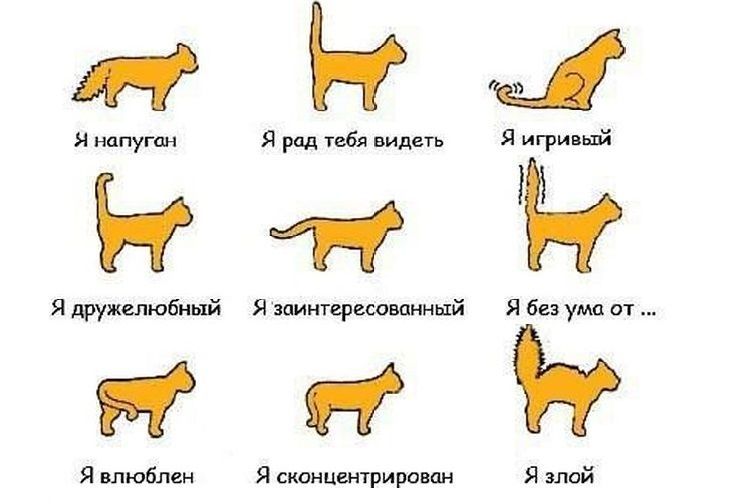
When hunting small rodents or insects, the cat presses its tail to the ground, slightly twitching its tip, thereby revealing its excitement.
A twitching tail tip indicates slight irritation that a pet may experience if, for example, there is a “rival” nearby – another pet, be it a cat or a dog, being petted by its owner.
When a cat begins to vigorously wag its tail and thrash it around on the floor and its sides, beware: it's extremely hostile toward the object or subject it's glaring at, and its claws and teeth may be about to come into play. A fight or a tearing apart of the prey is imminent.
If a cat's tail wags quickly back and forth, it means the pet is terribly angry.
That is, if your cat wags its tail, you don’t necessarily need to be wary – depending on the situation, this movement can be either a good or a bad sign.
In what cases does the tail "speak" differently?
-
Play and hunting. Quick, short flicks or twitches of the tip indicate concentration and pre-hunting excitement. It's best to offer a fishing rod rather than your hands.
-
Affection and contact. An upright tail with a soft curve at the end and a slight tremor at the base signifies greeting and trust, often accompanied by a purr.
-
Irritation and overload. Sharp, wide swipes, ears thrown to the side or back—it's best to stop the interaction. This poses a risk of biting.
-
Anxiety and fear. Tail tucked, occasional stiff movements, tense body—safe distance, cover, low sounds.
-
Encounter with animals. A high tail with fluffed fur and a "club" at the end is a demonstration of size, an attempt to scare off.
Table: Motion patterns and what they most often mean
| Movement pattern | Context | What should the owner do? |
|---|---|---|
| Tail erect, tip trembling | Greetings, strong sympathy | Say hello calmly and let him smell your hand. |
| Gentle rocking from side to side | Curiosity, neutral attention | Offer a game, don't force contact |
| Frequent, sharp swishes of the entire tail | Irritation, stimulus overload | Stop petting/playing, give a break |
| Twitching of the tip when fixing the gaze | Aiming before throwing | Switch to the fishing rod toy |
| Bottle tail (fluffed up) | Intense fear/defensive stance | Remove the irritant, do not touch, provide shelter |
| The tail is tightly pressed to the body | Anxiety, pain, cold | Check your health, warm up, and if in doubt, see a doctor. |
| Rhythmic tapping on the floor | Internal conflict "to approach/to leave" | Reduce the intensity of contact, sit down nearby |
Microsignals that are often missed
A cat can "talk" with its tail almost invisibly. Pay attention to three areas: the base, the middle, and the tip. If the base of the tail is soft and only the tip trembles, this indicates mild arousal, usually positive. If there's tension at the base and a simultaneous "fanning" motion, irritation is growing. The closer the movements are to the body and the more abrupt they are, the higher the stress level.
Age, breed, individual characteristics
Not all "tail dialects" are the same.
| Category | Features of the tail | Frequently used meanings |
|---|---|---|
| Kittens | Lots of small, quick movements | Excess energy, game search |
| Older cats | Economical, "economical" gestures | Signals are more noticeable when there is discomfort |
| Long-tailed breeds (Orientals, Siamese) | Expressive amplitude | Rich facial expressions, many halftones |
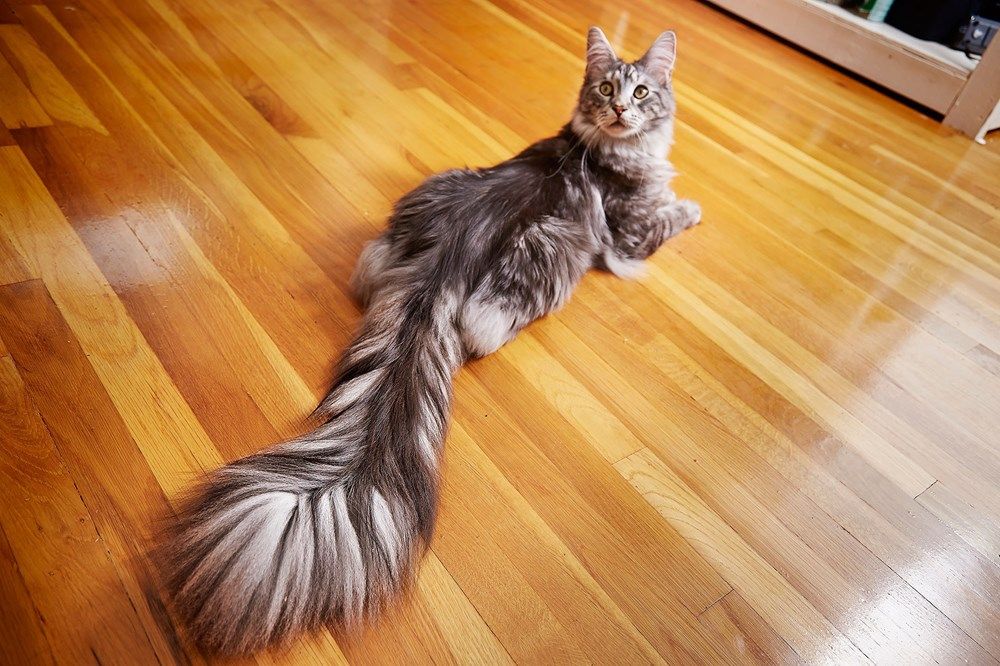
| Fluffy (Maine Coon, Norwegian) | Volume masks small movements | Focus more on your ears/eyes |
| Tailless/Manx, bobtail | Compensation by body and ears | Pay more attention to posture and voice. |
Practical analysis: three scenarios from everyday life
Scenario 1.It's evening. You're petting your cat. Its tail has been relaxed and suddenly starts lashing. Action: Stop, place your hand next to it, not on the cat. If the tail calms down, continue with shorter strokes.
Scenario 2.Before jumping onto the windowsill, the cat twitches its tip like a needle. Action: Don't disturb it, don't call its name, don't pick it up—that's a trick.
Scenario 3.The guest extends his hand, and the cat raises its tail, its base trembling slightly. Action: have the guest squat sideways and extend the backs of his fingers. This is a greeting, but without the overhanging motion.
Five common misconceptions and how to correct them
-
"Wagging means he's happy." Cats don't wag like dogs; sharp flicks usually mean "enough."
-
"If the tail is up, it's always friendly." If the eyes are puffed up and the pupils are wide, it could be a sign of defense.
-
"If he ignores you, it means he doesn't love you." Gentle rocking and averted gaze are a way to reduce tension, not to deny contact.
-
"It's okay to tease with the tail—it's fun." Touching the tail is not allowed: it's a source of pain and a trigger for aggression.
-
"If you wind me up too harshly, I'll play harder." On the contrary, reduce the incentives: playing for the worse leads to bites.
Read also:
- Aggression in cats
- Why does a cat twitch or shake its tail?
- Is it necessary to play with a cat and how to do it correctly?



Add a comment