
Why do cats lunge and bite at legs?
Pets provide a lot of warmth, and spending time playing and petting them is pure joy. But suddenly, out of the blue, you notice your cat making aggressive attacks. What's going on? Why is your cat biting your legs and attacking you? Let's try to figure out the reasons for this unusual behavior and learn how to tame your pet.
Content
Reasons
To figure out why your cat is biting your legs and attacking you, you need to watch it closely and analyze what's happening.
Both internal problems and external events can trigger aggression in animals. A pet may bite legs if:
- he is small and is teething (in this case, he will bite not only your legs, but also your arms when you try to play with him);
- he lacks vitamins (trying to make up for their deficiency, he will first of all gnaw on various objects in the apartment, your feet will be of no less interest to him);
- You have spoiled your cat too much and are not training her;
- in this way the cat demonstrates its love for the owner and encourages him to play with it, attacking stealthily, running away and hiding;
- something hurts him (often it is the pain that explains why a cat bites its owner’s legs and hisses at the same time);
- the cat is experiencing stress and, by attacking you, is trying to draw attention to its dissatisfaction with something: a change in food or place of residence, the appearance of a new family member or another animal in the house, etc.;
- the time of puberty has approached, unsatisfied desire causes nervousness, and the owner’s legs flashing back and forth in front of the cat irritate and provoke it to aggression;
- Often the hunting instinct forces the cat to attack its owner and leave bite marks on his legs.
But be that as it may, it is necessary to sort out the facts and eliminate the causes that provoke your pet to become aggressive.

Why Cats Attack Feet: The Deep Motivation of Predator and Player
Behavior such as a cat suddenly attacking legs moving under the blanket or attacking ankles while walking is rooted in deep instincts that haven't been erased by domestication. To understand your pet and redirect its energy, you need to see it not simply as a mischievous creature, but as a skilled hunter whose skills require realizing.
Play instinct: the main reason for kittens and young cats
For a young animal, the world is a vast training ground. Attacking the legs is the most accessible and "live" training device. Unlike a static toy, the legs move unpredictably, perfectly imitating prey behavior in the wild.
-
Social games:In the wild, kittens practice hunting techniques, learn to calculate bite force, and understand signals from their siblings while playing with their siblings. At home, deprived of such company, they transfer all these practices to humans. Your leg, moving under the blanket, becomes a substitute for a sibling in a fight.
-
Boredom and excess energy:This is a key catalyst for behavior. Cats require daily activity. If your pet doesn't get enough mental and physical stimulation during the day, their pent-up energy will find its most readily available outlet—attacking a moving object—you.
Misperception: When Play Turns Aggressive
It's important to distinguish play from real aggression. Play attacks are usually harmless; a cat may bite a leg, but not until it bleeds; its ears are often forward-facing, and its body is relaxed before and after the attack. However, sometimes this behavior pattern is reinforced by mistake.
-
Reinforcing bad behavior:If, in response to a leg bite, a person begins screaming loudly, twitching their leg, or, worse, playing with the cat with their hand, they unwittingly reward its actions. The screams and movements are perceived as a continuation of the game, meaning the pet will repeat this "successful" hunting maneuver next time.
-
Lack of socialization:A kitten weaned early from its mother and littermates has missed a crucial learning stage. It's the mother cat and its siblings who teach it to bite and retract its claws. Such a kitten will attack more aggressively, causing real pain, simply because it doesn't know any better.
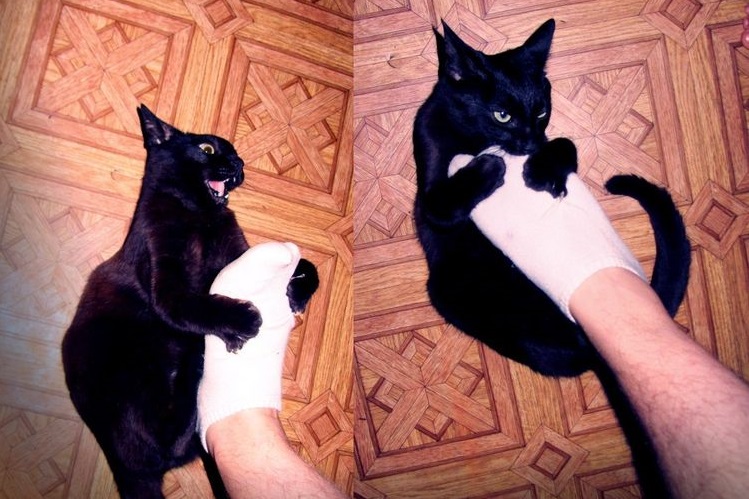
A Practical Guide: How to Redirect Your Hunting Instinct
Understanding the cause is only half the battle. The other half is proper correction. The goal is not to punish the cat for its nature, but to provide it with an alternative, acceptable outlet for its instincts.
Comparison table of causes and solutions:
| Reason for attack on legs | The essence of the problem | Practical solution |
|---|---|---|
| Gaming instinct and boredom | Unspent energy, lack of adequate toys. | Active games before bed (fishing rod, balls), food puzzles. |
| False reinforcement | The man, with his behavior (screams, movements), turned himself into a toy. | Completely ignore the attack: stop, do not move, do not look at the cat. |
| Lack of socialization | The pet has not learned to control the force of its bite and claws. | Training through a sound signal (a loud “ow!” or squeak), stopping the game if the bite is painful. |
| Hunting mode | The peak of a cat's activity occurs at dawn and dusk, which coincides with the morning gatherings and going to bed. | Create a stable feeding and play routine to predict and manage activity. |
Important clarifications regarding behavior correction:
-
No arms or legs as toys.All play with your pet should be done only with interactive toys (fishing rods, balls, feathers). Human touch should be associated only with petting, feeding, and grooming.
-
Creating an enriched environment.Provide your cat with opportunities to engage in all aspects of its natural behavior: climbing (scratching trees), observing (window shelves, bird feeders behind glass), and exploring (cardboard boxes, paper bags). This will reduce overall frustration and boredom.
-
Introduction of rituals.If your cat is used to attacking you early in the morning, demanding food, get ahead of it. Set up an automatic feeder that goes off half an hour before you usually wake up. When she wakes up, she'll run to the bowl, not to your feet.
Remember that this behavior is normal for a cat. The owner's job is not to suppress it, but to redirect it in a peaceful direction while maintaining trust and understanding with their pet.
Actions of the owner
So, we figured out why the cat attacks your legs and bites, now let's find out what to do in such a situation - How to wean him off this habitRemember, whatever the reason for strange behavior, don't justify it or let it slide. Nip aggressive intentions in the bud.
Take advantage of the advice of experienced breeders and take measures that are appropriate for your particular case:
- For a small furry cat with itchy teeth, give it a rubber toy that attracts attention (the same method can work with a spoiled, naughty cat);
- If the problem is a lack of vitamins, review your pet's diet and supplement it with special supplements;
- In the event of a sudden “attack,” when not only teeth but also claws are used, contact a veterinarian – most likely, the cat is experiencing attacks of pain associated with the development of some internal diseases;
- If your pet is wandering and mating is not possible, have it neutered or spayed to solve the problem once and for all.
However, the main reason why a cat bites its owner's legs is most often the breeder's inattentive attitude towards their pets.
Necessary play with an animal And don't just pet them while they're still cute kittens: adult felines need it just as much. Spend time with your pets, play with domesticated predators, and ensure their health and upbringing—and dealing with aggression won't be difficult.
Read also:
- The kitten bites and scratches: why and what to do?
- Aggression in cats
- What to do if a cat bites you and your hand swells


Add a comment