
Why does a cat twitch or shake its tail?
Attentive pet owners pay close attention to even the slightest behavioral nuances of their pets. Many wonder why their cat sometimes twitches its tail, making sharp movements in different directions. There are various possible causes. The tail is the most mobile part of the animal's body, consisting of numerous vertebrae. Its functions include expressing feelings and emotions.
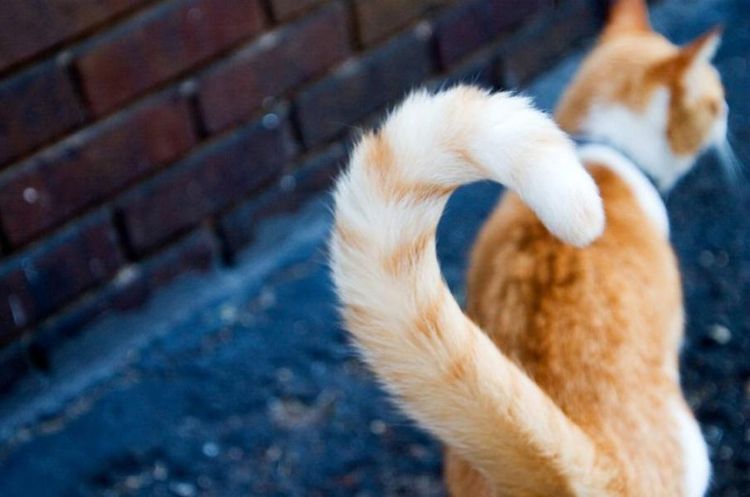
Why does a cat twitch its tail?
To understand what your pet's behavior is expressing, pay attention to the direction the tail moves. The cat's environment is also important. Using its tail, it attempts to express both negative and positive emotions:
- Anxiety. The tail moves sharply horizontally. Pressed ears indicate discomfort, discontent, and fear. A panicked cat is unpredictable, so the cause should be addressed by moving the animal away from the irritating object. A tail swinging from side to side is a sign that the pet is hunting and preparing to attack. In the wild, this behavior is often observed when large wild cats are preparing to attack prey. Domestic cats also behave similarly when playing with inanimate objects.
- Doubt. The need to make a choice is often another reason why cats wag their tails. These animals' behavior has much in common with humans. Living side by side for thousands of years has yielded certain results. When lost in thought, a human might involuntarily swing a leg or tap their fingers on the table. A cat, however, when faced with a choice, rhythmically twitches its tail. There are no other signals indicating anxiety or worry. Helping the animal make a decision is enough, and the process will cease.
- Contentment. A cat can also express positive feelings with its tail. A twitch of the tail conveys feelings of calm and happiness. This can be observed regularly when petting and scratching a cat with affection. Cats reciprocate with purring and a gentle twitch of the tail. This signifies satisfaction with whatever is happening.
- Interest. This is also a common reason why a cat's tail twitches. The movements are rhythmic and slow. The pet is relaxed, fully focused on a single object. The cat may walk around it, observing it cautiously, sniffing, and examining it. A cat's curiosity is similarly expressed when its owner brings home a bag of groceries.

When trying to understand your pet's condition by tail twitching, it is necessary to take into account the surrounding environment and other signals given by the animal.
How the tail reveals mood
Animal body language is incredibly well-developed. While it's not always possible to determine a pet's mood by their face, their tail is a dead giveaway. It will convey everything a cat likes or dislikes through its expression.
- You can tell a cat is playful if its tail twitches while held vertically. When it starts slapping the floor, it's a signal that it's time to stop playing.
- A pet's irritability can be identified by a tail twitching sharply from side to side. In some cases, a cat's nervousness is indicated by a tail raised like a pipe with a curled tip.
- Pain and stress also often cause cats to twitch their tails. They make smaller movements, sometimes tapping the floor.
- If the fur on the back rises along with the twitching of the tail, this means that the animal is extremely excited and is capable of attacking.
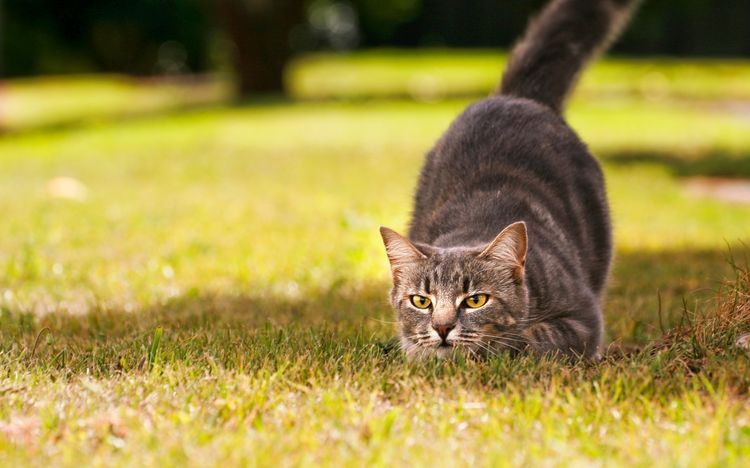
Knowing the possible reasons why a cat might twitch its tail makes it easy to determine its mood and needs. This behavior isn't necessarily a sign of negative emotions. Understanding animal body language helps establish rapport between owner and pet.
You can also ask our website's staff veterinarian a question, who will answer them as quickly as possible in the comments box below.
Read also:
- Why do cats bring their prey to their owners?
- The fastest cat in the world
- Why do cats love boxes and bags?


7 comments
Olga
My cat is shaking its tail while sitting in the litter box. What does this mean?
Christina
Hello, my cat gave birth four days ago. She's not eating much, only drinking mostly and going to the bathroom a lot. She's not even leaving the kittens. Is this normal? I'm just worried about her. Before she gave birth, she had a very good appetite and was very fond of herself, but now I don't recognize her. She's completely skinny, her fur is dull, and her eyes are starting to ooze. What could this be?
Daria is a veterinarian
Hello! It's completely normal for your cat to not leave her kittens' side (especially if this is her first litter). She's very anxious. Leave her alone. Don't stare at her. Place food and water close to her (almost right next to her bed) and, if possible, leave the room or shield her from human eyes (this will calm her down; she'll start eating near the kittens, as she won't be able to stray far from them). Place the litter box close by, too. She's afraid to leave the kittens for long periods. Choose a higher-calorie food and plenty of warm liquids (if she's breast-fed, then low-fat, unspiced broths; if she's commercially fed, then wet food should make up 70 percent of her daily ration, or even switch to it entirely). You can clean her eyes with chamomile tea or a furacilin solution.
Marina
Hello. My cat is 7.5 months old and has started twitching his tail up and down from the base. What's the cause?
Daria is a veterinarian
Hello! Is he neutered or not? Have there been any injuries? How is his general behavior? Has he started meowing loudly? Does he let you touch his tail? Does he mark his territory? How often does he do this?
Arthur
Hello, my cat hasn't eaten or drunk for a day and a half. He just lies or sleeps in one spot, rarely moving. He can't go to the bathroom. Sometimes he'll stand by the litter box for 10 minutes, and then lie down in it completely. He often shakes his tail convulsively, making small, oscillating movements. The vet said there might be kidney problems and that they need to collect a urine sample and do an ultrasound. But I can't get him to go to the bathroom because he won't eat or drink. He's obviously in pain.
Dasha is a veterinarian
Hello! So why doesn't the clinic collect urine with a catheter? Why hasn't they done an ultrasound yet? A blood chemistry panel will also "show" a kidney problem. We can't wait. The animal will become incredibly toxic if it doesn't urinate. Alternatively, give No-shpa or another antispasmodic to relieve spasms and "relax" the urinary tract and sphincters. An IV might even be needed. We can't wait.
Add a comment